





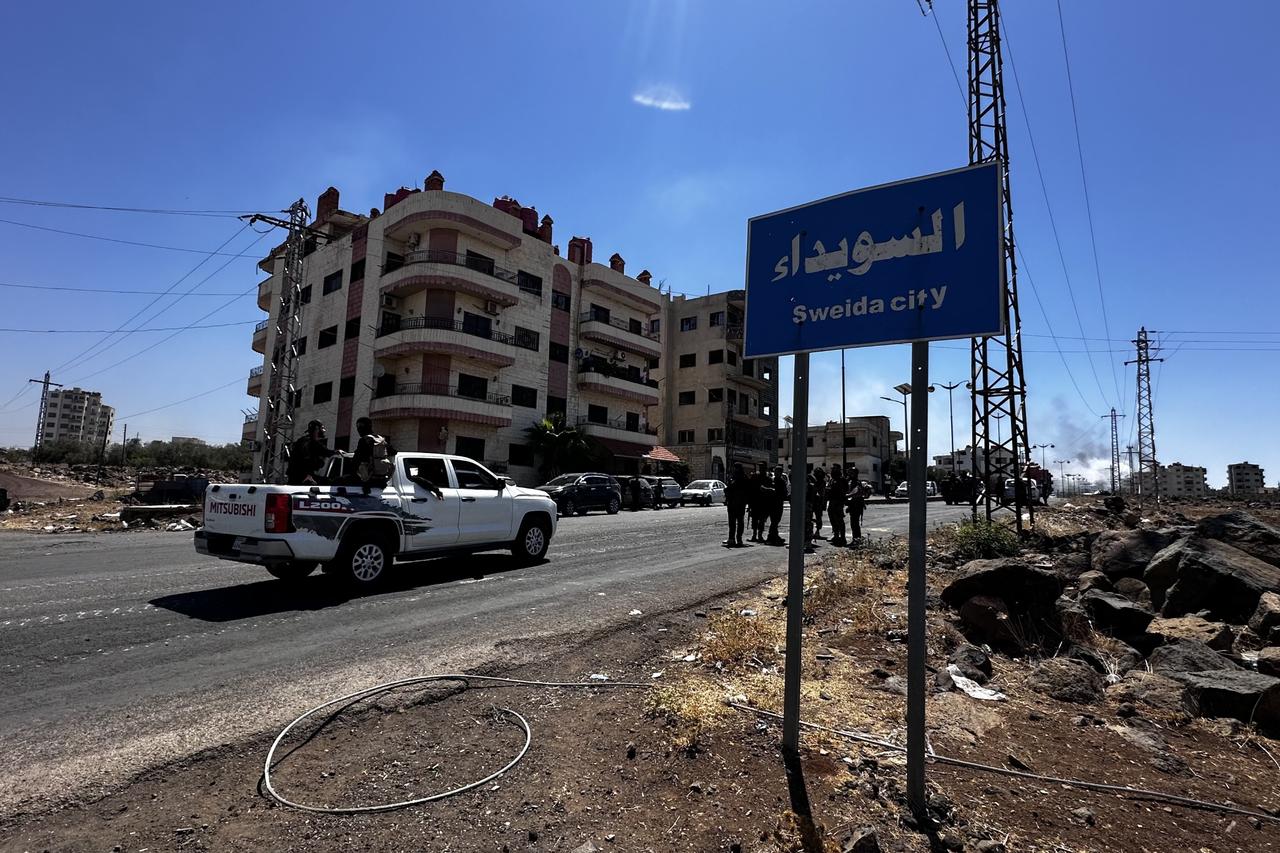
Tensions continue to surge dramatically in the southern Syrian province of Sweida, where the ever-shifting dynamics are increasingly shaped by both internal and external agendas.
What began as a localized tribal dispute has rapidly evolved into a pivotal regional geopolitical crisis—one with far-reaching implications for the political, sectarian, and strategic future of Syria.
The crisis began on the morning of July 13, with what initially appeared to be a routine tribal dispute. It quickly spiraled into violent confrontations between Druze factions and Bedouin tribes.
The Syrian authorities stepped in to deescalate the situation, but the conflict escalated dramatically following the Israeli occupation’s involvement under the pretext of “protecting the Druze community.”
This marked a dangerous new chapter, as Israel crossed all red lines by targeting critical Syrian regime sites—including the Presidential Palace, the General Staff Headquarters, and the Ministry of Defense in Damascus.
Despite efforts to contain the violence—culminating in a ceasefire agreement brokered through American and Turkish mediation—the situation remains volatile. Israeli provocations persist, exploiting the chaos to advance expansionist objectives.
Meanwhile, signs of internationalization are mounting, fueling concerns that southern Syria could become a battleground for regional and global power struggles.
Thus, the conflict has transcended local and even sectarian lines. Sweida, a province that spans only 5,550 km²—around 3% of Syria’s territory—has emerged as a geopolitical flashpoint with the potential to reshape the regional order. It now represents the most dangerous geopolitical challenge facing Syria since the war’s outbreak.
As the crisis unfolds, Syria’s neighbors—particularly Turkey, Iran, and Iraq—watch with mounting unease, wary of the geopolitical ripple effects such instability could unleash across the region.
External Agendas Clash with Internal Ambitions
Since July 13, fears of a regional spillover have intensified. Some influential Druze spiritual leaders in Sweida, particularly Sheikh Hikmat al-Hijri, along with armed factions like the “Military Council of Sweida” (a local militia formed after Assad’s fall and reportedly tied to Israel), have rejected reconciliation efforts and pushed for further escalation.
The unfolding events suggest a calculated attempt to redraw Syria’s postwar power map. Domestic ambitions for rebellion have become entangled with foreign intervention. This “new Syria” is being shaped not through diplomacy but through bloodshed, spurred on by sectarian incitement on social media and a flood of disinformation aimed at fueling division.
Nearly three weeks into the crisis, it’s clear this is no mere local uprising or passing sectarian flare-up. Rather, it is a complex battle of competing agendas—where calls to “protect minorities” mask deeply divisive agendas of fragmentation and subjugation. Syria’s new leadership now finds itself facing a daunting existential test.
Israel has seized the moment to reshape the southern Syrian theater, attempting to carve out a demilitarized zone stretching from the Golan Heights through Sweida and Daraa to the outskirts of Damascus. Israeli Prime Minister Benjamin Netanyahu is leveraging the Druze issue to gain political, security, and economic advantage.
Since Assad’s fall in late 2024, sectarian fires have swept across Syrian cities, exposing the growing complexity of the political crisis and the extent of foreign meddling. Despite the exposure of these external actors, Damascus has largely avoided decisive action, constrained by the strategic considerations of its new leadership.
Turkey: Fears of Partition
Turkey approaches the Sweida situation with two principal concerns: first, maintaining Syria’s territorial integrity and preventing its fragmentation; and second, countering Israel’s broader regional project, which seeks to redraw the geopolitical map of the Middle East.
Ankara’s response reflects its acute awareness of the sensitivity and strategic implications of southern Syria’s upheaval. From the start, Turkey recognized Israel’s early and active involvement as a signal that the conflict could have serious regional ramifications.
Accordingly, Turkey adopted a dual-track diplomatic approach: calling for calm and restraint inside Syria while simultaneously condemning Israeli aggression, viewing it as an attempt to impose new realities on the ground.
Turkey’s concerns fall into four main categories. The first is preserving Syria’s unity and avoiding geographic disintegration. Second is maintaining regional stability and avoiding escalation—especially as violence in Sweida could spill across borders.
Third, Ankara fears that the Kurdish-led Syrian Democratic Forces (SDF) might exploit the chaos to gain ground—potentially reviving their influence and threatening Turkish national security, particularly in the south.
Fourth, Turkey is determined to curb Israel’s expanding influence in Syria. Despite their formal diplomatic ties, Syria remains a battlefield for competing Turkish and Israeli interests. Sweida could become the spark for a broader confrontation, with both sides testing each other’s red lines.
Ankara blames foreign actors, chiefly Israel, for fueling separatist sentiment and accuses certain Druze leaders of becoming proxies for external powers bent on perpetuating a “non-state” order. Thus, Syria’s unity has become a red line for Turkey—one tied to a set of potential responses, including military intervention if necessary.
Among Ankara’s potential moves: dismantling the SDF, whose reported contact with Israeli entities and rumored involvement in Sweida have raised alarm, especially after hints from factions aligned with Sheikh al-Hijri.
Turkey is also likely to strengthen the five-nation security alliance formed in March—with Jordan, Lebanon, Iraq, and Syria—as a platform for crisis management, border control, and joint security operations.
Simultaneously, Turkey may seek deeper cooperation with Damascus. The recent escalation could push both sides toward a joint defense agreement—legitimizing Turkish military presence in southern Syria, securing the “Development Road” project, and countering Israel’s “Peace Corridor” initiative.
Iran: A Calculated Stance
Iran has approached Syria’s shifting dynamics since Assad’s fall with cautious pragmatism. It has refrained from overt hostility toward the new government, maintaining a message of calm, unity, and territorial integrity.
Following the clashes in Sweida, Tehran expressed concern, condemned Israeli airstrikes, and emphasized the need for a Syrian-led political resolution. Iran has avoided siding with any faction, mindful that Sweida is not a traditional zone of Shiite influence. Its neutrality thus avoids ideological entanglements or tensions with local allies.
Facing diminished regional influence and growing internal pressures, Tehran is reluctant to engage in new conflicts—especially against key players like Turkey, the US, Russia, or Israel.
Instead, Iran aims to preserve its remaining military and intelligence presence in key areas like rural Damascus and Daraa. Since late 2024, it has scaled back its footprint following Assad’s ouster, and now seeks to avoid friction with any of the dominant actors in southern Syria.
Iran’s ostensibly peaceful stance masks deeper motives: using media narratives to discredit Syria’s new leadership by painting it as a vehicle of Western-backed partition. Tehran portrays the evolving Syrian project as a betrayal—contrasting it with its own failed model, which collapsed with Assad’s fall.
Iraq: Haunted by Sectarianism
Iraq has long had a complex and porous relationship with Syria. Developments inside Syria inevitably echo across the border. Baghdad has therefore adopted a cautious posture since Assad’s fall—though at times swayed by competing influences.
Iraq views Sweida through a security lens. The province sits at a critical crossroads of militia and factional activity. Any loss of control could revive ISIS activity—and embolden sleeper cells in Iraq.
Security reports in June and July cited escape attempts from SDF-run prisons in northeastern Syria, raising fears of infiltration via the Iraqi border, especially through western Anbar and the Badia desert. In response, Iraq has ramped up security in Qaim and Rutba, and called for joint security coordination with Damascus.
Baghdad fears that further escalation in Sweida could drag Iraqi militias—especially those aligned with the so-called “Resistance Axis”—into a broader regional conflict. Rising violence could open the door for regional powers like Turkey, Iran, Israel, and the US to intervene—disrupting the balance along Iraq’s borders and intensifying domestic political polarization.
For Iraq, Syrian stability is a first line of defense. In March, the Iraqi Foreign Ministry warned of the risk that Syrian bloodshed could spill over, urging urgent deescalation to contain the threat.
A humanitarian dimension compounds the challenge. Should the Sweida crisis spiral, Iraq could face new waves of refugees, logistical strain, and the burden of hosting border camps—especially given the fragility of its western frontier.
Economically, Baghdad worries that instability in southern Syria will derail plans to reopen crossings like Al-Bukamal, expand trade, and develop joint infrastructure projects—including railway and pipeline links involving Syria and Iran.
Finally, Sweida’s turmoil may impact Iraq’s internal political dynamics—threatening gains like the partial US withdrawal and the repositioning of the Popular Mobilization Forces. A shift in Syrian power balances could reignite contentious debates in Baghdad, with implications for Iraq’s broader struggle for sovereignty and stability.