
Over the past two decades, French foreign policy has been plagued by confusion, oscillation, and a notable loss of balance. These trends often conflict with France’s long-standing diplomatic doctrine, centered on maintaining equilibrium and ambiguity in its approach to complex and historically rooted geopolitical issues—foremost among them, the Arab-Israeli conflict and, centrally, the Palestinian cause.
Paris has vacillated in its handling of the Palestinian issue, wavering between support for a two-state solution and an increasingly overt alignment with Israeli narratives. It has ranged from rejecting former US President Donald Trump’s decision to recognize Jerusalem as Israel’s capital to offering unwavering support for Tel Aviv and even proposing the formation of an international coalition against Palestinian resistance.
The ongoing war on Gaza has come to symbolize this ambiguity. France’s approach has oscillated dramatically—from providing military, political, and logistical support to Israel’s genocidal campaign against civilians in Gaza, to the sudden announcement of France’s intention to recognize an independent Palestinian state and submit the decision to the United Nations in September.
This report reviews the key milestones in the evolution of France’s stance on the Palestinian issue, tracing shifts in policy across nearly 70 years—from General Charles de Gaulle’s founding of the Fifth Republic in 1958 to the current Macron era, encompassing six varied presidencies in between.
Before the Fifth Republic
France’s entanglement with the Palestinian issue dates back to the 1916 Sykes-Picot Agreement and the 1917 Balfour Declaration, both of which paved the way for the establishment of a Zionist entity in Palestine. France and Britain were chief architects of this trajectory.
Official engagement began in November 1947, when France voted in favor of the UN Partition Plan that gave birth to Israel. Paris was among the first to recognize the new state and, by the 1950s, had become its most important ally, supplying arms and training Israeli forces.
France was also a key player in the 1956 Tripartite Aggression alongside Britain and Israel, aimed at toppling Egyptian President Gamal Abdel Nasser. Paris was instrumental in building the Dimona nuclear reactor, providing Israel with critical components for its nuclear weapons program—something the US opposed at the time.
Charles de Gaulle: Diplomatic Neutrality
The founding of the Fifth Republic in 1958 under General Charles de Gaulle marked a turning point. De Gaulle pursued a more independent foreign policy, steering away from the American-Soviet axis and adopting a more balanced approach toward Israel and the Arab world.
The 1967 Six-Day War was pivotal. De Gaulle openly criticized Israel’s occupation of Arab territories, including the Sinai, Golan Heights, and Palestinian lands, and called for full Israeli withdrawal under UN Resolution 242. In a 1967 press conference, he described Jews as “an elite people, sure of themselves and domineering,” provoking global outrage and straining relations with Tel Aviv.
For the first time, France took tangible action against Israel by halting arms shipments, despite previously being its primary arms supplier. De Gaulle also voiced support for Arab rights, including Palestinian refugees’ right to return or compensation—positions later echoed in UN resolutions.
Georges Pompidou: Gaullism with Realism
Georges Pompidou, who assumed office after De Gaulle’s death in 1969, continued his predecessor’s policy but with more pragmatism. He maintained ties with Israel while working to deepen France’s engagement with the Arab world.
Though France-Israel relations remained cool, Pompidou upheld the arms embargo and criticized Israel’s post-1967 expansionist policies. His insistence on Israel’s withdrawal from occupied territories, in line with Resolution 242, reinforced France’s legalistic stance on the conflict.
Valéry Giscard d’Estaing’s presidency (1974–1981) marked a shift toward European recognition of Palestinian rights. While maintaining ties with Israel, he adopted a more open approach to the PLO and played a key role in the 1980 Venice Declaration, which emphasized Palestinian self-determination and the necessity of involving the PLO in peace negotiations.
His tenure coincided with key regional developments: the Lebanese Civil War, the Camp David Accords, Yasser Arafat’s 1974 UN speech, and the Iranian Revolution. Giscard d’Estaing pushed for peace based on international law and repeatedly urged Israel to comply with UN resolutions.
François Mitterrand: Diplomatic Realism
François Mitterrand (1981–1995) embraced a balanced approach. In 1982, he became the first French president to address the Knesset, affirming Israel’s right to security while also calling for a Palestinian state—a groundbreaking stance at the time.
Mitterrand maintained strong ties with Arafat and recognized the PLO as the legitimate representative of the Palestinian people. During Israel’s 1982 invasion of Lebanon, Mitterrand condemned the excessive force used and facilitated the safe evacuation of Palestinian fighters from Beirut under a French-American deal.
Jacques Chirac: A Bold Advocate for Palestinian Statehood
Jacques Chirac (1995–2007) is widely regarded as the most outspoken French president in support of Palestinian rights. He opposed Israeli settlement expansion, condemned military violations during the Second Intifada, and championed East Jerusalem as the future capital of a Palestinian state.
Chirac clashed with Israeli forces during a 1996 visit to East Jerusalem, famously confronting an officer over the treatment of his press delegation. He maintained warm relations with Arafat, resisted efforts to isolate him, and rejected US-imposed peace plans, advocating instead for an impartial European role in the process.
Nicolas Sarkozy: Unprecedented Alignment with Israel
Nicolas Sarkozy (2007–2012) forged an unusually close alliance with Israel. Though he upheld France’s traditional support for a two-state solution, he often echoed Israeli rhetoric, referring to Palestinian resistance as terrorism and rejecting Palestine’s 2011 bid for full UN membership.
Sarkozy called instead for observer status and emphasized negotiations. While France voted in favor of Palestinian UNESCO membership, his tenure marked a shift toward political and military alignment with Israel, albeit with minimal support for Palestinian statehood.
François Hollande: Trapped in Balancing Acts
François Hollande (2012–2017) sought to maintain a balanced position. While condemning settlements and supporting a two-state solution, he adopted a neutral tone and avoided decisive action. His diplomacy was cautious, and despite symbolic gestures—like allowing a non-binding parliamentary vote on Palestinian recognition—he never implemented concrete steps.
Hollande hosted the 2017 Paris Peace Conference, attended by 70 countries, calling for renewed negotiations and respect for 1967 borders. Israel, however, rejected the initiative as unwelcome foreign interference.
Emmanuel Macron: Treading the Tightrope of Cautious Diplomacy
From the outset of his presidency in 2017, Emmanuel Macron endorsed a two-state solution, yet avoided bold action. He condemned Israeli settlements and called for resumed negotiations, but never applied real pressure on Israel.
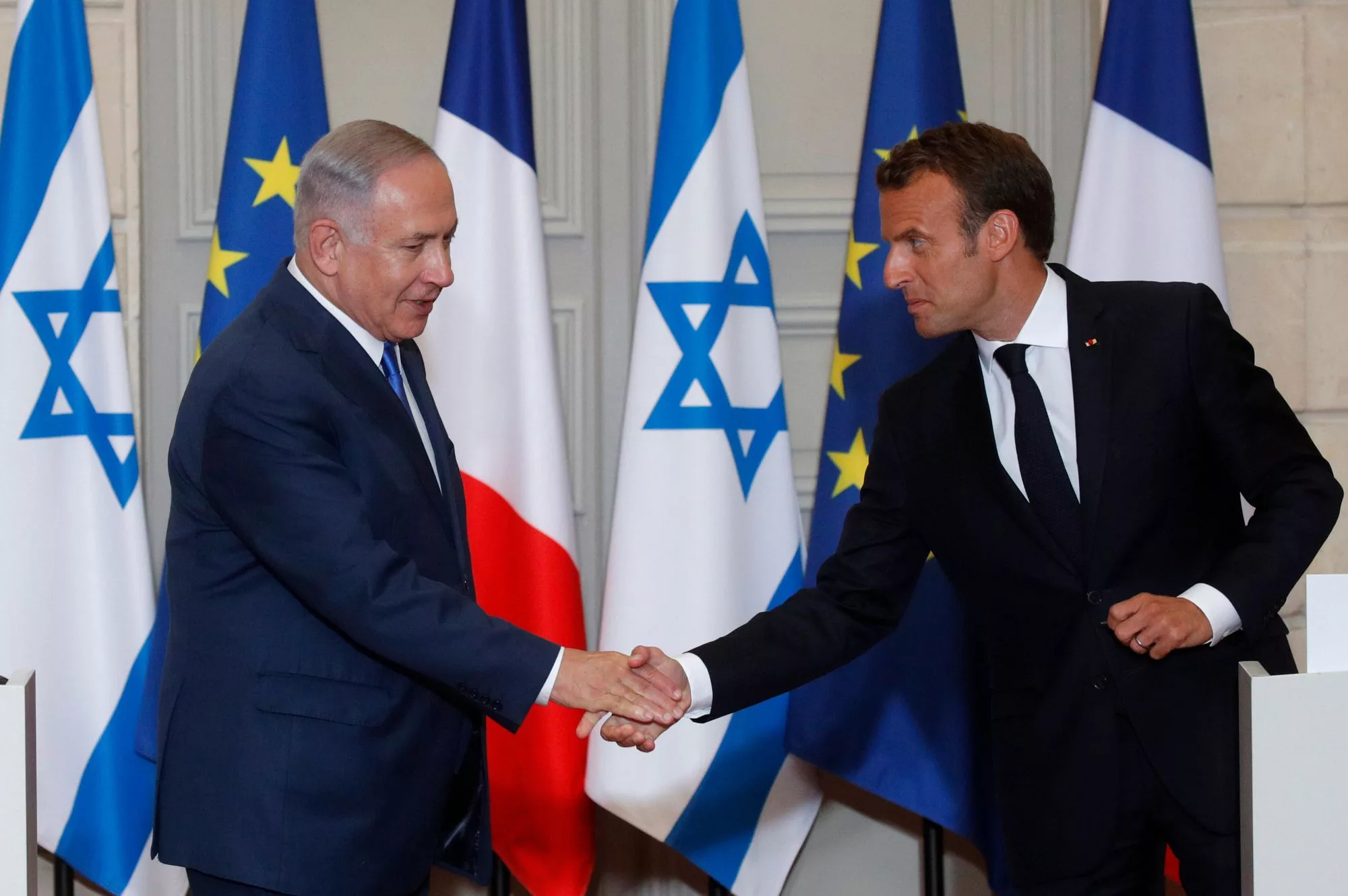
Following the outbreak of the Gaza war on October 7, 2023, Macron declared full support for Israel’s “right to defend itself” and lit the Eiffel Tower with the Israeli flag. He even proposed forming a global coalition against Hamas, mirroring the anti-ISIS campaign. Pro-Palestinian protests were banned.
Yet within months, France’s stance began to shift. Macron criticized the humanitarian toll of the war, hosted an aid conference for Gaza, and emerged as Europe’s most vocal critic of Israeli conduct. Eventually, he broke with European consensus, announcing France’s intention to recognize a “viable” Palestinian state at the UN in September 2025.
A Calculated Shift, Not a Moral Awakening
This shift is less an ethical awakening and more a response to mounting domestic and international pressure. A leaked November 2023 memo signed by 12 French ambassadors warned that France’s pro-Israel stance risked complicity in war crimes. At home, pro-Palestinian protests surged across cities housing millions of Muslims and Jews alike.
Faced with growing outrage and a shifting global consensus, Macron had little choice but to adjust course. His recognition plan is highly conditional—requiring a demilitarized Palestinian state that recognizes Israel, making it a toothless entity under international and Israeli oversight.
Macron’s move serves multiple goals: placating public anger, balancing relations with Jewish and Muslim communities, reviving France’s regional role after setbacks in Syria, Lebanon, and Africa, and aligning with a broader European trend—as seen in Spain, Ireland, and Norway’s May 2025 recognition of Palestine.
France’s position on Palestine has long aimed for balance—but often leaned toward hesitation. While grounded in a doctrine of neutrality and dialogue with both sides, it rarely translated into tangible policy. Driven by pragmatic calculations and global power dynamics, France’s diplomacy has often, by default, favored the Israeli narrative under the guise of evenhandedness.