
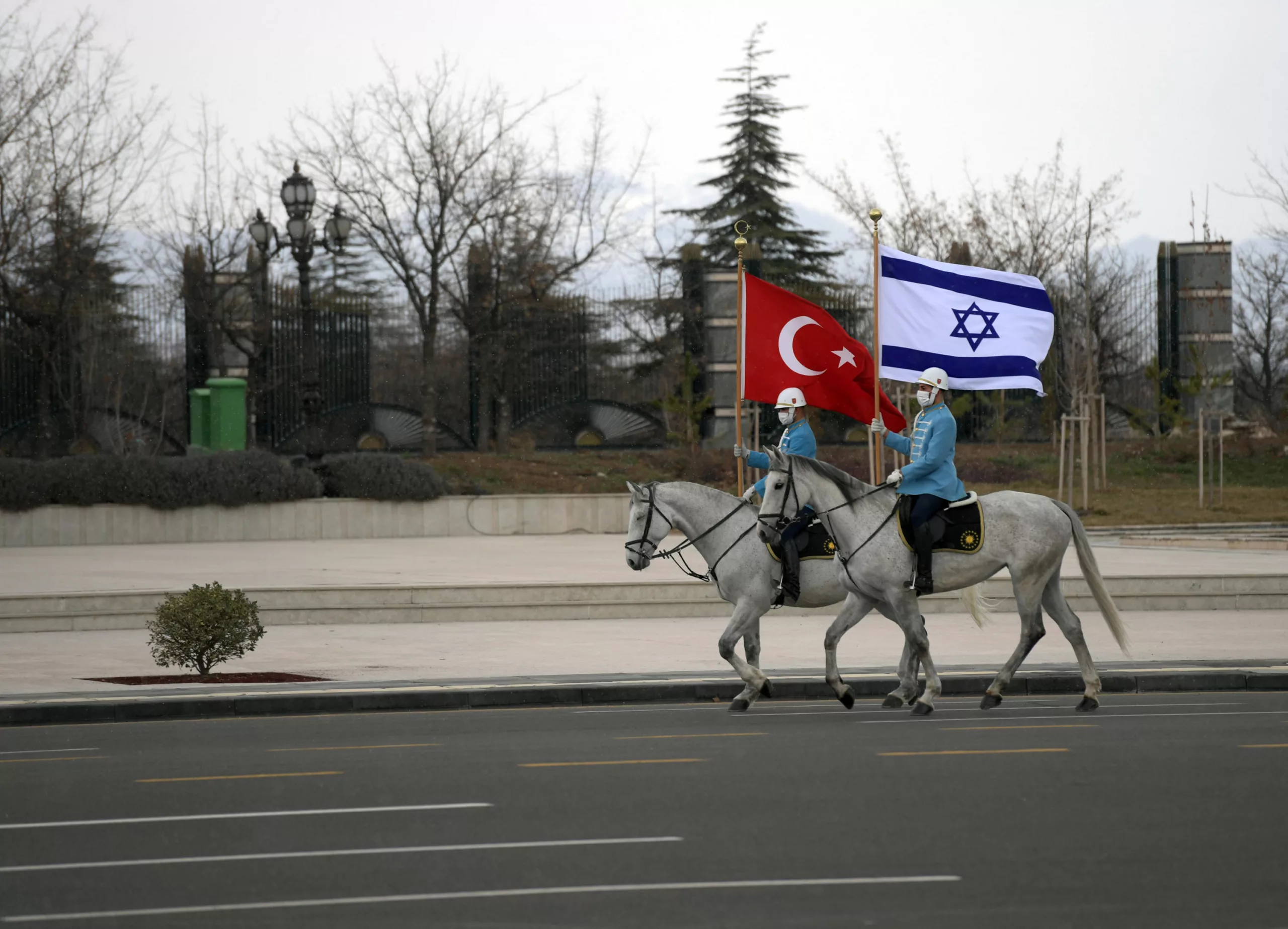
Turkish–Israeli relations have never been easy to define, let alone stable. Marked by a pattern of calculated rapprochements punctuated by recurring waves of tension and estrangement, the relationship has often swung between diplomatic frostiness and strategic cooperation.
Despite their long-standing ties in trade, security, and regional strategy—stretching back to Israel’s early years—the relationship has repeatedly veered into crises, at times reaching the point of ambassadorial withdrawals and fiery rhetoric, as seen recently following Israel’s repeated airstrikes on Syrian territory.
This dynamic unfolds within a complex web of factors, from religious and ideological considerations to regional geopolitics, large-scale economic projects, and each nation’s alignment within the global order—particularly in their respective relationships with Washington.
Despite surface-level tensions, both Ankara and Tel Aviv have tended to manage the relationship with a delicate balance, aiming to contain political clashes while preserving a functional level of coordination on sensitive issues.
A History of Turbulence
Since the early 2000s, Turkish–Israeli ties have endured successive rounds of tension—ranging from public diplomatic spats to a steady erosion in coordination, though rarely descending into full rupture.
Israeli policy under former Prime Minister Ariel Sharon played a pivotal role in fueling this volatility, quashing the early optimism that followed the launch of the Middle East Peace Process.
Sharon’s provocative visit to Al-Aqsa Mosque in September 2000 triggered the Second Intifada, sparking serious diplomatic reverberations in Ankara, which viewed Israel’s repressive policies as a threat to regional stability.
Despite concerted efforts to recalibrate the relationship—including official visits to the occupied Palestinian territories by Abdullah Gül and Recep Tayyip Erdoğan in 2005—a series of escalating events, from Israel’s 2006 war on Lebanon to the 2008 assault on Gaza, pushed the relationship into sharp decline.
A defining moment came at the 2009 Davos Forum, where Erdoğan stormed out of a panel after a heated exchange with Israeli President Shimon Peres—a symbolic gesture that significantly boosted Turkey’s popularity in the Arab world.
Tensions flared again over Turkish television dramas criticized by Israel, and escalated dramatically in January 2010 when the Israeli foreign ministry humiliated Turkey’s ambassador—a move that provoked a strong backlash in Ankara.
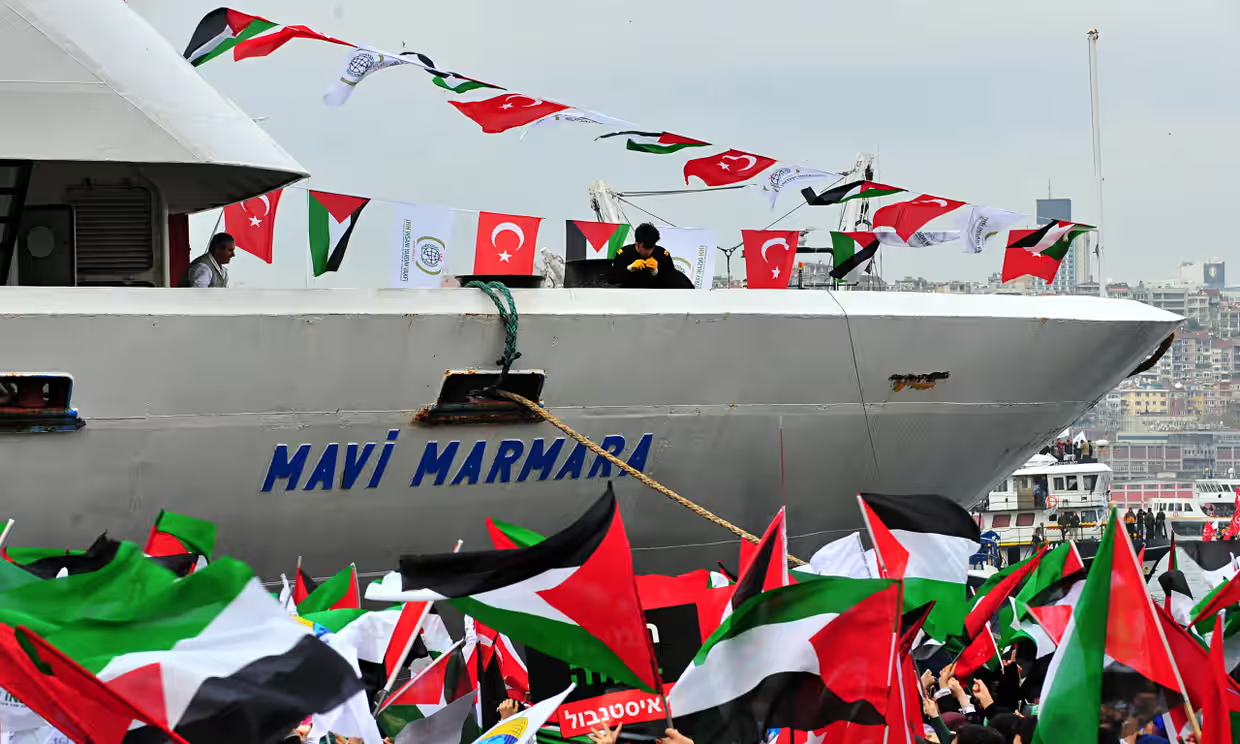
The breaking point came on May 31, 2010, when Israeli forces attacked the Mavi Marmara, part of the Gaza Freedom Flotilla, killing nine Turkish activists (a tenth later died of injuries). Ankara responded by recalling its ambassador, suspending military ties, and demanding an official apology, compensation, and an end to the Gaza blockade.
While Israel initially resisted these demands, a dramatic shift occurred in March 2013 when Prime Minister Benjamin Netanyahu issued a formal apology to Erdoğan in a US-brokered phone call.
This paved the way for protracted negotiations culminating in a normalization deal in June 2016, which included a $20 million compensation package for victims’ families, restored diplomatic ties, and Turkish humanitarian aid to Gaza.
But by May 2017, tensions had resurfaced after Erdoğan’s blistering comments against Israeli policies in Jerusalem, likening them to apartheid. Israel responded by recalling its ambassador—yet another sign of the relationship’s fragility.
A Cord That Never Snaps
Despite the recurring crises and political squabbles, Turkish–Israeli ties have never collapsed completely. Rather, they have operated within a framework of “manageable discord.” Both sides have often pulled back from the brink, reverting to pragmatic arrangements that safeguard mutual interests.
Turkey formally recognized Israel in 1949, becoming the first Muslim-majority country to do so. In the 1950s, trade flourished—Turkish grain met half of Israel’s demand, while Israel named a forest near Haifa in honor of Atatürk. However, the relationship was never smooth. During the 1956 Suez Crisis, Ankara downgraded ties, which remained lukewarm until the late 1960s.
Following the 1967 war, Turkey supported Arab calls for Israel’s withdrawal from occupied territories. Tensions deepened in the 1970s, as Turkey voted for the UN resolution equating Zionism with racism and recognized the PLO as the legitimate representative of the Palestinians.
Though diplomatic ties were elevated to ambassadorial level in 1980, Israel’s annexation of East Jerusalem prompted Turkey to cut ties again. By the late 1980s, relations were still frozen despite Turkey’s recognition of the State of Palestine.
The 1990s marked a period of thaw, driven by the Madrid Peace Conference and Oslo Accords. The countries upgraded diplomatic ties, reopened consulates, and signed landmark military agreements—including the 1996 defense training pact and joint naval drills in 1998 with US participation.
While the last decade has seen recurring flare-ups, the communication channels were never fully severed. In March 2022, Israeli President Isaac Herzog visited Ankara—the first such visit in 14 years—marking a new phase of normalization. This was followed by a Netanyahu-Erdoğan meeting in New York during the 2023 UN General Assembly, signaling a mutual desire to turn a new page.
The “Al-Aqsa Flood” and Renewed Hostilities
The latest detente was short-lived. The eruption of Hamas’ “Al-Aqsa Flood” operation on October 7, 2023—and Israel’s ensuing war on Gaza—reset the relationship back to open hostility and de facto severance.
Israel swiftly withdrew its diplomats from Ankara, while Turkey recalled its ambassador in protest over the Gaza bombardment and Israel’s refusal to heed ceasefire calls. Erdoğan condemned Israel as a genocidal state and asserted that Hamas was not a terrorist organization, but rather a legitimate resistance movement.
By March 2024, Erdoğan had escalated his rhetoric further, accusing Israel of committing genocide and lambasting the West for its unconditional support of Tel Aviv.
In May, Turkey took concrete steps to sever economic ties: halting energy cooperation, canceling a planned visit by its energy minister, and freezing joint gas exploration plans in the Eastern Mediterranean.
Then, in August 2024, Turkey joined South Africa’s genocide case against Israel at the International Court of Justice—vowing to present evidence of war crimes and ethnic cleansing in Gaza. By November, Erdoğan declared a full trade embargo and total cessation of relations, emphasizing unwavering Turkish support for Palestine.
Simultaneously, Turkish security agencies launched a crackdown on alleged Mossad-linked cells, arresting multiple individuals for espionage-related offenses.
From a security perspective, Israel has grown increasingly alarmed at Turkey’s continued support for Hamas leadership, viewing Ankara as a safe haven for adversaries. Israeli media reports have alleged that Turkey permits Hamas and Islamic Jihad to conduct military training inside Syria, with direct backing from Erdoğan.
According to I24news, Israeli officials consider this a grave breach of red lines, citing the growing presence of Palestinian factions in Syria under Turkish auspices.
Syria: The Emerging Flashpoint
Syria has recently emerged as a focal point in the Turkish–Israeli rivalry, with deepening political and military entanglements. For the first time, the possibility of a direct or proxy confrontation between Ankara and Tel Aviv is on the table.
On the night of April 3, 2025, Israel launched one of its most aggressive airstrikes in Syria, targeting three airbases in central Syria. Israeli sources claimed the bases had recently been inspected by Turkish military teams in preparation for a joint defense pact with Syria’s new administration.
Turkey reacted angrily, with its foreign ministry issuing a scathing statement labeling Israel as “the gravest threat to regional stability” and accusing the Netanyahu government of sabotaging peace efforts in Syria. It also denounced the inflammatory comments of Israeli ministers Yisrael Katz and Gideon Sa’ar, who accused Turkey of attempting to establish an “Ottoman protectorate” in Syria.
An Israeli official told The Jerusalem Post the airstrikes were a “direct warning” to Turkey: any permanent Turkish military presence in Syria would pose a threat to Israeli operations and would not be tolerated.
Despite the heated rhetoric, Ankara appeared intent on de-escalation. Days later, Turkish Foreign Minister Hakan Fidan, speaking from Brussels, clarified that Turkey had no intention of clashing with Israel in Syria, asserting that “Syria belongs to the Syrians,” and any potential understanding between Damascus and Tel Aviv was “an internal matter.”
This marked a notable softening in Turkey’s tone and an attempt to contain the fallout.
Yet Israel’s concerns over Turkey’s role in Syria predate the April strike. In January 2025, The Jerusalem Post revealed a report by the Nagel Committee—formed by Israel’s National Security Council in 2023—which warned of a possible future war with Turkey. The report described a budding Turkish-Syrian alliance as potentially more dangerous than the Iran axis.
It recommended increasing Israel’s defense budget by 15 billion shekels ($4.1 billion) annually for five years, with an emphasis on:
-
Expanding the air force with more F-15s, refueling planes, and long-range drones.
-
Upgrading missile defense systems: Iron Dome, David’s Sling, Arrow, and laser-based platforms.
-
Fortifying the eastern border with a defensive wall along the Jordan Valley—despite potential tensions with Jordan.
Ironically, Israel, long focused on countering Iranian presence in Syria, now views Turkey—a NATO ally—as a dual threat: reshaping the power balance in Syria while complicating containment efforts due to its Western alliances.
Managed Conflict: The Dominant Equation
Despite the heightened rhetoric and myriad fronts of tension, the Turkish–Israeli relationship remains governed by a framework of “controlled conflict.” Turkey’s assertive regional posture is tempered by a pragmatic approach that carefully calibrates its engagement to avoid unwanted military confrontations.
Ankara seeks to position itself as an indispensable regional actor—from Gaza to Syria and Iraq—without jeopardizing its strategic calculations. Likewise, Israel recognizes Turkey’s NATO membership and close US ties, making direct confrontation a costly gamble.
Both sides continue to navigate their differences through a strategic blend of confrontation and cooperation. A case in point was the situation in Sweida: despite Israeli strikes affecting areas under the new Syrian regime’s influence, Turkey refrained from any military retaliation. Instead, it facilitated indirect Syrian–Israeli talks that eventually evolved into direct negotiations—with US involvement—aimed at establishing de-escalation mechanisms.
Turkish Foreign Minister Hakan Fidan, speaking at the fourth Antalya Diplomacy Forum, reiterated that Ankara “does not seek conflict with any actor in Syria,” and that technical talks with Israel would resume as needed to avoid direct clashes.
The behind-the-scenes talks in Baku marked a turning point, reportedly yielding a tacit agreement on spheres of influence in Syria: Turkey would refrain from encroaching on Israeli zones, while Israel would implicitly recognize Ankara’s sway—under pressure from President Donald Trump, who maintains a personal rapport with Erdoğan.
As Israeli analyst Galia Lindenstrauss of the Institute for National Security Studies told Times of Israel: “Turkey cares more about Syria than Israel does, and it invests accordingly, giving it leverage in shaping the rules of engagement.”
She added that Trump’s support for Erdoğan constrains Israel’s response options, with the US President urging moderation and pushing Tel Aviv to limit its actions in Syria to essential red lines, such as blocking weapons transfers to Hezbollah.
Ultimately, regardless of the provocations, the Turkish–Israeli relationship appears destined to remain suspended in its familiar state: perpetually on the brink of confrontation, but unlikely to cross the threshold into open conflict.