Amid the protracted conflict in Yemen, which has persisted since the Houthi group’s seizure of state institutions in September 2014, thousands of civilians have endured arbitrary arrest, enforced disappearance, and torture within the group’s prisons. These practices are not only flagrant violations of international humanitarian law—they have profound humanitarian, social, and economic consequences for families and Yemeni society as a whole.
This report presents first-hand testimonies and personal narratives of individuals who have suffered these abuses, alongside documented statements by human rights groups that highlight the immense suffering and harsh conditions experienced by detainees and their families.
Years of Enforced Disappearance and Torture
“On June 9, 2015, the Houthis abducted me. I spent five and a half years detained—days lost to enforced disappearance and both physical and psychological torture.”
This is how journalist Hisham Tarmum recounts his ordeal to Noon Post, detailing transfers between Houthi detention facilities, harsh treatment, and total deprivation of rights. Meanwhile, his family searched for him for months without knowing his fate.
Hisham says, “My mother visited prison gates daily. Later, my family received word that I had died under torture in 2019. That rumor nearly shattered them mentally.” His family was also extorted—paying bribes to Houthi supervisors who falsely promised his release. Even during rare visits, they traveled long distances from the Hajja countryside to Sana’a, waiting hours only to see him briefly.
After his release, Hisham continues to suffer chronic health issues, including cervical disc displacement, colon and joint pain—results of torture, medical neglect, and freezing detention-cell conditions.
“I left prison, but its impact remains. I was the detainee, but my family lived the ordeal with me,” he concludes—a living testament to the trials of journalism under militia rule.
Torture at the Hands of a “Humanitarian” Official
Journalist Tawfiq Al-Mansouri was shocked when the Houthi “prisoner affairs” official, Abdul Qader Al-Murtada, stormed in, furious on the evening of August 20, 2022, in response to media demands for his transfer to receive treatment.
Al-Mansouri recounts: Abdul Qader, in a hysterical rage, demanded, “What will the media and organizations do for you?” Tawfiq weakly replied, “I don’t know—I’m not allowed to contact anyone.” Abdul Qader sneered, “Then what do you want?” Tawfiq pleaded for medical care for his swollen legs, heart condition, and chronic respiratory issues. Before he could finish, Al-Murtada raised an iron baton and struck him on the head, rendering him unconscious.
Despite the serious nature of his injuries and warnings from the prison nurse, Al-Mansouri was neither taken to a hospital nor given necessary treatment.
He is one of four journalists sentenced to death by the Houthis after years of enforced disappearance and torture for their reporting.
During more than eight years in captivity, he endured brutal torture—but calls this incident the “most severe,” as it was inflicted by someone presented as a negotiator for detainees and a “humanitarian partner” in peace talks.
Although some colleagues were later released, Tawfiq still struggles with lasting physical and psychological effects. He is now demanding accountability—not merely condemnation—of those responsible.
U.S. Sanctions on Houthi Prison Officials
In December 2024, the U.S. sanctioned the National Authority for Prisoners and Detainees (HNCPA) and its head, Abdul Qader Al-Murtada, under Executive Order 13818. The sanctions were due to their responsibility or complicity in serious human rights abuses, with Al-Murtada personally involved during his leadership.
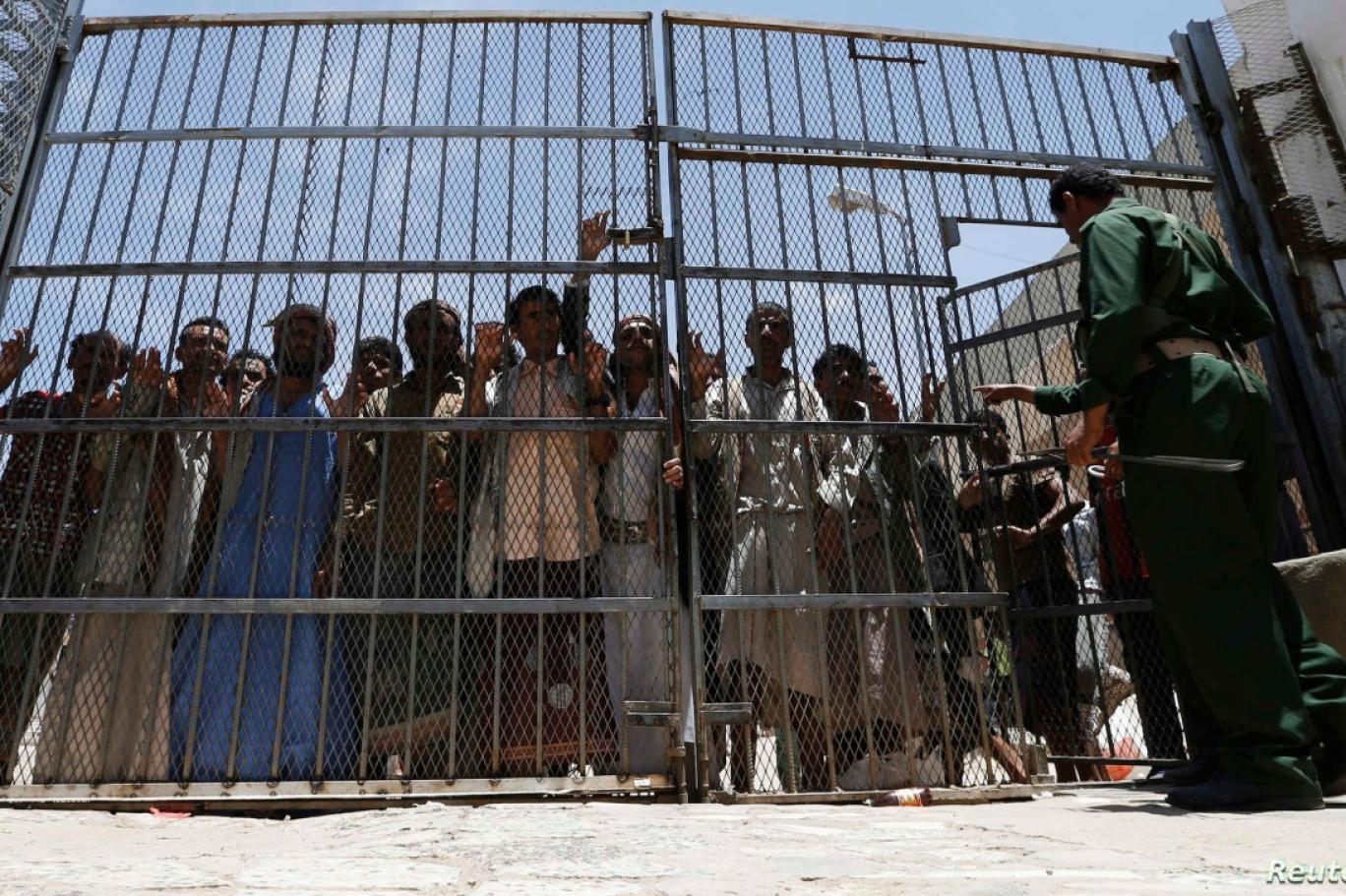
The HNCPA oversees Houthi detention facilities, including the notorious “Exchange House” prison in Sana’a, where the UN has documented systematic torture and inhumane conditions.
Enforced disappearance has been a primary tool for crushing dissent. Many are detained without charge and held for years, unknown to their families.
The family of Saleh Mubarak Al-Ramadi still awaits news of his son, Ismail, missing since December 25, 2014, after Houthi forces raided his home in Bayt Marran, Arhab district, north of Sana’a. They have no updates on his wellbeing or whereabouts. Saleh recounts endless anguish wondering whether his son is alive, sick, or dead. Despite appeals to Houthi officials in Arhab, Sana’a, and even visits to Sa’da and Dhahyan power centers, their efforts remain unanswered.
Arrests for Speaking Out
Such arrests are not limited to men. Female activists have been detained, threatened, and abused—leaving deep emotional and social scars on their families and communities.
Human rights activist Sonia Saleh, a graduate of Sana’a University and founder of “Despite Difficulties,” was detained in March 2019 in Hadda district of Sana’a for criticizing rent inflation and censorship. Sonia, who had provided community support and orphan care in Hadhramaut, was arrested simply for speaking out.
She recounts, “My crime was that I saw injustice and wrote about it. The punishment was arrest and torture.” Although later released on bail, with forensic confirmation of torture, her freedom was hollow.
After her release, Sonia suffered psychological breakdowns and familial isolation, as her family regarded her as a disgrace. She was barred from working, had her phone confiscated, and even was physically assaulted by her brother, who broke her arm in an attempt to silence her.
Sonia fled to Aden and then to Cairo using visa‑free travel. Yet even in exile, safety eludes her. She reports that although many organizations documented her case, “none provided real support,” and others represented her internationally without consent.
The Scale and Social Impact of Abuses
In Aden, journalist Ahmad Maher was detained by Security Belt forces after criticizing corruption and advocating for the poor. He says he was forced under torture to confess to false criminal charges.
Authorities threatened his family, stole his money and electronics, but he emerged after two and a half years, “my head held high like Mount Shamsan,” determined that truth ultimately prevails.
Mohammed Al‑Omda, chair of the Yemeni Network for Rights and Freedoms, said that between the December 21, 2014 coup and mid‑2025, the Houthis committed a series of crimes against civilians—arbitrary arrest, enforced disappearance, and torture—flagrantly violating humanitarian and international law.
The network documented at least 20,731 civilian arrests; 4,201 remain detained, including 389 politicians, 464 activists, 340 journalists, 374 women, 176 children and 2,458 professionals .
These arrests occurred publicly—on streets, in homes, in mosques and markets—and detainees were transferred to secret prisons unknown to their families, enduring catastrophic humanitarian conditions including torture, medical neglect, and death. The network recorded 1,317 enforced disappearances, 2,467 torture cases, numerous killings and deaths from medical neglect, and use of detainees as human shields .
Rights activist Tawfiq al‑Hamidi emphasized that arbitrary arrests represent one of Yemen’s gravest war consequences, causing devastating social and economic breakdown for women and children. With men detained, many women—a minority—took on breadwinner roles, suffering financial and emotional pressure, while children faced psychological and educational disruptions .
Calls for International Accountability
Radwan Masoud, head of the National Authority for Prisoners and Detainees, disclosed to Noon Post that between September 2014 and June 2024, Houthi forces abducted over 22,000 people, including women and children, systematically targeting activists, politicians, journalists, and dissidents.
They are detained in secret facilities without contact, with over 2,000 enforced disappearances and 50 unknown‑fate cases.
The Authority documented 1,397 torture cases affecting both women and children, featuring beatings, electric shocks, sleep and food deprivation, and hanging. They also recorded 436 deaths in detention—197 from direct torture and 239 due to medical neglect—plus more from worsening illnesses.
He urged urgent international action: classify the Houthis as a terrorist organization, open prisons to independent observers, release all detainees unconditionally, and continue documentation for legal accountability.
Legal and Social Consequences
Lawyer Huda Al‑Sarrari told Noon Post: arbitrary arrest violates the International Covenant on Civil and Political Rights, which guarantees freedom and personal security. Enforced disappearance—even worse—constitutes an international crime. She confirmed the existence of secret torture prisons, denial of legal representation, and unfair trials.
Women displaced by male breadwinners’ detention face dire socio-economic pressure: constant anxiety, poverty, forced asset sales, and bribes for release. Families often face social stigma and isolation—especially in rural communities .
Al‑Sarrari lamented weak international pressure despite UN reports and highlighted the need for stronger mechanisms to hold perpetrators accountable, defend victims’ rights to visitation and fair trials, support local NGOs documenting abuses, and deliver psychological and social care for victims and their families.
Shocking Conditions in “Exchange House” Prison
A UN-appointed group of international experts on Yemen reported in Annex 80 about detainee abuses in the Central Security Camp in Sana’a, especially the “Exchange House” prison supervised by the HNCPA under Abdul Qader Al‑Murtada. The prison houses civilians, journalists, political detainees, war captives from the 2019 Wadi Jabara battle, criminal detainees, mentally ill individuals, and drug addicts. Some have been held for years without trial or clarity of fate, despite eligibility for prisoner exchanges.
The experts documented systematic torture: mock executions, severe beatings, electric shocks, prolonged suspension, denial of critical medical care—causing permanent injuries and deaths under unclear circumstances. Reports describe organized extortion, with families forced to pay for phone calls or visits, while detainees who pay are given preferential treatment.
Medical neglect is appalling: medicines are sold at up to five times market price, sometimes labeled as humanitarian aid. Some guards sell information or qat procured with detainees’ money. Some detainees are placed in isolation cells called “squeezers”—roughly 1×0.5 m in size, lacking ventilation or water—for months.
As part of “ideological reeducation,” detainees are forced to listen daily to religious sermons, Al‑Masirah TV broadcasts, and speeches by Abdul‑Malik Al‑Houthi, even though many are Sunni.
The Central Security Camp holds around 3,000 detainees, including minors arrested as children. Ongoing torture and abuse have resulted in psychological illnesses, and several deaths remain unexplained.