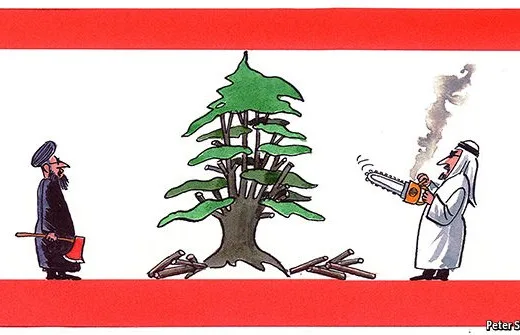

The United States has officially announced a ceasefire agreement between Israel and Iran, ending weeks of unprecedented escalation that nearly tipped the region into full-scale war. While the deal has been promoted as a political and security achievement for all parties, a closer examination from the Palestinian perspective—particularly from the vantage point of the resistance in Gaza—offers a far more complex assessment of gains and losses.
Definitions of victory and defeat vary, shaped by each party’s interests and strategic narratives. Yet the war in Gaza remains the most enduring and bleeding wound in the Palestinian, Arab, and global conscience.
Today, the world’s gaze returns to the battleground that the Israeli government tried to sideline, presenting it as a peripheral front in the international discourse—only for Gaza to reassert itself once again as a central theater in the regional conflict.
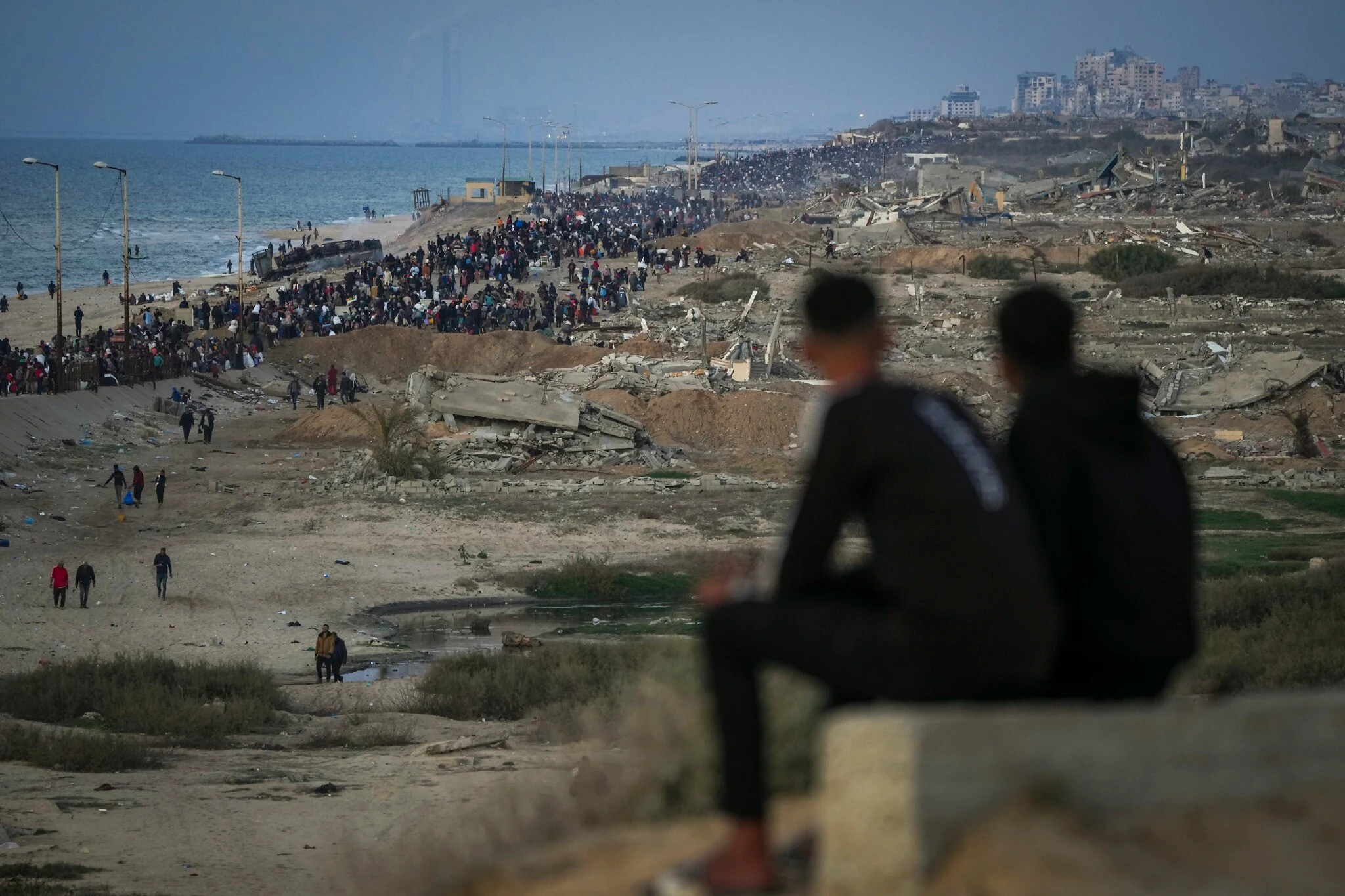
No Winners, No Losers
The final choreography of the Iran–Israel confrontation reflects the scale of tacit understandings reached prior to the ceasefire announcement. After the U.S. strikes on Iran’s Fordow nuclear facility and other strategic sites in Natanz and Isfahan, it became clear that Washington intended to deliver a powerful message of deterrence without being drawn into a broader war—an objective aligned with Tehran’s stance, which also sought to avoid open conflict.
On the other hand, Iran’s retaliatory strike on the U.S. Al-Udeid base in Qatar appeared more political than military in nature. It served as a symbolic endnote to the escalation, with prior coordination reportedly undertaken with both Qatari and American parties. The strike solidified Iran’s deterrence equation and allowed all actors to disengage with their dignity intact, avoiding further entanglement.
Qatar played a key mediating role, transforming mutual signals into an actual agreement grounded in the principle of “no victor, no vanquished.” The ceasefire enabled all parties to contain their losses without any one side suffering a clear defeat.
In a detailed announcement, former U.S. President Donald Trump confirmed that the ceasefire had come into effect, writing on his Truth Social platform: “Please do not violate it.” He explained that the agreement entailed a synchronized ceasefire beginning with a 12-hour halt by Iran, followed by a corresponding Israeli pause, culminating in the official end of hostilities after 24 hours.
Trump hailed the deal as “a diplomatic victory for Israel, Iran, and the world,” stating that the “12-day war” could have devolved into a region-wide catastrophe if not for what he called the “patience, courage, and intelligence” of both sides.
In Israel, the government issued an official statement following a cabinet meeting chaired by Prime Minister Benjamin Netanyahu. The statement declared that “Operation People Like a Lion” had achieved—and even surpassed—its objectives, citing the elimination of Iran’s nuclear threat, devastating blows to command centers in Tehran, and the assassination of a senior Iranian nuclear scientist.
Iranian state media also confirmed acceptance of the ceasefire, describing Israel as “the enemy forced into submission.” Foreign Minister Abbas Araghchi emphasized that Iran was prepared to halt its operations so long as Israel ceased its “illegal aggression.” He noted that the de-escalation window was set to expire at 4 a.m. local time and that Iran’s final decision to stop was made only after Israel upheld its part of the agreement.
Ultimately, all parties suffered varying degrees of damage but retained sufficient rhetorical material to frame the outcome as a “victory” for domestic audiences. The reality, however, is that no side achieved a decisive triumph, and Israel’s primary strategic objectives in Iran were left unmet. The clearest conclusion: there was no clear winner and no definitive loser.
Resistance in the New Strategic Landscape
The ceasefire between Israel and Iran reverberated directly onto the region’s most volatile front: the ongoing war in Gaza. With attention now refocused on the Palestinian arena, the resistance has undertaken a careful strategic reassessment of the deal’s implications for Gaza and for the broader Palestinian national project.
1. Iran’s Endurance: A Strategic Gain for the Resistance
For Palestinian resistance factions, Iran’s survival of the direct confrontation without collapse or humiliating concessions is a critical outcome. Tehran remains the last central and reliable backer of the resistance—playing a pivotal role in armament, financing, and deterrence capabilities.
A crushing blow to Iran’s internal stability or its missile and security infrastructure would have crippled these supply chains, undermining the resistance’s ability to withstand Israel’s military machinery over the long term. Therefore, Iran’s political and military resilience—and its success in ending the escalation on favorable terms—is viewed as a direct strategic win for the resistance in Gaza.
2. Netanyahu’s “Perfect Ending”: No Defeat, No Quagmire
From another angle, the deal provided Israeli Prime Minister Benjamin Netanyahu with an ideal exit strategy from the Iranian front—avoiding a prolonged quagmire while maintaining the optics of strength. The escalation allowed him to claim significant domestic gains, including a surge in public opinion polls and a reassertion of his leadership role amid Israel’s political turbulence.
He also secured rare political consensus on his decision to strike Iran—something he hadn’t achieved even during major military campaigns in Gaza. The agreement thus enables him to market a narrative of “decisive victory” without enduring the costs of protracted warfare and potentially pivot back to the Palestinian front, where he may channel this “war momentum” into recalibrating his options in Gaza.
3. The United States: Resolution Without War
For Donald Trump’s administration, the outcome represents a long-sought formula: political resolution achieved without direct warfare. Washington succeeded in sending a stern message to Tehran without toppling its regime, and crucially, it contained a conflict that could have spiraled into broader regional chaos.
This allowed Trump to project two key images:
-
A decisive leader who imposed de-escalation through diplomatic strength.
-
A “peace through strength” strategist, setting the stage for broader regional stabilization, potentially including Gaza, under the banner of “enough escalation.”

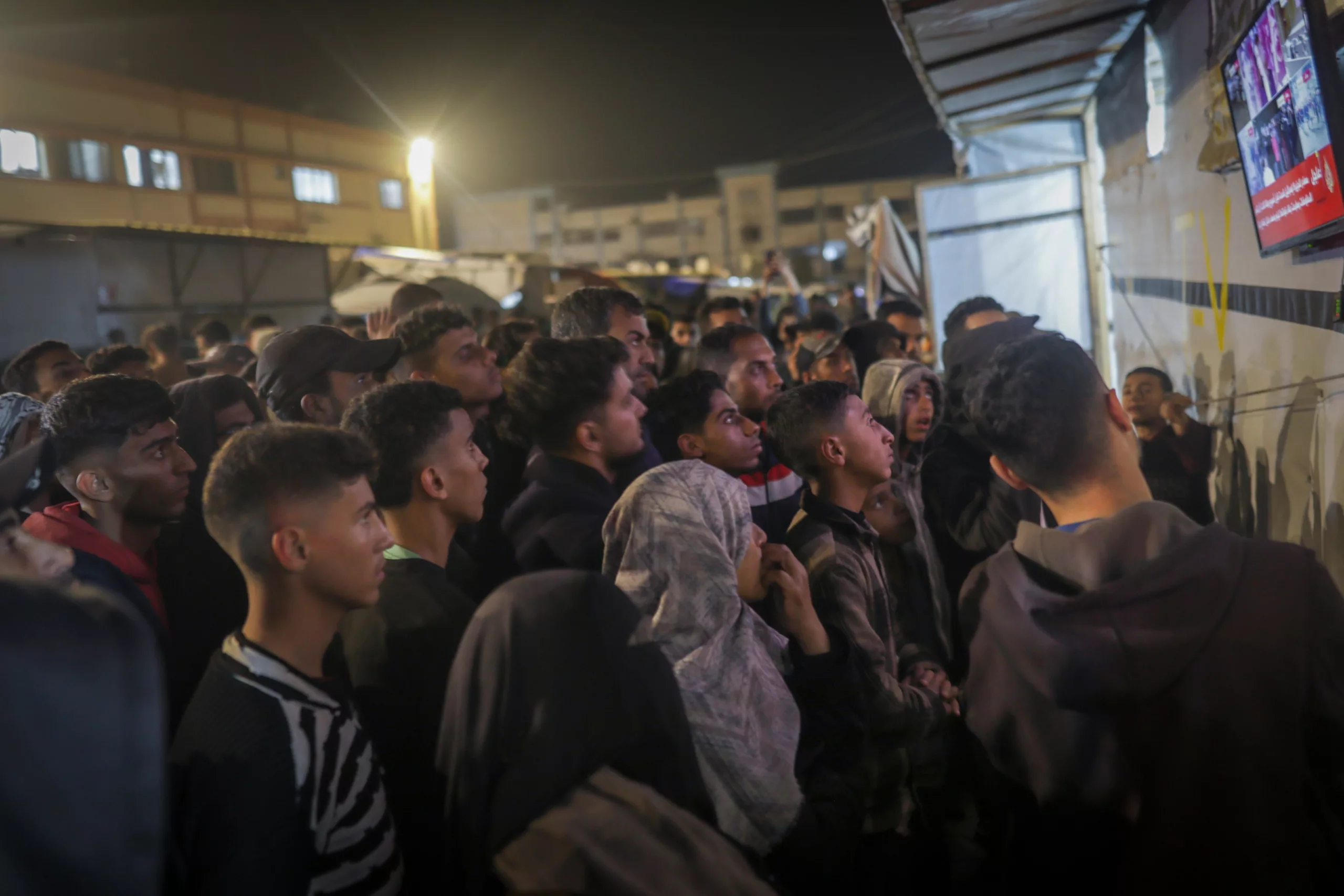
Palestinians watch television as they await the announcement of a ceasefire agreement between Hamas and Israel in Khan Younis. (AP)
A Resistance Perspective on the Ceasefire
From the resistance’s standpoint, the agreement reduces strategic threat levels while keeping Iran fully operational within the deterrence equation. This continuity ensures that vital logistical and military support will not be disrupted.
Nevertheless, the resistance is acutely aware that the de-escalation with Tehran does not rule out renewed aggression in southern Palestine. Netanyahu, having emerged from the Iranian front with a boost in popularity and broad political backing, may now view Gaza as an opportunity to complete his “Chariots of Gideon” strategy—either to establish a narrative of “multi-front deterrence” or to achieve a symbolic victory stretching from Tehran to Gaza.
Since the early stages of the war, the resistance had hoped that rising regional tensions would lead to a comprehensive political resolution in which Palestinians would no longer be the weakest link, but rather recognized participants. Yet developments—whether the previous de-escalation with Hezbollah or the current deal with Iran—have fallen short of this vision.
That said, the absence of a comprehensive settlement doesn’t necessarily imply bleak outcomes. Gaza continues to impose itself as a central front in the broader conflict—one that cannot be stabilized without halting the ongoing war of annihilation—even if it is denied a seat at the negotiating table.
What Comes Next: Three Post-Agreement Scenarios
In light of the Iran–Israel ceasefire, Palestinian resistance now faces a spectrum of potential scenarios in Gaza—militarily and politically. How regional actors engage with the agreement, and how Netanyahu maneuvers domestically, will largely determine the path ahead. These scenarios can be summarized as follows:
Scenario One: Escalation After Iran
Netanyahu views the de-escalation with Iran as a mandate to resume the military campaign southward, focusing on Gaza. He proceeds with the “Chariots of Gideon” operation to reinforce a narrative of “multi-front victory” ahead of early elections.
Scenario Two: Comprehensive but Temporary Truce
The U.S. administration seeks to capitalize on the Iran deal to market Trump as a peace-bringer, pushing for broader calm that includes Gaza. Truces may be brokered via mediators to halt hostilities without addressing core issues.
Scenario Three: The Likely Outcome – “Calculated Closure
This scenario stabilizes the Iran–Israel equation without major escalations. Israel markets the ceasefire as a win, the U.S. avoids direct conflict, and Netanyahu pivots to a controlled Gaza truce, ideally with a prisoner swap.
Resistance benefits from an honorable end to nearly two years of war and gains key negotiating ground.
Facing these scenarios, Palestinian resistance understands that the next phase demands strategic balance: capitalizing on regional shifts while staying vigilant. Should de-escalation hold, the resistance must consolidate political and negotiation power—without offering substantive concessions.
Should the situation deteriorate, it will rely on two years of resilience and international momentum to counter any Israeli aggression and keep Gaza central to the regional equation. The compass remains unchanged: halting the genocide, defending national rights, and resisting displacement.