









This spring marks the 48th anniversary of what has become known as the U.S. State Department’s Country Reports to Congress, or “Human Rights Reports” (HRRs). In 1977, the U.S. Congress mandated the newly formed Bureau of Democracy, Human Rights, and Labor (DRL) at the State Department to compile these reports as a core instrument to guide U.S. foreign policy.
Over nearly half a century, these reports have shaped American diplomacy, operating within a complex matrix of interests and geopolitical calculations. They’ve redefined human rights and freedoms, raised fundamental questions about who qualifies as “human” under shifting political agendas, and determined which governments should rise or fall. They’ve scrutinized the slightest infractions by adversaries while turning a blind eye to the gravest abuses committed by allies.
What are these reports exactly? How have their tone and goals shifted depending on who occupies the White House? How are they deployed as tools of neo-imperialism marked by double standards? What hidden role do they play in securing U.S. interests abroad? And what of Trump’s shocking decision to gut them? What fears has this decision unleashed? This article explores these questions in depth.
A Tool for Leverage and Blackmail
In 1977, Congress amended Section 116 of the 1961 Foreign Assistance Act to require the preparation of annual human rights reports. Ostensibly, these were to guide funding decisions and shape intelligence and security cooperation based on a country’s human rights record.
In principle, this section prohibits U.S. aid to governments complicit in human rights abuses. Initially tied to the so-called “Leahy Laws” of the 1970s and ’80s, which restricted U.S. military support to abusive regimes, the reports evaluated nations on core rights: freedom of expression, peaceful assembly, religious liberty, bodily integrity, privacy, protection against discrimination, and political representation—all drawn from the 1948 Universal Declaration of Human Rights.
They also address issues under other international treaties, including prohibitions on torture and cruel or inhumane treatment, conditions of detention, prison systems, and the broader citizen-state relationship—collectively forming what is known as the “universal human rights framework.”
Originally covering a small group of countries with direct U.S. ties, Congress expanded the scope in 1979 to include all United Nations member states. From 105 countries in 1978, the reports now cover 194 nations annually.
Compiled using governmental sources, NGOs, international organizations, media, and direct victim testimony, the reports undergo internal reviews by U.S. diplomats before submission to Congress.
Far from static, the reports have evolved in tone and content, often reflecting the ideological priorities of the party in power. Different administrations have emphasized or downplayed certain rights accordingly.
For example, under President Reagan, labor rights (1988) and protections against discrimination (1986) were added. Obama’s administration prioritized women’s and children’s rights and expanded coverage of corruption and transparency starting in 2009.
Trump’s administration dramatically narrowed the focus, concentrating primarily on coerced abortion and involuntary sterilization. Biden reversed course, reinstating Obama-era emphasis on women’s rights—highlighting how partisan agendas define what counts as a “human right.”
Since 2009, the reports have maintained a seven-part structure: labor rights, corruption, personal integrity, civil liberties, political participation, societal discrimination, and government cooperation with human rights investigations. Though non-binding and free of direct recommendations, they serve as a detailed record of each country’s rights performance.
Particular attention is paid to armed conflicts and associated atrocities. Recent reports highlight war crimes in Sudan, abuses in Gaza, and Russian aggression in Ukraine. Yet they rarely apply equal scrutiny. Israel and the UAE, for instance, often escape criticism couched in vague, euphemistic language.
Human Rights Rhetoric: A New Face of Imperialism
The U.S. has long portrayed these reports as proof of its global moral leadership. While not the sole basis for foreign aid or sanctions, they play a critical role in shaping such decisions—whether in cutting aid to El Salvador in the 1980s or sanctioning apartheid-era South Africa.
In the 1990s, they justified action against genocidal regimes in Bosnia and Myanmar. Yet under President Bill Clinton, strategic alliances with China, Iran, and Gulf monarchies tempered critiques—while Iraq under Saddam Hussein faced scathing condemnation.
The post-9/11 era marked a watershed moment. Human rights gave way to national security. The HRRs were increasingly sidelined in funding and diplomatic decisions.
In theory, a “political terrorism index” emerged to block support for state sponsors of violence. But in practice, HRRs, along with reports from Human Rights Watch and Amnesty International, served more as fig leaves for predetermined foreign policy moves.
Pakistan, Egypt, and Jordan continued receiving generous U.S. aid despite poor rights records, so long as they played their part in America’s “war on terror.” Saudi Arabia secured major arms deals even amid rampant abuses.
Nonetheless, the reports retained indirect clout. Under Obama, U.S. aid to Egypt was frozen after the 2013 coup and crackdown. That era also saw expanded focus on digital rights, minority protections, and reproductive health.
Given their public availability, HRRs became essential references for researchers, journalists, and civil society actors. Domestically, they informed asylum claims, supported immigration efforts, and helped bar deportations to abusive regimes—driving refugee flows from places like Venezuela, Cuba, Haiti, and Afghanistan.
Stone Weapons, Glass Houses
America’s claim to moral authority is undermined by its own behavior. From war crimes abroad to its assault on international institutions—most notably the International Criminal Court and the United Nations Security Council—it frequently violates the very standards it demands of others.
Its flagrant tolerance of Israeli abuses in the Occupied Territories exemplifies these contradictions. HRRs on “Israel” have evolved to mirror political strategy: “Israel and the Occupied Territories” became “Israel, the Golan Heights, the West Bank, and Gaza” under Trump—laying the rhetorical groundwork to legitimize annexation.
The 2023 report made vague mention of settler violence and mobility restrictions in the West Bank but failed to address the ongoing genocide in Gaza. By 2024, even the phrase “settler violence” had been softened into “construction activity.”
The bombing of hospitals and civilian infrastructure in Gaza was reduced to “complex combat environments”—parroting Israeli narratives. In fact, references to “occupation” and “annexation” were scrubbed entirely from HRRs under Trump, consistent with the “Deal of the Century.”
Domestically, the U.S. fares no better. While condemning China and Russia for surveillance, dissent suppression, and digital repression, it mirrors those same tactics at home.
Black Lives Matter activists face surveillance and intimidation. Muslim communities are targeted by the FBI. Immigration enforcement abuses detainees. Pro-Palestinian voices are criminalized. Yet none of this appears in parallel reports or diplomatic rhetoric.
U.S. double standards also manifest in selective outrage. UAE’s use of Pegasus spyware goes unmentioned. Turkey’s forced deportation of Syrian refugees is downplayed. Iran’s treatment of Christians is amplified, while Saudi executions of Shia minorities are ignored.
Russia is castigated for restricting foreign-funded NGOs. Egypt’s identical laws are deemed “counterterrorism measures.”
Thus, the HRRs’ imperial vocabulary and criteria have earned them a notorious reputation among America’s traditional adversaries. It is now clear that the U.S. is willing to manipulate its human rights discourse to serve its geopolitical supremacy.
Trump’s Era of Manipulation and Evasion
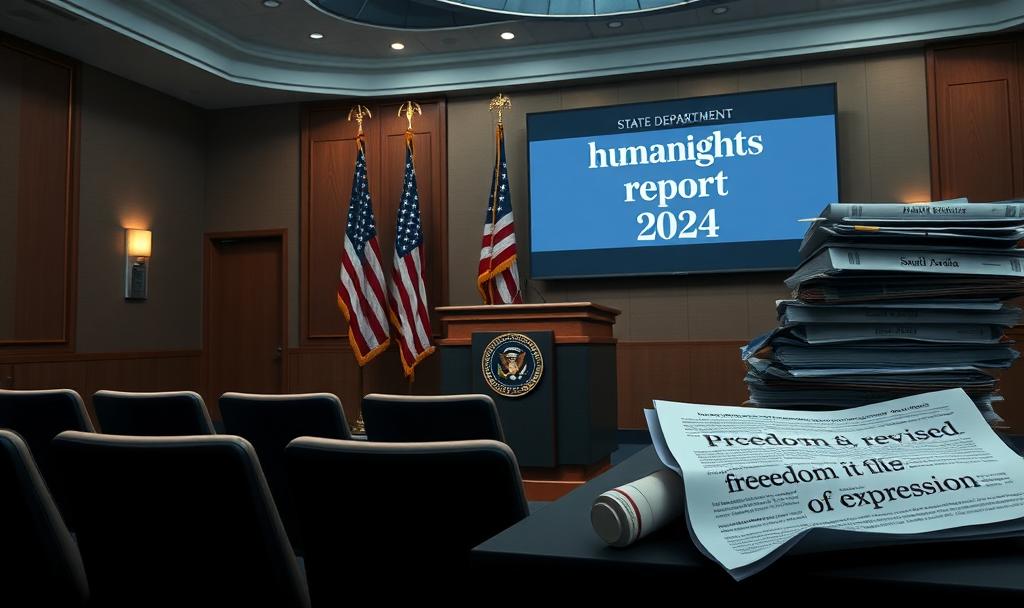
In a stunning shift under the Trump administration, and with figures like Senator Marco Rubio—once a vocal supporter of human rights reports—now backing the changes, the State Department significantly reduced the reports’ scope, limiting them to only what is legally required.
That means omitting vital sections on freedom of speech, peaceful assembly, political imprisonment, corruption, and violence against minorities and marginalized communities. The new guidelines demand that reports align with Trump-era executive orders and political messaging.
Entire sections were scrapped—such as those covering government intrusion into personal privacy, gender-based violence, internet freedom, unethical medical and psychological practices, and discrimination based on gender identity, sexual orientation, or health status.
Women’s rights sections were drastically narrowed to reproductive issues alone, in alignment with the administration’s “pro-life” stance. Trump’s broader domestic agenda to dismantle DEI (Diversity, Equity, and Inclusion) programs was mirrored in the removal of references to transgender rights, replaced by a binary understanding of gender.
The reports also began favoring certain regimes. A “political appointee” would now review reports on at least 20 countries—ranging from Hungary and Egypt to the UK and Canada—with the authority to redact or amend content. Notably, Hungary’s government corruption section was removed, even though its prime minister, Viktor Orbán, has been labeled authoritarian by previous U.S. officials and hailed as “a great leader” by Trump.
The changes preserve coverage of religious freedoms, child marriage, and antisemitism—key drivers of U.S. policy toward Muslim-majority countries. References to war crimes or genocide remain legally mandated, but their framing is now heavily politicized, shielding close allies like Israel from direct accountability.
Even the content that remains is diluted—often with a single illustrative case per violation—undermining the reports’ credibility and their use in legal or advocacy efforts.
The DRL bureau was ordered to lay off about 60 contractors who contributed to report preparation. A version of the 2024 report, initially ready for release in January, was shelved for redrafting, with publication postponed until May or beyond.
American Democracy on Life Support
The administration claimed it was simply streamlining reports to focus on “what matters.” But critics see a deliberate attempt to align foreign policy documentation with Trump’s domestic rollback of civil rights and democratic norms.
The real concern lies in the synchronicity between the gutted HRRs and Trump’s aggressive dismantling of human rights infrastructure at home. In his first month back in office, Trump shuttered 132 offices, including the Bureau of Democracy, Human Rights, and Labor’s community security division, and dismissed 15% of personnel working on democracy, gender equality, and racial justice.
This internal crackdown parallels external revisions. Sections on freedom of assembly and speech have been minimized abroad—mirroring escalating restrictions on Palestinian solidarity activism on U.S. campuses, such as Columbia University.
Political opponents are being prosecuted without due process, raising fears about the erosion of civil liberties. Participation, transparency, and election integrity—cornerstones of the reports—are now conspicuously absent. This aligns with Trump’s own record of stoking distrust in elections and suppressing dissent.
The narrowed focus also reflects Trump’s hostile immigration agenda. Asylum seekers often rely on these reports to substantiate claims of political persecution. By removing sections on political rights, discrimination, and prison conditions, the administration undermines their ability to seek refuge.
For example, El Salvador—a recent recipient of deported U.S. immigrants—no longer features a detailed section on prison conditions. This omission allows the U.S. to skirt legal bans on repatriating individuals to countries where they risk torture or abuse.
Consequently, the reports now exclude unlawful deportations, the dismantling of asylum protections, and the broader anti-immigration drive—especially toward Muslim-majority nations, which again face travel bans as part of Trump’s revived agenda.
Trump’s stated desire to seek a third presidential term, his son’s suggestion of dynastic succession, and efforts to erode electoral oversight provoke deep fears—not least because the current reports omit concerns about electoral freedom in other countries.
Let us not forget the January 6 Capitol insurrection. Trump’s rhetoric around “blood in the streets” if he loses again shows how far he’s willing to go. These events, far from discrediting him, are instead mirrored in the systemic erasure of rights-related terminology from official documentation.
The Colonial Mask Comes Off
During Trump’s first term, HRRs already reflected a sharp departure from global human rights norms. National interests—particularly in the Middle East—took precedence over democratic values.
Even after the murder of journalist Jamal Khashoggi, the report on Saudi Arabia was heavily redacted. Egypt’s 2017 NGO crackdown was glossed over. Human rights were sidelined in favor of advancing the Abraham Accords and arms deals with Crown Prince Mohammed bin Salman.
Peaceful assembly and press freedom were rebranded as “counterterrorism measures.” Jailing dissidents became an issue of “judicial process,” not persecution. Meanwhile, the rights of Coptic Christians in Egypt were amplified to paint a picture of religious tolerance.
More strikingly, recent changes go beyond realpolitik—they betray a supremacist worldview common among far-right ideologues. Populations in the Global South are not seen as equals entitled to dignity and freedom, but as pawns in America’s strategic chessboard.
Thus, leaders like Abdel Fattah el-Sisi, Mohammed bin Salman, and Mohammed bin Zayed are granted carte blanche to oppress their people—as long as U.S. and Israeli interests are protected. “America First,” the MAGA rallying cry, now governs human rights too.
Rights groups have voiced alarm. Paul O’Brien, Executive Director of Amnesty International USA, declared that the Trump administration’s decision “effectively abandons the United States’ role in documenting human rights abuses and advocating for accountability.”
Even the terminology used in the HRRs has changed. “Freedom of political participation” is now “personal security.” “Freedom of expression, including the press,” is just “press freedom”—excluding digital spaces, despite their centrality to contemporary resistance.
The Trump administration’s overhaul of the State Department’s human rights reports signals more than a policy shift—it marks a deeper ideological reorientation. No longer even pretending to universal standards, the U.S. has weaponized human rights selectively, punishing enemies while shielding friends.
The result is a weakened global framework for justice and accountability. Worse, it sets a chilling precedent: any administration can now redefine rights to suit its political ends.
In this new chapter, human rights have become both a tool of suppression and a casualty of power.