















Following the U.S. invasion of Iraq in 2003, Iran found a prime opportunity to expand its influence in a nascent Iraqi state that had, until recently, been its arch-enemy and with which it had fought an eight-year war.
Iran exploited Washington’s need to consolidate its occupation by helping suppress the resistance that had erupted—largely from Sunni Arabs—immediately after the invasion. Tehran offered its loyal Shia political parties as viable actors to manage the new state. But beneath this veneer, Iran was intent on building a failed state incapable of serving its people, while ensuring that the Shia parties leading the state would have no issue with the American occupation, so long as their grip on power remained secure.
Events unfolded as Tehran had planned. Iranian cooperation with the U.S. oscillated between covert and overt forms, aimed at eliminating resistance and shaping the new Iraqi state in line with both Iranian and American interests.
At the same time, Iran had to navigate the demands of Iraq’s so-called “new democratic system,” which necessitated political representation for all components of Iraqi society. However, Tehran systematically worked to diminish Sunni Arab political representation, fragment Sunni political blocs, and sideline Sunni appointments to political and security posts through a deeply sectarian system of power-sharing.
Demonizing the Real Iraqi Resistance
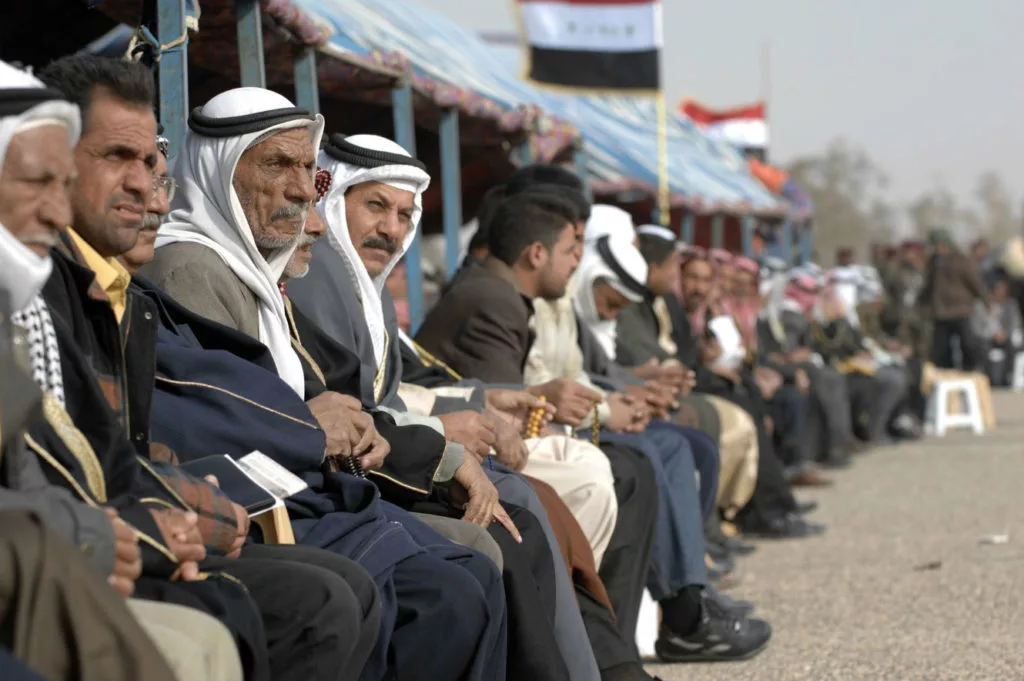
Early in its effort to marginalize the Sunni community—traditionally most opposed to the post-invasion changes—Iran sought to delegitimize and combat the genuine Iraqi resistance. This resistance was rooted primarily in Sunni Arab regions, driven by deep national and religious convictions that prohibited collaboration with any occupying force, regardless of origin.
In contrast, Kurdish and Shia regions saw the former regime as repressive to their national aspirations (Kurds) and religious identity (Shia). These sentiments were actively nurtured by the Americans and Iranians, respectively.
Iran deployed its allied Shia militias to aid U.S. military operations against the resistance—either by infiltrating the nascent security services or directly targeting resistance fighters with assassinations and bombings, particularly in Sunni areas.
More dangerously, Iran supported extremist groups like al-Qaeda in Iraq to commit atrocities against Shia, Sunnis, and other Iraqis, thereby discrediting the resistance and breaking its popular support. These groups antagonized all sects in Iraq, and Iran used this to brand all Sunni Arabs as extremists, further isolating them.
Additionally, al-Qaeda worked to prevent Sunnis from joining Iraq’s new civil and security institutions. This opened the door for Shia political dominance—an outcome Iran actively encouraged. Iraqi resistance factions later found Iranian weapons and cash in al-Qaeda hideouts, and multiple media reports confirmed the presence of al-Qaeda leaders and their families inside Iran, under government protection.
The same strategy was used with ISIS, whose emergence devastated the Sunni community and rendered it Iraq’s weakest link. Iran and its proxies bogged down Sunni resistance in side battles with al-Qaeda and later ISIS, distracting them from fighting the U.S. occupation or the sectarian regime. Many resistance fighters were forced to abandon anti-U.S. efforts and turn their attention to combating these extremist groups.
The U.S. also looked the other way as Sunni tribes battled al-Qaeda from 2007 to 2009 in what became known as the “Awakening Councils.” Though these groups successfully curbed al-Qaeda’s expansion, they lost significant popular support for allegedly abandoning resistance to the U.S. occupation.
Once al-Qaeda was defeated, the sectarian Iraqi regime moved to dismantle the Awakening Councils, with U.S. complicity, leaving these groups politically and militarily stranded. Their contribution was never acknowledged, and they were excluded from the post-conflict political order, unlike the Shia militias that gained formal recognition and power.
Fragmenting and Weakening Sunni Political Blocs
When most Sunni Arabs initially boycotted the political process, viewing it as a product of the occupation, some Sunni politicians opted for pragmatic participation to secure their community’s rights. This led to the formation of the Iraqi Accord Front in 2005, which included the Iraqi Islamic Party, the Iraqi People’s Conference, and the Iraqi National Dialogue Council. It won 44 parliamentary seats, despite accusing the elections of fraud.
Though numerically limited, the bloc exerted real political influence, which deeply unsettled Iran-backed Shia parties. Tehran worked to dismantle the coalition by politically targeting and even assassinating key figures like Iyad al-Azi and Harith al-Obaidi.
Internal disputes also fractured the bloc. One major rupture came over the speaker’s post after Mahmoud al-Mashhadani resigned. Shia factions exploited this divide by accusing Sunni ministers of corruption or terrorism, leading to the bloc’s eventual collapse.
Its failure to protect Sunni regions from raids, arrests, and killings severely eroded its base, particularly the Islamic Party, which saw its parliamentary representation plummet in subsequent elections.
In 2010, all Sunni factions joined the “Iraqiyya List,” led by secular Shiite Iyad Allawi. Though technically non-sectarian, it became a de facto Sunni electoral front. Despite winning the most seats, it was prevented from forming a government due to a court ruling that defined the largest parliamentary bloc—not the electoral winner—as entitled to do so. This enabled Shia parties to unite behind Nouri al-Maliki for a second term, despite his bloc’s electoral loss.
In the following years, Sunni political blocs fragmented across provinces. Iran persistently worked to prevent Sunni unity, favoring internal rivalries that fractured their decision-making.
Today, two major blocs dominate: “Taqaddum,” led by ousted Parliament Speaker Mohammed al-Halbousi, and “Azm,” now led by Muthanna al-Samarrai. The two formed a new alliance, “Sovereignty Coalition,” headed by Khamis al-Khanjar. But whether it will last remains uncertain, given their previous failed alliance.
Marginalization in Political and Security Posts
Post-Saddam Iraq saw the U.S. dismantle all state institutions and rebuild them from scratch. Sunni Arab boycotts of this process—encouraged by al-Qaeda and some Sunni political voices—allowed Shia and Kurdish parties to dominate state institutions, with only token Sunni involvement.
The U.S. viewed Sunni dominance in Iraq as anachronistic. Civil administrator Paul Bremer famously stated that “liberating Iraq” ended 1,000 years of Sunni rule. In the first U.S.-established political body, the Governing Council, Sunnis received only 20% representation—a ratio that has since been institutionalized across government.
In Iraq’s first constitutional elections in 2005, Sunni representation was second to Shia, but their parliamentary seat count was undervalued compared to Shia provinces. Kurdish provinces, meanwhile, were overrepresented.
The Shia-Kurdish alliance ensured that the prime ministership went to Shia, the presidency to Kurds, and the speaker’s post to Sunnis. Sunnis were given the Defense Ministry, while the Shia held the Interior Ministry. But even this limited role was deemed a threat by Iran, which sought to weaken the Defense Ministry by denying it resources and forming parallel security bodies under the Prime Minister’s Office—such as the Counterterrorism Service, National Security Agency, and Intelligence Service.
In 2014, the Popular Mobilization Forces (PMF)—composed largely of pro-Iran militias—was formalized under the Prime Minister’s command, receiving substantial military and ideological support, with tacit U.S. approval.
Successive governments refused to equip the army with advanced weaponry, citing various concerns. Kurdish factions feared a re-empowered army might one day attack them. The army became riddled with corruption, including “ghost soldiers” drawing state salaries without serving.
Shia factions effectively vetoed any real effort to strengthen the military, fearing a revived national army could challenge their power. Iraq’s official army now shares its mandate with politicized security forces like the PMF and Kurdish Peshmerga, many of which maintain ties with Tehran.
Even more concerning is the rise of “loyalist factions”—armed groups that report directly to Iran, bypassing the Iraqi state altogether, and operate both inside and outside the country.
Marginalizing the Presidency and Parliament
Despite its largely ceremonial nature, the presidency—traditionally held by Kurds—was further weakened by Iran and its allies. Sunni vice presidents also lost all meaningful authority. The aim was to concentrate real power in the hands of the Shia prime minister.
When a strong Sunni like Tariq al-Hashimi held the vice presidency and publicly opposed Shia policies, he was politically and judicially targeted with terrorism charges. He fled the country and has remained in exile ever since.
Kurds continue to vie for the presidency to safeguard the constitution that guarantees their political gains. The post also carries financial perks that benefit the ruling Kurdish parties. Iran has used this Kurdish stake to extract concessions, such as pressuring presidents to sign execution orders against Sunni resistance members or political prisoners convicted under torture.
Parliamentary Marginalization
Iran has used the same playbook in the Parliament. Although the speaker is a Sunni, Tehran has ensured he is either weak or allied with its agenda. Shia and Kurdish deputies fill key roles in the speaker’s office, consolidating control.
The judiciary, particularly the Federal Court—dominated by Iran-backed factions—has repeatedly intervened to diminish Parliament’s power, such as by redefining “largest bloc” to favor al-Maliki in 2010 or removing Speaker al-Halbousi in 2023.
Parliament also served Iran’s interests when it passed the PMF Law in 2016 under Speaker Salim al-Jubouri, whom Iran then sidelined to prevent his return.
Today, the Parliament is at its weakest, with Speaker Mahmoud al-Mashhadani seen as pliant and pro-Iran. He succeeded Shia deputy Mohsen al-Mandalawi, who held the post after Halbousi’s removal.
Undermining Sunni Religious Institutions
The Sunni and Shia religious endowments (awqaf) replaced the pre-2003 Ministry of Endowments. The Sunni Waqf oversees all Sunni mosques and properties outside Kurdistan, managing vast real estate and financial assets.
Iran-backed factions have ensured that the Sunni Waqf is led by weak figures who align with their vision, allowing Iran to seize Sunni properties and even convert Sunni mosques into Shia husseiniyas. More alarmingly, they’ve sought to reshape Sunni religious identity to mirror Shia beliefs—echoing the Safavid-era Shiification of Iran.
Iran engineered multiple leadership changes at the Sunni Waqf, often under the pretext of corruption. Sunni fears have mounted as Iran-backed groups demolished or neglected historical mosques and shrines—like that of al-Zubayr ibn al-Awwam—and installed clerics with heterodox beliefs, further dividing the community.
Government budgets overwhelmingly favor the Shia Waqf, deepening the marginalization of Sunni institutions.
Marginalizing Sunni Provincial Councils
Marginalization has extended to Sunni-majority provinces. In Diyala, where Sunnis formed the majority, the governorship remained Sunni until 2015, when Iran-backed Badr Organization leader Hadi al-Amiri intervened to install Shia leadership.
In Nineveh, Iran aligned with Sunni figures and Kurdish parties to ensure any governor assumed office with Shia and Kurdish—and therefore Iranian—approval. Similar dynamics unfolded in Salah al-Din and Anbar, where service projects were only implemented through Gulf-funded initiatives, while Shia provinces enjoyed robust state support.
Iran’s role in marginalizing Iraq’s Sunni population is part of a broader strategy, not merely revenge for the 1980s war. Tehran envisions Iraq as part of its historical Persian domain—with the capital of its ancient empire, Ctesiphon, located in Iraq. Through sectarian leverage, Iran seeks to turn Iraq into a launchpad for regional expansion into the Arab world.


