
It is no secret that the United States plays a pivotal role in militarizing the Israeli state. Since its founding in 1948, Israel has consistently topped the list of recipients of U.S. aid. By March 2023, total U.S. assistance had reached $158 billion, of which $114.4 billion was military aid, while $34.3 billion was economic aid—including $9.9 billion specifically allocated to missile defense systems.
The genocidal war on Gaza, launched on October 7, 2023, has dramatically escalated Israel’s militarization, positioning the United States not merely as a secondary supporter or peace broker, but as a direct partner in the war on Palestinian existence.
While many believe that both the Democratic and Republican parties operate under the influence of the pro-Israel lobby—prompting them to offer unconditional military support to Israel—others argue that this bipartisan consensus stems primarily from core U.S. national interests.
So how has the militarization of Israel evolved under different U.S. administrations? Have Democratic and Republican governments differed significantly in arming Israel? What are the key instruments of Israeli militarization? And how has U.S. support helped Israel maintain military superiority globally?
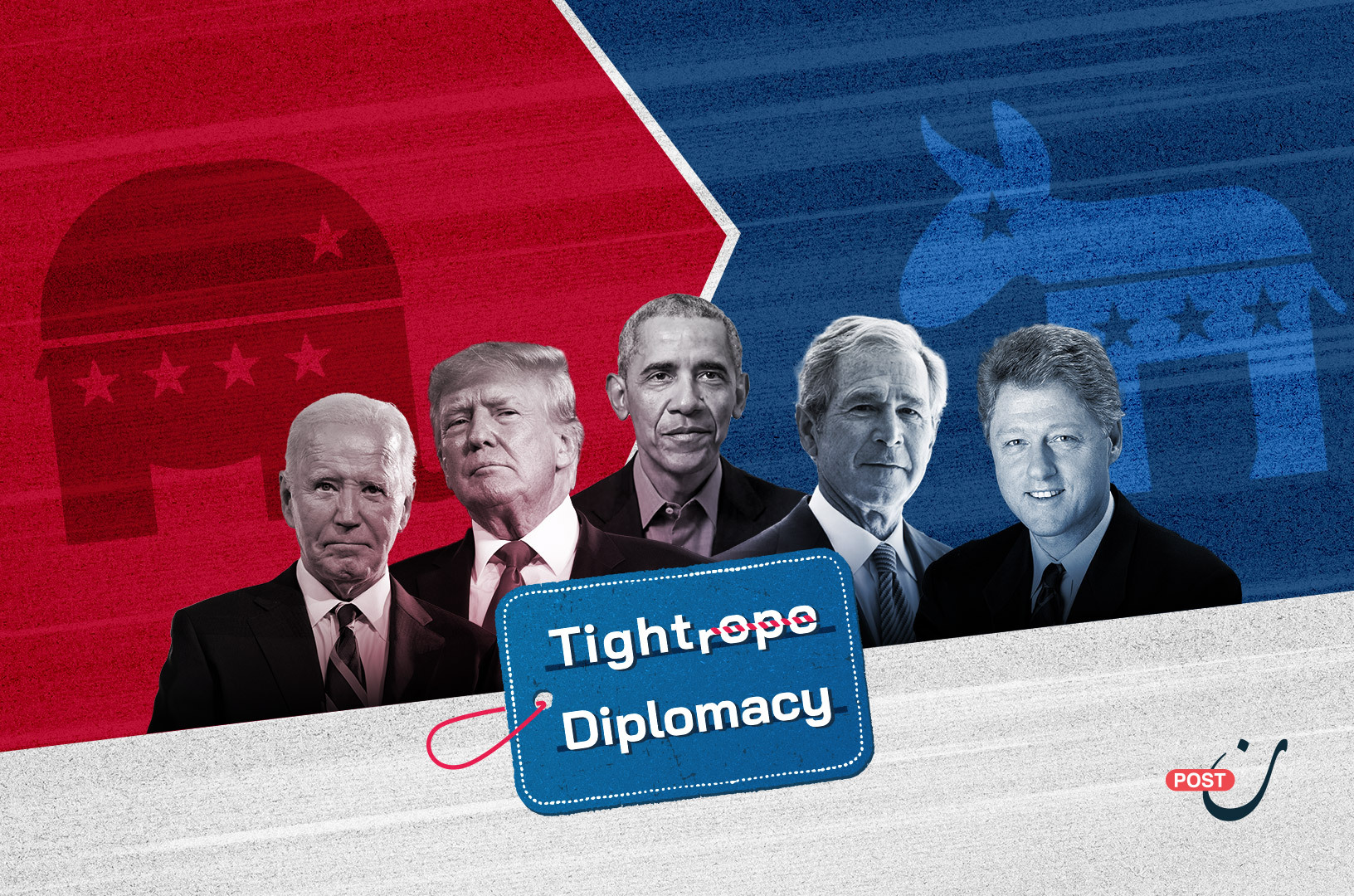
These questions are at the heart of this article, part of the “Diplomacy of the Twin Ropes” series, which examines the contrasting approaches of U.S. administrations—Democratic and Republican—to the Palestinian issue and its most pressing dimensions.
Clinton: Arming in Peace and War
President Bill Clinton aimed to preserve what military strategists call Israel’s “Qualitative Military Edge” (QME)—a strategic advantage that ensures Israel maintains superiority over its regional adversaries. QME requires not just advanced weaponry, but also superior intelligence, communication, and technological capabilities.
While this doctrine didn’t originate with Clinton—it began after the 1973 war—it reached new heights during the technological revolution of the 1990s. Clinton upheld a long-standing tradition of unwavering U.S. military support for Israel. One of his most consequential moves came at the end of his presidency with the establishment of the Military Memorandum of Understanding (MOU)—a 10-year military aid agreement renewable under new terms.
Since 1999, three such MOUs have been signed (under Clinton, Bush Jr., and Obama), increasing in both size and scope. Clinton circumvented Congress by classifying these MOUs as executive agreements rather than international treaties, thus bypassing Senate approval. While technically non-binding on Congress, they have been honored without exception.
Clinton’s first MOU (1999–2008) was valued at $26.7 billion, including $21.3 billion in military aid. Known as the “Glide Path Agreement,” it marked a turning point—military aid began to replace economic aid, which was phased out completely by 2007.
Although Clinton’s term delivered the lowest annual average of military aid to Israel—around $1.8 billion—it laid the groundwork for future military superiority. This occurred at a time of relative calm due to the Oslo Accords, which reduced perceived threats to Israel.
Clinton also introduced a funding category that would shape future military budgets: “counterterrorism.” In 1996, he approved an additional $200 million under this banner, framing Israel as under threat from its Palestinian, Arab, and Muslim surroundings.
This framework thrived under Bush Jr., amid the Second Intifada and the post-9/11 “War on Terror.” In 2003, Bush approved a $9 billion military loan and a $1 billion grant to Israel as part of broader regional operations.
Clinton expertly played both sides. While arming Israel, he also supported Palestinian state-building under the guise of the Oslo peace process. In 1998, he pledged $400 million to the Palestinian Authority under the Wye River Agreement, which also granted Israel $1.2 billion to bolster its own counterterrorism efforts.
Israel also enjoys NATO-like privileges in U.S. arms deals, including expedited congressional review (15 days instead of 30) and higher financial thresholds. These preferential terms originated with the 1987 National Defense Authorization Act under Reagan and were expanded under Clinton in 1996.
George W. Bush: Guaranteeing Israel’s Regional Superiority
Under George W. Bush, the U.S. and Israel signed the second 10-year MOU (2007–2018), valued at $30 billion.
Bush continued the tradition established by his father—ensuring Israel’s military superiority even as the U.S. sold arms to Arab states. For example, when the U.S. sold F-15 fighter jets to Saudi Arabia in 1992, it compensated Israel with Apache helicopters and pre-deployed U.S. defense systems.
In 2007, after a JDAM munitions deal with Saudi Arabia, Bush’s administration announced even more advanced munitions for Israel. That same year, Congress passed the U.S.-Israel Strategic Partnership Act, requiring the U.S. to ensure Israel’s ability to counter any American-supplied weapons to other Middle Eastern states.
Obama’s administration mirrored this practice: the 2010 F-15 sale to Saudi Arabia was matched by a 20-jet F-35 deal for Israel; a 2013 UAE F-16 deal was offset by refueling tankers and advanced radar missiles for Israel.
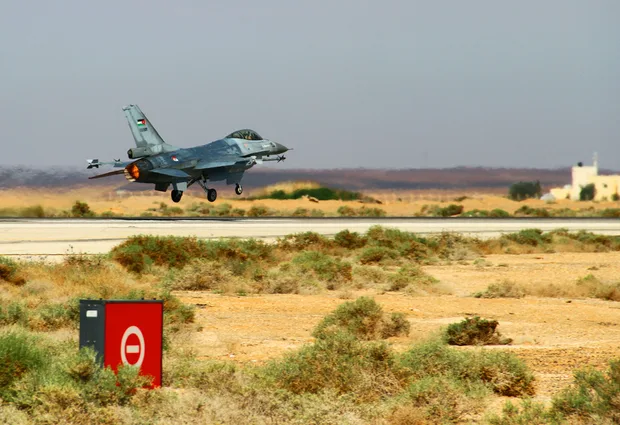
Israel became the world’s first operator of the F-35 stealth fighter, which enabled it to strike long-distance targets without refueling—reaching Syria and even Iran. Though three F-35 deals have secured 50 aircraft, only 39 have been delivered, with the remainder due before the current contract ends. The Bush-era Pentagon proposed selling 70 units in a potential $15.2 billion deal.
Bush also launched joint training programs, notably Juniper Cobra, a biennial missile defense drill between U.S. and Israeli forces, and initiated the David’s Sling missile program targeting medium-range threats from Syria, Iraq, and Lebanon.
Obama: Architect of Missile Defense
The Obama administration oversaw the largest foreign aid package to Israel in U.S. history: the third 10-year MOU (2019–2028), valued at $38 billion, including $33 billion in military aid and $5 billion for missile defense.
This support extended beyond weapons to legal and logistical frameworks enhancing U.S.-Israeli defense collaboration. A key example is the Foreign Military Financing (FMF) procurement program, which allowed Israeli defense companies to operate as local entities in the U.S.
Under Obama, the MOU mandated that these Israeli firms be incorporated as American companies and required detailed spending reports on U.S. military grants.
While missile defense programs like Iron Dome and David’s Sling began under Bush, Obama institutionalized U.S. funding for Iron Dome starting in 2011. In 2014, his administration enabled joint production and operations of Iron Dome systems and provided $225 million during Israel’s war on Gaza.
Obama’s MOU was unique in allocating $500 million annually for missile defense—specifically Iron Dome and David’s Sling—responding to Hamas’ evolving rocket capabilities. In 2022, after the Battle of “Operation Guardian of the Walls,” Congress increased this amount to $1 billion.
Trump: The Golden Age of Arms Trade
U.S. support has propelled Israeli defense firms to global prominence. Companies like Israel Aerospace Industries, Rafael, and Elbit Systems now rank among the world’s top arms exporters, particularly to India, Azerbaijan, and Vietnam.
Israel even became a supplier to the U.S. military, exporting $1.5 billion in equipment in 2019 alone.
During Trump’s presidency, arms trade between Israel and U.S. firms boomed. Notable deals included:
-
$440 million with Leonardo DRS (2017)
-
$238 million with MTU America (2018)
-
$2.4 billion with Boeing (2020)
-
$3.4 billion with Lockheed Martin (2021)
Trump also expanded the David’s Sling program in the U.S., with Washington investing $2.4 billion in it, compared to $3 billion for Iron Dome and over $4.5 billion for the Arrow missile system.
Annual U.S. spending on the Arrow system skyrocketed under Trump—from under $100 million under Clinton, to $272 million in 2017, peaking at $392 million in 2018, before dipping slightly under Biden.
Trump also supported a counter-tunnel program—initiated under Obama—to detect and neutralize underground threats, contributing $320 million between 2016 and 2023.
Both Trump and Biden funded a drone defense system, with Biden outspending Trump: $75 million to his $13 million between 2020 and 2023.
Biden: A War for Israel’s Survival
U.S. military aid to Israel now includes grants, foreign military loans, and direct sales. Israel is among the top recipients of U.S. military loans and ranks globally in defense spending—5.17% of its GDP.
Military loans began in 1973, with Congress approving $2.2 billion. President Gerald Ford later converted these into non-repayable grants by deducting them from future aid packages.
In 2023, Congress approved $3.3 billion in new military loans and at least $3.8 billion in annual grants under Biden’s administration.
Since the Gaza war erupted on October 7, 2023, Biden has committed a record $17.9 billion in military aid to Israel in just one year. A Brown University study notes this is the highest single-year total ever.
Beyond aid to Israel itself, Biden’s administration spent $4.86 billion on operations targeting groups like Hezbollah, the Houthis, and Iranian forces in Syria and Iraq—further securing Israel’s interests.
One of Biden’s final acts was approving a $20 billion arms package to Israel in August 2024, including F-15 fighter jets.
U.S. military stockpiles in the Middle East—kept there since the 1980s—were opened to Israel. Washington also deployed the THAAD missile defense system to shield Israel from potential Iranian retaliation.
Cybersecurity aid also increased, with $6 million annually (2022–2026) allocated to enhance Israel’s cyber capabilities.
In April 2025, Biden approved a $94 billion foreign aid bill, allocating funds to Israel, Ukraine, and Taiwan. He even bypassed Congress in December 2024 to fast-track two emergency arms deals for Israel worth $106 million and $147.5 million, respectively.
Despite public pledges to tie arms sales to international law and minimize civilian casualties—especially after allegations of Israel using U.S.-made white phosphorus and unguided “dumb bombs”—military support has continued unimpeded.
A Divided Electorate, A Unified Establishment
As the 2024 election looms, Democratic voters are increasingly calling for restrictions on military aid. At the August Democratic National Convention, uncommitted delegates demanded that Vice President Kamala Harris pledge to halt aid unless Israel ends its war on Gaza.
While some Democratic representatives favor conditional aid, Harris has pledged to continue supplying Israel with whatever it needs to “defend itself.”
According to a Reuters/Ipsos poll, the U.S. public is split: 47% say a candidate’s support for arming Israel makes them more likely to vote for them, while 48% say the opposite. Partisan lines are clear—62% of Republicans favor military aid, compared to 56% of Democrats and 51% of independents who are more cautious.
Among policymakers, however, consensus reigns. Regardless of party, every administration—Democratic or Republican—has increased the scope and sophistication of military support to Israel. The partisan divide ends where strategic partnership begins.