





At the entrance of every refugee camp in the diaspora stands a map of Palestine. These maps, in varying sizes, are scattered across the narrow alleys and winding passages of the camps.
Inside the homes, a rich heritage lives on in the physical space and collective memory: embroidered garments, dishes that share a name but differ in preparation, and deep-rooted social connections among families.
Then there is the ever-striking answer to the question, “Where are you from?”—always the name of the ancestral village from which the first generation was displaced during the Nakba.
This indelible identity reflects a profound aspect of the events of 1948, one rooted in psychological, emotional, cultural, and social impact rather than purely political or legal definitions.
While the term “Nakba” offers a unified national narrative capable of reclaiming political and historical rights, everyday language often opts for more emotive and colloquial expressions: “displacement,” “expulsion,” “loss of homeland,” and others.
From this lived identity—one that presents the Palestinian catastrophe as a cultural, social, and human dispossession—emerges a narrative carried through oral traditions, visual symbols, and the daily practices of the diaspora’s generations.
This memory stretches from the lost geography of villages and towns to their vibrant presence in songs, names, and embroidery motifs, forming a cultural and human resistance to forgetting.
It is a process of constantly reproducing the homeland through its people’s language, attire, and stories.
Villages Carried on Shoulders and in Memory
In her book The Absent Ones: Women and Palestinian Cities until 1948, researcher Manar Hassan highlights the emphasis on villages and rural memory at the expense of cities in the Palestinian exile narrative.
She describes how collective memory has been shaped predominantly by a rural consciousness that transcends Palestinian communities worldwide—an orientation that also influenced intellectuals and scholars.
This focus is warranted, given the symbolic power villages hold in Palestinian oral geography. These places often stand equal to, or even surpass, cities in significance, serving as sources of poetry, harvest songs, wedding chants, and even resistance hymns. Their symbolic weight is heightened by the massacres, burnings, and destruction they endured.
Reviving and commemorating these villages is thus a step toward reclaiming them. Yarmouk Camp in Syria exemplifies this phenomenon—a two-square-kilometer space housing refugees from over 300 villages across the Galilee and Palestinian coast, along with nearly 16 central cities.
First, the camp’s diverse origins make it a living archive of Palestine in exile. Second, its residents have played a vital role in every phase of Palestinian national struggle, preserving traditions from their original villages and towns.
Streets, shops, sports clubs, and cultural centers carry names like Lubya Street, Safad Street, Al-Ja’una Street, the KhaLsa Theater, Tabgha and Jenin libraries, and the Karmel and Talhoum teams.
Third, the camp’s demographic layout mirrors the geographical order of Palestine. Families from specific villages congregate in distinct areas—residents of al-Tira from Haifa gather in the camp’s southern quarter, those from Saffuriyya in the center, and people from Balad al-Sheikh in the adjacent Tadamon neighborhood. Such clustering has preserved traditions and facilitated intergenerational transmission.
This pattern is repeated across diaspora camps, where walls bear slogans like “Palestine, the Eternal Wound,” “Revolution Until Victory,” and “Palestine, My Homeland.” Names of children also carry symbolic weight: Yafa, Bisan, Quds, Haifa, Jenin, or more abstract expressions like Areej (fragrance), Intisar (victory), Thawra (revolution), and Haneen (longing).
Scholar Long Yaling interprets this social behavior as a collective affirmation of Palestinians’ ties to their land and the legitimacy of their belonging. He argues that such shared experiences go beyond the personal to become mechanisms for cementing group identity, where “a community of memory reinforces its identity by recalling the past.”
For Yaling, the individual memory of a refugee cannot be separated from collective memory, no matter how personal. Both are essential in shaping identity. This confluence is what forms the independent Palestinian identity—a narrative centered on the Nakba, serving as the nation’s foundational myth that answers “Who are we?”, “Where did we come from?”, and “Where are we going?” Songs, chants, and inherited tales provide a powerful response.
Inherited Memory Through Stories and Chants
According to Palestinian historian Nur Masalha, storytellers and their oral narratives were the first to preserve cultural memory after the Nakba, especially in a context marked by grief, silence, and a hostile environment. These stories were soon followed by popular chants and written poetry.
Oral history became a cornerstone of Palestinian identity and a means of preserving the details of the Nakba—not shaped by intellectuals but by mothers, grandmothers, elders, and shepherds. They passed down first-hand accounts of displacement, embedding memory into popular folklore.
Through Palestinian oral history, the memory of place has been preserved: homes, threshing floors, clay houses, roads, and the paths of flight—where they fled first, where families reunited, and where they dispersed. These recollections are especially resonant today amidst the genocide in Gaza, validating memory through the lived reality of renewed displacement and violence.
Less commonly discussed but equally vital are forms like zajal, hadaaya, and tarweedat—oral poetic traditions that evolved in the 1950s as vehicles for lamenting the enemy, celebrating the lost village, and chronicling exile.
These forms appeared in social gatherings, striking a balance between not celebrating amid grief and not surrendering to despair. They even featured in mourning rituals.
Such performances highlighted a unique Palestinian voice that echoed across Arab identities, reviving the joy of harvest and wedding songs in melodies like mi’jana and ‘ataaba, which communities sang together:
My steed gallops when war erupts / darkness unfolds / Where are the eyes to see the fire / that blazes from the muzzle of a gun?
These traditions emerged alongside a renaissance in Palestinian political poetry in the 1960s, with poets in occupied Palestine leading the charge. They reframed the Nakba as a pan-Arab cause, going beyond individual nostalgia to document stories of displacement, resistance, and the land itself.
Through such tools, Palestinian refugees created an alternative map—one built not on photos or documents, but on collective yearning that intensified during moments of cultural or political resistance.
This evolution of nationalist poetry paved the way for resistance songs. As writer Badr Al-‘Uqbani notes, the post-1967 shift from martyrdom to armed resistance galvanized composers and poets to create lyrics rooted in nationalist and pan-Arab ideals.
These songs incorporated terms like bullets, fire, and tanks, especially after the launch of Voice of the Storm radio in Amman in 1968.
Thus, even refugees who had never set foot in Palestine could recount their village’s layout, its families, springs, fruits, and alleys—passing this knowledge on to the next generation as a heritage to be safeguarded, regardless of the challenges of return.
In this way, the Nakba evolved from a collective trauma to a social and emotional inheritance, with memory preserved not merely as information, but as identity and continuity.
Embroidered Geography: The Dress as a Miniature Homeland
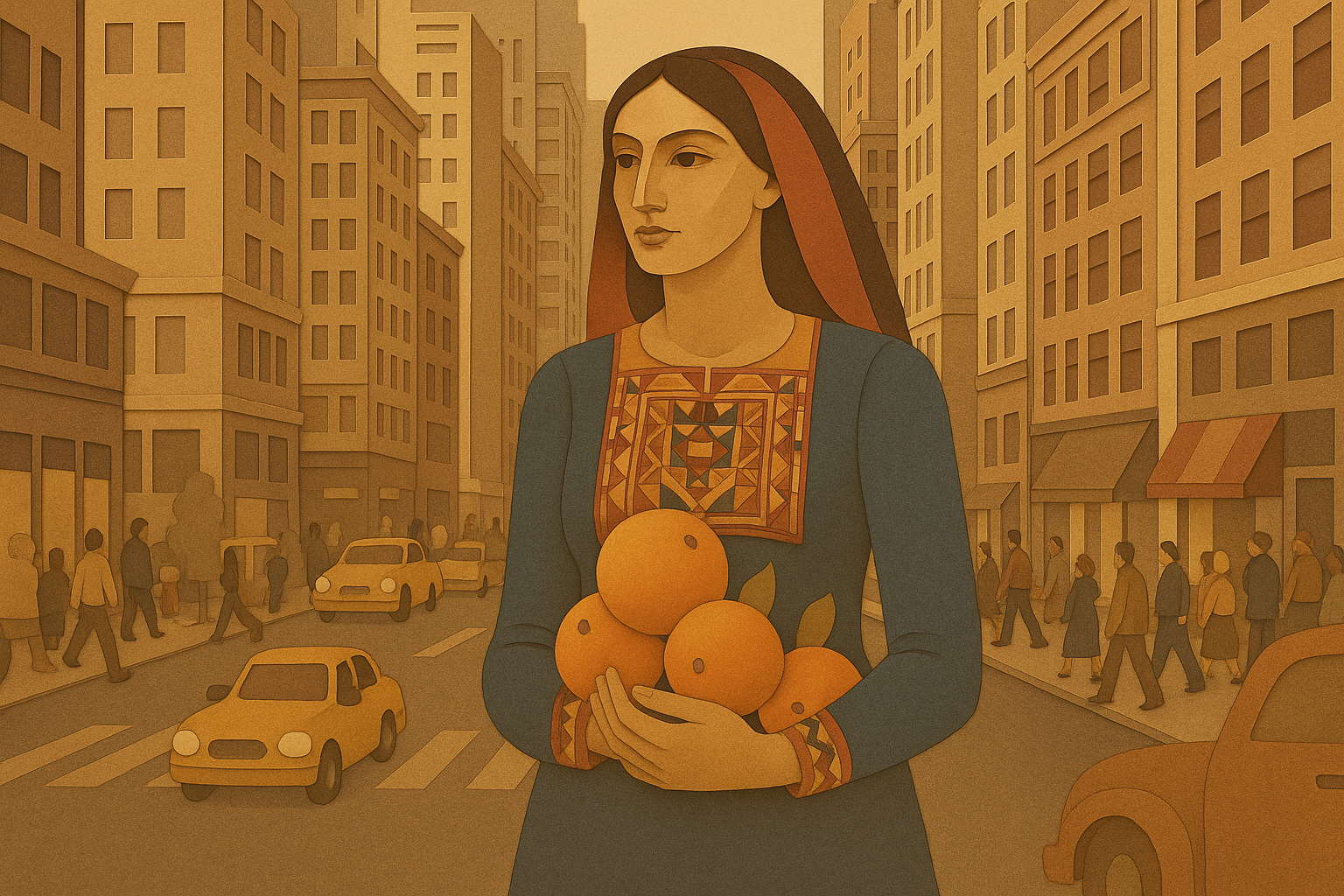
Thread and needle predate the Nakba by millennia—some date the practice to 2500–3000 BCE—but embroidery has always adapted to political, social, and economic shifts. Each village had its own motifs, symbols of love, joy, the sea, harvest, weddings, and religion. Gold and silver coins sewn into dresses reflected economic and social status.
Traditionally, Palestinian girls would begin embroidering their wedding dresses at age ten, using white, blue, black, and brown fabrics. Natural dyes were sourced from river silt and sea shells, and embroidery patterns ranged from 11 to 33 stitches, including cross-stitch (fallahi), ant stitch, Bedouin wrap, and Gaza’s sickle stitch.
Maha Saca, director of the Saca Heritage Center and known as the guardian of the Palestinian dress, has documented its legacy. She identifies the oldest known Palestinian dress as the “Jericho Dress,” dating back 10,000 years. The oldest photograph of such a dress comes from 1886 and features her ancestors.
After the Nakba, Palestinian embroidery suffered due to deteriorating social and economic conditions and Israel’s efforts to appropriate Palestinian heritage. This spurred grassroots efforts to preserve it—folk heritage parades, community centers, and educational campaigns aimed at sustaining Arab Palestinian identity.
These efforts led to the formation of associations to protect embroidery and support Palestinian families. Women began to embroider not just for loved ones, but as paid work to sustain their families.
By the 1950s and ’60s, several organizations emerged, including Family Revival Society in Ramallah, Palestinian Refugee Revival in Beirut, the Returnees Association in Syria, and the Arab Women’s Union across its branches.
The Palestine Liberation Organization also founded the SAMED Foundation, where women described their embroidery as “political and social resistance.”
The Dress as Political Expression
Despite its commodification, the Palestinian dress has remained a powerful symbol of identity. It reflects nostalgia for communal traditions—weddings, births, construction, and harvest—and embodies the blending of styles that occurred in the camps. Financial hardship led to fewer gold coins being used, making traditional dresses rarer and triggering campaigns for their revival.
The dress has also become a canvas of resistance, its traditional motifs replaced with the Palestinian flag, rifle, key, and map of the homeland. As embroidery went global—particularly after Oslo, which saw the creation of 64% of all embroidery associations—it moved from a private cultural artifact to a symbol of national pride.
This shift raised fears of losing the dress’s original meaning. Organizations like Tarazein, Family Revival, and the Palestine Museum launched initiatives to document regional styles and host exhibitions that go beyond commodification to preserve village-specific dress patterns.
The dress became a threatened memory, much like Palestine itself. Israeli efforts to appropriate it—substituting the six-pointed star with Palestinian embroidery, having ministers’ wives wear it, and displaying it as “Israeli heritage” in international exhibitions like the one Moshe Dayan’s wife organized at the White House—underscore the urgency of cultural preservation.
The dress must now be elevated beyond folklore to a political statement and soft form of resistance. Wearing it at weddings, graduations, and public events has become an act of reclaiming history and defying erasure.
This culminated in 2021 when Maha Saca compiled a 700-page book on the Palestinian dress and submitted it to UNESCO. The result: 194 countries voted to add Palestinian embroidery to the 2021 Intangible Cultural Heritage list—marking a victory for cultural resistance and a bulwark against appropriation.
In the end, this embroidered fabric preserved the scent of a mother, the taste of her cooking, the seasons of harvest stitched into its folds. It conveyed stories unspoken, histories unwritten, and continues to embody the Palestinian experience in defending cultural heritage against occupation.
It is a testament that Palestine may not always need grand institutions, but rather individuals who remain true to their compass—those who know that the path home will never be betrayed by memory, will never be missed by the rifle, and will always be cloaked in the warmth of stories and their embroidered gowns.