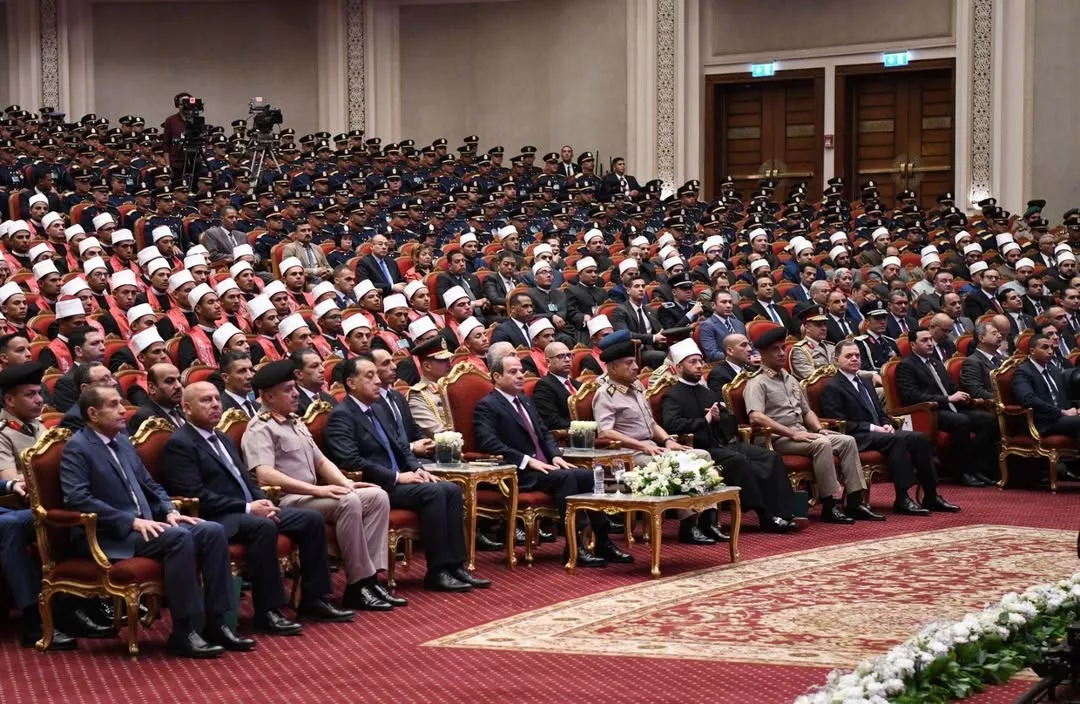
On Tuesday, April 22, the Egyptian state-owned media outlet Youm7, operated by the General Intelligence-affiliated United Media Services Company, published a headline: “President Sisi Attends Graduation Ceremony of Endowment Ministry Imams from the Military Academy.”
The report covered the graduation of the second cohort of imams, totaling 550, who underwent a six-month training program.
According to the Presidential Spokesperson, the program was conducted under the president’s directive to the Ministry of Religious Endowments (Awqaf), in coordination with relevant state institutions, including the Egyptian Military Academy.
The goal was to create an integrated training curriculum to enhance the imams’ capabilities across various dimensions, improve religious discourse, modernize communication tools, and combat extremist ideologies, all while deepening awareness and understanding of contemporary intellectual and societal challenges.
The report, its language, the video footage of the imams pledging allegiance to Sisi, and the rows of solemn clerics attentively listening to the president—along with leaked behind-the-scenes details—were all deeply unsettling to many Egyptians.
These scenes evoked haunting memories of a fascist-style totalitarian era and marked what many viewed as a dangerous regression.
This event is unprecedented in Egypt. Even under the many authoritarian regimes that have ruled the country, no leader has taken such a step. Yet, given recent trends and mounting evidence, this development seemed inevitable—a forced path toward the militarization of civilian life under a regime that sees itself as the people’s guardian.
Is this what the state truly envisions as “religious renewal”?
168 Days of Military Life
Over the course of six weeks, the 550 imams lived a life akin to military service. From early morning wake-ups to lights out at night, they were subject to the strict authority of army officers who had the power to determine whether a participant would pass or fail—and thus whether they would secure a position or not.
Their daily routines mirrored that of enlisted soldiers, with only slight differences in form. This was confirmed by the Sahih Masr page, which quoted three imams who took part in the program.
To even qualify for this mandatory training (a prerequisite for employment), candidates had to pass several evaluations conducted by the Central Agency for Organization and Administration, the Military Hospital in Kobri El-Qobba, and the Reserve Officers College in Ismailia.
These included assessments in computer skills, English language proficiency, IQ testing, and physical health screenings—such as EKGs, blood and urine analysis, and measurements of height and weight.
One key requirement was maintaining an “ideal weight.” For instance, an imam who is 180 cm tall should not weigh more than 90 kg. Exceeding 100 kg would likely disqualify the candidate from advancing, according to one participant.
Physical fitness tests were held at the Reserve Officers College and included a 1,500-meter run, push-ups, sit-ups, and zigzag sprinting. Results were documented daily by soldiers and submitted to their commanders.
The final hurdle was a formal panel interview at the Military Academy, attended by army officers and Ministry of Endowments officials. Here, the imams were judged on appearance and demeanor. Those who passed were cleared to begin the military training program.
Once admitted, the indoctrination began. A military officer briefed the new recruits on strict rules: no personal belongings, including mobile phones. The academy provided everything—uniforms, shoes, razors, and even an old-fashioned mobile phone with a new SIM card.
Imams were allowed to make only three phone calls per week at predetermined times, after which phones were confiscated and stored.
The course officially launched in November 2024. From that point on, the imams’ lives were indistinguishable from army recruits: wake up before dawn prayers, perform physical training, eat breakfast at 8 a.m., undergo a grooming inspection, and attend daily lectures.
During the first month, the imams entered a military-style boot camp with no phone access or time off. They trained in weapon handling using non-live ammunition. After completing this phase, they were granted a 10-day leave before resuming the course, followed by three-day breaks every 15 days.
The curriculum featured dozens of lectures on both religious and military topics. Religious speakers included prominent regime-aligned clerics like Grand Mufti Shawki Allam, Dar al-Ifta Secretary-General Nazir Ayyad, Minister of Endowments Osama Al-Azhari, and pro-government preacher Khaled El-Gendy, as well as former Culture Minister Abdel Wahed El-Nabawy.
Military lectures were delivered by army officers and covered the history of Egypt’s military, national security, cyber warfare, patriotism, counterterrorism, misinformation, and the laws and legacy of Egypt’s armed forces. After the lectures, an evening roll call was held, followed by lights out at 9:30 p.m.
At the program’s conclusion, participants underwent a final examination based on performance and discipline. According to one imam, a disagreement with an officer could negatively impact final scores, which were calculated using a detailed rubric.
Once passed, the imam received a certificate sent directly to the Ministry of Endowments—an essential requirement for appointment to a mosque.
One graduate said the military training made him a “Renaissance imam” in President Abdel Fattah el-Sisi’s vision. He cited newfound skills in verifying information on social media, understanding Egypt’s external threats, and adhering to state-sanctioned fatwas—provided they don’t violate sharia, he added.
Loyalty to Faith or to Power?
This entire spectacle has raised troubling questions—many of which have become flashpoints in recent years. Chief among them is the independence of religious institutions and the repeated government calls for “renewing religious discourse.”
The most pressing question: To whom did these imams pledge allegiance? To religion, as represented by institutions like Al-Azhar? Or to the state, personified by the president and his military leadership who stood at attention during the ceremony?
Even the choice of religious lecturers raised eyebrows. Shawki Allam, known for his unwavering loyalty to the regime, and Khaled El-Gendy—who proudly describes himself as the “Sheikh of the Sultan” and “the regime’s drummer”—hardly represent independent religious scholarship.
What can such figures truly offer to young imams expected to lead Egypt’s religious discourse in the coming years?
And then there is the fundamental question: Is this militarized format what the state means by religious renewal? Does pledging loyalty to the regime cleanse religious discourse of its flaws and misconceptions? Will turning clerics into quasi-soldiers save the faith from extremism?
The state appears to be ignoring the lessons of history. When religious institutions are subjugated by political power, public trust erodes. As that trust fades, people inevitably turn elsewhere for spiritual guidance—often to sources that pose far greater threats to the state’s narrative and stability. That, precisely, is the danger.
Militarizing Civilian Life: A National Strategy
This event cannot be seen in isolation from the broader strategy the Egyptian regime has adopted over recent years—namely, the full-scale militarization of civilian life.
In April 2023, the Secretary-General of the Cabinet issued a circular to all ministries, citing a presidential directive: all candidates for government positions must undergo a six-month training course at the Military Academy. Completion of this course is now a prerequisite for employment.
The policy debuted with the “30,000 Teachers” recruitment campaign, in which applicants were subjected to military-style tests that included weight and fitness assessments. Those deemed overweight were disqualified. Soon, the policy extended to engineers, doctors, diplomats—even the judiciary, which reportedly resisted the mandate.
This sweeping strategy reflects a deeply ingrained authoritarian mindset—one that sees the military as the ultimate institution capable of safeguarding both regime stability and national security. But as history shows, this path is fraught with peril. Attempts to impose military discipline on civil society are like planting time bombs beneath the surface. Sooner or later, they explode.