






British prisons have recently witnessed an open-ended hunger strike across several correctional facilities, led by activists from the now-banned Palestine Action movement. These activists, arrested throughout 2025 due to their opposition to the UK’s support for Israel and their advocacy for Palestinian rights, are at the center of a protest that lays bare Britain’s glaring contradictions on freedom and human rights.
Ongoing since November 2, the hunger strike exposes the hollowness of Britain’s rhetoric around liberties and justice. Behind these lofty claims lies a punitive system targeting any expression of solidarity with the Palestinian cause.
This double standard highlights a politically and ideologically motivated agenda to suppress dissent, especially when it challenges Israel or exposes the nature of its alliance with Western powers. As such, Britain’s official policies are now facing direct scrutiny.
The way Keir Starmer’s government has handled the strike relying heavily on legal justifications while invoking the language of national security signals a deeper transformation in Britain’s role: from a self-styled legal and moral authority to a political actor using the law and state security as tools to shield Israel’s global image while repressing domestic voices that seek to challenge that narrative or highlight its moral costs.
Details of the Strike
The hunger strike began on November 2, 2025, initiated by several Palestine Action activists detained over the preceding months some even before the UK formally outlawed the group in July. This timeline suggests that security enforcement preceded legal action, hinting at premeditated political intent.
Initially involving just eight detainees, the strike has expanded significantly and is now approaching its fiftieth day. The physical toll has been alarming, with participants experiencing dramatic weight loss and frequent blackouts. Seven activists have been hospitalized since the strike began.
Among the first to join were Caesar Zahra (20) and Amo Gibb (30), both held at Bronzefield Prison, later joined by Heba Mouraissi (31) at New Hall Prison. Others include Tuta Khoja (29), Kamran Ahmed (28), and Louis Chiaramillo (22). Several have had to suspend participation due to severe health complications, underscoring the escalating human cost of the protest.
The detainees face charges linked to the storming of RAF Brize Norton in June, while others are being prosecuted for actions against Elbit Systems facilities in 2024. Elbit is Israel’s primary arms supplier. All detainees deny the allegations.
Timing: Palestine as the Underlying Catalyst
In an op-ed published by The Guardian, imprisoned activist Amo Gibb explained his motives for undertaking the hunger strike at Bronzefield. He framed his action not as a personal protest, but as a political stance meant to hold Britain accountable both historically and in the present for its role in Palestinian suffering.
Gibb noted that the strike began on November 2, the anniversary of the Balfour Declaration, which he described as the moment Britain “planted the seeds of the genocide we are witnessing today.”
By aligning the strike with this historical marker, Gibb placed the protest within a broader critique of Britain not just as a backer of Israel’s current war on Gaza, but as a founding accomplice in the broader colonial project against Palestine.
Reflecting on his political awakening, Gibb said he first learned about the Palestinian cause in secondary school not through the curriculum, but from young Muslim female classmates. While he was initially unaware of the full historical context, images of bombed civilians left a lasting impact.
Over time, he came to understand that such scenes were not isolated incidents but part of a recurring pattern one that ultimately led to his current political position.
The Protesters’ Demands
According to statements from Gibb and other detainees, five key demands underpin the hunger strike:
-
Shut down arms factories supplying weapons to Israel.
-
Lift the ban on Palestine Action.
-
End the mistreatment of prisoners.
-
Grant immediate bail to the detainees, citing their families’ mental and emotional suffering alongside the violations they face in custody.
-
Guarantee a fair trial, including full disclosure of communications between British and Israeli officials and arms dealers concerning the activists.
Widespread Violations in Custody
Emergency physician and UCL lecturer Dr. James Smith, who has maintained direct contact with several hunger-striking activists and their families, described their condition in chilling terms to The Guardian: “Some of these detainees are dying slowly.”
Smith explained that after approximately three weeks of refusing food (the strike has now lasted more than double that time), the human body exhausts all fat reserves and begins consuming muscle and organ tissue for energy. This can result in sudden, potentially fatal, complications.
Beyond the physical toll, Palestine Action activists have reported harsh prison conditions, including restrictions on communication, movement, visits, and exercise. They say their writings and public statements are being heavily censored.
Gibb shared that he was barred from joining a prison craft group after embroidering the phrase “Free Palestine” on a pillow a move authorities labeled a “security threat.” Ironically, this incident coincided with the UK’s official recognition of the State of Palestine.
He reported losing approximately 11 kilograms and now moves extremely slowly, with dangerously low blood sugar levels and elevated ketone levels a sign of metabolic distress.
What Message Are They Sending?
The hunger strikers acknowledge that their protest, while morally powerful, is unlikely to shift the current balance of power in any immediate way. But ending it, they argue, would mean accepting the state’s imposed narrative and surrendering to its logic.
Their persistence represents a deliberate act of resistance against what they see as Britain’s complicity in genocidal violence against Palestinians. Even if the political return seems distant or uncertain, the protest holds symbolic weight.
For the activists, “victory” isn’t necessarily defined by material outcomes, but by the cultivation of ethical and political values within their community. Resistance, as opposed to submission, is sustained through mutual trust, care, and solidarity.
This practice, they say, reminds them that agency can never be fully stripped away, and that political imagination remains alive even in the harshest conditions. In this sense, the hunger strike becomes not just a protest, but a form of life itself.
It is, therefore, not merely an individual action but a political statement: imprisonment does not negate freedom when met with conscious resistance. The strikers maintain that their arrest lacks legitimacy but their actions from within prison demonstrate that even the most repressive state cannot extinguish a deeply rooted moral commitment to Palestinian liberation.
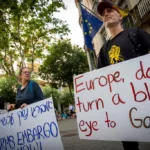
In response to the strike and the government’s treatment of the detainees, dozens of supporters have taken to the streets across the UK, expressing solidarity and condemning the Starmer government’s crackdown on dissent and its reliance on repression to silence opposition.
Mounting Rights Concerns
Since the strike began early last month, human rights organizations have voiced growing alarm. There are fears that the government’s apparent inaction could result in preventable deaths among detainees who have yet to be convicted raising serious legal and ethical questions about the state’s duty of care.
British media have quoted families expressing deep concern that the continued strike, in the absence of any political or legal resolution, could end in irreversible tragedy. They have called for urgent government intervention and a meaningful dialogue before it’s too late.
Yet the Ministry of Justice, according to local outlets, has responded only by stating that strikers are receiving medical care according to protocol without addressing the legal basis for their detention or their political demands.
The rights group CAGE, which focuses on civil liberties, called the detainees’ willingness to risk their lives a “moral and legal alarm bell.” It argued that the issue extends beyond the individual cases and calls into question the integrity of Britain’s justice system.
Ignoring the Palestine Action activists, it warned, could set a dangerous precedent, hollowing out the state’s duty of care and turning hunger strikes into the last resort for claiming basic rights.
Starmer’s Government and the Criminalization of Palestine Advocacy
Beyond London’s usual rhetoric about freedom and human rights which has grown increasingly hollow Keir Starmer’s government has set a legally and morally troubling precedent by expanding the 2000 Terrorism Act to encompass non-violent political movements.
This expansion gives the executive sweeping powers to ban political groups and criminalize even expressions of sympathy or support effectively shifting the state’s focus from policing violence to policing thought and opinion. Merely recounting facts or analyzing the legal and political context around Palestine Action can now be construed as “terrorist” activity.
This trend became more pronounced with a 2019 amendment to Section 12 of the Act, which criminalized expressing any “supportive opinion or belief” about a banned organization if it could “encourage” others to support it even hypothetically. The penalty? Up to 14 years in prison.
The deliberate vagueness of this law has created a legal minefield for journalists, lawyers, and rights groups. Discussing the Gaza genocide or providing legal commentary on Palestine Action’s activities could now invite prosecution. The result has been a chilling effect on public discourse and widespread self-censorship.
Major outlets like the BBC have reportedly hesitated to cover the strike out of legal caution. This leaves the official narrative unchallenged, suggesting that ambiguity in the law is not a flaw but a strategic tool to foster fear and delegitimize Britain’s own human rights discourse.
A Blatant Double Standard
Britain’s legislative crackdown on pro-Palestinian voices has laid bare the stark contrast between its stated support for Palestinian rights and the reality of its actions. While the government pays lip service to the two-state solution, its day-to-day policies make it a complicit actor in crimes against Palestinian civilians.
A previous Noon Post investigation revealed the extent of British complicity in Israeli military operations in Gaza enough to justify demands for legal accountability.
Starmer’s symbolic gestures such as pausing certain trade talks with Israel or imposing limited sanctions on a few West Bank settlers have been little more than PR moves to deflect public outrage.
In truth, these events strip away any pretense: Britain’s policies are a thin veneer over a deeper, structural complicity. Supporting Palestinian rights remains a hollow slogan, one that diverges completely from the moral and political realities of UK actions on the ground.


