













In November 2023, the Houthi movement began launching intermittent attacks on Israeli-linked shipping vessels particularly in the Red Sea using missiles and drones in solidarity with the Palestinians in Gaza, who have been subjected to a brutal Israeli assault since October 7, 2023.
The United States and its Western allies swiftly responded to the Houthi attacks. However, they failed to deter the Yemenis from expressing their solidarity with Palestinians. Several ships were sunk or set ablaze, while others were seized.
These reciprocal attacks have disrupted global trade. At the heart of this disruption is the Bab el-Mandeb Strait, a narrow passage between Yemen and Djibouti at the southern tip of the Red Sea. It is one of the busiest maritime chokepoints in the world, through which roughly one-fifth of global oil consumption passes.
Egypt, too, has felt the impact. Ships that normally transit the Suez Canal a vital source of national revenue—en route to the Mediterranean have been forced to reroute along a longer and costlier path around the Cape of Good Hope at the southern tip of Africa.
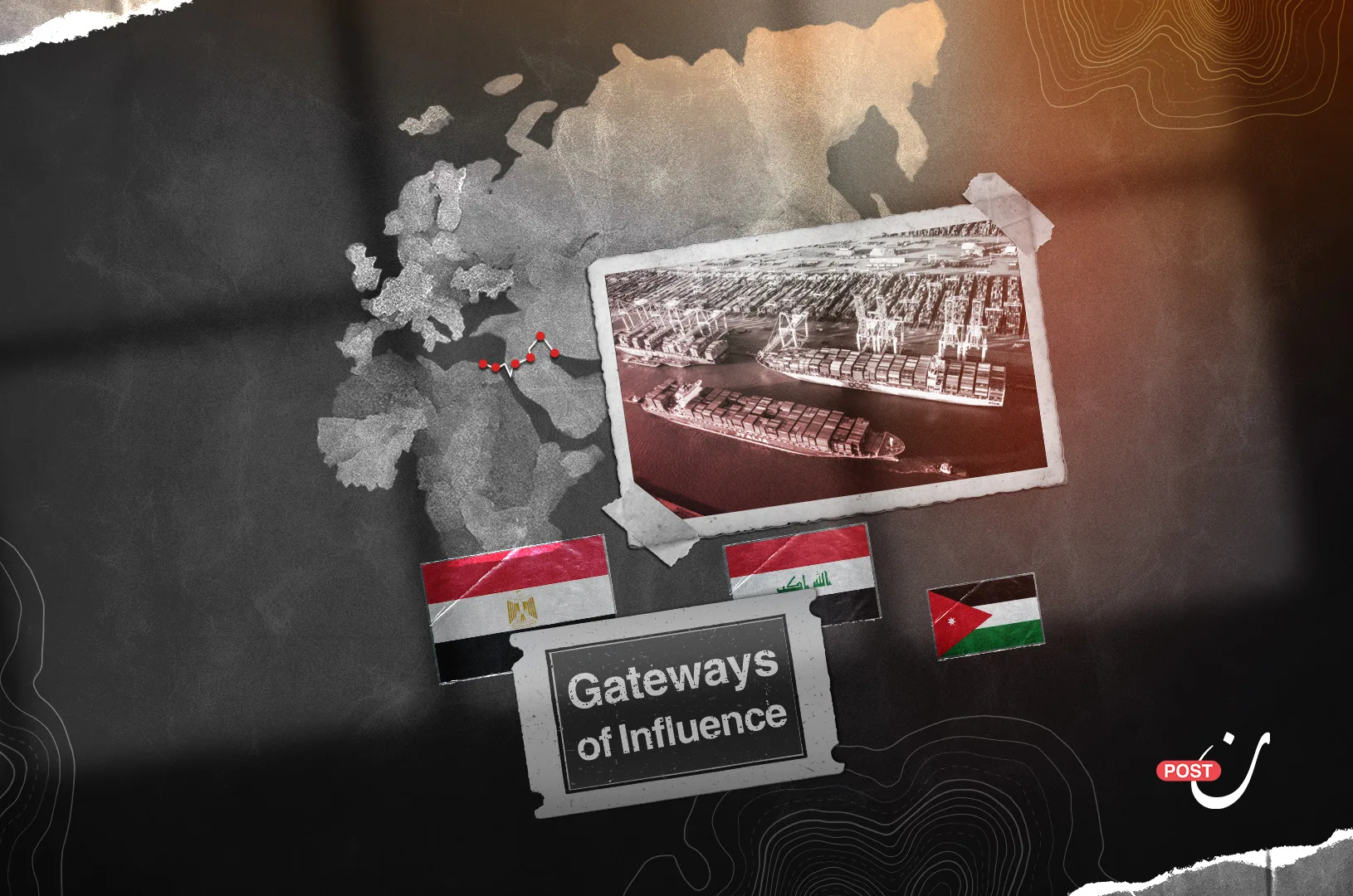
This shift has led to a sharp decline in Suez Canal revenues, prompting Egyptian authorities to push forward with the Arab Trade Corridor an ambitious logistics project connecting Gulf countries with Egypt on a path to European and American ports.
Reviving an Old Vision
This planned corridor falls under wider initiatives aimed at reviving ancient trade routes like the Silk Road and enhancing intercontinental cooperation. The Houthi attacks have accelerated the implementation of this promising project, which brings together Egypt, Jordan, and Iraq and aims to link Gulf and other Arab nations in Asia with North African states via Egypt, and onward to Europe and the Americas.
The project envisions a multi-modal logistics network combining land routes, railways, seaports, and inland waterways. Goods from Asia and the Gulf would arrive at Iraq’s Basra port on the Arabian Gulf, be transported to Baghdad, and then shipped to Jordan’s historic Aqaba port.
From there, they would move to Egypt’s ports of Nuweiba and Taba. Railways and highways would then connect them to Egypt’s Mediterranean ports Arish, Port Said, Damietta, and Alexandria.
Parts of the infrastructure already exist, including seaports in all three countries and segments of railway in Iraq, Jordan, and Egypt.
According to Egypt’s Ministry of Transport, the country is currently constructing a 500-kilometer railway line Taba–Arish–Bir al-Abd–Ismailia as one of seven international logistical corridors included in the project. This line will link the Red Sea ports of Nuweiba and Taba with the Mediterranean port of Arish.
The project will be implemented in three phases:
-
Transporting goods from Iraq to Jordan
-
Moving goods from Jordan to Egypt
-
Exporting the goods to European and American ports via the Arab Bridge Maritime Company.
This maritime company was established in November 1985 as a joint venture between the governments of Jordan, Egypt, and Iraq, with a starting capital of $6 million equally divided among the three founding countries. Since 2002, the company’s capital has increased steadily, reaching $100.5 million by 2014, according to its website.
Today, the company owns a fleet of seven vessels valued at over $140 million. Previously, it relied on leased ships. It now plans to expand operations and further strengthen its fleet.
“New Levant” Vision
This proposed corridor is part of a broader cooperative framework launched in September 2020 between the three countries under the name “The New Levant” an economic initiative modeled on the European Union aimed at forming a regional bloc capable of addressing shared challenges, according to former Iraqi Prime Minister Mustafa al-Kadhimi.
While the idea was first floated during the tenure of former Prime Minister Haider al-Abadi, it was under al-Kadhimi’s leadership and with US approval that the project began to gain traction, as Iraq sought to deepen ties with Egypt and Jordan and move away from Iranian influence.
In just two years, leaders of the three nations have met four times, with ministerial and senior official meetings also increasing. This growing coordination aligns with US strategic interests in the region.
It’s worth noting that thirty years ago, these three countries along with North Yemen established the Arab Cooperation Council shortly after the end of the Iran-Iraq War. That council aimed to rival the Gulf Cooperation Council (GCC), which includes six Arab states bordering the Gulf but excludes Iraq. However, the project was quickly abandoned following Iraq’s invasion of Kuwait.
The renewed alignment is not limited to diplomacy. Economic cooperation has also surged in recent years. Egypt began importing Iraqi oil in 2017, followed by Jordan in 2019. Iraq, in turn, hosts a growing labor force from Egypt and Jordan.
Numerous agreements now exist among the three nations in sectors such as electricity exchange, energy cooperation, manufacturing, agriculture, and transport all aimed at serving mutual interests.
Multiple Ambitions
The combined GDP of Iraq, Egypt, and Jordan is approximately $800 billion, and their collective population stands at around 155 million. This presents vast opportunities if cooperation can be effectively implemented. Egypt contributes demographic weight; Iraq brings energy resources; and Jordan offers a strategic geographic link between the two.
Beyond connecting Asia, Africa, Europe, and the Americas, the Arab Trade Corridor aspires to position the three countries as major logistics hubs in global trade routes. It could also enhance political, economic, and military ties among them by facilitating energy and goods flows from Basra in the east to the Mediterranean in the west.
In terms of distance, the corridor offers a shorter route than the traditional passage through the Arabian Gulf, Indian Ocean, and Red Sea, potentially cutting travel time and shipping costs for vessels heading to European ports.
In addition to its economic promise, the project could elevate the regional standing of the participating countries. Control over trade routes often translates into political leverage and greater influence in global affairs.
Strategically, the project offers Iraq an opportunity to diversify its regional alliances and reduce its dependence on Iran. Meanwhile, Egypt and Jordan see the initiative as a means of decreasing their reliance on Saudi Arabia.
Chances of Success
The Arab Trade Corridor could yield significant political and economic benefits for its stakeholders. Yet, it faces formidable obstacles chief among them the fact that it seeks to provide an alternative to the Suez Canal.
Should Israel’s war on Gaza end and stability return to the Bab el-Mandeb Strait, global shipping traffic would likely resume its normal routes through the canal, which is easier and more cost-effective.
This scenario suggests that Egypt is poised to benefit regardless of the outcome. If the canal is bypassed, Egypt gains from the corridor. If shipping resumes through the canal, Egypt still wins. Iraq and Jordan, by contrast, may see fewer incentives, dampening their enthusiasm for the project.
Another issue is the limited domestic production in Egypt, Iraq, and Jordan. The corridor may lack sufficient export goods to sustain regular shipping activity, as most production in these countries serves domestic markets.
Moreover, Egypt and Jordan are grappling with severe financial strains, making it difficult to fund such a massive undertaking without external loans most of which come with strings attached. Technical hurdles, corruption, and bureaucratic inefficiencies further complicate matters.
Geopolitical challenges also loom large. Some regional powers have a vested interest in preventing the project’s success. Chief among them is Israel, whose proposed Ben Gurion Canal intended to connect the Red Sea to the Mediterranean would face direct competition from this Arab initiative.
Iran is equally wary. A successful corridor would loosen its grip on Iraq and shift Baghdad closer to its Arab neighbors, threatening Tehran’s strategic foothold in the country. As such, Iran is expected to actively work against the project.
Intra-Arab trade accounts for only about 13.8% of the Arab world’s total foreign trade, a modest figure according to the Arab Monetary Fund. High customs duties remain a major barrier, even though some countries have lowered their tariffs to near-global averages. The lack of harmonized standards and a unified vision has further hindered trade integration.
Still, success is possible if political will can be summoned. Should the corridor be completed, it could become a powerful tool for economic recovery, job creation, and geopolitical balance. And perhaps, with time, more Arab nations may join the initiative to expand its impact even further.


