


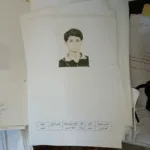




Amid the whitewashed graves in the cemetery of Sidi Makhlouf, a town in the southern Tunisian governorate of Medenine, one marble plaque stands out. On its right side is the flag of Tunisia; on the left, the flag of Palestine. Inscribed in between: “Martyr Miloud Ben Najeh Nouma, born in 1955 in Mohammedia, Sidi Makhlouf, Medenine. Martyred during the hang glider operation against the Zionist enemy in northern Palestine on 25/11/1987.”
Buried here lies the body of one of Tunisia’s noble sons, a man who gave his life for the just Palestinian cause. A fighter who joined the Palestinian resistance early on, Miloud took part in numerous operations against the Israeli occupation—including the dramatic hang glider assault on November 25, 1987, which killed several Israeli soldiers.
Miloud Ben Najeh: The Tunisian Fedayeen
Southern Tunisia has long been a cradle of resistance. It gave rise to figures like Azhar Charaiti, co-founder of the first armed cell against French colonial rule alongside Mesbah Jarboua, and Salah Ben Youssef, a prominent leader of the national liberation movement. Among these names stands Miloud Ben Najeh Nouma, a hero of the hang glider operation against Israel.
The exact date of Miloud’s birth is unknown, but records confirm he was born in 1955 in the village of Sidi Makhlouf just one year before Tunisia gained independence. Raised among peers who valued honor and solidarity, Miloud was shaped by the deeply rooted traditions of Tunisia’s south, where courage and integrity are cultural cornerstones.
Though he did not witness the 1948 Nakba, Miloud grew up hearing of the atrocities: the displacement of Palestinians, the destruction of their homes and institutions, and the broader erasure of their political and cultural life all unfolding under the indifferent gaze of the so-called “civilized” world.
At the age of 12, Miloud witnessed the aftermath of the 1967 Arab defeat, as Israel seized more than triple the territory it had occupied in 1948, dramatically improving its strategic position. The loss left a deep scar on Miloud’s consciousness. Watching Palestinians suffer while the world looked away compelled him to take action.
Convinced of the futility of relying on Arab leaders who had effectively abandoned the cause, Miloud resolved to join the armed struggle.
In 1978, he left his small southern hometown behind family, friends, and all worldly comforts to commit himself fully to the Palestinian cause. He was one of many young Arabs who joined the resistance during that period.
Miloud enlisted in the Popular Front for the Liberation of Palestine – General Command (PFLP-GC), a Palestinian faction founded secretly in 1958 by Ahmad Jibril and publicly announced in 1965 with a military operation targeting the Eilabun Tunnel. The group’s ideological alignment with pan-Arab nationalism and its high-profile operations from Syria and Lebanon against Israeli targets made it a natural fit for Miloud.
Upon joining the resistance, Miloud took the nom de guerre “Abu Ali al-Tounsi.” He was selected for combat training in Syria rather than Lebanon a move that deepened his commitment to the Palestinian cause and strengthened his resolve to fight for it, no matter the cost.
The Hang Glider Operation
For years, Miloud dreamed of carrying out a fedayeen operation against Israeli forces. Palestinian factions had been intensifying their resistance, launching bold attacks such as the assassination of Moshe Hanania (Baruch Cohen), the elimination of a Mossad cell in Madrid, the assault on the Israeli ambassador to Cyprus (Rahmim Timor), and attacks on Israeli airline planes and settlements like Kiryat Shmona in northern Palestine.
Miloud trained relentlessly until November 25, 1987 a day that would mark the culmination of his dream. He was selected to participate in a daring airborne raid against Israeli forces alongside Palestinian and Arab fighters using powered hang gliders nicknamed “Qibya,” in symbolic revenge for the 1953 Qibya massacre carried out by war criminal Ariel Sharon.
That morning, Miloud stood beside his lightweight, motorized hang glider atop a hill in Lebanon’s Bekaa Valley. With him were two Palestinian fighters (whose names remain unknown) and a fourth Syrian fighter named Khaled Mohammad Akhr. They all knew the mission was a one-way journey and yet, their belief in the Palestinian cause was stronger than fear.
According to reports and eyewitness accounts, Miloud flew his glider into the Israeli Northern Command headquarters at the Gibor base home to elite Israeli units in occupied Palestine. During the mission, his glider was struck and crashed in the hills of Hulta in southern Lebanon.
Wounded in the crash, Miloud refused to retreat. Instead, he engaged Israeli forces stationed nearby, managing to kill and injure several before running out of ammunition and ultimately attaining the martyrdom he had longed for sacrificing himself for the cause that had guided him since boyhood.
A Final Testament to Palestine
In his will, Miloud wrote:
“I am Miloud Nouma from southern Tunisia. My comrades and I decided to carry out this operation to restore dignity to the Palestinian cause, which is the mother of all causes.”
His words were a direct response to the Arab League Summit held in Amman on November 8, 1987, where the Palestinian issue was conspicuously absent. Instead, Arab leaders were preoccupied with the Iran-Iraq war and the Gulf conflict.
To Miloud, the Arab stance had become indistinguishable from the international indifference surrounding the Palestinian struggle. He chose martyrdom to reignite focus on the central cause of Arab and global conscience and to challenge the growing arrogance of the Israeli occupation.
The Martyr Returns Home
When news of his martyrdom broke over local radio, Sidi Makhlouf erupted in celebration. Though grief-stricken, the villagers were proud one of their own had sacrificed his life in the land of prophets and resistance fighters. The narrow alleyways filled with ululations as Miloud became a symbol of honor.
Just two weeks after the hang glider operation, the First Intifada broke out on December 8, 1987. In his hometown, Miloud came to be known as “Abu Intifada.” The uprising of the stone-throwing youth continued until 1992, when negotiations between the PLO and Israel culminated in the 1993 Oslo Accords.
Israel did not return Miloud’s body to his family until 21 years later. His remains were released in 2008 as part of a prisoner exchange deal with Hezbollah. He was one of eight Tunisian martyrs repatriated and buried in their respective hometowns.
Legacy Reawakened
Thirty-six years later, hang gliders like those Miloud once flew reappeared in the battle against Israel. On October 7, 2023, Palestinian resistance forces used them to launch surprise attacks during Operation Al-Aqsa Flood, catching Israeli forces off guard.
Miloud Ben Najeh Nouma was not the only Tunisian who centered his life around the Palestinian struggle. Many others followed the same path, among them martyrs like Mohamed Zouari, Khaled Ben Salah Jlassi, Fayçal Hachaychi, Kamal Al-Saoudi Al-Badri, and Baligh Anwar Al-Lajmi.


