












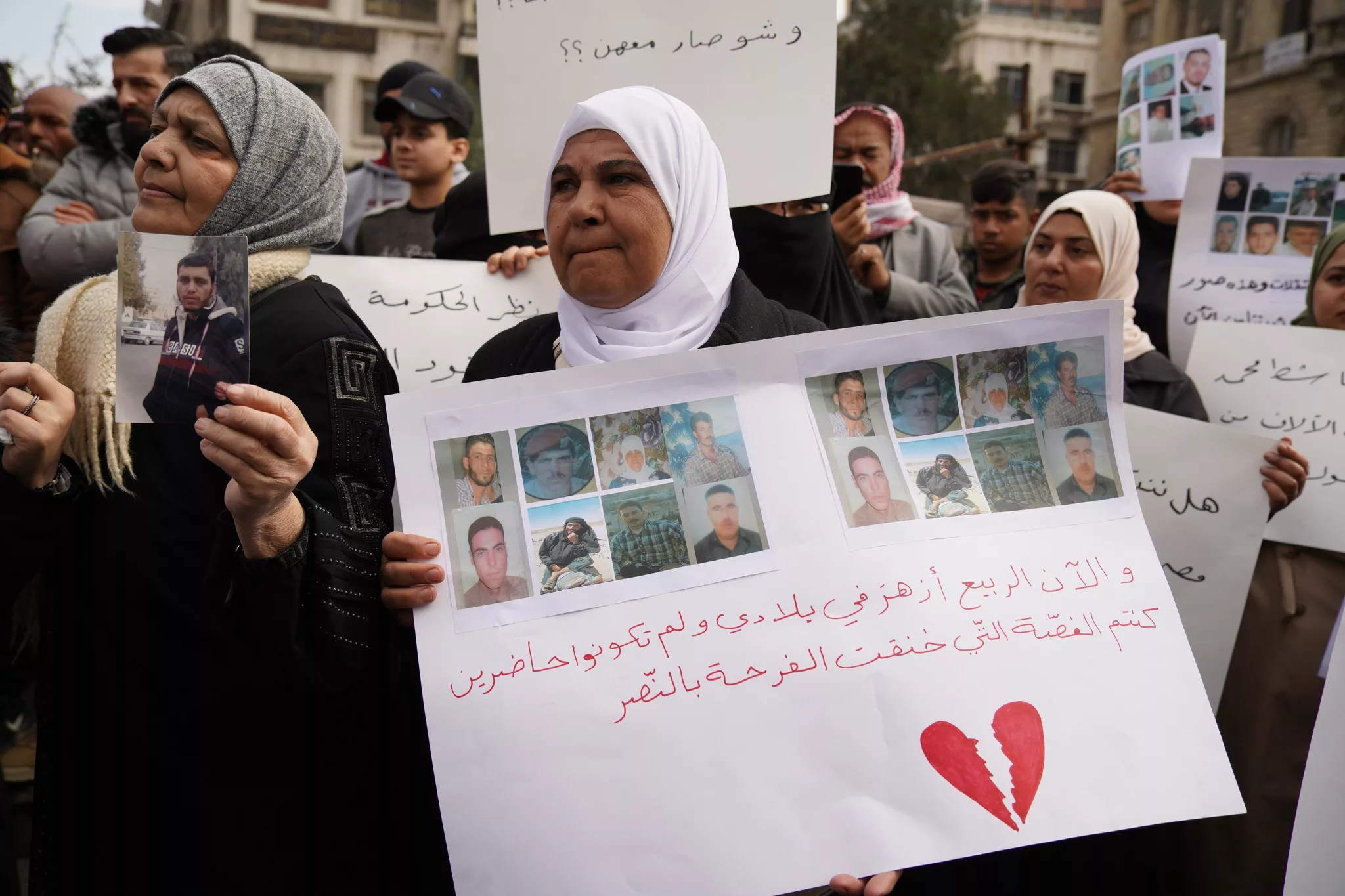
The fall of Bashar al-Assad’s regime on December 8, 2024, did not mark the end of the suffering for tens of thousands of Syrian families. Instead, it opened a new chapter of anguish as they continued to search for any credible information about the fate of their loved ones who disappeared into the hands of the security apparatus and prisons.
As the prison doors opened, some survivors emerged physically depleted, mentally scarred while the vast majority remained unaccounted for. Photos of the released flooded phone screens as desperate families rushed to morgues, prisons, and mass graves in search of a clue, a trace, or even a fragment of remains.
Enforced disappearance remains one of Syria’s most sensitive and complex humanitarian issues. Since the uprising against Bashar al-Assad began in March 2011, thousands of families have been searching tirelessly for their missing relatives.
The formation of the National Authority for the Missing, the discovery of dozens of mass graves, and the availability of documentation from security branches and prisons have offered a sliver of hope.
Families are now cautiously optimistic about learning the fate of their loved ones and seeing justice served through accountability and the establishment of legal safeguards to prevent such crimes from recurring.
The International Day of the Victims of Enforced Disappearances, marked on August 30, serves as an annual reminder to push for truth, justice, and accountability. In Syria’s case, it underscores the need to place the issue of the missing at the core of transitional justice, and to ensure truth and redress for victims.
According to the United Nations, enforced disappearance occurs when individuals are arrested, detained, or abducted against their will, followed by a refusal to acknowledge the deprivation of their liberty or to reveal their fate or whereabouts thus placing them outside the protection of the law.
Between 120,000 and 300,000 Missing
The Assad regime met the 2011 uprising with brutal force. Tens of thousands have been forcibly disappeared since then mainly at the hands of regime forces, allied militias, and paramilitaries who funneled detainees into a labyrinth of detention centers across the country. Others vanished at the hands of armed factions in areas beyond regime control.
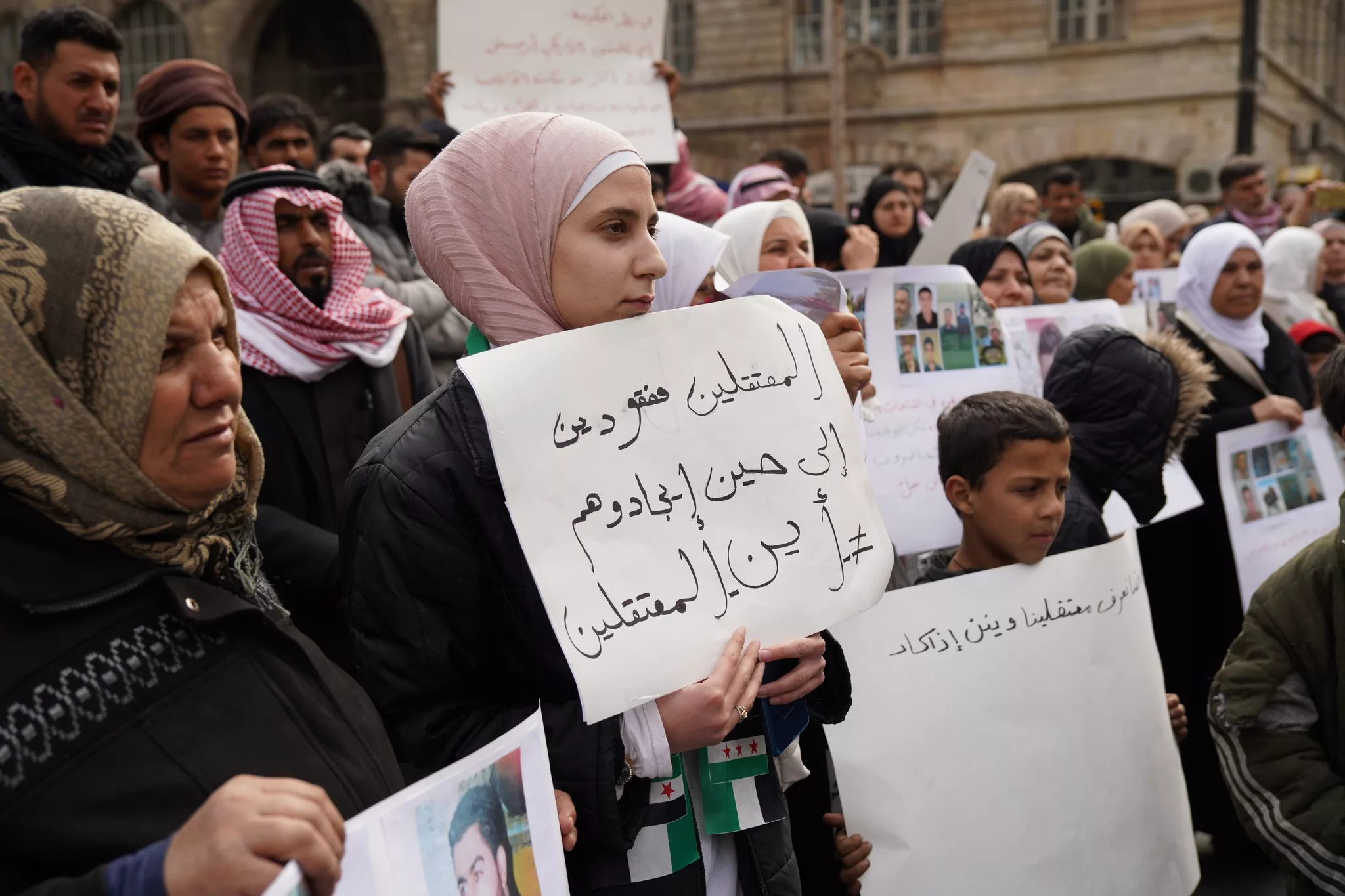
The Syrian Network for Human Rights has documented at least 181,312 individuals subjected to arbitrary arrest or enforced disappearance between March 2011 and August 2025. Of these, around 177,057 are classified as forcibly disappeared. The network holds the Assad regime responsible for nearly 90% of these documented cases.
The International Commission on Missing Persons estimates that approximately 200,000 people have gone missing in Syria since 2011 due to summary executions, arbitrary detention, abductions, chemical attacks, forced displacement, and other human rights abuses.
This phenomenon is not new. Bashar al-Assad continued the legacy of his father, Hafez al-Assad, under whose rule tens of thousands disappeared or perished in detention. Estimates suggest that between 120,000 and 300,000 individuals have gone missing since 1970, according to the National Authority for the Missing, established by a presidential decree issued by transitional president Ahmad al-Shara on May 17, 2025.
Syria’s prisons described as human slaughterhouses have long been execution sites where detainees were buried in mass graves without notifying their families. Over the past 14 years, the regime has also sought to shield its security branches from accountability by falsifying death certificates and relocating bodies, thus concealing evidence of torture and extrajudicial killings.
Investigative reports and data from organizations tracking detainees and the missing identify three main types of locations responsible for these crimes:
-
Security branches spread across provinces, notorious for torture and extracting confessions.
-
Prisons, including Adra Central Prison, Mezzeh Military Prison, Sednaya, and Palmyra Prison, alongside secret facilities in military zones and airports.
-
Military hospitals, such as Harasta, Aleppo, Homs, al-Sanamayn, and Tishreen. The latter is a central hub for issuing forged death certificates and processing the remains of victims from Sednaya, security branches, and military police.
The National Authority for the Missing
Decree No. 19 by President al-Shara established the National Authority for the Missing. It is tasked with searching for missing and forcibly disappeared persons, documenting cases, building a national database, and providing legal and humanitarian support to families.
The body has full legal and administrative independence and jurisdiction across Syrian territory.
The establishment of the Authority has been welcomed by the international community and rights organizations, although many acknowledge the immense challenges it faces. These groups emphasize the need for transparency, collaboration, and the inclusion of victims’ families in the process.
According to Mohammad Rida Jalkhi, head of the Authority, 63 mass graves have been identified as of August 18. The estimated number of missing individuals ranges between 120,000 and 300,000, though the actual figure may be significantly higher due to underreporting and lack of documentation.
Jalkhi asserts that the Authority’s work is foundational for transitional justice and national reconciliation. This effort requires cooperation from official institutions, civil society, victims’ associations, and international bodies.
The Authority has outlined a six-phase plan to be implemented over three to six months:
-
Launch national consultations on the missing.
-
Establish legal and ethical frameworks.
-
Recruit staff.
-
Approve a final structure and bylaws.
-
Define strategic objectives.
-
Present the Authority’s first public report.
The first phase took place over three days in July, dedicating two days to family members and one to civil society. International consultations were also held in Geneva, where foundational principles for cooperation were defined emphasizing Syrian ownership of the process.
Currently, the Authority is working with the Syrian Bar Association, human rights groups, and international experts to design the legal framework. It is also signing cooperation agreements to strengthen capacity in forensic science, documentation, and infrastructure.
Jalkhi emphasized that all agreements are conducted within the framework of Syrian sovereignty and international norms.
A Cornerstone of Transitional Justice
Post-Assad Syria is fragile and deeply fractured, burdened by 53 years of authoritarian rule. Despite steps to establish justice-related institutions, families of the missing and survivors continue to demand truth and accountability from all sides.
Interviews conducted by Amnesty International reveal that families want more than justice; they seek recognition, compensation, education, healthcare, and guarantees that enforced disappearances will never happen again.
Nawras al-Abdullah, a legal researcher at the Syrian Dialogue Center, argues that uncovering the fate of the missing is central to transitional justice. In his view, truth-seeking may even outweigh criminal accountability, as truth is the bedrock of genuine peace.
He stresses that reconciliation in Syria depends on revealing the fate of the missing, dignified burials, and reparations to families. These steps offer relief from collective trauma and lay the groundwork for rebuilding a cohesive, rights-respecting society.
According to the UN, transitional justice encompasses mechanisms to help societies recover from violent histories marked by grave human rights abuses. Its goals include acknowledging victims, preventing future violations, rebuilding trust, and fostering sustainable peace.
The Complexities of Enforced Disappearance
Accessing hundreds of thousands of documents and identifying mass graves marks only the beginning of a long, arduous path. Determining victims’ identities is fraught with challenges, especially given the regime’s systematic use of disappearance as a tool of collective punishment.
Post-conflict Syria faces numerous obstacles: the sheer scale of the crisis, fragmented data, limited forensic expertise, and resource shortages. Around 130 suspected mass graves remain unexamined.
The International Committee of the Red Cross emphasizes that resolving the missing persons crisis requires coordinated efforts by families, civil society, authorities, international actors, and donors.
In January, UN Syria investigator Robert Petty confirmed that hundreds of detention facilities had been documented remotely since 2016 each one with its own mass grave. He warned that it would take years to grasp the full extent of the atrocities.
The Syrian Network for Human Rights faces critical documentation hurdles. Perpetrators deliberately conceal evidence and deny detention, hampering verification efforts.
A recent report obtained by Noon Post shows that the fall of Assad’s regime allowed for greater access to previously sealed facilities, revealing thousands of new cases through survivor testimonies and forensic evidence. The influx of data has overwhelmed documentation teams.
Al-Abdullah believes that while identifying mass graves and retrieving documents is essential, DNA-based identification will be a long, costly process requiring advanced technical resources.
Global Precedents in Truth and Accountability
Around the world, enforced disappearance has been a core issue in post-authoritarian and post-conflict justice efforts. Countries like Argentina, Morocco, and Chile provide important examples.
In Argentina, after the fall of the military dictatorship in 1983, President Raúl Alfonsín created the National Commission on the Disappearance of Persons (CONADEP). It documented over 8,000 disappearances—though estimates reach 30,000—and its findings laid the groundwork for historic trials of former regime leaders. The 1984 report “Nunca Más” (“Never Again”) became a cornerstone of accountability and memory.
In Morocco, the Equity and Reconciliation Commission (IER), established in 2004, investigated abuses between 1956 and 1999. It succeeded in truth-telling and compensation but was criticized for not prosecuting perpetrators and failing to clarify the fate of prominent disappeared individuals.
Syria, now at the dawn of its own transitional journey, faces a massive task. Truth, justice, and healing will require unwavering commitment, cooperation, and courage to confront decades of horror.


