












In Palestine, the olive tree embodies the meaning of land and roots. It is a source of livelihood, memory, and identity all at once. It becomes a symbol of resilience when a Palestinian farmer tills the soil with his own hands, and its presence stands as testimony to the deep connection between people and their land so much so that it has become an icon of belonging, captured in the words of Mahmoud Darwish: “We shall remain as long as thyme and olives remain.”
But what happens when the occupation uproots the olive trees? What becomes of the Palestinian whose livelihood depends on them, especially in villages where daily life is centered around these trees?
Here lies the essence of the settler-colonial strategy long employed by Israel and its settlers: a focused campaign of violence against olive trees and farmers, part of a deliberate policy aimed at expanding settlements and forcibly displacing Palestinians from their land. These acts are not random; they are calculated efforts to impose a new reality on the ground.
This report sheds light on that strategy, with a specific focus on how it has materialized most recently in the campaign targeting the village of Al-Mughayyir, east of Ramallah.
A Strategy Decades in the Making
Israel’s strategy of uprooting olive trees began to take clear shape after the 1967 war, once it had exhausted legal and political justifications for further territorial expansion. It focused on seizing highlands and wide agricultural areas to isolate Palestinians in towns and villages under Israeli control, effectively placing them under siege and reducing them to captives of the occupation.
Within this framework, Israeli forces systematically tightened restrictions on Palestinian farmers, pushing them to abandon their land. Targeting olive trees—by far the most prevalent crop in the West Bank—was a strategic move aimed at disconnecting Palestinians from their history and land.
Statistics show that Israel has uprooted more than 800,000 olive trees since 1967, as part of a deliberate policy to entrench settlements and displace Palestinians.
But the attacks have not been limited to uprooting trees. Olive harvest season in the occupied territories has become a time of dread and constant threat for Palestinian farmers. Every year, settlers backed by the Israeli military carry out violent attacks during the harvest, while the army launches raids that block access to farmland, restrict water usage, and destroy crops, turning the Palestinian countryside into a battlefield against olive farmers.
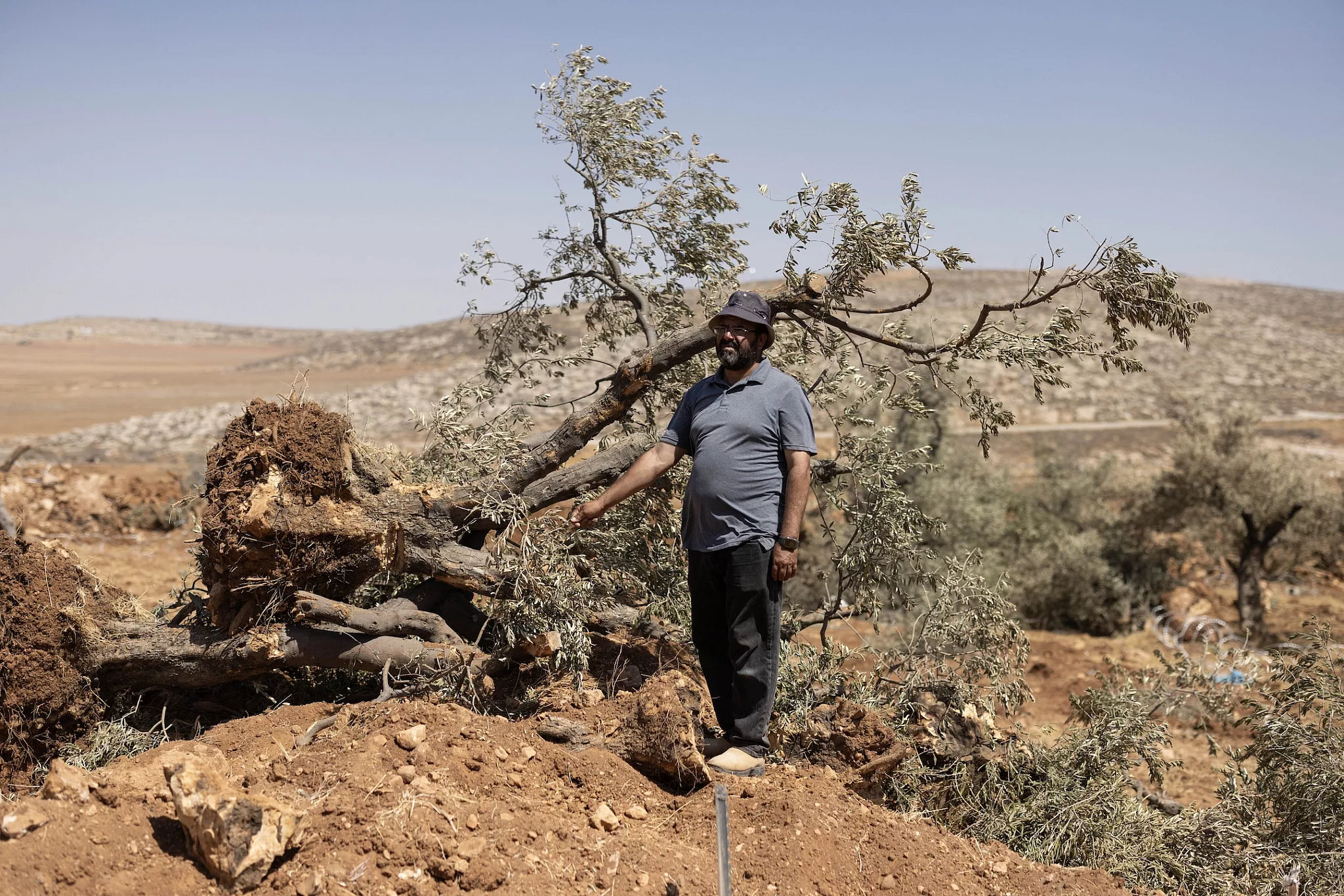
Human rights reports, including a 2021 report by Human Rights Watch, confirm that these assaults are not isolated incidents but part of a broader, systematic effort to empty the land of its native inhabitants. A 2022 UN report documented the destruction of some 650 olive trees in May alone, as settlers and soldiers sought to claim Palestinian lands and force farmers to abandon them.
These organized attacks intensified year after year—particularly after October 7, 2023—when UN experts reported record levels of settler violence during the olive harvest, along with increased restrictions on movement. Attacks included physical assaults, arson, destruction of crops, theft of livestock, and denial of access to farmland and water. These acts forced a record number of Palestinians to flee, abandoning their homes and land.
Last year was described as “the most dangerous yet,” marked by tactics resembling warfare: trees were burned, cut down, stolen, and poisoned. Forty-six villages came under attack, where farmers were barred from harvesting and about 600 trees were destroyed.
This pattern extends beyond the West Bank. In Gaza, which has endured continuous destruction for nearly two years, Israel has destroyed over 75% of the enclave’s olive trees—equivalent to around 1.3 million trees—as part of its ongoing campaign.
The Assault on Al-Mughayyir’s Olive Groves
The most recent victim of this sustained assault is the village of Al-Mughayyir, which now serves as a stark example of how olive trees are weaponized to displace Palestinians. In late August 2025, the village endured an unprecedented military operation: Israeli forces imposed a full lockdown, enforced a curfew, and began extensive bulldozing of olive fields using military equipment.
Eyewitnesses described multiple bulldozers deployed across the village hills, accompanied by Israeli vehicles, uprooting approximately 10,000 olive trees over three continuous days. Many of the trees were over 70 years old, making their loss deeply painful for local families who consider them part of their heritage and agricultural legacy.
Marzouq Abu Na’im, deputy head of the village council, stated that the bulldozing exceeded the officially declared “security buffer zone” of 296 dunams, and that the actual damage spanned well beyond that.
The destruction also targeted the vegetation lining a nearby settler road, which Ghassan Abu Alia, head of the Agricultural Association, said was a calculated attempt to seize more land and coerce villagers into leaving.
This operation coincided with a propaganda campaign by settlers, who circulated photos of transport trucks offering “free rides” to anyone willing to leave Al-Mughayyir. Residents also reported being threatened by Israeli intelligence officers, some of whom warned, “Al-Mughayyir will become the next Rafah,” referencing the mass displacement of Palestinians in Gaza.
On the second day of the incursion, settlers began constructing a new road on village land—believed to be intended to link Al-Mughayyir to Adi Ad, a nearby settlement outpost, and connect it to Route 458 (Alon Road), confirming villagers’ fears of creeping annexation.
A Strategic Obstacle to Settlement Expansion
The attack on Al-Mughayyir is not the first. The village has been subject to near-constant assaults, including fatal shootings. Just four days before the latest campaign, Israeli forces raided the village and shot a young man, Abu Alia, in the back before beating him.
Why is Al-Mughayyir targeted so persistently?
Amin Abu Alia, the village council head who was detained during the recent operation, explained that the village’s strategic location makes it a consistent target. Al-Mughayyir lies at a key gateway to the eastern West Bank, near the Jordan Valley, an area Israel seeks to annex under the so-called Alon Plan—a strategy still active in practice despite official claims of its suspension.
Abdullah Abu Rahma, Director General of Popular Action at the Wall and Settlement Resistance Commission, agrees. He explained that Israel’s de facto annexation plan depends on controlling the eastern Ramallah region, known as Shafa al-Ghor, or “East of Alon Road.” This road has already severed two-thirds of Al-Mughayyir’s land from the rest of the village and has displaced most Bedouin communities in the eastern zone over the past 22 months.
While legal ownership of the land is registered with official documents (Tabu titles), the occupation turns to violence because it cannot expropriate the land through legal means. Hence, it resorts to sheer force—intimidation, collective punishment, and terror tactics reminiscent of those used by Zionist militias during the 1948 Nakba—to create new facts on the ground and impose its control over the land.


