














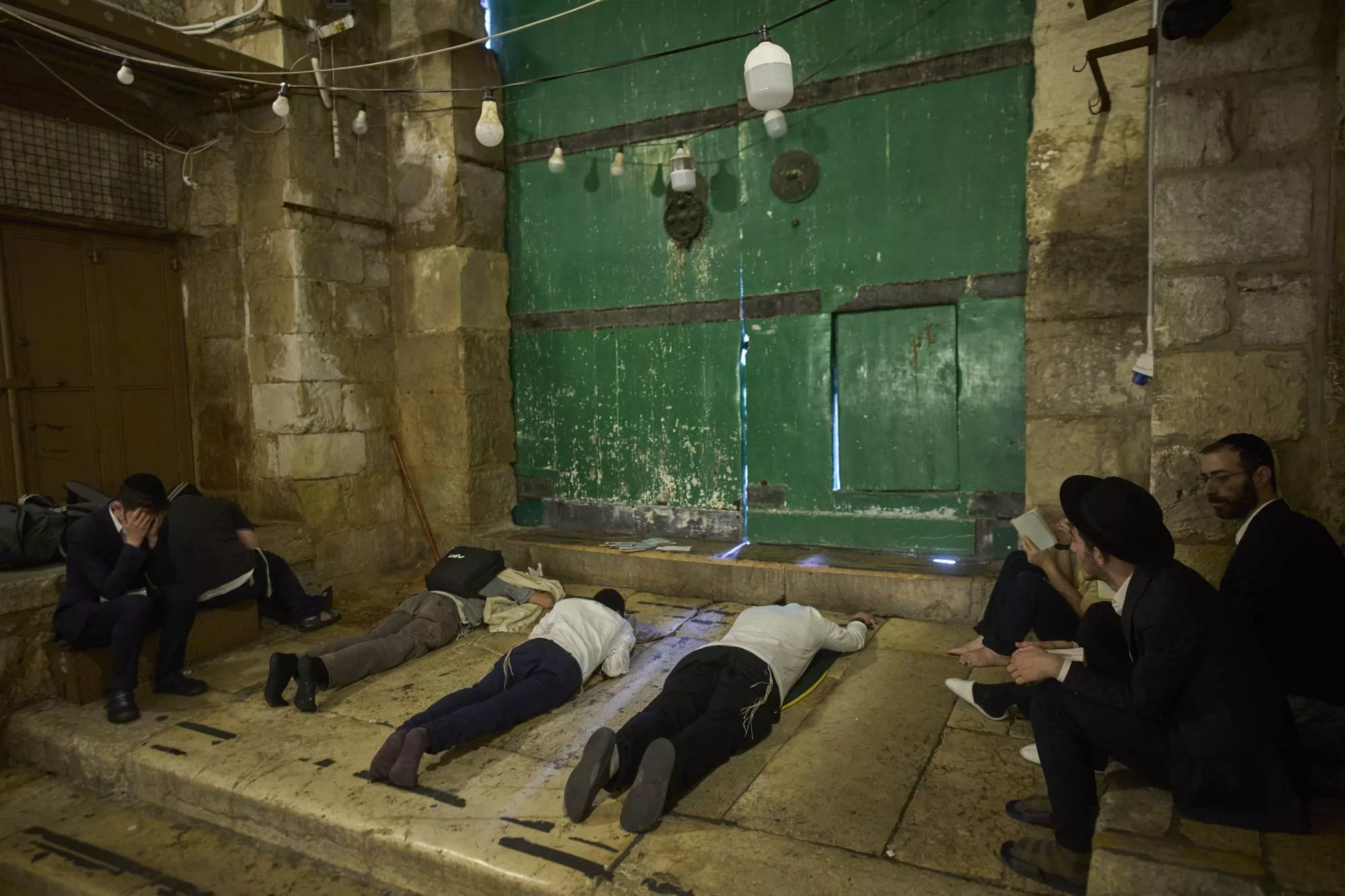
On Sunday, August 3, 2025, nearly 4,000 extremist settlers stormed the courtyards of the Al-Aqsa Mosque in what has been described as the largest such incursion in a single day since the occupation began.
Leading the charge were Israel’s National Security Minister Itamar Ben-Gvir, Knesset members Amit Halevi and Sharren Haskel from the Likud party, and Negev and Galilee Development Minister Yitzhak Wasserlauf.
For the first time, six groups of settlers were allowed to enter the compound simultaneously, one every ten minutes through the Moroccan Gate. Each group, numbering in the dozens, performed Talmudic prayers across various sections of the mosque with complete freedom.
Canopies were erected outside to shield them from the sun as they waited, while extremist organizations provided free transportation and tour guides—all under the protection and coordination of Israeli police. These measures were part of commemorations for what they refer to as the “Destruction of the Temple.”
This unprecedented brazenness has raised serious questions about the absence of meaningful reaction to what appears to be state-sanctioned provocation. Above all, it revives a crucial question: where is the Hashemite Custodianship, and where is the Jerusalem Committee—both tasked with protecting Al-Aqsa and countering Israeli violations?
A Raid Unlike Any Before
Since General Mordechai Gur stormed Al-Aqsa with Israeli troops in 1967, raised the Israeli flag over the Dome of the Rock, and burned Qur’ans, the mosque has not witnessed a raid of this magnitude.
This event was exceptional not just in scale but in nature. Nearly 4,000 settlers entered in one day, performing what is known as the “Priestly Blessing” across the entire mosque compound. The ritual—where rabbis raise their hands over followers while chanting passages from the Book of Numbers—was no longer confined to the eastern section.
Unlike previous quiet incursions, this time the settlers chanted loudly, their voices echoing beyond the mosque’s walls. According to Mazen Al-Jaabari of the Jerusalem National and Civic Work Committee, these acts were religious in form but political in essence—engineered by religious Zionist parties, especially those led by Ben-Gvir.
He emphasized that the ceremony took place across the entire Marwani Prayer Hall, marking a significant expansion in settler activity. The mass participation of political figures indicates this was a calculated mobilization, likely to be leveraged in election campaigns as a show of strength to religious Zionist constituents. The goal is clear: incremental control of Al-Aqsa and de facto partition by time and space.
Jaabari noted that reaching 5,000 settlers in a single raid has long been a strategic aim of extremist groups. Their open display of Torah scrolls near the bridge to the Moroccan Gate underlines their intent to introduce Jewish religious paraphernalia into the sacred site—a symbolic step toward turning Al-Aqsa into a temple.
Ben-Gvir, who has stormed the site 11 times recently, is racing to cement a policy of Judaizing Islamic and Christian holy sites. The Israeli police, acting under his authority, referred to the raiders in a statement as “pilgrims,” pledging to facilitate their rituals.
This statement, Jaabari warns, carries a dangerous implication: it marks a shift from mere incursions to officially sanctioned religious activity. The Israeli authorities are no longer merely permitting settlers to sing and dance in the mosque—they are now punishing any police officer who intervenes. This signals an end to the historical “status quo” governing Al-Aqsa since before Israel’s occupation of East Jerusalem in 1967.
An Attempt to Enforce New Realities
The latest raid is part of a broader effort by Israeli authorities to impose new facts on the ground by military force. The event served as a public spectacle meant to prepare domestic opinion for what is being dubbed “a renewed covenant to remove Al-Aqsa and build the Third Temple.”
The Islamic Waqf in Jerusalem condemned the participation of Israeli ministers and lawmakers, under heavy police protection, describing the event as a militarization of the sanctuary and a blatant challenge to the Hashemite Custodianship and international law.
Experts warn that these developments mirror the gradual Judaization of the Ibrahimi Mosque in Hebron after the 1994 massacre, amid mounting international apathy and growing Arab and Muslim complacency.
Raids on Al-Aqsa have evolved from sporadic individual acts into a systematic and central pillar of a long-term settler colonial project. The goal: to legitimize a new “status quo” that divides the mosque temporally and spatially, eventually turning it from a purely Islamic site into a shared public space within an extremist expansionist vision.
Where Is the Hashemite Custodianship?
Each incursion raises immediate questions about the Hashemite Custodianship and the role of Amman. Under the 1994 Wadi Araba peace treaty with Israel, Jordan is recognized as the official custodian of Islamic holy sites in Jerusalem, particularly Al-Aqsa.
Yet, the response from Jordan’s Foreign Ministry was limited to a familiar denunciation: a press release calling the raid a “dangerous violation of the status quo” and a breach of international law. It reaffirmed that Al-Aqsa, with its 144 dunums, is an exclusive Muslim place of worship and that Israel has no sovereignty over it.
This statement joins a long list of similar declarations—dozens if not hundreds—offering condemnation without concrete action. Many such statements are nearly identical, falling short of the legal and historical responsibilities that come with Jordan’s custodianship.
This inaction has emboldened extremists within Israel, encouraging efforts to dismantle Jordanian oversight and claim full Israeli sovereignty over the site. In 2014, Likud Knesset member Moshe Feiglin formally proposed that the Knesset debate removing Jordan’s custodianship altogether, declaring: “He who controls the Temple Mount controls the land.”
Among Jordanians, this perceived helplessness has sparked widespread public anger. Activists have repeatedly urged the government to act—but to no avail. When the authorities did respond, it was often by silencing dissent.
In August 2024, Jordanian security forces arrested activist Israa Zahir for holding a handwritten sign reading “Where is the Hashemite Custodianship?” outside the Israeli embassy in Amman.
Year after year, under the constraints of Wadi Araba and its passive political framework, Jordan’s role has steadily eroded. Today, the symbolic keys to Al-Aqsa are slipping away—not just to Israel, but also to competing regional powers eager to claim guardianship over Islamic holy sites.
What About the Jerusalem Committee?
A similar critique applies to the Jerusalem Committee, established in 1975 by the Organization of Islamic Cooperation and chaired by the King of Morocco. While its mission is to protect the sanctity of Jerusalem and defend its Arab and Islamic identity, it too merely issued a statement warning of “unprecedented escalation” and accusing the Israeli government of turning parts of Al-Aqsa into a de facto synagogue.
The committee, tasked with engaging international organizations and advising member states on protecting the city, claimed that Israel is exploiting global distraction by the ongoing war in Gaza to accelerate its Judaization efforts.
But after more than 20 sessions since 1979, the committee has taken no tangible steps. It has relied solely on statements and periodic meetings that have never translated into decisive action.
Both the Hashemite Custodianship and the Jerusalem Committee are constrained by governments that maintain normalized relations with Israel and are driven by self-serving pragmatism. These approaches have led them to surrender core national and religious responsibilities, reframing passivity as political realism—even if the cost is abandoning Al-Aqsa to Judaization.
A History of Betrayal
What happened on August 3, 2025, was not an isolated event—it was the culmination of decades of incursions and violations since 1967. What is new is the boldness: open Talmudic rituals, loud prayers across the compound, state protection, and the presence of prominent political and security figures.
Throughout this history, one constant remains: Arab and Islamic complicity. Official responses rarely go beyond dramatic speeches and empty condemnations—words that pacify the public but change nothing.
Since Egypt’s peace treaty with Israel in 1979, and the subsequent normalization deals by Jordan, the UAE, Bahrain, Morocco, and Sudan, the fate of Al-Aqsa has entered an existential crisis.
Faced with pro-Israel policies backed by Washington, Jordan has abdicated its custodianship role. Morocco has sidestepped its obligations via the Jerusalem Committee. The OIC remains in deep slumber, while the rest of the so-called Muslim world watches in silence—as if this were a foreign issue of no concern.
In this vacuum, Israel has found the perfect environment to execute its plans: to assert sovereignty over Al-Aqsa and the wider sanctuaries and to realize its long-held dream of spatial and temporal division of the mosque.
With no unified stance or meaningful resistance, Al-Aqsa is left to bear the cost of normalization, the burden of humiliating compromises, and the price of surrendering to a Zionist agenda aimed at crushing the very grassroots resistance that has long stood as the mosque’s last line of defense.


