
In the far south of Iraq, on the banks of the Shatt al‑Arab, Basra stands today as a silent witness to a deepening tragedy: “thirst” is no longer abstract but a bitter reality for its residents. A province once rich in oil and water now endures a crippling water crisis—one forged by the interplay of harsh natural forces and administrative failure.
Water Crisis in Decline
Basra’s water crisis didn’t emerge overnight. It’s the result of intertwined factors that have gradually escalated to threaten daily life in the city.
Salinity sits at the heart of the crisis—especially in the summer months—when river discharge from the Tigris falls and saltwater pushes up the Shatt al‑Arab into Basra itself.
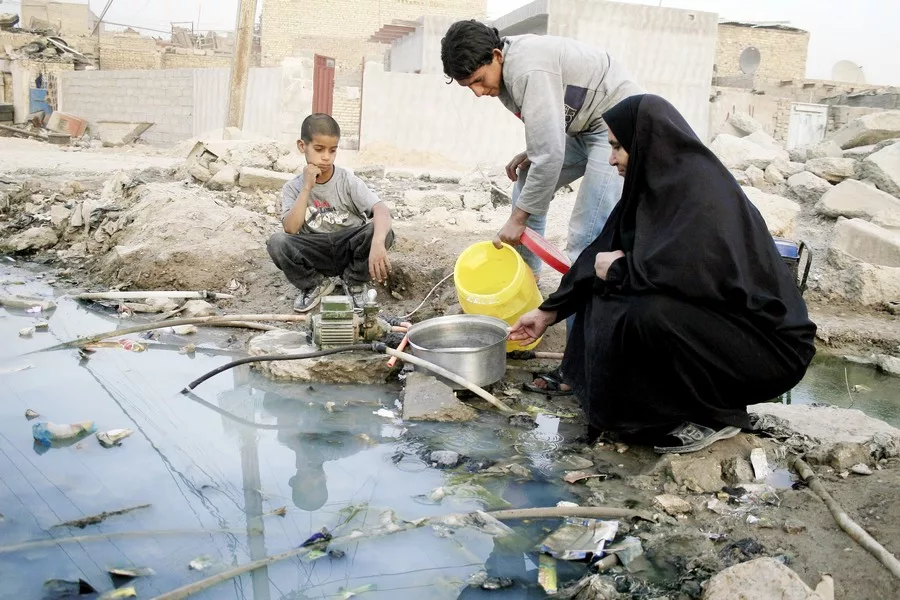
In the province’s north, early signs of disaster appeared: crops destroyed by saline buildup, livestock dying after drinking contaminated water tainted by sewage and oil. Local testimony reveals that tap water is unsafe for either human or animal use and has triggered multiple skin and intestinal disorders.
Dr. Ramazan Hamza, a senior water policy expert, attributes responsibility to both nature and management failure. Climate change and water control by upstream countries—Turkey and Iran—have reduced Tigris and Euphrates flows, intensifying salinity and pressure on the Shatt al‑Arab.
Yet Hamza holds administrative shortcomings responsible for the worst consequences: “bureaucratic inertia and a lack of coordination among ministries and local governments” have allowed the crisis to grow unchecked.
On June 12, the Agricultural Division of Imam al‑Sadiq District reported dozens of cattle deaths from poisoning due to contaminated Euphrates water. Veterinary tests warn of further fatalities—signaling threats not only to the environment but also to local food security.
In central Basra, salinity in feeder canals supplying neighborhoods such as Maqil, Jbeila, and Al‑Ashar reached over 19,000 TDS, according to the Basra Water Directorate. Water—with its foul odor and yellow tint—is no longer even suitable for washing dishes, forcing families to purchase expensive bottled water for all daily needs.
Lives at Risk
Thirst in Basra is no longer seasonal anguish—it is a daily health, livelihood, and dignity crisis. Increasing salinity and pollution have made drinking, cooking, and washing dependent on pricey water tankers. This burden strains low-income households.
BWD Deputy Director Haitham Jarallah explained that reduced releases into the Shatt al‑Arab are directly responsible. Salinity levels reached 3,500 TDS in Kitban and exceeded 19,500 TDS in Sihan due to the closure of the Karun River.
For public health, Mehdi al‑Tamimi of the Basra Human Rights Commission warns: acute intestinal poisoning has been reported in homes using chemically and bacterially contaminated water without treatment. Northern districts are effectively “disaster zones.”
He criticized the lack of a declared emergency and field-response teams, calling it official negligence, and warned that “if urgent measures are not taken, Basra will face a catastrophe worse than 2018.”
Hamza warns that Basra’s environment has entered an “ecological catastrophe.” Polluted and saline water is causing mass livestock deaths, widespread crop destruction, and repeated poisoning waves. He notes that the environmental infrastructure of Basra is being eroded by three fronts: water degradation, oil emissions, and unregulated waste dumping—making the region uninhabitable.
The cumulative social and economic damage is long-term and significant without immediate intervention.
Public Outrage
Desperate for solutions, Basra’s citizens have taken to the streets in northern districts, demanding real water solutions. Activists report that the local government has responded with indifference and even legal prosecution.
On June 12, parliamentarian Addi Awad sharply criticized the Ministry of Water Resources for its inaction, stating the ministry “should have anticipated this crisis and acted before waiting for disaster.” He dismissed financial excuses, saying, “it would have been easier to collect donations from Basra residents than let the city die of thirst.”
He also derided talks with neighboring countries as “empty words” and vowed to push Basra’s needs at the Ministries of Water Resources and Finance.
A Road Map for Relief
After years of escalating crisis, talking about Basra’s water shortage is no longer enough—it demands a comprehensive rescue plan with clear priorities and actionable steps.
Water expert Ramazan Hamza outlines a roadmap divided into urgent and medium‑term stages:
Short‑term steps: deploy mobile desalination units, intensify water-quality monitoring, and launch public-awareness campaigns.
Medium‑term goals: complete large-scale desalination projects, upgrade infrastructure, coordinate with upstream nations to secure equitable river flows, and support agriculture with salinity‑resilient techniques.
Geography plays a role—saltwater intrusion from the Arabian Gulf into the Shatt al‑Arab—but Hamza stresses this is exacerbated by administrative failure: “The real issue is management. Authorities have failed to secure adequate water shares or counter internal and external water exploitation, making this fundamentally an administrative crisis cloaked in a geographic guise.” He warns that without strategic action, Basra’s thirst will become a perpetual threat, with pollution sealing its fate.