














Since the fall of Bashar al-Assad’s regime and the ascension of the new Syrian administration led by President Ahmad al-Shara, Israel has swiftly embarked on a series of hostile actions.
These began with a blunt declaration that the 1974 Disengagement Agreement had collapsed and quickly escalated to repeated ground incursions into the buffer zone, particularly around Quneitra and Mount Hermon, under the pretext of establishing a security belt separating Syrian territory from the occupied Golan Heights.
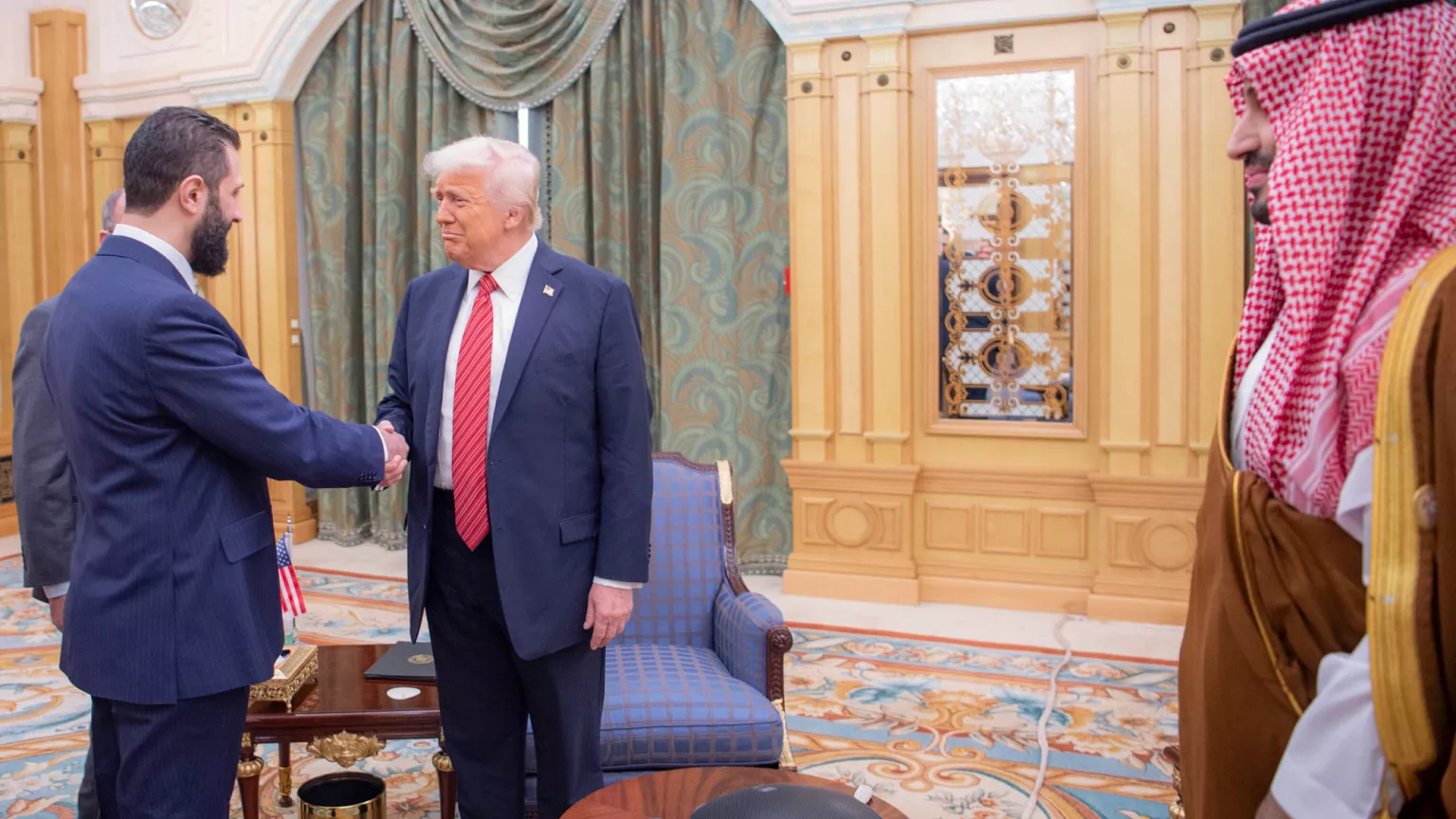
Simultaneously, the United States has presented normalization with Israel as a gateway to “international legitimacy” for the new Syrian regime and as a mechanism for regional and global reintegration. President al-Shara confirmed that former US President Donald Trump had urged him to pursue this path during their meeting in Saudi Arabia on the sidelines of Trump’s Gulf tour in mid-May.
In response, the Syrian administration has adopted a policy of “containment, openness, and de-escalation,” recognizing the fledgling regime’s need for breathing room to rebuild state institutions after inheriting a fragmented and exhausted country.
This raises a pivotal question: how far is Syria’s new leadership willing to go in its flexibility toward Israel? This question has gained urgency amid mounting indications of indirect communications and on-the-ground measures fostering a climate of de-escalation—despite official denials of any normalization efforts, with the government framing such contacts merely as attempts to avoid escalation.
Israel’s Policy: Between Imposing Facts and Driving Normalization
Following the collapse of Assad’s regime, Israel adopted an aggressive and proactive strategy toward Syria, capitalizing on its expanding regional influence post-October 7, 2023. It has sought to impose new military and territorial realities that could reshape its relationship with Damascus under President al-Shara.
Militarily, Israel launched a broad campaign of airstrikes targeting Syrian military infrastructure—ammunition depots, vehicles, naval assets, and research centers. These strikes have continued for months, with Israeli warplanes pounding positions in rural Damascus, Daraa, and Hama.
According to the Israeli military, the attacks targeted “military installations, anti-aircraft systems, and surface-to-air missile infrastructure,” stressing that Israel “will act whenever necessary to protect its citizens.”
On the ground, mere hours after the formal collapse of Assad’s regime on December 8, 2024, Israel initiated its first incursion into the UN-patrolled buffer zone between Syria and the occupied Palestinian territories, blatantly violating the 1974 disengagement accord.
This demilitarized zone, known by the Alpha and Bravo lines, spans 235 square kilometers from Mount Hermon in the north to the southern front.
Within less than four months, Israel had established nine new military outposts—seven inside the buffer zone and two just outside—expanding its effective control to over 1,400 square kilometers.
Defense Minister Yoav Gallant announced a three-tier security map for southern Syria: a demilitarized zone, a 15-kilometer area stripped of advanced weaponry, and a third zone allowing only police presence—effectively rendering southern Syria a sovereignty-free area.
In February 2025, Israeli Prime Minister Benjamin Netanyahu escalated rhetoric by demanding that the provinces of Quneitra, Daraa, and Suwayda—spanning over 11,000 square kilometers—be designated completely demilitarized.
In parallel, Israel has exploited sectarian dynamics, particularly the minority file, in shaping its post-Assad Syria policy. This approach intensified following the May 2 airstrike near the Presidential Palace in Damascus, amid unrest in Druze-heavy suburbs like Jaramana and Sahnaya.
Netanyahu and Foreign Minister Israel Katz described the raid as “a clear message to the Syrian government,” declaring Israel’s firm stance against any threat to the Druze population.
On the diplomatic front, Israel is attempting to reframe normalization—from a political privilege to a security necessity—casting it as essential for ensuring the stability of Syria’s new regime. Netanyahu has stated multiple times that “the Middle East is changing” and that “every state must reconsider its ties with Israel—including post-Assad Syria.”
Ambiguity and Open-Ended Scenarios
From the earliest days of the new administration, its stance on escalating Israeli attacks has sparked intense scrutiny—especially since these began before Syria could even stabilize its internal power structure.
Initially, the Syrian leadership appeared to ignore the provocations. Later, it issued brief and vague statements calling for an end to aggression, repeatedly emphasizing that it sought no escalation and stressing “there is no justification for conflict.”
This position, born out of necessity to focus on reconstruction, has carefully avoided any signal that might be interpreted as an invitation to confrontation. Instead, Turkey has taken the lead in issuing more forceful denunciations.
During President al-Shara’s first post-sanctions visit to Ankara, President Recep Tayyip Erdoğan declared the Israeli strikes “unacceptable” and pledged to oppose them on all international platforms.
Meanwhile, in the days leading up to the lifting of US and European sanctions, intense diplomatic activity unfolded as Washington and Arab states sought to shape the parameters of engagement with Syria’s new regime. Much of this was tied to how Damascus would handle its relationship with Israel.
During a meeting with French President Emmanuel Macron at the Élysée Palace in May, al-Shara acknowledged indirect negotiations with Israel via intermediaries aimed at “de-escalating tensions and maintaining control.”
Reuters, citing informed sources, reported that direct face-to-face meetings had occurred between Israeli and Syrian officials—despite official Syrian denials—aimed at preventing broader conflict in border areas.
Although not publicly acknowledged, several developments hint at confidence-building gestures. Notably, Israel’s military and intelligence agency Mossad jointly announced the recovery of the remains of soldier Tzvika Feldman during a “special operation deep inside Syria,” without clarifying whether Syrian consent—explicit or tacit—had been involved.
Israel’s army radio later claimed Syria had not participated, offering no further detail. Other sources linked the operation to the arrest of Talal Naji, head of the Popular Front – General Command, believed to hold key information about the soldier’s burial site.
Even more striking was the case of Eli Cohen’s intelligence archive. According to Israeli outlet i24NEWS, a Syrian source claimed an Israeli helicopter landed in Suwayda on May 2 to retrieve the archive as a “gesture from President al-Shara to Israel and the United States.”
The Israeli Prime Minister’s Office confirmed the recovery of approximately 2,500 documents, photos, and personal items, describing the operation as “covert and complex,” executed by Mossad and an allied intelligence service.
Further confirmation came from Reuters, which quoted three sources—a Syrian security official, a presidential advisor, and a source familiar with the secret talks—who said the archive handover was part of a Syrian initiative to “build trust” and open channels with the Trump administration.
According to these sources, al-Shara recognized the archive’s diplomatic value and used it to prompt engagement. Israeli newspapers Yedioth Ahronoth and Maariv reported that Syria was also considering returning Cohen’s remains, describing the move as a “surprising and serious goodwill gesture.”
US Engineering and Turkish Coordination
Observers broadly agree that Syria’s moves—framed as “openings” or “trust-building” measures—are aimed at winning American approval. The Israel file is a central key to that approval, particularly as sanctions relief hinges on Syria’s regional posture.
Following his meeting with President al-Shara in Saudi Arabia, Trump praised Damascus for its “willingness to engage,” noting that al-Shara expressed interest in joining the Abraham Accords.
The pro-Israel Jewish Magazine quoted the Syrian president as saying it was time to “end the era of endless bombing” and voiced his openness to future security partnerships with Israel based on shared threats. In remarks during his meeting with American businessman Jonathan Bass, al-Shara added: “Peace is not built on fear, but on mutual respect.
We will cooperate where there is sincerity and a clear path to coexistence, and avoid other paths.” Syria’s Ministry of Information denied an official interview with the magazine but confirmed the Bass meeting.
Congressional interest further underscored US engagement. Congressman Cory Mills met al-Shara in Damascus on April 18, stating that Syria was open to improving relations with Israel and willing to join the Abraham Accords if conditions were right. A similar message emerged from Congresswoman Marlin Stutzman after her April 21 meeting, linking normalization to guarantees of Syrian sovereignty and territorial integrity.
On May 15, Secretary of State Marco Rubio told AFP that Syria’s transitional government was “prepared for peace with Israel,” following a meeting with Syrian Foreign Minister Asaad al-Shibani in Antalya, Turkey.
These moves highlight a concerted US effort to shape Syria’s trajectory using sanctions relief and global reintegration as leverage to advance an agenda aligned with Israeli interests—an agenda that directly influences Syria’s internal political dynamics.
Nonetheless, President al-Shara has been keen to clarify that rapprochement with Israel does not equate to abandoning national principles. In a key statement, he emphasized his aim to return to the post-1973 Disengagement Agreement, with a core goal of “protecting the Druze community in the Golan and Syria,” insisting their security is “non-negotiable.” He reiterated, “Peace is not built on fear, but on mutual respect.”
The new Syrian regime walks a razor’s edge—balancing urgent needs for global engagement and economic recovery against the geopolitical minefield of engaging with Israel. While Washington orchestrates a tightly controlled opening based on sanctions and conditional diplomacy, Israel positions itself as an unavoidable gatekeeper to international legitimacy, using calculated military and political maneuvers.
Despite signals of de-escalation and gestures of trust-building, the relationship remains riddled with structural contradictions: Israel shows no sign of halting aggression or relinquishing the Golan, while Syria knows that normalization under duress could undermine its revolutionary legitimacy and trigger uncontrollable domestic and regional fallout.
Ultimately, Syria’s trajectory will depend not only on how it handles mounting external pressures, but also on whether it can balance the imperatives of survival with the demands of sovereignty in a rapidly shifting regional order that rewards strategic positioning—not unreciprocated concessions.
