
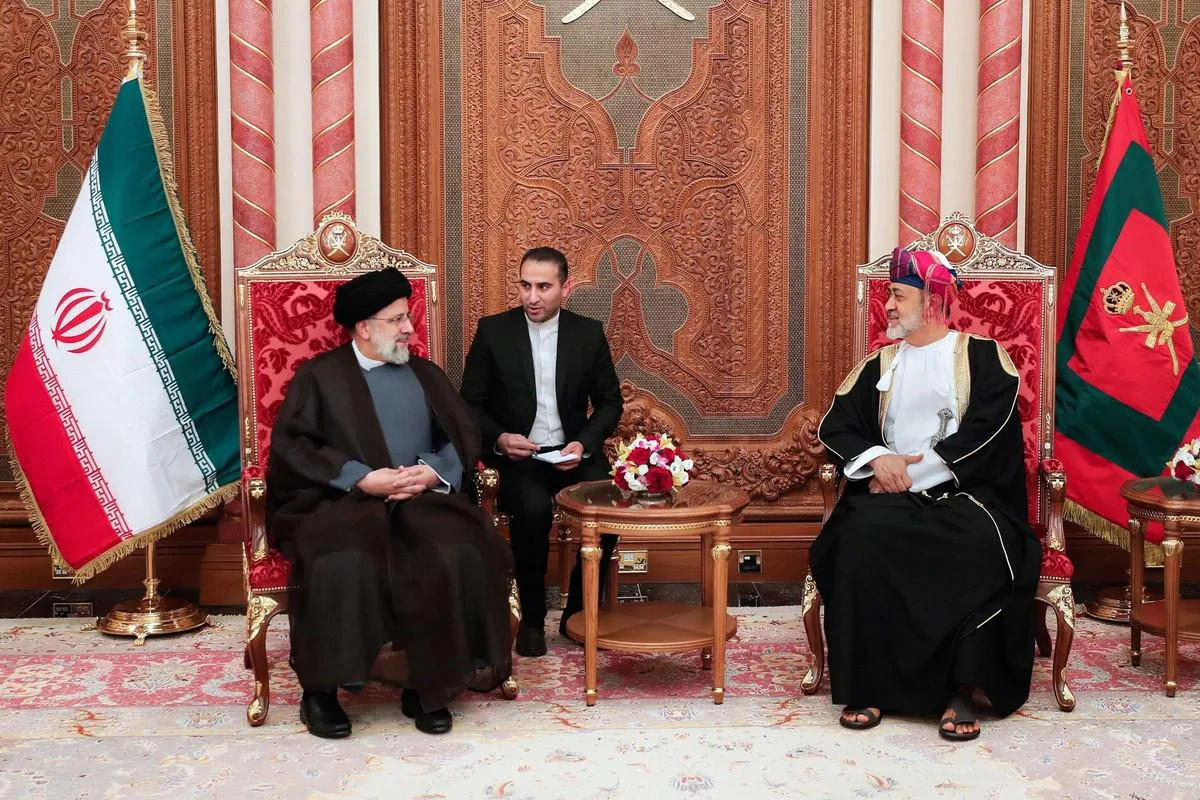
At a time when Gulf capitals have escalated their rhetoric toward Tehran following attacks on targets inside their territories amid Iranian responses to U.S. and Israeli strikes Oman has adopted a notably different tone. Sultan Haitham bin Tariq Al Said congratulated Mojtaba Khamenei on his selection as Iran’s Supreme Leader, expressing his wishes for success in fulfilling his leadership responsibilities.
This message carried particular political significance: it was the only congratulatory note issued by a monarch or president of an Arab state. The only other official Arab response came from Iraq, through its prime minister, alongside statements from several pro-Iran factions in Iraq, Lebanon, and Yemen.
Oman’s approach has not surprised its neighbors within the Gulf Cooperation Council (GCC). For years, Muscat has pursued a somewhat distinct policy in its dealings with Iran—one that has reinforced its unique political and diplomatic posture within the region and set it apart from other Gulf capitals.
In this context, the Omani congratulatory message issued at a highly sensitive moment, even after Iranian drones targeted Oman’s commercial port of Duqm underscores the Sultanate’s distinctive position within the Gulf system regarding relations with Iran. While tensions between Tehran and Gulf capitals continue to intensify, Muscat maintains open channels of communication with the Islamic Republic.
This approach is not a fleeting deviation from the Gulf consensus but rather the continuation of a long-standing equation shaped by geography, history, and strategic interests, as well as by the core principles of Oman’s foreign policy.
An Exceptional Model: Three Decades of Partnership
Omani-Iranian relations represent a unique model within the architecture of regional alliances. The partnership rests on firm foundations of broad cooperation and continuous coordination across multiple sectors making it markedly different from many other regional alignments that periodically face tension and instability.
Since the establishment of formal diplomatic relations on August 26, 1971, bilateral ties have demonstrated a notable degree of stability and momentum. The relationship has been characterized by constructive cooperation, ongoing consultation, and regular exchanges of interests and perspectives across a range of issues.
The scale of mutual engagement is evident in the frequency of official visits: more than 80 political and economic delegations are exchanged annually. Oman is home to over 25,000 Iranian residents, supported by expanding air connectivity between the two countries currently around 50 flights per week while bilateral trade has reached approximately $2.5 billion.
This level of alignment and partnership is not a matter of coincidence or temporary political circumstances. Rather, it reflects the cumulative impact of geopolitical, historical, and economic factors that have collectively strengthened cooperation between Muscat and Tehran and helped contain potential disagreements before they escalate into disputes that might threaten the core relationship.
The Duality of History and Geography
Geography has played a foundational role in shaping the relationship between Muscat and Tehran. The two countries share strategic oversight of one of the world’s most critical maritime passages: the Strait of Hormuz, through which roughly one-fifth of global seaborne oil trade passes.
The strait stretches roughly 1,000 nautical miles, with Iran along its northern shore and Oman along its southern flank, while the distance between the two countries at the narrowest point is approximately 21 nautical miles. The stability of this waterway is therefore vital not only to regional security but also to global economic stability.
From this geopolitical reality emerges a clear calculation: any serious deterioration in relations between Oman and Iran both of which depend, to varying degrees, on the energy flows passing through this corridor would negatively affect international shipping and the direct economic interests of both countries.
Maintaining stable relations has therefore become not merely a diplomatic preference but a strategic necessity imposed by geography and economic security considerations.
History has further reinforced this partnership. One of the pivotal moments shaping bilateral relations was Iran’s support for Oman during the Dhofar Rebellion, which began on June 9, 1965, against the rule of Sultan Said bin Taimur and lasted until 1975.
At the time, Iran deployed roughly 4,000 officers and extensive air and ground equipment in Salalah, playing a decisive role in tipping the balance in favor of the Omani government and bringing the insurgency to an end. This intervention helped shape a relatively positive political memory between Muscat and Tehran—distinct from the historical perceptions that have shaped Iran’s relations with several other Gulf states.
Economic and Security Considerations
Despite international sanctions on Iran, its relationship with Oman remains an exception in the regional landscape. Economic ties between the two countries have continued to expand, driven by clear political will to broaden and diversify areas of cooperation.
Both sides are working toward increasing bilateral trade to $5 billion within the next five years, focusing on key sectors such as energy, petrochemicals, food industries, and manufacturing. Plans also include projects linking ports, expanding Omani investments in Iran’s oil sector, and developing joint gas fields.
Beyond economics, security and logistical considerations also shape Muscat’s approach toward Tehran. Oman views Iran as a significant regional power that cannot simply be ignored or isolated. From this perspective, dialogue and security coordination offer more sustainable benefits than policies of escalation or isolation.
From a pragmatic standpoint, Oman treats the stability of its relationship with Iran as a security necessity dictated by geography and regional power balances—rather than merely a diplomatic option subject to change. This outlook explains Muscat’s commitment to maintaining at least a minimal level of engagement with Tehran even during times of crisis.
Foreign Policy: Neutrality and Preventive Diplomacy
Oman approaches regional and international challenges with a high degree of political realism, grounded in a clear understanding of its geographic position, capabilities, and limits of influence. The country views its strategic environment pragmatically, crafting policies designed to avoid being drawn into conflicts beyond its capacity or entangled in the region’s complex geopolitical rivalries.
Accordingly, Oman has consistently avoided becoming embroiled in sharp regional polarization or fully aligning with any side in conflicts. Instead, it adheres to a policy of positive neutrality, maintaining balanced relations with all actors.
This approach has enabled Oman to avoid the costs of direct involvement in regional conflicts while preserving a broad network of relationships with diverse partners even when its stance appears to diverge from that of some fellow GCC members.
Despite labels sometimes attached to it such as “the forgotten state,” “isolated,” or “neutral” Oman has remained one of the region’s most stable countries. It has largely succeeded in shielding itself from the waves of political and sectarian conflict that have swept across the Middle East over the past decades.
This stability owes much to a cautious and experienced style of governance that carefully balances priorities. Supporters of this approach argue that it has served the goals of stability, development, and improved living standards even if critics view it as a form of authoritarian governance.
Since the era of the late Sultan Qaboos bin Said, and continuing under Haitham bin Tariq, Omani foreign policy has crystallized around several core principles: avoiding rigid regional alliances, maintaining communication channels with all sides, and acting as a quiet mediator whenever necessary.
This strategy has helped keep Muscat removed from many of the region’s escalations including its dealings with Iran where Oman has consistently favored dialogue and containment over rupture or open confrontation.
Mediation: Muscat as Tehran’s Window to the World
Since the 1990s, during the height of Iran’s international isolation, Oman emerged as one of the key channels through which Tehran maintained contact with the outside world. Muscat often served as a bridge between Iran and several international capitals at a time when the Islamic Republic faced increasing diplomatic and political pressure.
The roots of this mediation role go back even earlier. In 1987, Omani officials floated the idea of mediating between Tehran and Washington, according to the memoirs of the late Iranian president Ali Akbar Hashemi Rafsanjani.
In 2009, the late Sultan Qaboos bin Said carried messages from the United States under President Barack Obama to Tehran regarding the nuclear issue. Muscat proposed establishing a secret channel that would pave the way for direct negotiations between the two sides.
Over years of mediation between 2009 and 2015, Oman helped narrow the gap between Washington and Tehran and played a pivotal role in facilitating dialogue that ultimately led to the Iran nuclear deal. The agreement marked a major turning point in relations between the two sides before the United States withdrew from it in 2018.
In the Yemeni conflict, Oman also adopted a position that diverged from the broader Gulf stance. It declined to join the Saudi-led military coalition, partly to avoid damaging its ties with Tehran and partly to remain consistent with its policy of distancing itself from direct involvement in regional conflicts.
At the same time, some media reports have alleged that Oman played a role in facilitating the transfer of certain Iranian weapons to the Houthis accusations that sparked visible dissatisfaction in Washington at the time.
Even after the United States withdrew from the nuclear agreement and reinstated stringent sanctions on Iran, Oman continued to play an active role in managing tensions and preventing a direct confrontation. Muscat also helped keep communication channels open between Iran and regional states amid crises such as the Gulf tanker attacks and the 2020 assassination of General Qassem Soleimani in Baghdad.
More recently, Oman helped return Tehran and Washington to the negotiating table by hosting rounds of talks in Muscat and at its embassy in Geneva, reaffirming its reputation as a trusted mediator capable of managing back-channel diplomacy in some of the world’s most sensitive disputes.
Even within the Gulf itself, Muscat has worked to narrow differences between GCC states and Iran, benefiting from its ability to maintain dialogue with all sides.
Over time, Oman has consolidated its role as an effective diplomatic bridge between Tehran on one side and Gulf and Western capitals on the other giving it a distinct political weight in regional calculations. In this sense, the Sultanate has become an important strategic card within Gulf dynamics, even when its political approach toward Iran diverges from that of its neighbors.
An Exception Within the Gulf Approach
The way Muscat and other Gulf capitals perceive Tehran plays a central role in shaping their respective policies toward Iran explaining the clear divergence between Oman’s stance and that of many of its neighbors.
At its core, this difference stems from contrasting security perceptions, historical experiences, and geopolitical calculations within the Gulf environment. While some Gulf capitals particularly Saudi Arabia and the United Arab Emirates view Iran as a direct strategic rival and a threat that must be contained or confronted, Oman sees Tehran through a different lens: as a neighboring state and an unavoidable regional power with which coexistence and balanced engagement are necessary.
Geography once again reinforces this distinction. As noted earlier, Oman and Iran share responsibility for overseeing the two shores of the Strait of Hormuz. Any direct escalation between them would carry high costs for Oman’s maritime security and economic interests.
Maintaining a degree of stability with Tehran therefore represents a geographic necessity for Muscat arguably more so than for other Gulf states such as Saudi Arabia, which does not border the strait directly, or the UAE, which possesses logistical alternatives that somewhat mitigate this constraint.
The divergence also extends beyond geography and security perceptions to the diplomatic doctrines guiding Gulf states’ foreign policies. Saudi Arabia given its political weight and regional position tends to pursue a strategy centered on projecting influence and consolidating leadership within the Arab and regional arena. The United Arab Emirates, for its part, has adopted in recent years an assertive foreign policy with expansionist elements in certain files.
By contrast, Oman’s policy is not driven by ambitions of influence or regional expansion. Instead, it rests on a consistent triad: neutrality, dialogue, and mediation. These principles have enabled Muscat to manage its relationship with Iran away from the logic of confrontation and polarization.
Given the geopolitical realities, historical accumulation, and pragmatic realism guiding Omani diplomacy, it is hardly surprising that the Sultan of Oman emerged as the only Arab leader to congratulate Iran on the appointment of its new Supreme Leader.
The gesture aligned with a deeply rooted Omani approach to managing relations with Tehran—even at moments of acute tension, and just days after Iranian drones targeted an Omani port, amid rising Gulf anger toward Iran.