
As the Israeli-American war on Iran continues and its repercussions intensify, the Middle East is undergoing transformations at an unprecedented pace. These developments coincide with a striking political shift inside Iran following the death of Supreme Leader Ali Khamenei and the appointment of his son, Mojtaba Khamenei, as his successor.
Amid this landscape, quick analyses are insufficient to grasp the magnitude of what is unfolding in the region. The current war raises broader questions about the nature of regional power balances and their future trajectory.
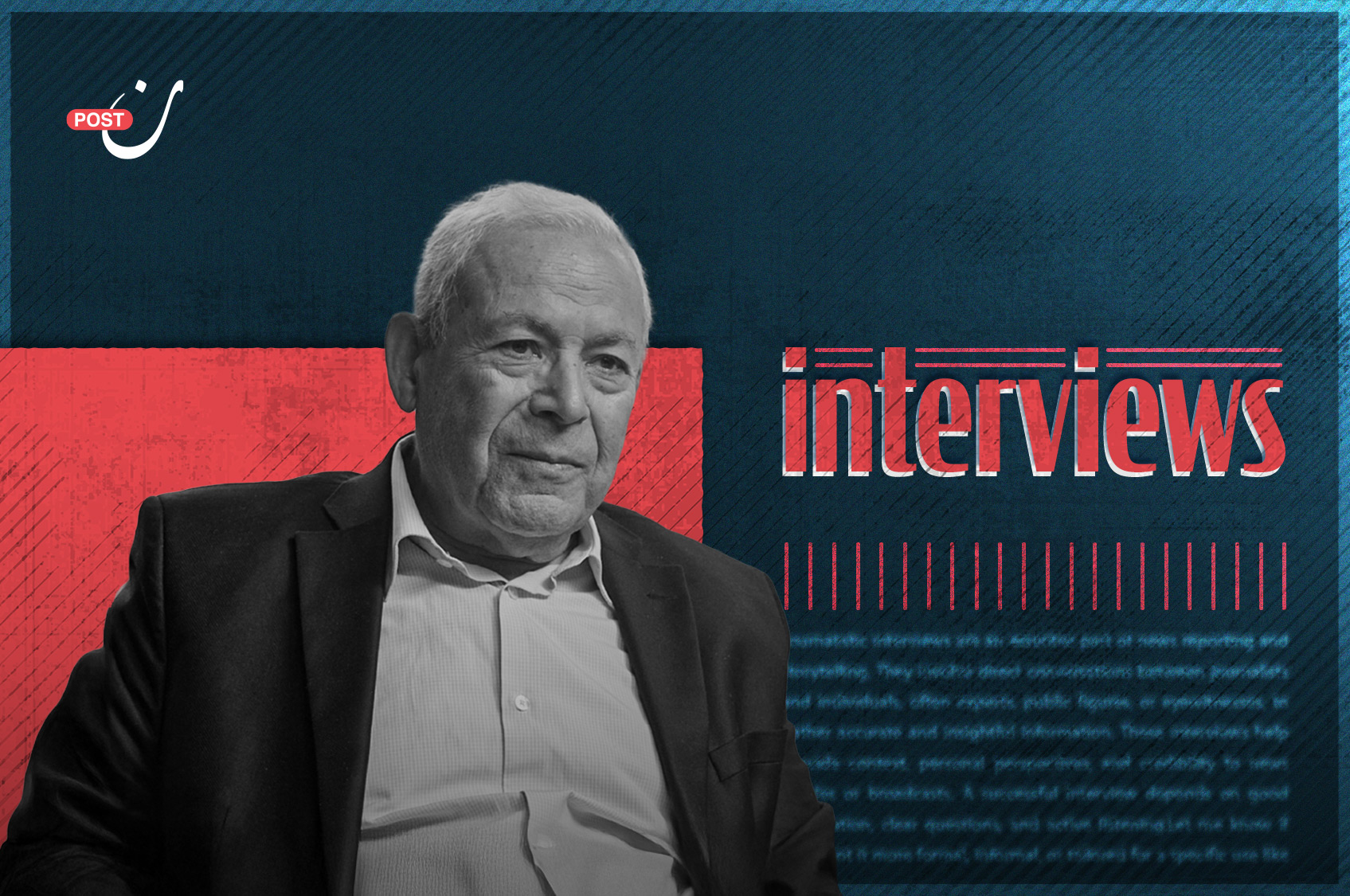
In this interview, prominent Syrian intellectual and academic Burhan Ghalioun offers a deeper reading of the conflict reshaping the region. The war, he argues, cannot be understood in isolation from a broader project that revisits questions of hegemony and influence, nor can it be separated from ongoing attempts to redraw the map of alliances in the Middle East and beyond.
The discussion examines the nature and limits of the current war and explores the idea of a “new regional axis” proposed by Benjamin Netanyahu a project that envisions reshaping the region’s balance of power. The debate does not stop at the regional level. It extends to Syria itself, a country that has spent years at the center of regional turmoil and is now struggling to preserve what remains of its sovereignty.
Is what we are witnessing today against Iran a war against its influence and governing system, or the beginning of dismantling the Middle Eastern order that emerged after the Iranian Revolution?
The war currently unfolding in the Middle East is, first and foremost, Benjamin Netanyahu’s war to remain in power, and a racist Israeli war aimed at declaring regional dominance, entrenching the foundations of an apartheid system in Palestine, and eliminating any hope of the birth of a Palestinian state.
It is also the war of President Donald Trump and a crisis-stricken imperialism against international law and established norms one that seeks to trample the rights of other peoples, seize their resources through armed force, undermine the spirit of global solidarity, and obstruct the rise of other states and global poles. Military superiority is being used to extract quick and unearned gains at the expense of peace, justice, and global security.
At the same time, it is a war waged by the revolutionary guardians of the Iranian empire to preserve their own survival after the retreat of their regional dominance.
The principal victim is the Iranian people, along with the other peoples of the region who are being pushed toward a new era of regional wars conflicts that serve none of their interests but from which they will bear the catastrophic consequences: destruction, devastation, and the loss of their future and that of generations to come.
The arrogance and disregard for global public opinion displayed by the architects of this war have reached such extremes that they no longer feel compelled to justify it. Instead, they simply announced the discovery of the location of Tehran’s leadership and used it as an opportunity to eliminate them and openly force the capital to surrender as though the world were still living in the Middle Ages, or in the era of white colonial settlement in the Americas and the extermination of Indigenous peoples more than five centuries ago.
They have even named their campaign “Epic Fury.”
Unfortunately, this campaign may serve only as a prelude to the violation of the entire region and the spread of chaos and destruction throughout it precisely the outcome sought by Israel’s settler government to legitimize intervention across Arab countries under the pretext of defending Israel’s security and its biblical claims.
About a week before the outbreak of the current war, Netanyahu spoke of a “new regional axis” that would include countries such as India, Greece, and Cyprus alongside Arab states, confronting what he described as a Sunni axis forming while a Shiite axis collapses.
After several days of war, how do you interpret this proposal? To what extent does it reflect an Israeli vision for restructuring alliances in the region?
Through this announcement, Netanyahu is attempting to offer a carrot to some fearful Arab governments, encouraging them to overlook the destruction of the region’s future security, peace, and human development. He also seeks to convince himself, Israelis, and perhaps certain regional leaders that he is advancing a grand strategic initiative to reshape the Middle East under Israeli leadership a vision he has long harbored.
Yet what has occurred since the war of extermination in Gaza, alongside Israel’s occupation of additional territory in southern Syria and Lebanon, and its disregard for the interests of Arab states even those that signed the Abraham Accords should be sufficient to push Arab leaders to avoid falling into this trap.
Arab leaders must reject the dismantling of international law and the chaos that Netanyahu and Trump openly seek to impose. Instead, they should cooperate to build a new Middle East grounded in respect for state sovereignty, the right of peoples to self-determination, and the rejection of foreign intervention wars wars that have brought nothing but destruction to the region, as seen in Iraq, Syria, Lebanon, Yemen, Sudan, and Libya.
Arab states understand that the only objective of this supposed alliance is to ignite an Arab-Iranian, Sunni-Shiite war that would drain all regional powers for decades to come solely for Israel’s benefit.
They must instead thwart this project and work collectively, in coordination with the United Nations and its United Nations Security Council, to launch a comprehensive regional initiative for peace, security, and cooperation among the region’s peoples, protecting everyone’s rights and curbing Israel’s expansionist ambitions.
Just as Khomeinist Iran does not represent Shiites as a faith or a people but instrumentalizes them for a project of regional domination, Arab governments in the Levant do not represent Sunnis either they are political elites pursuing their own interests.
The Sunni-Shiite conflict itself is a colonial project historically used to pit the region’s peoples against one another, facilitating European and later American dominance. Over the past four decades, the Iranian system of Wilayat al‑Faqih used the same division for similar purposes. Now we are witnessing its blowback in the form of Iran’s regional isolation.
This is precisely the dynamic that Tel Aviv seeks to reproduce: Arabs against Iranians and Iranians against Arabs in an endless war whose sole beneficiary would be Israel.
What should follow this devastating war, instead, is a collective awakening among Sunnis and Shiites alike a recognition that these divisions have served a colonial strategy designed to weaken everyone and transform the region into an open plantation for Washington and Tel Aviv.
How do you assess Syria’s position amid these regional transformations? What scenarios might the country face politically, economically, or in terms of security in the coming phase?
Syria has no option but to distance itself from this war while expressing solidarity with Arab states facing missile attacks from Tehran on one side and Israeli-American pressure to become involved in the conflict on the other.
At the same time, the continuation of the war poses a serious threat to Syria’s fragile stability. Syria is not far from the battlefield it lies at its very heart. Only months ago, it was one of the central arenas of what was called the “axis of resistance,” and one of the central stakes in the current regional struggle is control over Syria’s strategic location.
The country is striving, with great difficulty, to maintain even the minimum margin of sovereignty and independence in its decision-making.
Regional instability does not only threaten Syria’s internal political transition and social peace; it also carries significant economic consequences. Much of the hope for reconstruction after the vast destruction caused by the internal war, in which Tehran’s system was also deeply involved rested on Gulf investment.
But the current wartime climate, and the destruction it may bring even to Gulf countries themselves, could undermine confidence in investing across the region.
For this reason, Syrians may need to reconsider their reconstruction strategies and place greater emphasis on domestic human and natural resources.
What practical and political steps should the Syrian government take to prevent the country from being dragged into a regional conflict of this magnitude?
The most important step is tightening control over the Lebanese and Iraqi borders to prevent militias supported by Iran from using them as routes that could pull Syria into the conflict.
Syria must also coordinate closely with other Arab states particularly the Gulf countries, Jordan, and Turkey to unify positions and address shared risks.
More crucial still is strengthening the domestic front. This includes resolving the political issues that obstruct progress in the transition process and developing a clear program for navigating this extremely sensitive phase, which is unfolding amid highly volatile regional circumstances.
It also requires confronting urgent economic and social challenges inherited by the new authorities after six decades of authoritarian rule allied with Tehran.
Nothing will strengthen national unity and rebuild trust so desperately needed in times of crisis more than engaging openly with the public, cooperating with citizens to solve their problems, involving them in responsibility, practicing transparency, and placing the rule of law above ideological or political calculations.