














After maintaining silence during the first two days of the US–Israeli attack on Iran, Hezbollah officially announced its entry into the confrontation by launching rockets and drones toward northern Israel on the morning of March 2, a move that shifted the Lebanese group from the position of observer to that of a direct actor in the escalation equation.
This involvement came just hours after the assassination of Iran’s Supreme Leader, Ayatollah Ali Khamenei, along with several senior commanders an act deemed to have crossed a “red line” that could not be met with restraint or watchful hesitation.
Hezbollah’s leadership concluded that maintaining the neutrality it had observed during the first two days was no longer viable, and that transitioning to military action had become a political and security necessity.
Beyond the domestic repercussions within Lebanon and the potential pretext this step may offer Israel to widen its operations, deepen its incursion into southern Lebanon, and impose new security and logistical arrangements more pressing questions have emerged since Hezbollah’s entry into the fray. These concern the party’s reading of the current balance of power and its assessment of the costs and benefits of its decision.
The first question centers on how Hezbollah interprets the present balance of forces, despite the devastating blows it suffered during the 2024 Gaza war, which resulted in the loss of its first- and second-tier leadership, as well as the erosion of a significant portion of its arsenal and military capabilities.
More sensitive still is the scale and scope of its involvement: Are we witnessing a calibrated intervention designed to send controlled messages, or the beginning of an open-ended escalation? Most pressing of all: Will Hezbollah’s entry set a precedent that breaks the neutrality of Iran’s other regional proxies, opening the door to a broader, multi-front confrontation?
Official Entry Into the Battle
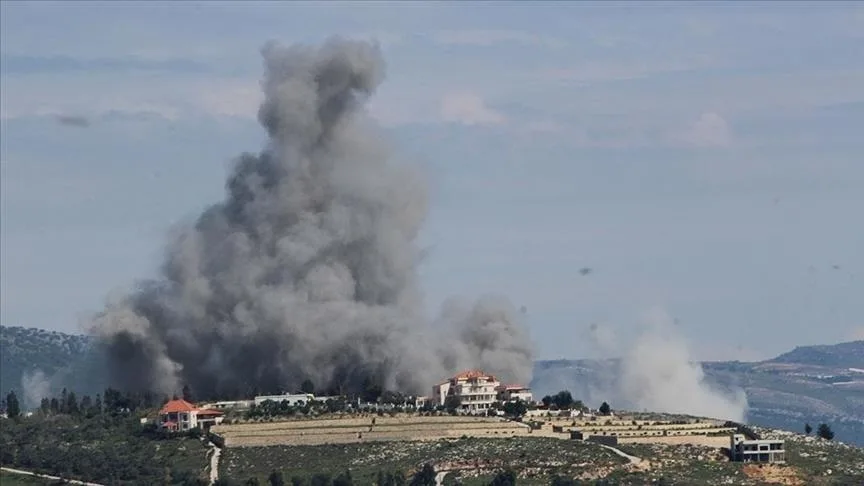
Hour by hour, Hezbollah expanded its direct and conspicuous engagement in the escalation, moving beyond political condemnation to successive barrages of rockets and drones aimed at northern Israeli territory. Among the targets was the Meron air surveillance and operations management base in northern Israel, where one radar system and a command building were reportedly hit.
The group also targeted radar installations and control rooms at the Ramat David airbase, as well as the Nafah base, headquarters of the 210th Bashan Division in the occupied Syrian Golan Heights. The Israeli government reported that four settlers in the Galilee were wounded in the strikes.
In response, the Israeli military launched heavy attacks on Beirut’s southern suburbs, killing 52 people and wounding 154, according to Lebanon’s Ministry of Health. At the same time, Israeli forces ordered the immediate evacuation of more than 80 villages in southern Lebanon.
On the ground, an Israeli force comprising a tank and three bulldozers advanced from the Metula settlement and pushed toward the Tal al-Nahhas area between the towns of Kfarkela and Burj al-Muluk in southern Lebanon.
With these developments, Hezbollah is no longer merely observing the escalation it has become a direct participant in the war, with all the implications that entails for the trajectory, limits, and potential expansion of the conflict.
Defense and a “Legitimate Right”
In a statement issued on Tuesday morning, March 3, Hezbollah defended its operations against Israel which have drawn domestic criticism describing them as an “act of defense and a legitimate right.” The group called on what it termed “concerned and responsible parties” to act to “halt the aggression,” describing it as the “direct cause of all that is unfolding.”
Hezbollah asserted that “Israeli aggression has continued against Lebanon for fifteen months” through “killing, destruction, bulldozing, and all forms of criminality,” arguing that political and diplomatic efforts had failed to curb this aggression or compel Israel to implement the ceasefire agreement and its provisions.
The statement stressed that the ongoing assault could not be justified by pretexts and that confrontation was a “legitimate right.” What the “Islamic Resistance” had undertaken, it said, was a reaction to aggression, grounded first and foremost in national considerations and aimed at securing safety and stability for Lebanon’s people and regions.
The Military Ban: A Disruption of Calculations
On the evening of Saturday, February 28 the first day of the US–Israeli strike on Iran Hezbollah issued a lengthy statement expressing political support for Tehran and calling on regional governments and peoples to stand against what it described as a dangerous scheme.
At the time, this stance reinforced a widespread perception among Lebanese that Hezbollah was prioritizing Lebanon’s security and had absorbed the cost of sliding into a new confrontation with Israel, especially given the heavy losses it had sustained to its organizational, administrative, and military structure.
Accordingly, many expected the group to maintain neutrality, limiting itself to political support and condemnatory statements until the assassination of Iran’s Supreme Leader, officially announced on Iranian state television, marked a decisive turning point. Hezbollah effectively abandoned its neutrality and declared itself a direct party to the confrontation, even if it later framed its actions as a response to Israeli violations in southern Lebanon.
This move triggered discontent within Lebanon’s still-fragile government, headed by Prime Minister Nawaf Salam. Anticipating Israeli retaliation, the cabinet took an unexpected and consequential decision: banning all Hezbollah military and security activities and declaring any rocket or drone launches from Lebanese territory illegal a move that sparked fierce debate.
Notably, the decision passed with the approval of ministers affiliated with Hezbollah and the Amal Movement, without objection or withdrawal a departure from past practice. Many interpreted this as a sign of divergence or internal tension within Hezbollah’s political environment, raising broader questions about the party’s strategic approach and loyalties amid a volatile regional moment.
Ideological Primacy: Hezbollah’s Core Approach
From a pragmatic standpoint, Hezbollah’s current condition within this highly sensitive regional context would have suggested adopting cautious neutrality and avoiding escalation or the opening of new fronts with Israel and the United States.
Yet the path it ultimately chose reflects a different political logic, shaped by its role within the Iran-backed “Axis of Resistance.” Its decision cannot be separated from its weight within this network, its “functional value” to Tehran, and the regional presence it derives directly or indirectly from Iranian support.
From Tehran’s perspective, Hezbollah is the linchpin of its proxy network, one of the most influential and favored organizations. The targeting of Iran at its core through the assassination of its Supreme Leader and the possibility of regime destabilization constitutes, in Hezbollah’s calculations, an existential matter affecting the axis’s balance and the party’s future within it.
Hezbollah thus faced a complex political dilemma. If it refrained from fighting, it risked eroding its central status within the axis in favor of Iraqi or Yemeni actors and appearing to abandon its primary patron at a critical juncture.
If it intervened, it risked dragging Lebanon into a new war at a time of unprecedented internal collapse a danger repeatedly warned against by Lebanese politicians.
It chose swift entry into the confrontation. Yet the crux of the issue now lies not in the decision to engage, but in the level and limits of that engagement: Will it remain controlled and calculated, or spiral into an open conflict that imposes costs beyond what Lebanon can bear?
The Iraqi Front: Early Involvement
Lebanon was not the only arena to engage early. The Iraqi front quickly emerged perhaps even preceding Lebanon in tempo given Iraq’s status as a traditional sphere where Iranian and American interests intersect.
The presence of US bases in Iraq, alongside armed factions linked to Iran, has made the country directly vulnerable to the conflict’s reverberations. Pro-Iran factions found themselves swiftly drawn into the battle after becoming targets of US strikes, including reported airstrikes on Kataib Hezbollah positions in Jurf al-Sakhar (officially Jurf al-Nasr) north of Babil province.
In response, these factions targeted US military bases in Erbil. The “Islamic Resistance in Iraq,” including Saraya Awliya al-Dam, claimed a drone swarm attack on the Victoria military base at Baghdad International Airport, framing the operation as support for the Islamic Republic of Iran.
From the earliest hours, then, Iraq became a direct theater of war, amid expectations of continued escalation given the country’s precarious balance between Iranian influence and the presence of the United States and its allies.
The Houthis and Cautious Neutrality
On the Yemeni front, the tempo of engagement has thus far been less intense. Despite the prominent role played by the Houthi movement over the past two years establishing itself as one of Iran’s most active regional arms it has adopted a posture of cautious neutrality.
Houthi leader Abdul-Malik al-Houthi declared his group “fully prepared for any developments,” asserting that there was “no need to worry about Iran” in the face of “US–Israeli aggression” and expressing confidence that Tehran’s response would be decisive.
So far, however, the group has limited itself to political support and calls for demonstrations, describing its stance as one of Islamic and moral solidarity with Tehran while emphasizing readiness to act should circumstances require.
Several factors shape the Houthis’ calculus, foremost among them developments inside Iran. If Tehran’s response proves sufficient to contain the blows and restore deterrence, there may be less need to activate the Yemeni front preserving it instead as a strategic reserve, especially amid talk of a prolonged war.
Domestic pressures also weigh heavily: financial suffocation under sanctions, mounting public discontent over deteriorating living conditions, and the risks inherent in large-scale mobilization. Recent strikes have also degraded parts of the group’s military capacity, encouraging caution before entering a confrontation that differs significantly in scope and intensity from previous rounds.
Thus, this “cautious neutrality” does not signal a pragmatic retreat from supporting Tehran so much as a watchful approach: keeping the option of intervention on the table while postponing activation until leadership judges that the cost of remaining outside the war exceeds that of joining it.
In sum, Tehran is racing against time to absorb the initial shock of war at the lowest possible cost, after losing the apex of its political and religious hierarchy and a cadre of senior military leaders. Its network of proxies remains a set of pressure cards activated or withheld depending on evolving balances.
Under this logic, no scenario is off the table. The pragmatism of proxies and their local calculations intersect with ideological loyalties and financial dependencies to form a new war equation one fraught with unpredictable possibilities.
With each passing moment, indicators of unprecedented escalation multiply, casting a shadow over the entire region and placing it before a perilous and uncertain test.


