
India is moving at a rapid clip to entrench its presence on the global stage not merely as a partner within the international system of interests, but as an influential actor capable of reshaping the geopolitical chessboard.
It is now evident that this momentum can no longer be reduced to a regional rivalry with neighboring powers—China and Pakistan in particular as was once the case. New Delhi’s geopolitical ambitions have expanded well beyond its immediate periphery, reaching toward a broader reconfiguration of global spheres of influence.
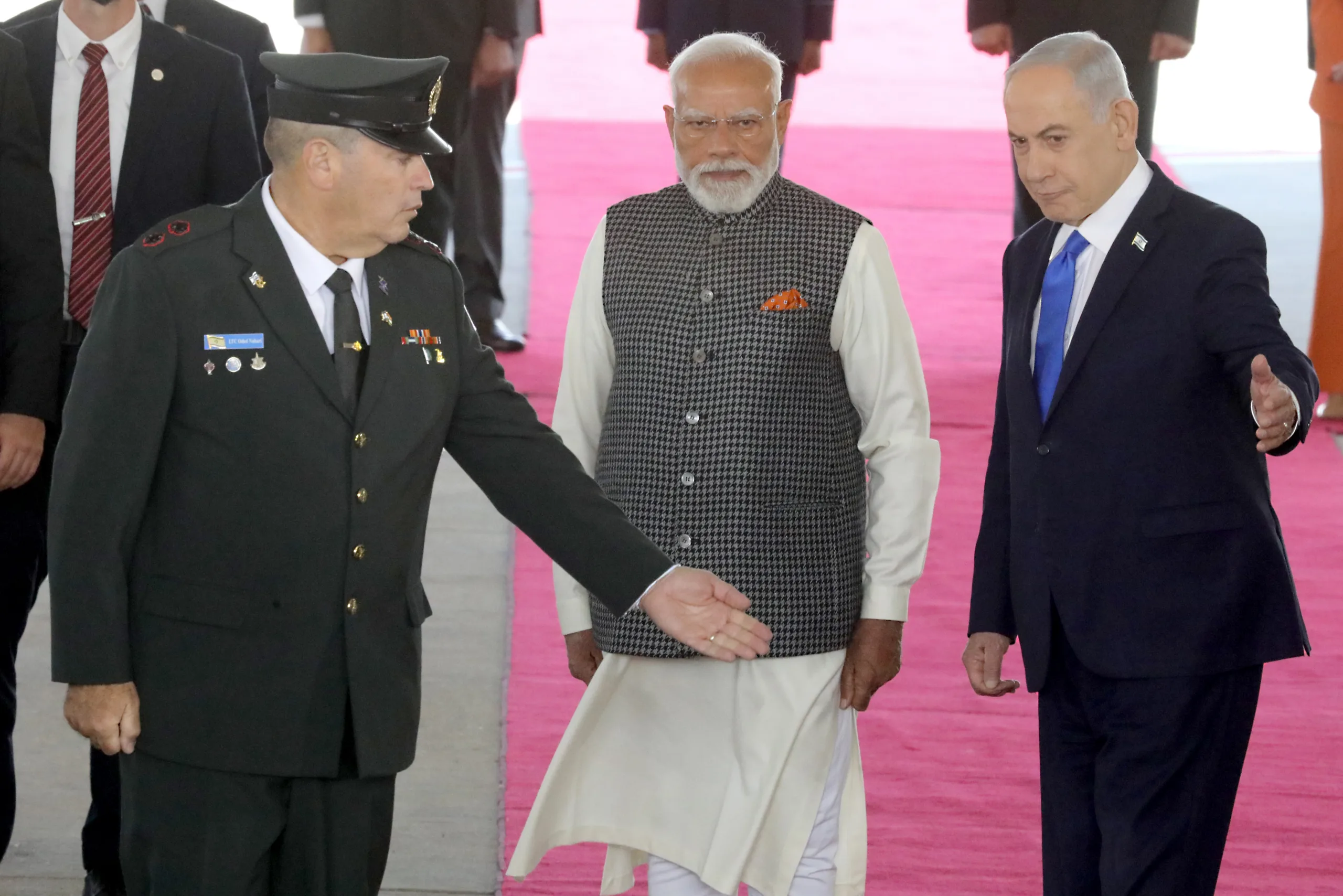
Within this context comes Indian Prime Minister Narendra Modi’s visit to Tel Aviv on Wednesday, January 25 an occasion that transcended the symbolism of protocol. The extraordinary warmth that surrounded Modi’s meeting with his Israeli counterpart, Benjamin Netanyahu, underscored a striking convergence in outlooks and positions, even reflected in the nuances of body language that conveyed a high degree of rapport and personal chemistry between the two leaders.
Modi’s trip his second since taking office, following his first visit in 2017 cannot be dismissed as a routine diplomatic stop. He arrived with a defined political agenda, situated within a web of Indian alliances stretching from Asia to the United States, through the Middle East, and from the fringes of Europe deep into Africa.
At the heart of these alliances lie the Arab states, positioned within a delicate and often confounding balance. Despite India’s generally positive relations with countries across the region, New Delhi operates according to a strict pragmatism and a transnational political ambition that pays limited heed to regional sensitivities or Arab national security considerations.
If not carefully assessed and strategically managed, this expansion could evolve into a new source of pressure, unsettling regional calculations and pushing the Middle East toward greater complexity akin to placing it atop a volcano of overlapping alliances and fragile balances. The essential question, then, becomes: What are the likely consequences of India’s rising ambitions for Arab states and the broader Middle Eastern order?
The “Six-Way” Alliance
On February 22, Netanyahu ignited widespread speculation when he spoke of efforts to form a “six-way” alliance orbiting the Middle East, comprising India, Greece, and Cyprus, alongside unnamed Arab, African, and Asian states. He indicated that he would work to flesh out this framework during Modi’s visit to Tel Aviv.
According to the Israeli prime minister, the declared aim of the alliance is to confront what he termed the “Shiite alliance” a reference to Iran and its regional axis as well as to counter what he described as an emerging “Sunni alliance,” alluding without explicit confirmation to a Turkish-Saudi-Pakistani alignment, potentially with extensions involving Egypt and Qatar.
When Netanyahu’s remarks are considered alongside Modi’s statements during the visit particularly his explicit support for Israel and its regional policies the contours of a broader shift become visible. This appears to extend beyond economic coordination or conventional political understandings, pointing instead toward an attempt to engineer a more comprehensive axis of alliances, one resembling durable regional blocs capable of producing long-term alignments.
Under this reading, a clearer configuration begins to emerge: a growing India–Israel alignment, bolstered by overt Emirati support, counterbalanced by a competing axis centered on Saudi Arabia, Pakistan, and Turkey, with Egypt and Qatar potentially aligning or intersecting with it on certain issues.
Complicating matters further is New Delhi’s continued maintenance of cordial relations with some capitals within this “counter-axis.” This fluidity disrupts straightforward calculations and introduces shifting balances that evolve according to changing interests and policy files drawing the region into an even more intricate and sensitive political calendar.
Tel Aviv–New Delhi: A Convergence of Visions
Since the 1990s, India–Israel relations have developed at a pace exceeding that of most bilateral relationships. Over three decades, they have become a model of convergence, at times approaching near-identical strategic outlooks.
This rapprochement rests on hard-edged pragmatism governed by the language of interests rather than principles. It is underpinned by tangible mutual gains reinforced through an expanding partnership. On the logistical and economic front, Tel Aviv afforded New Delhi a significant strategic opening when India’s Adani Group secured a contract to manage a terminal at Haifa Port, replacing Chinese firms.
The move granted India advanced maneuvering space in the Eastern Mediterranean, enabling it to edge ahead of Beijing in a theater increasingly shaped by competition over corridors and ports.
Militarily, India has emerged as one of the largest customers of Israel’s defense industry, accounting for approximately 34 percent of Israeli arms exports. Over the past five years, it has been the leading market for Israeli weapons, including advanced military technologies such as drones, surveillance systems, and reconnaissance and intelligence applications.
Israel has also bolstered India’s military presence in operational environments linked to the region. New Delhi participated in joint exercises on occupied territory, including the “Blue Flag” exercise in 2014 alongside the United States and several European states. These drills provided operational experience and enhanced India’s aerial capabilities strengthening its readiness to confront border-related challenges, particularly those involving China and Pakistan.
Over time, the relationship has deepened further through India’s participation in influential regional groupings such as the I2U2 bloc, established in 2022 and comprising India, Israel, the United States, and the United Arab Emirates. This framework has broadened New Delhi’s access to Israeli geography as a gateway to the Eastern Mediterranean, energizing the India–Middle East–Europe Economic Corridor (IMEC) by positioning Haifa as a strategic hub linking Mumbai to European markets.
Collectively, these evolving ties have gradually positioned New Delhi as an increasingly influential actor on the global geopolitical map within trade dynamics, networks of influence, and emerging alliance systems.
For Modi and his government, this strategic convergence with Tel Aviv appears not merely transactional, but reciprocal a partnership marked by alignment in positions, synchronization in outlooks, and unity in policy.
India’s Strategic Mindset
Understanding the strategy behind India’s rapid diplomatic and security expansion requires examining its decision-making logic, encapsulated in the doctrine of “India First.” Interests—not normative considerations—serve as the compass guiding Indian policy. While this can produce apparent contradictions, such inconsistencies align with a sharp pragmatism that treats contradiction as a tool of maneuver rather than a flaw.
This duality is evident in India’s relations with major powers. Despite periods of trade and political tension with Washington, New Delhi continues to solidify strategic partnerships—particularly in defense cooperation viewed as a pillar of balance within a fluid international order.
The same logic applies to Europe. India manages disagreements as acceptable costs for preserving open channels of partnership, embracing what might be termed “extreme pragmatism,” where returns outweigh rhetorical coherence.
Many analysts attribute this approach to India’s chronic security environment, especially its border disputes with China and Pakistan. China’s expanding influence in the Indian Ocean politically, economically, and militarily has prompted New Delhi to reassess its positioning and broaden its strategic partnerships in search of depth beyond its immediate geography.
Accordingly, India has pursued a defense-security approach reinforced by economic and political instruments, aimed at cementing its role as a security actor in the Indian Ocean and adjacent theaters.
This has translated into expanded naval deployments, heightened presence along vital maritime corridors, and defense cooperation with several African states bordering the Indian Ocean alongside increased involvement in maritime security and anti-piracy missions, including in the Gulf of Aden.
Financial indicators reinforce this trajectory. India’s 2026–2027 fiscal budget allocates approximately $86.7 billion for defense a record figure representing a 15.19 percent increase over 2025–2026 estimates underscoring the centrality of security and military modernization to state policy.
Not the First “Six-Way” Axis: An Expanding Web of Alignments
Talk of a regional “six-way alliance” is merely one node within a broader network of arrangements that New Delhi has cultivated in recent years intersecting, to varying degrees, with Arab interests while repositioning India as a pivotal global actor.
Greece has emerged as a key pillar in India’s Eastern Mediterranean strategy, particularly following Modi’s 2023 visit to Athens the first by an Indian prime minister in four decades. The visit signaled ambitions extending beyond bilateral ties toward a strategic European–Mediterranean footprint amid energy and maritime competition.
This orientation dovetails with IMEC, which runs through Haifa Port and aims to connect India directly with European markets via a multimodal land–sea route. Far from a mere logistical initiative, the project represents a framework for reshaping trade networks and alliances, complementing India’s evolving security and defense ties with the European Union after years of negotiations.
In Africa, the Horn—particularly Somaliland—has become central to India’s strategic calculus. The geostrategic location of Berbera Port, overlooking the Gulf of Aden and the southern gateway to the Red Sea, offers leverage over global trade flows and supply lines.
India’s interest reflects efforts to construct logistical and security arrangements that bolster its maritime presence and counter growing Chinese influence in one of the world’s most critical navigation zones.
Potential Repercussions for the Middle East
At first glance, India’s expanding footprint in the Middle East may not appear threatening to Arab states; some even view it as an economic opportunity, given India’s status as one of the world’s fastest-growing economies and its vast consumer market exceeding 1.4 billion people.
Yet an alternative reading raises concerns about the long-term strategic implications. Deepening India–Israel ties particularly where positions converge on sensitive regional issues fuel apprehensions that India’s rising influence could evolve into an additional pressure point on Arab policy stances.
Economically, India’s diversified global partnerships may gradually reduce its reliance on traditional Gulf energy supplies as it seeks alternative sources and renewable energy pathways potentially affecting hydrocarbon-dependent economies.
Major initiatives such as IMEC could also reshape regional trade balances, redirecting maritime and land routes. This may have varying implications for established corridors like the Suez Canal, while elevating the role of Eastern Mediterranean ports.
From a security perspective, India’s widening alliance network and expanding technological-military capabilities introduce a new variable into already complex regional equations.
Its growing interest in the Horn of Africa and the continent’s eastern seaboard directly tied to Red Sea security and vital shipping lanes will be closely watched by concerned capitals.
Politically, India’s ascent may contribute to reshaping Middle Eastern geopolitics, whether through emerging alliances or intensifying global competition, particularly between India and China. Arab states may find themselves navigating delicate balances—seeking diversified partnerships without drifting into polarizations that impose political or economic costs.
Ultimately, India’s regional rise presents a dual equation of opportunity and challenge. It opens avenues for cooperation with a major economic power boasting a vast market and investment potential. Yet it also raises concerns tied to entangled global alliances and sharp geopolitical competition especially amid growing India–Israel alignment.
The central challenge for Arab states, therefore, lies in managing this transformation with strategic pragmatism: maximizing economic and political gains while mitigating potential risks, within a regional and international environment defined by rapid shifts and intersecting interests.