




“Braveheart” was the name given to the operation carried out by Israeli occupation army units on January 25, aimed at locating and retrieving the body of the last “Israeli” captive held in the heart of the Gaza Strip, Ran Guily. The recovery was intended to pave the way for concluding the first phase of the ceasefire agreement and moving toward closing the long-running file of Israeli captives held by the resistance, a dossier open since 2014.
Behind the operation’s name lay a sweeping Israeli media campaign that meticulously chronicled its details, portraying it as an act of battlefield heroism and the recovery of a fallen citizen’s remains. It was framed as yet another affirmation of a maxim that has become something of a covenant for successive Israeli governments: “We leave no one behind.” Even if that meant scattering the remains of 250 Palestinian bodies, leaving them strewn across the site.
The matter extends beyond the physical disturbance of graves. It assumes broader Israeli media and political dimensions that reaffirm the Palestinian his body and remains as an object, or less than that. In the following lines, we trace Israeli media coverage of what was described as the “heroic” recovery of Ran Guily, in an attempt to shed light on occupation policies toward the Palestinian body most recently through the delivery of boxes containing corpses and dismembered remains and to contrast this with the reverence accorded to the Israeli body and spirit.
Emotion and Courage Through a Colonial Lens
On the Israeli news site Ynet, the exhumation of Guily’s body from a Palestinian cemetery in Gaza was documented under the headline: “Fighters Burst into Tears and Embraced at the Graves.” The article described a complex and arduous operation carried out on the front lines, quoting the major in charge identified as “Mehalam” who emphasized respect for the dead, stating: “This is one of the differences between us and our enemies,” after noting that the bodies had been examined to ensure they were free of explosives.
The narrative begins from the perspective of the bomb disposal unit commander, described as “among the first to approach the Palestinian bodies removed from the cemetery in eastern Gaza City, touching them to ensure they were not rigged with explosives.” The report dwells on the joy and tears of the “fighters” upon finding Guily’s body, while omitting any further mention of the Palestinian remains.
On another platform, the operation was dubbed a “DNA revolution in the heart of Gaza,” referring to the military rabbinate’s identification and burial branch, which succeeded in conducting DNA analysis “under enemy fire and issuing a swift halachic ruling.” In fact, the operation was carried out in coordination with the Palestinian resistance following the ceasefire agreement and in full compliance with it by the resistance.
In a radio program titled “Eight Zero Zero,” Rabbi Nir Yaffe elaborated at length on the operation, describing it as exceptionally complex and unprecedented, combining personal and professional challenges and reflecting advanced capabilities that enabled the army to conduct DNA identification in the field. This came despite the army’s two-year struggle of exhuming Palestinian graves in search of its soldiers’ bodies.
Even lifestyle and health pages joined the coverage of what was deemed a major event—but from a “medical” angle. On the Israeli platform “Mako Health,” Dr. Assi Sharon, a specialist in oral and maxillofacial reconstruction, was spotlighted for her role in identifying Guily’s body.
Her interview was headlined: “My Heart Raced and I Lost My Composure.” The article detailed her work under difficult field conditions alongside soldiers and the moment she realized the identification process had been completed and the file closed. She described her work as a “national mission” in which hundreds of bodies were examined without any mention of whose bodies they were.
Meanwhile, the clerical website “Vilna Gaon” focused on the logistical, security, and forensic obstacles accompanying the operation, as well as the role of the global rabbinate in developing tools and methods to ensure the reunion of the Jewish soul and body at resurrection. The search was led by the Third Brigade alongside Iskandroni forces, an infantry unit, the Yahalom engineering unit, and 20 forensic doctors.
The operation centered on examining as many bodies as possible in the shortest time. Follow-up units from Abu Kabir Forensic Institute were mobilized, along with fingerprint, dental, and field DNA teams. Guily’s body was found after 250 corpses had been examined.
Notably, while the reports emphasize the precision of DNA testing and fingerprints and dramatize the “heroism” of working swiftly in “enemy territory,” they also acknowledge that Guily’s body was found largely intact, still wearing his official uniform, in an area identified by a Palestinian Islamic Jihad prisoner familiar with the movements of the cell that had held him.
The disclosure that the Shin Bet interrogated a member of Islamic Jihad with direct knowledge of the burial site thereby narrowing the search leaves little doubt that exhuming 250 bodies was not a genuine necessity, particularly as graves were being simultaneously disturbed in the pursuit of speed.
“First to Enter… Last to Leave,” read the headline of a report in the Israeli newspaper Mishpacha, recounting how Guily left on the morning of October 7 to confront the assault and was recently recovered. The piece gave space to his mother, to his mourning council, and to the collective relief of Israelis at the return of “their last one.” It also revealed a hidden dimension of the exhumation process.
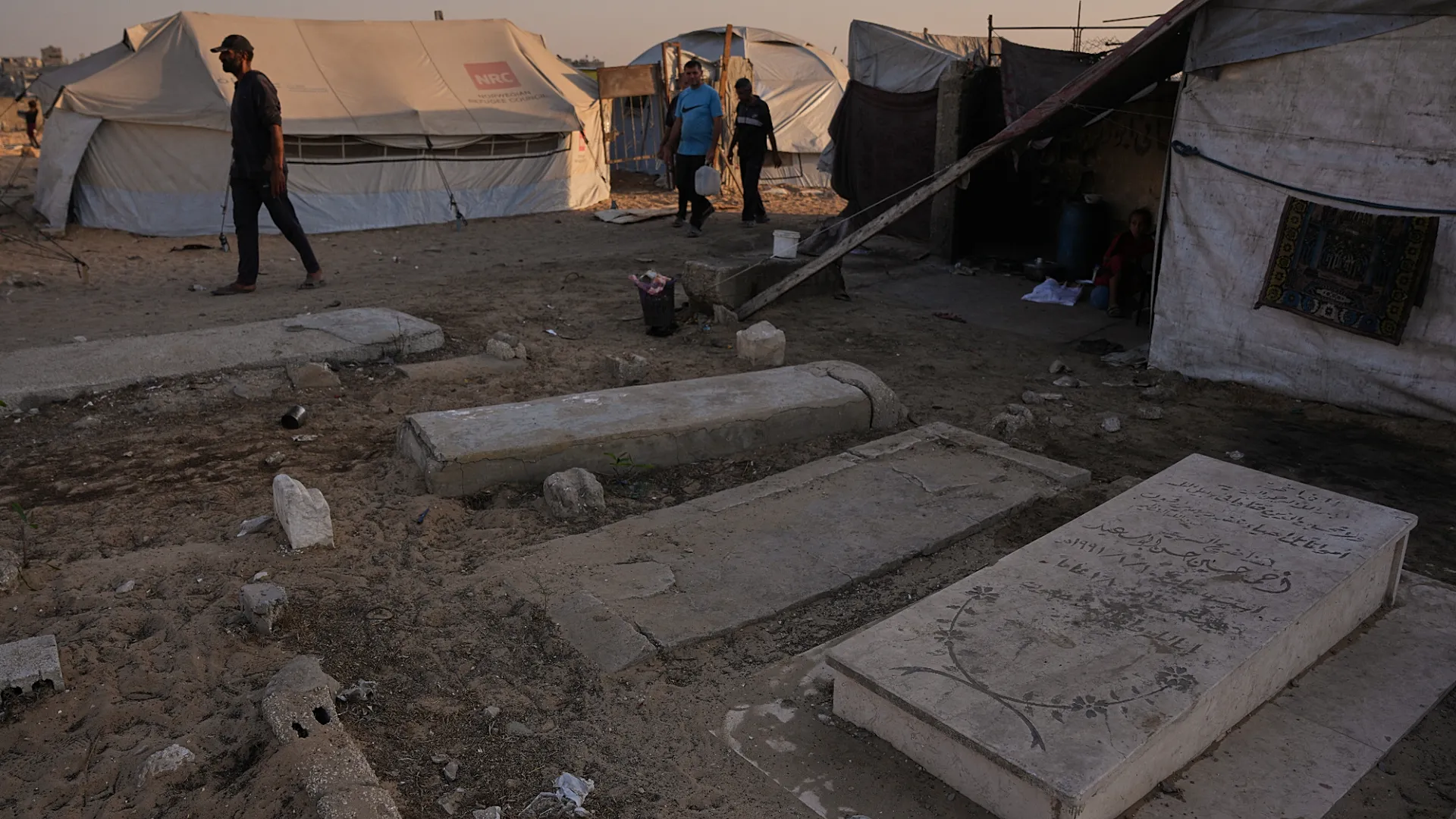
According to the report, occupation forces exhumed 800 graves in al-Batsch cemetery. Despite Islamic graves typically bearing details such as age and gender, the forces carried out a comprehensive and collective exhumation. From these, 250 bodies sharing Guily’s approximate age, gender, and height were selected for forensic examination.
The report further disclosed that 150 experts, technicians, and engineers participated, including forensic dentists, lab technicians equipped with portable X-ray machines, and members of the military rabbinate. It reaffirmed that Guily had been wearing the uniform of the special police unit “Yasam,” stripping away any remaining justification for Israeli tampering with Palestinian graves and bodies.
The article largely bypassed any reference to Palestinians, focusing instead on the soldiers who worked for 24 consecutive hours exhuming the cemetery, who hastened to cover Guily’s body with the Israeli flag and sing over him. It concluded with the line: “Perhaps gathering Ran Guily’s remains and burying them in the Land of Israel heralds our own redemption as well.”
In reality, the coverage across other Israeli outlets differed little. All praised the operation’s heroism and courage in retrieving a body from among hundreds, conducting a swift search in enemy territory, and bringing closure to a decade-long file of captives. The word “Palestinians” was scarcely mentioned; they appeared only as “bodies” and “remains.”
This erasure is magnified by the fact that several Palestinian corpses were transferred to Abu Kabir Forensic Institute in Jerusalem. The occupation army declared the area a closed military zone after completing its search.
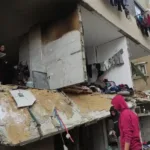
Journalistic footage showed shattered graves, bodies strewn outside their burial sites, and widespread destruction in the cemetery denying Palestinians even the ability to identify their loved ones’ final resting places.
Bones and Remains
This Israeli media treatment of the Palestinian body is not detached from a prevailing political and social ideology that views the Palestinian as an object to be disposed of. Less than a week after the exhumation at al-Batsch cemetery and the scattering of the dead’s remains left vulnerable even to stray animals occupation authorities handed over the bodies of 54 Palestinians killed, along with 66 boxes containing remains and body parts, via the International Committee of the Red Cross.
The handover did not come as part of the ceasefire arrangements or after coordination with Palestinian health authorities and medical teams. It was sudden, prompting Gaza’s Director General of the Ministry of Health, Dr. Munir al-Barsh, to write on X that “it is as if the goal was not merely to end life, but to erase identity, break memory, and humiliate the living before the dead.”
The Special Committee for Missing Persons and Unidentified Bodies at Gaza’s Ministry of Health announced the activation of a dedicated identification room since late January to verify the identities of the martyrs and complete legal procedures for burial in a manner befitting their dignity.
Families of the missing were called upon to attend and participate in the identification process, to help end the anguish of searching and enable relatives to receive their loved ones’ remains. The identification process in northern governorates was scheduled to take place at al-Shifa Medical Complex from 9 a.m. to 2 p.m. over three consecutive days.
In the face of this tragedy, Israeli media limited themselves to brief English-language reports, treating the matter as an external affair. The Times of Israel headlined its piece: “Hamas-run Health Ministry announces return of remains of dozens of Palestinians to Gaza,” adding that “Israel did not comment on the ministry’s statement.”
No mention appeared in Hebrew-language outlets, as though the event had not occurred. This silence underscores the alignment of Israeli policy and media, united in a single premise once articulated by Israeli Finance Minister Bezalel Smotrich: “There is no such thing as a Palestinian people.”
More Than Just Policy
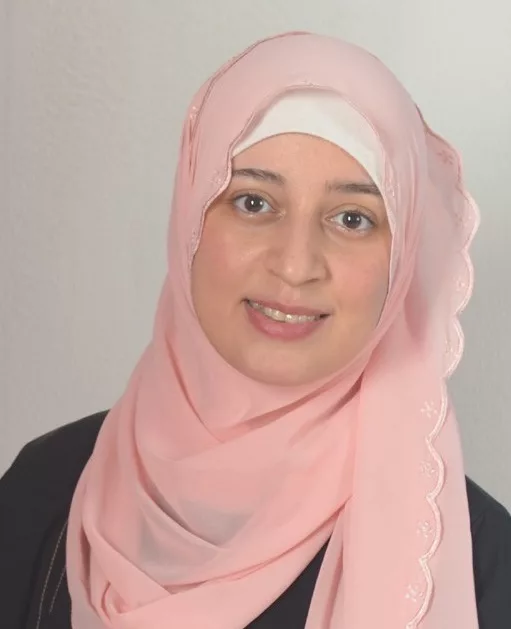
Sociologist Iman al-Badawi, a specialist in the sociology of resistance and occupation policies, told Noon Post that “the policy of exhuming graves and returning mutilated remains after detention represents two opposing pillars in constructing a colonial power structure that continually reproduces violence and conflict. Violence inflicted upon the dead body extends to violence upon the living body.”
She added that the manner in which bodies are returned often in poor condition, bearing signs of torture and fragmentation reintroduces Palestinian society into a recurring state of trauma, rather than allowing it to enter a phase of healing and closure.
As for grave exhumations—repeated throughout what Palestinians describe as a genocide—they transform cemeteries from spaces of collective memory and reverence into contested sites of meaning and identity. Cemeteries function as mechanisms of mourning and collective recognition of the dead within an inherited cultural framework.
When occupation forces destroy and bulldoze cemeteries, open graves, mix remains, displace bodies from their original sites, and confiscate them without clear documentation, they target the symbolic and national structures that sustain collective memory and social resilience.
They sever the symbolic bonds between the living and the dead, generating a collective sense that even death does not mark the end of suffering.
Returning remains in a mutilated and fragmented state, al-Badawi argues, deepens the psychological pain of families and fuels collective frustration particularly regarding the cost and perceived futility of resistance while serving as a performative assertion of Israel’s control over every dimension of life and death.
In sum, Israel appears intent on ensuring that Palestinians never forget its capacity to torment their existence and their endings. Even when it performs what might be construed as a humanitarian act returning bodies and granting families a measure of closure—it does so in a manner that degrades the Palestinian body and violates its dignity.
Not merely because it is an occupying power, nor solely out of an expanding desire for retribution, but because, in its view, the Palestinian does not deserve even an honorable ending the hymns and prayers afforded to its own soldiers. In the past, Menachem Begin declared: “The good Palestinian is a dead Palestinian.”
Today, the “good Palestinian” is not only dead, but denied burial with dignity or remembrance in wholeness the Palestinian whose body, even in death, remains subject to examination, suspicion, bargaining, and violation; whose life and remains persist as terrain for the occupier’s control and manipulation.