
















Following the launch of Operation Al-Aqsa Flood on October 7, 2023, and Hezbollah’s entry into the conflict the following day, Israel has not treated Lebanon merely as a military front but as a theater for systematic abduction operations driven by its “long arm” doctrine, unhindered by any deterrent.
Despite a ceasefire agreement, Israeli occupation forces continue to breach Lebanese territory, conducting raids targeting specific individuals who are then abducted. What are the latest developments in this campaign, and what are the most notable kidnappings carried out by Israel in Lebanon since the start of the war?
Israel’s Most Notorious Abduction Operations in Lebanon
1. Ground Raid and the Abduction of an Islamic Group Leader
On February 9, 2026, Israeli forces carried out a ground infiltration into the village of Habbariyeh, located in the Arqoub region east of Hasbaya District. They raided the home of Attoui Attoui, a local leader in the Islamic Group, assaulted his family, and took him across the border into Israeli-held territory.
According to Lebanon’s National News Agency, around 20 Israeli soldiers entered the village on foot at 2 a.m. before arresting Attoui. The Israeli army swiftly confirmed the abduction, justifying the raid with the claim that weapons had been found in his home.
The Islamic Group denounced the kidnapping as “part of a series of daily violations,” asserting that Israel aims to terrorize residents of southern Lebanon and force them to abandon their villages. The group called on Lebanese authorities and international bodies to urgently intervene and secure the release of all detainees.
2. Seaborne Infiltration and the Abduction of a Ship Captain
In a striking operation far from the southern front, Israeli forces carried out a geographically distant raid revealed by The Guardian.
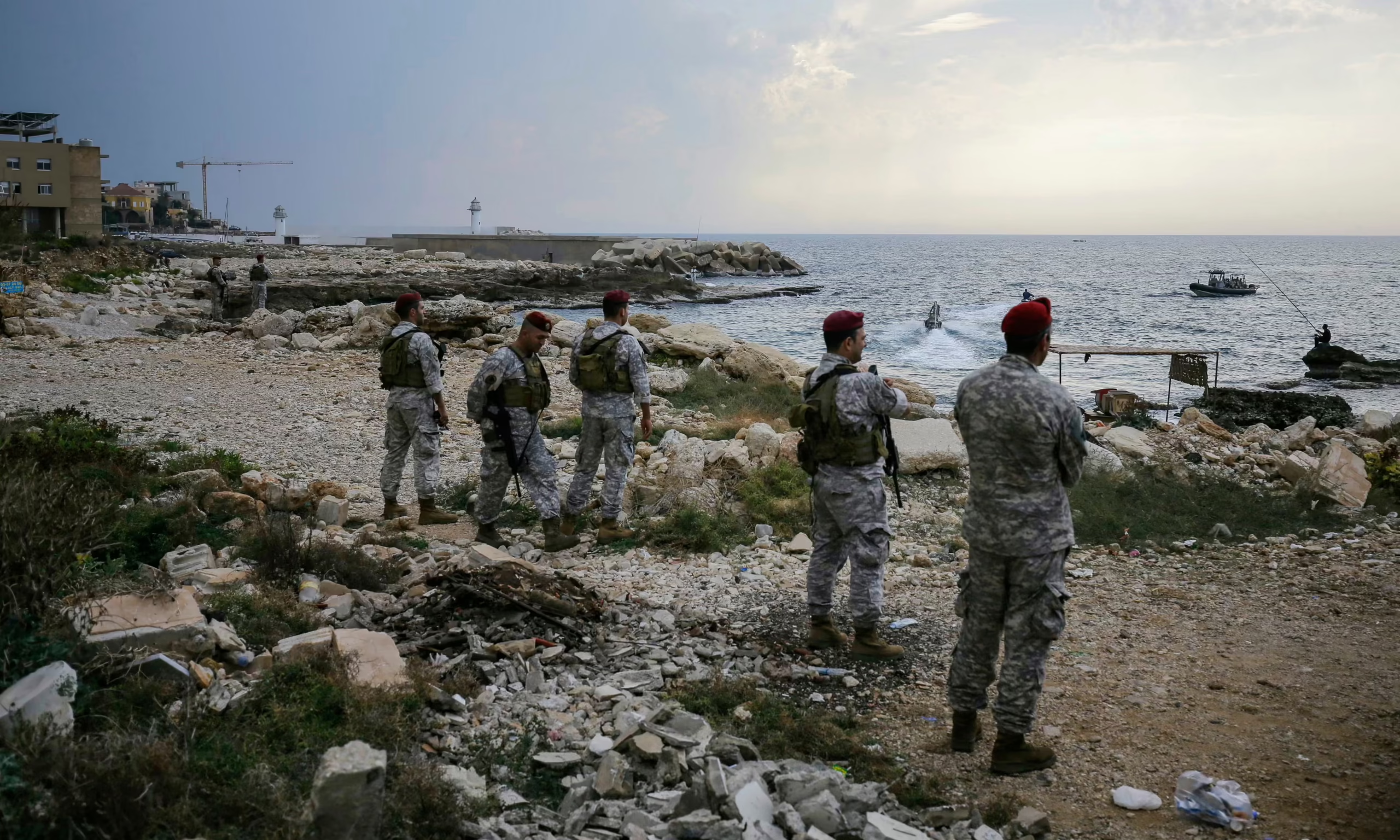
In the early hours of November 3, 2024, Israel’s Shayetet 13 naval commando unit conducted a landing on the coast of Batroun, a northern Lebanese city approximately 160 kilometers from the border.
Arriving in fast boats, commandos stormed a nearby chalet and abducted Lebanese ship captain Imad Amhaz, returning with him via sea. Amhaz was transferred to Israeli territory, where the army labeled him a senior operative in Hezbollah’s naval unit.
Lebanese authorities dismissed Israel’s narrative, stating that Amhaz was “a student of marine navigation,” and condemned the raid as a “blatant violation” of UN Security Council Resolution 1701, which governs the status of the border.
3. Intelligence Operations and the Missing Pilot Case
On December 17, 2025, retired Lebanese General Security officer Ahmad Shukr disappeared from his hometown of Nabi Sheet in the Bekaa Valley under mysterious circumstances. Lebanese investigations revealed that his disappearance was the result of a foreign intelligence entrapment operation.
By mid-January 2026, Lebanon’s military judiciary had taken over the case, determining that the Israeli Mossad was behind the abduction, which was executed inside Lebanon by a sophisticated spy network.
Judge Claude Ghanem referred one suspect to Chief Military Investigating Judge Ghada Bou Alwan, while issuing arrest warrants in absentia for four other defendants identified as fugitives.
Shukr’s disappearance coincided with renewed speculation about the fate of Israeli pilot Ron Arad, who went missing in 1986. Reports indicated that a relative of Shukr may have been involved in holding Arad decades earlier.
Lebanese Prisoners in Israeli Jails
Lebanese sources stress that these Israeli abductions are not isolated incidents but part of an escalating pattern. Over 20 Lebanese nationals have been abducted and detained in Israeli prisons since the outbreak of war in October 2023 including approximately ten since the ceasefire.

Following Attoui’s abduction, Lebanese media reported that the total number of detainees has now risen to 24.
Hezbollah MP Hussein al-Hajj Hassan confirmed that Israel is holding over 20 Lebanese prisoners, including civilians abducted from their homes after the ceasefire, and that their cases are now part of ongoing ceasefire monitoring mechanisms.
The detainees include field commanders, Hezbollah members, and civilians some of whom, like Amhaz, Shukr, and Attoui, have been publicly identified, while the fate of others remains unknown.
Israeli authorities refuse to publish lists of the detainees or permit visits by the International Committee of the Red Cross, exploiting their imprisonment as a tool of political and security leverage.
Strategic Objectives Behind the Abduction Policy
1. Intelligence Gathering:
Israeli sources claim the abduction of Attoui was meant to obtain information on cooperation between the Islamic Group and Hezbollah, and how they conduct joint operations.
In the case of Ahmad Shukr, the intelligence objective was evidently tied to renewed attempts to solve the mystery of Ron Arad, explaining the operation’s complexity and secrecy.
2. Power Projection and Psychological Warfare:
The Amhaz abduction delivered a dual message: targeting what Israel deems Hezbollah’s naval arm, while demonstrating its capability to execute maritime operations deep within Lebanese territory.
These operations serve the domestic political agenda of Israel’s right-wing government, allowing it to claim symbolic victories against Hezbollah and project an image of military reach and freedom of action.
3. Coercion and Intimidation:
Israel’s motives go beyond conventional deterrence, using the abductees as bargaining chips to pressure Lebanese opposition groups and terrorize civilians alike.
Some analysts suggest the abductions are part of a psychological campaign aimed at demoralizing residents of southern Lebanon aligning with overt Israeli calls for the depopulation of border villages.
These three cases illustrate that Israel does not view the ceasefire as a binding halt to hostilities. Instead, it exploits the truce as cover to wage a low-cost shadow war: raiding homes at night, abducting individuals from their beds, transferring them across the border, and imprisoning them without due process or disclosure of their fate.


