





The visit by Turkish President Recep Tayyip Erdoğan to Cairo on Wednesday, January 4, has elevated Egyptian–Turkish relations to an advanced level of partnership after years of stagnation that lasted nearly a full decade. In a distinctly pragmatic fashion, the visit signaled the launch of a new phase of cooperation and coordination, particularly on the logistical and strategic fronts, amid an exceptionally sensitive regional and international climate.
Although the visit lasted no more than a single day, it stands as the most significant milestone in bilateral relations in recent years not only because of the understandings and agreements it produced, but also for its profound political and symbolic implications.
It comes at a time when the Middle East is undergoing a sweeping realignment of power and influence, alongside attempts to reengineer the region in line with an American–Israeli vision.
The size and composition of Erdoğan’s accompanying delegation underscored the visit’s special importance. Alongside his wife, the delegation included the ministers of foreign affairs, defense, treasury, family, energy, industry, youth, and health, in addition to the head of the Turkish presidency’s communications directorate and the president’s chief adviser for foreign policy and security. This lineup pointed to a comprehensive agenda that went well beyond protocol toward an integrated strategic approach.
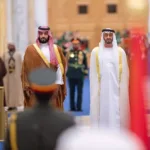
The visit gained additional momentum as it followed a similar trip by Erdoğan to Saudi Arabia, where he met Crown Prince Mohammed bin Salman. That visit yielded a package of partnerships and agreements, along with renewed understandings on major regional flashpoints from Iran to Gaza and Yemen, and from Syria, Libya, and Sudan to the Horn of Africa.
Against this backdrop of rapid diplomatic movement, several questions have emerged regarding the significance of the tour: Are we witnessing the formation of a new regional axis bringing together Turkey, Egypt, and Saudi Arabia? Or could this trajectory evolve into broader arrangements, akin to what some describe as an “Islamic NATO,” with the potential inclusion of other states such as Pakistan and Indonesia?
An Exceptional Regional Moment
The visit cannot be read through a narrow, purely protocol lens, nor can it be separated from the sweeping transformations unfolding across the region amid an unprecedented state of political and security fluidity. Reducing it to a routine diplomatic encounter overlooks core dimensions imposed by the broader regional context especially as it formed part of a calculated tour that began in Riyadh and concluded in Cairo, two capitals of immense political and strategic weight.
This tour came at an extraordinarily complex moment, as regional tensions escalate to levels that risk a major explosion, amid growing prospects of a direct confrontation between the United States and Iran. These dynamics are compounded by a web of overlapping threats to Arab and regional national security, as well as mounting risks to Arab and Islamic interests more broadly, raising the specter of descent into cycles of chaos and instability that would be difficult to contain.
At this pivotal juncture, the region appears to be standing on the threshold of a comprehensive reshaping of its geopolitical map, driven by rapidly unfolding developments. This reality is pushing all actors—without exception—to reassess their positioning, reconsider the landscape from new angles, and seek to secure an influential place within the emerging regional order.
From Normalization to a Comprehensive Partnership
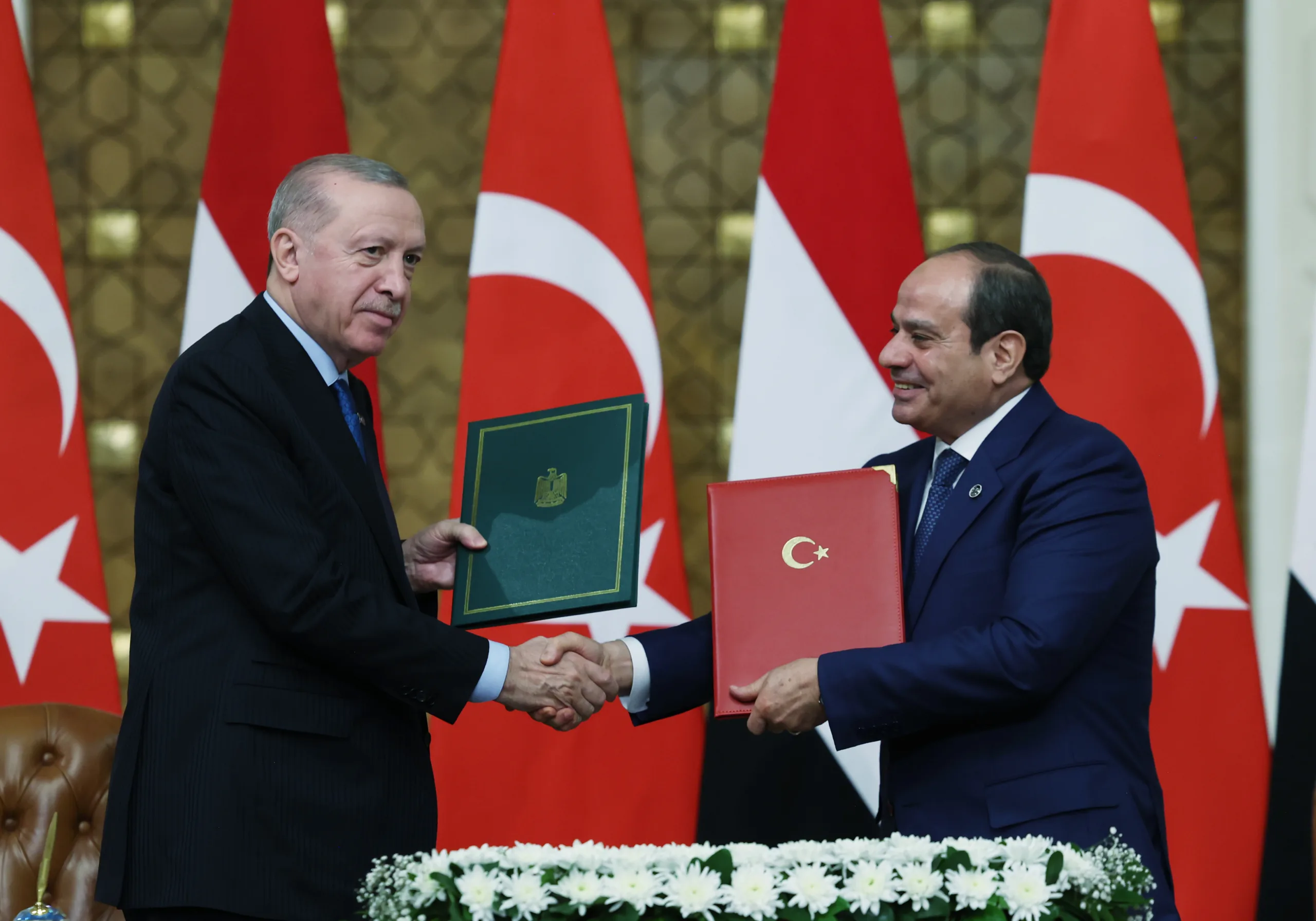
The warm reception accorded to Erdoğan and his delegation, coupled with the positive tone of the statements exchanged by the Egyptian and Turkish presidents during their joint press conference and reinforced by the agreements and memoranda of understanding signed in military, investment, medical, sports, and economic fields reflects a clear qualitative shift in relations between Ankara and Cairo.
The relationship has moved beyond the phase of re-normalization after years of estrangement toward the construction of a comprehensive partnership with a long-term horizon.
This pivotal shift reflects a high degree of pragmatism now governing both sides’ approaches. Despite the persistence of certain unresolved ideological differences, the intertwining of interests and the escalation of shared challenges have provided sufficient impetus to temporarily set those differences aside, opening the door to mutual gains and entrenching a discourse of interests as a more rational political language in an exceptionally sensitive regional phase.
From this perspective, the visit transcends its formal association with the second meeting of the High-Level Strategic Cooperation Council between the two countries. Instead, it lays the groundwork for something deeper and more consequential a significant step toward a long-term strategic partnership spanning multiple fields and advancing at a pace that may exceed even the most optimistic expectations for the future of Egyptian–Turkish relations.
The Economy: Both Driver and Objective
The economic dimension constitutes the primary engine behind Cairo and Ankara’s shift from limited coordination toward full-fledged partnership. Both countries possess resources and capabilities that, if deployed within an organized cooperative framework, could yield mutual returns and help alleviate the mounting economic pressures and livelihood challenges facing their societies.
In this context, the brief visit culminated in the signing of a broad package of agreements and memoranda of understanding. These included a framework military agreement, as well as cooperation in pharmaceutical regulation and medical supplies, plant quarantine, veterinary services, foreign trade and investment, social services, and youth and sports—underscoring a move toward a multidimensional partnership.
Erdoğan has expressed hope that trade volume with Egypt Turkey’s largest trading partner in Africa will rise from around $9 billion currently to $15 billion in the coming period. He also voiced satisfaction that Turkish investments in Egypt are approaching $4 billion, viewing this as a clear indicator of growing mutual confidence and the attractiveness of the Egyptian market.
Regional Coordination in the Face of Crises
Egyptian and Turkish perspectives converge across a wide range of regional files that now require a high level of joint coordination to confront their intertwined challenges. The Gaza file sits at the forefront of these issues, as both countries wield significant political influence over “the day after” arrangements following the war whether in reconstruction efforts or in overseeing the implementation of the agreement signed in Sharm el-Sheikh amid repeated Israeli attempts to circumvent its provisions and exploit it to serve an expansionist regional narrative.
This convergence extends to Syria, where both sides agree on the priority of preserving Syria’s territorial unity and supporting Damascus’s return to its regional role and weight, in the face of internal and external pressures and schemes, while emphasizing the need to confront escalating Israeli encroachment in southern Syria.
In Libya, understandings between Cairo and Ankara have reached advanced levels after years of sharp divergence. Both sides affirm their commitment to Libya’s unity, the need to end division, restore stability, and rebuild Libyan state institutions on inclusive foundations.
A similar approach applies to Sudan, where the two countries’ positions align on the importance of preserving Sudan’s unity and confronting militia-driven secessionist tendencies backed by regional actors. Both support state institutions chiefly the Sudanese army in confronting the Rapid Support Forces, particularly in light of recent battlefield developments and their seizure of the strategically significant city of El Fasher.
This coordination also extends southward to the Horn of Africa, amid growing Israeli influence and the fueling of secessionist currents that pose a direct threat to Arab and Islamic national security along its southern flank. The region has become an open arena for great-power competition, necessitating a collective approach to confront and contain these schemes.
From this standpoint, Egyptian–Turkish coordination has emerged as a key pillar of regional stability and a safety valve against the risk of unchecked escalation into comprehensive chaos. This also explains both countries’ efforts to help de-escalate tensions between Washington and Tehran, in order to avert a large-scale military explosion that would scramble calculations and balances across the entire region.
Are We on the Verge of a New Regional Axis?
Erdoğan’s visit to Cairo, following directly after his trip to Riyadh, has revived debate over the possibility of launching a new regional axis anchored by Egypt, Saudi Arabia, and Turkey—one based on a calmer approach to regional management, away from polarization and rising tensions.
Such a trajectory would aim to confront shared challenges across regional flashpoints, recalibrate geopolitical balances in the face of Israeli policies, Iranian influence, and active Emirati roles in certain files.
This emerging alignment would mark a significant turning point in the region’s history, extending beyond economics into broader security, political, and logistical horizons. It could be described as an “alliance of necessity,” imposed by the complexities of the current phase.
The combination of Egypt’s and Turkey’s historical military and political weight with Saudi Arabia’s vast economic capabilities could lay the foundations for a formidable regional bloc capable of becoming a decisive factor in regional and international balance equations.
Some observers have gone further, suggesting that this rapprochement could evolve into what is described as an “Arab–Islamic NATO,” particularly if heavyweight actors such as Pakistan with its nuclear capabilities—and Indonesia—with its demographic weight were to join. Were such a scenario to materialize, it would have a profound impact on reshaping the regional landscape as a whole.
Yet such alliances, despite the validity of their motivations, remain contingent on the availability of full political will and require more time to address complex details and overcome potential challenges. Any such bloc would naturally provoke deep concern in Israel and, by extension, the United States.
Some argue that the three capitals’ relations with Washington could provide a window for advancing such an alliance or at least neutralizing American objections. However, an expected clash with Israel remains the most formidable challenge, one that could obstruct the emergence of such arrangements or hollow them out of their strategic substance.
In sum, the warnings issued by Canadian Prime Minister Mark Carney at the recent Davos Forum about the decline of the old global order and the rise of a new international system governed by pragmatism and interests above all else appear increasingly reflected in reality.
The world is witnessing a transitional moment that is redrawing the rules of interaction among powers, away from the assumptions that dominated past decades.
Carney cautioned medium and emerging powers that failure to join effective coalitions outside traditional frameworks coalitions that secure them a seat at the decision-making table alongside major powers would leave them vulnerable to marginalization, or even “on the menu.”
In this context, Europe has begun turning eastward toward Beijing, while Arab powers, in turn, are attempting to reposition themselves through exploring alliances with clearly defined regional missions and strategies.
Yet this notable shift in the level of rapprochement among Cairo, Riyadh, and Ankara despite its momentum and backing remains contingent on the presence of solid political will capable of transforming it from a pragmatic convergence imposed by the pressures of the moment into an effective Arab–Islamic bloc with real weight in regional balances.
The question thus remains: Will this will mature enough to translate opportunity into a sustainable reality, or will this rapprochement remain hostage to short-term calculations?