

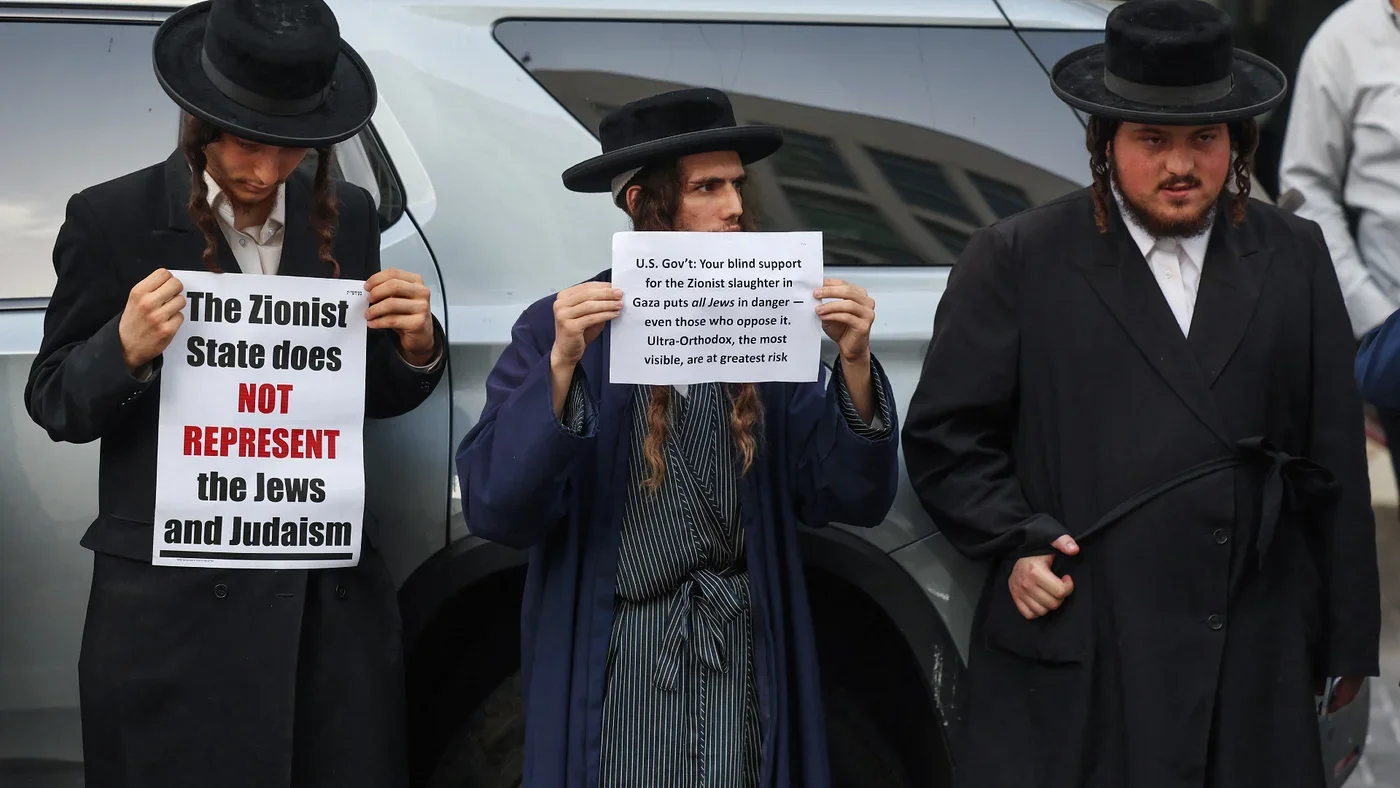
“There is no finish line… If someone uses the word ‘Zionist’ as an insult, it will be classified as a crime, and action will be taken against them,” declared Adam Presser, TikTok’s new Head of Operations, inaugurating a new era in Israel’s criminalization strategy. In this era, “anti-Zionism” becomes an immoral act deserving of punishment.
What Presser didn’t say is that TikTok’s new policy merely echoes a long-standing Zionist campaign. One of its earliest champions was David Ben-Gurion, who lambasted a British court for prosecuting Zionist leaders over arms smuggling into Palestine at a time when Israel was still just a vision in the Zionist imagination.
British historian Christopher Sykes chronicles this episode as the first turning point linking anti-Semitism to anti-Zionism. The linkage served to transform political and legal critique into a moral accusation of religious hatred against Jews. Over time, this evolved into the forms of anti-Semitism we recognize today.
These forms now work in unison to build a legal and moral fortress around Israel, criminalizing virtually any critique of its policies, institutions, or even the concept of Israel itself. Traditional anti-Semitism includes hatred of Jews for their religion, ethnicity, or alleged global influence, as well as age-old tropes of dual loyalty and conspiracy.
More modern forms focus on Holocaust denial or critique of the Israeli state forms that Zionist thinkers now prioritize due to the decline of older expressions.
A pivotal figure in this moral restructuring is the so-called “self-hating Jew” a person of Jewish heritage who criticizes Israel or Zionism. Israel is now leveraging social media to redefine moral norms, pushing a framework that not only protects Zionism from criticism but also seeks to delegitimize its opponents even those within the Jewish community itself.
This article explores the entwined evolution of anti-Zionism and anti-Semitism, tracing their emergence as concepts and instruments of political utility. It examines how Israel, faced with growing international scrutiny over its human rights violations, seeks alternative ethical and legal frameworks outside the UN to silence dissent frameworks that criminalize criticism while leaving hatred itself untouched.
From Concept to Instrument
Hatred of Jews stretches back centuries in Europe rooted in Catholic theology, mysterious rituals, or alleged economic exploitation. Accusations ranged from ritual child murder to financial greed. From ancient Rome through the Enlightenment, anti-Jewish sentiment remained embedded in European society. In contrast, Jews in the Arab world enjoyed relative inclusion and respect in fields such as medicine, finance, and the arts.

Only in the late 19th century did anti-Semitism become a fully formed concept. As Europe transitioned from empires and churches to nation-states and racial ideologies, Jews were increasingly seen as an alien presence. Wilhelm Marr coined the term “anti-Semitism” in 1879, and it was swiftly weaponized by figures like Vienna’s mayor and later adopted by the Nazis in their quest to purify the Aryan race.
Though Semitic peoples included Jews, Arabs, Arameans, and Abyssinians, the term came to denote Jews exclusively, replacing the more direct “Judenhass” (Jew-hatred).
Anti-Semitism became a form of nationalist expression, culminating in Nazi Germany’s extermination campaign. Though often associated with Germany, anti-Semitic practices also thrived in Britain, France, Hungary, Poland, and Russia driving Jewish migration to the U.S., which later restricted immigration, redirecting Jewish migration to Palestine.
Post-WWII, the Holocaust turned anti-Semitism into a global taboo. The Zionist project, now manifested as a physical state in Palestine, gained full Western and UN support through the 1947 partition plan and the 1948 war that established Israel on most of historic Palestine.
In the Arab world, rising Jewish immigration and colonial meddling prompted tensions. The Balfour Declaration of 1917 marked a turning point, pitting native populations against Zionist settlers. Despite Arab recognition of Jews as historic minorities, their new colonial identity provoked resistance. Western media labeled Arabs as anti-Semitic, backward, and anti-liberal language that shaped the emerging narrative.
Even when Palestinian intellectual and political leaders distinguished anti-Zionism from anti-Semitism, the Western media and Jewish leadership focused their messaging around the latter. Incidents such as the 1920-21 Nabi Musa riots in Jaffa and the 1929 Buraq Uprising were framed in terms of “religious fanaticism” and “blind hatred,” signaling a shift of moral burden from Europe to the Arab East.
By the time of WWII, this narrative had become fixed. Critique of Israel was automatically equated with anti-Semitism, sidelining the legitimate political grievances of Palestinians.
Criminalization and Exception
Following the 1948 war, Israel’s narrative of victimhood found fertile ground in the West. The nascent state defeated multiple Arab armies, seized more land than allotted by the UN, and was portrayed as fulfilling Jewish self-determination. Never mind that it had a well-trained military supported by Britain, France, and the U.S., while Arab forces were fragmented and ill-equipped.
This moral framing discredited Palestinian liberation as aggression. The 1956 Suez War confirmed Western alignment with Israel, now enshrined as a global moral exception. However, the 1967 war exposed Zionist expansionist ambitions, as Israel occupied Egyptian, Jordanian, Syrian, and Lebanese lands. Global sympathy began to wane.
In response, Zionist organizations like AIPAC and the ADL launched a campaign to redefine anti-Zionism as the new anti-Semitism. Israeli Foreign Minister Abba Eban declared that distinguishing between the two was a false dichotomy. Booklets and media campaigns reinforced this equivalence until 1975, when the UN passed Resolution 3379 declaring Zionism a form of racism.
Though later revoked under U.S. pressure during the 1991 Madrid Peace Conference, Resolution 3379 remains a historical rupture. It stripped Israel of its political sanctity, shifting its image from victim to occupier. In retaliation, Israel accused the UN of global anti-Semitism and began appealing directly to Western governments for support.
From then on, anti-Semitism reemerged as the preferred shield against criticism. The concept of anti-Zionism was again demonized, even as the global conversation increasingly focused on Israel’s occupation, assassination campaigns, and suppression of Palestinian leaders and intellectuals.
The New Face of Anti-Semitism
Post-1991, accusing Zionism became increasingly risky. Zionist institutions began redefining the discourse, blending anti-Zionism and anti-Semitism into a single moral and legal charge. This effort intensified in the mid-1990s with systematic legal and media tactics to conflate political criticism of Israel with anti-Jewish hate.

In 2002, AIPAC and the ADL spearheaded an initiative to establish a new moral standard one that classified opposition to Zionism as an expression of anti-Semitism. A comprehensive study argued that criticism of Israel masked a deeper animosity toward Jews, painting Israel as Nazi-like and evil.
Scholar Norman Finkelstein observed that these campaigns typically coincided with Israeli PR disasters—such as the Intifadas or international pressure to end the occupation. Journalist Tamar Meisels conceded that some extreme anti-Zionist rhetoric indeed echoed classical anti-Semitism but insisted that legitimate criticism of Israel remained valid.
The line between the two became blurrier after the 2014 Gaza protests. Legal scholar Rob Kahn proposed criteria to distinguish between them: location (attacking a synagogue is anti-Semitic; an embassy, anti-Zionist), intent (boycotting kosher goods is anti-Semitic; Israeli goods, not necessarily), and rhetoric (global conspiracies vs. criticism of occupation).
Kahn also noted that Muslims in Europe often suffer from Islamophobic versions of anti-Semitism, such as bans on halal slaughter or circumcision further muddying the waters of discrimination.
As pro-Palestinian Jewish voices emerged like Jewish Voice for Peace, If Not Now, and Neturei Karta Zionist institutions faced a crisis: how to silence criticism from within. They resurrected Abba Eban’s label: “self-hating Jews.”
By pathologizing dissent, critics were framed as mentally unwell rather than ideologically opposed. But these Jewish critics created a rift in the Zionist narrative they did not abandon Judaism, only opposed the colonial policies of the Israeli state.
This internal criticism, coming from individuals who are themselves Semites, undermined Israel’s ability to brand all opposition as anti-Semitic. It legitimized anti-Zionism in Western discourse—in academia, media, and human rights movements.
As a result, Zionist organizations crafted a new ethical paradigm, combining morality, memory, victimhood, and law to criminalize criticism even when anti-Semitism as a charge fails.
From 2020 Onward: The Final Synthesis
Since 2020, Western legislatures in the U.S. and France have debated equating anti-Zionism with anti-Semitism an attempt to criminalize political dissent. In parallel, Israel passed openly racist laws, such as the 2018 Nation-State Law and annexation efforts in the West Bank.
A December 2023 U.S. House resolution declared anti-Zionism a form of anti-Semitism, mandating federal institutions to enforce this standard. In France, a bill is under debate to redefine anti-Semitism to include denial of Israel’s statehood.
This legislative trend is driven by politicians like MP Caroline Yadan and supported by President Emmanuel Macron, who has equated anti-Zionism with anti-Semitism.
The most recent battlefield is TikTok, where Israel seeks to shut down pro-Palestinian activism that uses slogans like “From the river to the sea” interpreted by Israel as genocidal, despite being a call for liberation.
This effort includes denial of the Gaza genocide, blaming Hamas, and repeating the same justification used since 1948: “We had no choice. If you disagree, you are an anti-Semite and a Zionism-hater.”
Ultimately, the discourse surrounding anti-Zionism is judged not by geographic or political content, but by its stance toward Israel’s legitimacy. The phrase “From the Nile to the Euphrates” symbolizes Israel’s expansionism, while “From the river to the sea” threatens its current form.
In conclusion, the Zionist narrative today faces increasing challenges from Jewish dissent, international criticism, and shifting public opinion. Israel is compelled to abandon the anti-Semitism framework and craft a new Zionist moral code one that punishes opposition and sustains its colonial enterprise, even as traditional justifications collapse in the face of undeniable atrocities.
What is now required is a modern, sophisticated discourse one that welcomes non-Jewish Zionists while excluding anti-Zionist Jews. A narrative capable of perpetuating colonial domination in Palestine and regional hegemony under new rationales, yet to be fully articulated or accepted.