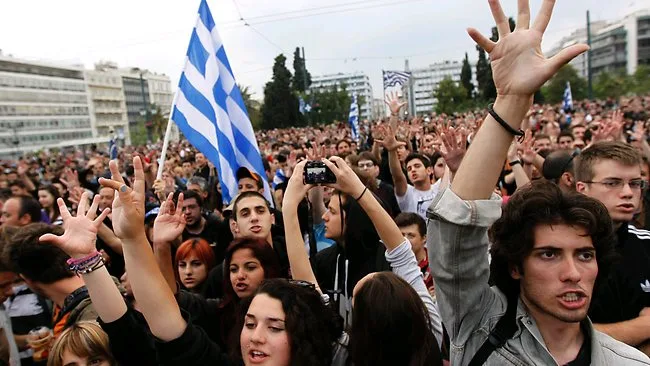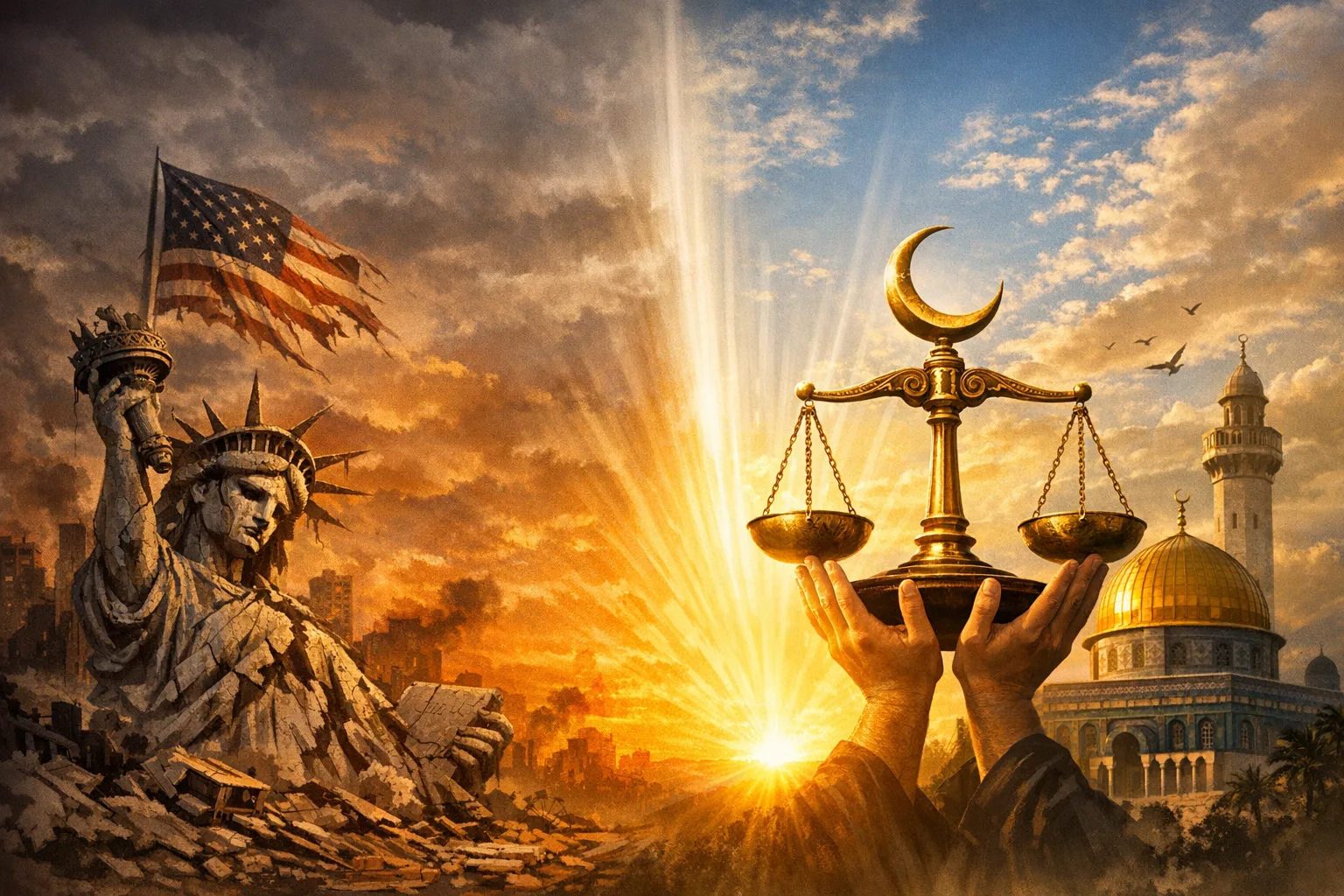
In today’s world, grand ethical questions are no longer the luxury of intellectual debate or elite discourse. They have been thrust upon global consciousness by the stark realities unfolding before our eyes.
The open genocide in Gaza, politically justified and met with deafening international silence, and the Jeffrey Epstein scandals that exposed the fragility of justice systems in societies most self-righteous about protecting human rights, have ushered in a moment of profound reckoning. It is no longer sufficient to dismiss such contradictions as fleeting double standards.
We must now confront the moral foundations of the West’s claim to global leadership in the name of values.
For decades, the West constructed a framework of moral superiority, positioning itself as the universal benchmark for ethics, justice, and legitimacy. This framework, long presented as the culmination of enlightened human experience and value-based governance, now appears fractured.
It is increasingly unconvincing and unable to withstand the test of reality when principles clash with interests. Gaza stands as the clearest example of this unraveling where human rights rhetoric collapses under the weight of bloodshed, and declared values retreat in the face of geopolitical calculations.
Thus, the real question is no longer about criticizing the West or indicting its contradictions. It is about reassessing ourselves and the societies that have long consumed Western values as the ultimate moral compass.
Is it time to reconsider this ethical dependency? Do our Islamic and Arab societies possess foundational values strong enough to form an alternative ethical paradigm one that stands not as a reactive posture or ideological rival but as a resilient, principled framework in its own right?
This article does not issue a romantic call to replace one system with another, nor does it indulge in nostalgic idealization. Rather, it offers a rational dissection of our current moral collapse and poses the question of alternatives with intellectual seriousness and historical responsibility.
When grand illusions fall, the search for authentic moral roots becomes not a matter of ideology but a necessary endeavor to restore meaning and justice in a world rapidly losing its shared ethical compass.
The West’s Moral Authority: Origins, Claims, and Limits
What has been termed the “moral authority of the West” did not emerge from pure ethical supremacy. It was forged in a specific historical context following World War II. Europe was devastated, both materially and morally, after the exposure of fascism and Nazism, while the United States rose as an unscathed military and economic power.
The creation of a new global order could not rely on force alone; it required a compelling ethical narrative to legitimize leadership. Thus began the investment in a value and legal system presented as universal and trans-cultural.
This vision was crystallized in the founding of the United Nations, the 1948 Universal Declaration of Human Rights, and the development of international humanitarian law. It extended to international courts and judicial mechanisms.
This architecture was not solely the product of altruism, but part of an effort to engineer a global order in which the West maintained its leadership and prevented a relapse into global chaos.
The problem was never the announced values themselves many of which hold genuine humanistic merit but rather how they were politically weaponized. From the early Cold War years, it became clear that Western moral discourse was not a binding standard but a selective tool activated when convenient, suspended when inconvenient.
Defense of democracy did not preclude support for authoritarian regimes in Asia, Latin America, or Africa. Championing human rights did not stop the West from ignoring widespread abuses by strategic allies. Despite these contradictions, the West retained what might be called symbolic moral capital. Violations could be dismissed as exceptions or failures of implementation.
The Western system was seen as capable of self-correction, with free media, oversight institutions, and judicial independence. This capacity for self-critique was key to sustaining the West’s moral claims lending it an aura of ethical superiority, even in moments of failure.
But this claim began to erode after the Cold War. As the West emerged as a quasi-unipolar force, the need for moral justification diminished. The world witnessed major military interventions that were ethically justified at first, only to be later exposed as legally and morally bankrupt.
Repeated instances of this pattern eroded not only the credibility of Western policies but the integrity of the discourse itself.
This transformation was clearest in the flexible interpretation of international law. Rules were bent to serve Western interests, applied harshly against adversaries, and suspended when inconvenient. The issue evolved from mere double standards to a deeper moral legitimacy crisis.
Legitimacy demands more than power and institutions it requires persuasion, and persuasion is impossible without basic consistency between words and deeds.
With the rise of global media and digital platforms, the West lost its monopoly over narrative control. Violations could no longer be hidden or easily spun. The global public became a direct witness to the dissonance between stated values and realpolitik. Thus, moral leadership is no longer established through declarations or legal texts but tested daily in the court of reality.
Today, the limits of Western moral legitimacy are not determined by international law or treaty counts, but by the willingness to uphold values when it is politically or strategically costly. Ethics untested by sacrifice do not confer legitimacy; they remain cosmetic. Therefore, the crisis of Western moral authority is not a passing glitch but the product of cumulative contradictions laid bare for all to see.
In this sense, the West has not so much lost its values as it has lost its monopoly on representing them. When universal values become tools of politics, they lose their legitimizing power and instead become subjects of dispute. Western moral authority is not entirely collapsed, but it is no longer accepted as an uncontestable global standard.
Epstein and Gaza: From Double Standards to Narrative Collapse
The deep fracture in Western moral narrative cannot be understood solely through political events. It requires examining how the Western system handles internal and external crises as tests of its claimed ethical leadership.
The juxtaposition of the Jeffrey Epstein case and the atrocities in Gaza offers a revealing contrast—not in the nature of the events themselves, but in the patterns of denial, protection, and justification that shaped their handling.
Epstein’s case was never a mere individual criminal scandal. From the moment it erupted, it exposed the incestuous ties between power, wealth, and elite networks in the West. Since 2019, court records and media reports have unveiled an extensive web connecting Epstein to powerful figures in politics, business, and media. Despite documented complaints of trafficking minors, justice systems failed to act for years.
His death in jail—officially ruled a suicide—shut the door on accountability, leaving fundamental questions unanswered about judicial independence and the system’s ability to hold the powerful accountable.
The moral significance of this case lies not in the crime itself, but in how the scandal was contained. The episode demonstrated that the very system proclaiming child protection and human dignity could paralyze transparency and accountability when the stakes threatened elite interests. Epstein became a symbol of a structurally compromised justice system, where values function as public slogans, not binding commitments.
Gaza, in contrast, presented an external test—a searing trial of Western ethics. As images of large-scale bombings, destroyed civilian infrastructure, and massacred children emerged, the facts were undeniable and globally broadcast. Yet Western governments offered political justifications, remained selectively silent, or actively used legal and diplomatic tools to obstruct any serious international accountability.
This is not merely about double standards. It is the unraveling of the Western narrative itself. Historically, Western ethics were rooted in the notion that human rights are indivisible and identity-neutral. Gaza revealed that such principles are redefined according to alliances and interests. International humanitarian law is interpreted flexibly when the perpetrator is a strategic ally and enforced harshly when the adversary is beyond Western influence.
The analytical link between Epstein and Gaza is not in the crimes, but in the system’s reaction. In both, we see a values framework unable to face hard truths when the political cost is high. In one, elites were shielded through procedural closure. In the other, strategic alliances were defended at the expense of justice even if that meant sacrificing moral credibility.
What is dangerous here is not a temporary public outrage. It is the collapse of narrative itself. When global audiences see that justice is selective and victims are weighed on political scales, trust in Western discourse as a moral reference erodes. At that point, complaints of double standards become inadequate. The flaw is not in application but in the very basis of the ethical claim.
Epstein was an internal moment of exposure. Gaza is an external one. Between the two, moral credibility crumbles—a key pillar of any moral leadership. Power may enforce silence, but it cannot manufacture lasting legitimacy. Narratives that fail in the face of reality fall, even if tools of domination persist.
Thus, Epstein and Gaza are not isolated crises. They are links in a chain marking the West’s shift from defensible ethical inconsistency to a paralysis in justifying its own values. Historically, such moments have preceded the great declines of empires.
Historical Comparisons: When Empires Fall Morally Before They Collapse Politically
A survey of empire history reveals that collapse rarely begins with military defeat or economic ruin. It starts with a more subtle, more dangerous erosion: the loss of moral legitimacy that once justified and sustained dominance. Power alone cannot endure. It must be accompanied by a narrative that convinces both subjects and rivals that the order it maintains is just, necessary, or at least the lesser evil.
The Roman Empire, one of the most vivid classical examples, was not just a military machine. It projected itself as the guardian of “Pax Romana” a stabilizing force trading submission for peace. But that narrative weakened when peace became oppression and Rome was seen less as a source of justice and more as a center of exploitation.
As the gap widened between rhetoric and practice, the moral ties that bound the empire began to fray well before military or territorial decay set in. Late Roman historians chronicled the rise of elite corruption and the decay of republican virtues, paving the way for a long, inevitable decline.
A similar pattern appeared in the modern European colonial empires, especially the British one. For a century, Britain justified its global expansion through a civilizing mission and modern governance. But this moral claim unraveled as colonial subjects faced manufactured famines, brutal repression, and resource plunder. In major colonies like India, it became clear that civilization was a cover for economic domination.
As independence movements grew, the challenge was not only military but moral even Western publics began questioning the empire’s legitimacy.
What these experiences share is the decisive role of moral exposure. Once subjected peoples realize that proclaimed values are mere political tools, and once imperial centers fail to model what they preach, decline begins. It does not happen overnight but initiates a slow erosion where persuasion gives way to raw force, and credibility evaporates.
In this light, comparisons to the current Western predicament are historically justified. The post-WWII values order anchored in human rights and international law—played a similar role to “Pax Romana” or the civilizing mission. But with each selective application, each justified abuse, the system’s credibility has suffered. This doesn’t mean the West will fall imminently, but it signals the erosion of the moral leadership that underpinned its global reach.
History doesn’t repeat itself literally. But it often echoes. And in every echo, the moral fall comes before the political one. Empires fall not just when they lose territory, but when they lose their own image and that of others. When meaning fades, so does power.
Beyond the West: Toward an Indigenous Moral Framework in the Islamic and Arab Worlds
The current crisis of Western moral authority is no longer a matter of reputational damage. It signals a structural imbalance between power and principle in the global order. When moral leadership loses its core requirement coherence between stated values and actual behavior—it shifts from leadership to mere posturing. In this vacuum, it is not just one order that crumbles, but a universal moral space that threatens to collapse.
Yet this vacuum need not be filled by morally bankrupt alternatives. Nor must we resign ourselves to the tyranny of brute power. Islamic and Arab societies possess a rich, underutilized ethical legacy that has yet to be tested in modern global terms—not as reactive identity politics, but as a serious source of moral vision in international affairs.
Islamic ethics are built on principles of justice, human dignity, the sanctity of life, accountability of authority, and the centrality of conscience. These are not abstract ideals but binding prescriptions regulating individual and collective conduct. Justice in Islam is not a relative value postponed in the name of interest. It is the foundation of civilization and the prerequisite for stability. Humanity is honored for its essence, not affiliation. Power is a trust, to be questioned before it is obeyed.
Arab moral traditions, too, offer enduring values: loyalty, aid for the vulnerable, keeping promises, honoring agreements, and rejecting treachery. These norms long governed community relations and diplomacy. When revived not as cultural nostalgia but as active political ethics, they can form the backbone of an alternative moral discourse. One that does not compete with the West for global supremacy, but speaks to human beings with authenticity.
Returning to Islamic and Arab values does not imply retreat or isolation. Nor does it excuse domestic failures under the guise of cultural specificity. It means constructing a self-accountable ethical standard that holds us to account before judging others. A framework where values guide politics, rather than serve it. The distinction between living moral systems and decayed ones lies not in their origin but in their willingness to bear the cost of moral commitment when it is burdensome.
In a post-Western moral world, strength is not only measured in weapons or wealth, but in meaning, justice, and ethical discipline. If the West has lost its moral monopoly, the Muslim and Arab worlds need not inherit it in its old form. They can offer something different: a more modest, coherent, and action-driven model that reconnects ethics with action and frees values from instrumental use.
Here lies the real challenge: not to proclaim an alternative, but to embody it. Values that do not shape policy, governance, and internal justice will remain inert. But if ethics are once again treated as the foundation of legitimacy rather than its ornament, the world may yet avoid a binary choice between failed hegemony and value-free chaos and instead witness the emergence of a new moral path forged by plural sources, yet united in humanity.