














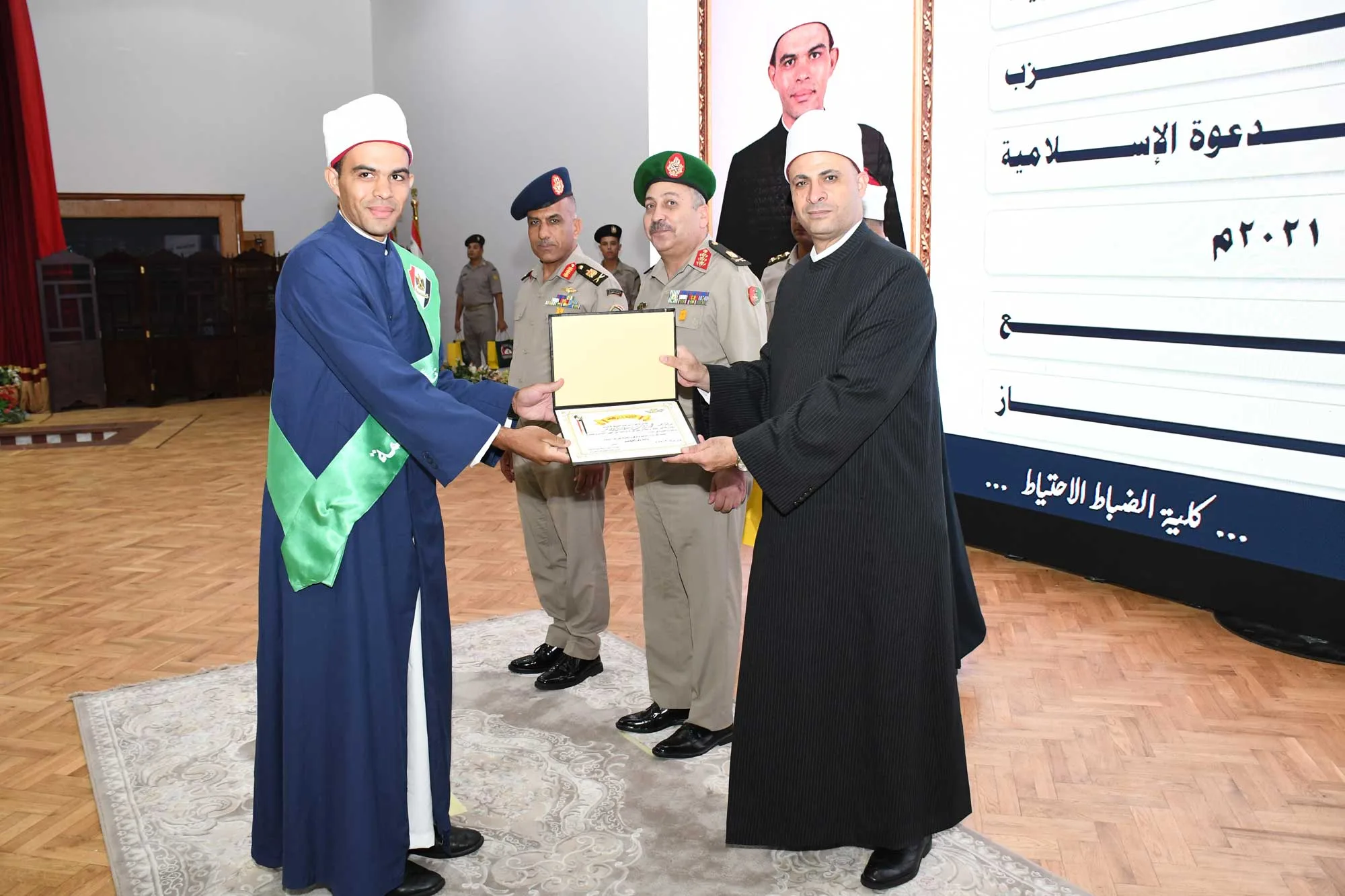
In a move that has ignited widespread controversy over the extent of military interference in religious and judicial affairs, Egypt’s Military Academy has disqualified 179 imams and preachers from a training course required for appointment by the Ministry of Religious Endowments.
The decision was based on military-style criteria such as body weight and previous medical exemptions from military service, despite the candidates having passed all publicly announced phases of the selection process.
This decision appears far from an isolated administrative action. Instead, it reflects a broader trajectory in which sovereign civilian roles from the pulpit to the judiciary are being reengineered under direct military supervision.
This unprecedented expansion of military discipline into domains historically rooted in independence and professional competence signals a shift toward prioritizing physical conformity and institutional obedience over intellectual merit and autonomy.
This article explores the implications of subjecting both imams and judges to military-derived standards, revealing an unprecedented entanglement of military authority with both religious and judicial institutions. It also examines how “training” has become a mechanism for exclusion, political vetting, and ideological realignment.
We further assess the consequences of these policies for the future independence of religious discourse and the judiciary, and for core principles such as civilian governance and equal opportunity. These developments are placed within the broader context of a state increasingly operating its civilian institutions as extensions of the security apparatus, rather than as independent arenas for justice, thought, and public service.
Rewriting the Philosophy of Egypt’s Civil Servant
This transformation in civil appointments was built on a solid legislative foundation with the passage of Law No. 149 of 2022, which established the Egyptian Military Academy as the umbrella institution overseeing the country’s military colleges army, navy, air force, and air defense.
The academy operates under the authority of the Minister of Defense and is headquartered at the state’s strategic command center in the New Administrative Capital. It coincided with the creation of a Military Technological College under Law No. 150 of 2022, expanding the military education system’s capacity to train civilian professionals, including forensic specialists.
While the stated goal was to train combat unit officers, it quickly became clear that the real aim was the systemic militarization of the state’s administrative apparatus. Presidential Decree No. 302 of 2022 and its amendments granted military academy graduates civilian bachelor’s degrees in disciplines such as economics, political science, statistics, and computer science, effectively enabling military personnel to formally enter civilian domains with academic credentials equivalent to those from civilian universities.
In April 2023, the initiative shifted from selective training to a mandatory system. A circular from the Cabinet Secretary-General, Major General Osama Saad, outlined presidential directives requiring all applicants for government positions to complete a six-month military training course at the War College as a prerequisite for employment.
The academy thus became not merely an educational center, but a political, physical, and ideological “filter” applied uniformly to all candidates be they civil servants, diplomats, or judges.
This vision stems from an executive belief in the need to shape a distinct kind of public servant one whose influence extends to their family and social environment.
It reflects a fundamental distrust in civilian educational and employment systems and posits the “military model” as the sole means to ensure control and absolute discipline within the state’s bureaucracy. The practical result is a steady erosion of the civilian state and its replacement with a military-administered apparatus.
Imams Between “Guardianship of Faith” and Military Doctrine
The case of the “Imam Hassan al-Attar cohort” at the Ministry of Endowments stands out as a stark example of how physical criteria are being used to exclude candidates. In January 2026, the Military Academy dismissed 179 imams and preachers who had already undergone a rigorous two-year testing process, starting with the Central Agency for Organization and Administration.
Their exclusion came during the final “persona assessment” stage, based on unpublished standards, such as exceeding the military “ideal weight” by just 3 to 5 kilograms or having been previously exempted from military service for medical reasons like flat feet conditions that do not impair an imam’s ability to perform religious duties.
This physical screening raised serious concerns about equal opportunity, especially since previous cohorts, like the “Imam Muhammad Abduh batch,” were accepted despite weight variances of up to 20 kilograms. This reinforces the belief that “training” has become a political and social screening mechanism, rather than a purely physical one.
Beyond body metrics, the initiative appears aimed at creating a parallel religious authority under military control. Imams were subjected to a six-month training program or two years for those with doctorates conducted at the state’s strategic command headquarters.
The program includes early wake-ups at 4 a.m., bans on mobile phones except with special permission, and mandatory use of academy-issued clothing and grooming supplies. The curriculum features lectures on national security, deradicalization, and even non-lethal firearms training to instill a sense of combat discipline.
This shift was institutionalized through the establishment of a “Scientific Council” within the academy, chaired by Minister of Endowments Osama al-Azhari, to supervise religious and linguistic content.
This encroaches on the constitutional prerogatives of Al-Azhar University (as outlined in Article 7 of the Constitution), and marks a deliberate move to transform imams from independent religious scholars into disciplined state employees.
They are now expected to monitor ideological shifts within their communities and report them to authorities, thus turning mosques into extensions of the security apparatus.
Militarizing the Judiciary
Perhaps the most alarming shift has been the subjugation of the judiciary a traditionally sovereign institution to military oversight. Since January 2026, all judicial appointments have been transferred to the Military Academy per presidential directives that effectively nullified the long-standing role of the judiciary’s own administrative offices.
The new process begins with candidates undergoing medical, physical, and security assessments at the academy. Only those who pass are referred to the “Supreme Judicial Council’s Seven-Member Committee” for legal testing.
The academy then reevaluates scores and compiles the final list of appointments for presidential approval. In effect, the academy now holds veto power over judicial appointments.
It even annulled the entire 2022 law graduate cohort’s nominations and took over the selection process, including halting interviews for 2024’s public prosecution candidates midstream.
Beyond procedural barriers, the academy imposed a significant financial burden in January 2025: new judges must pay training fees of 112,000 EGP for men and 120,000 EGP for women to cover accommodation and instruction. Several judges confirmed that their appointment orders were withheld until proof of payment was submitted. This effectively turned judicial positions into privileges for the financially capable, further eroding the principle of meritocracy.
The encroachment didn’t stop at appointments. Presidential Decree No. 429 of 2025 barred around 100 State Lawsuits Authority advisors from promotion for failing to complete the academy’s training despite having met all legal qualifications. The decision provoked a judicial backlash, prompting Egypt’s Judges Club to convene an emergency general assembly on February 6, 2026, to confront what it called a “grave development.”
Hundreds attended in person and via videoconference, and the club declared a state of permanent session to defend judicial independence and the separation of powers. Judges’ clubs from Alexandria and Monufia to Qena and Upper Egypt issued solidarity statements.
The Disciplinary Republic and the End of Civil Autonomy
What is unfolding in Egypt is not reform, but a forced reengineering of the state in the image of the military institution. The involvement of the Military Academy in overseeing religious and judicial appointments marks the explicit end of public sector independence and the beginning of governance by barracks, not by constitutional rule.
The new “loyalist personality” imposed as a hiring standard is not merely rhetorical it represents a fundamental shift. It sidelines intellect in favor of physical conformity, and competence in favor of obedience. The civil servant is being replaced by the “disciplined element,” akin to a soldier or officer.
This not only violates the principle of equal opportunity, but deliberately strips the judiciary and religious establishment of their independent legitimacy, converting them into tools of social control.
When citizens realize that justice and religious discourse are filtered through military criteria body weight and wealth, rather than law and knowledge the state loses its authority and opens the door to legal chaos and oppositional religiosity that it cannot contain. The clash with the judiciary and protests from graduates are just early signs of a deeper fracture in Egypt’s civil structure.
A “disciplined republic” built on exclusion and silencing may enforce quiet, but it cannot produce stability. States are not governed by loyalty, height, or weight but by institutions, expertise, and the rule of law.