
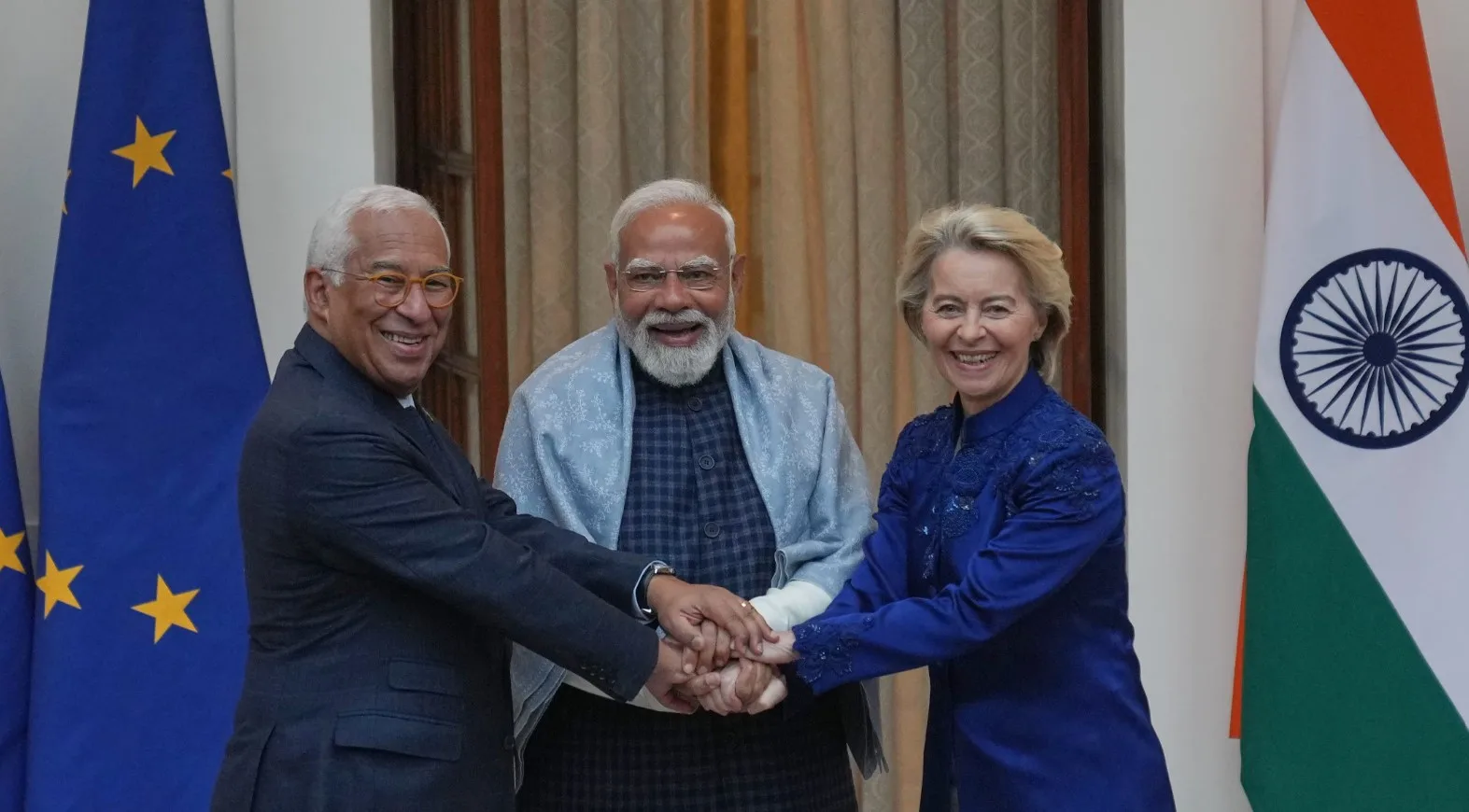
In a major shift poised to reshape the contours of global trade, India and the European Union announced on Tuesday, January 27, 2026, the conclusion of a comprehensive trade agreement culminating two full decades of negotiations at a moment of unprecedented geopolitical sensitivity on the international stage.
Dubbed “the mother of all deals” by Reuters, the agreement carries extraordinary weight due to its demographic and economic scale. It spans a market of nearly two billion people approximately 1.4 billion in India and around 500 million in EU member states. Together, they represent nearly 25% of global GDP and about a third of international trade, making this one of the most consequential trade agreements in the modern global economic system.
This alignment is not limited to commerce. In parallel, the European Union also announced a security and defense partnership with India, a direct response to mounting strategic challenges and escalating global uncertainty.
According to an official statement, this partnership establishes a comprehensive framework that outlines both sides’ strategic ambitions and governs cooperation in peace, security, and defense, signaling a transition to a deeper and more integrated relationship.
This dual-track partnership economic and security-oriented emerges against the backdrop of growing geopolitical turbulence, disrupted global supply chains, and a fractured trade landscape, aggravated in large part by the protectionist policies of former US President Donald Trump. These policies upended global trade balances and reopened debates about the future of the multilateral trading system.
A Historic Deal: What Are the Details?
European Commission President Ursula von der Leyen described the deal as a historic moment, writing on X (formerly Twitter): “Europe and India are making history today,” adding that the two parties had reached “the most significant agreement ever,” creating a free trade zone encompassing nearly two billion people, with mutual benefits.
Indian Prime Minister Narendra Modi echoed the sentiment, calling it “the most important deal globally,” and asserting that it would open vast economic opportunities for India’s 1.4 billion citizens and millions more across EU countries.
Both sides expect the agreement to significantly boost bilateral trade by slashing tariffs across numerous sectors. According to estimates from Brussels, reduced Indian tariffs on EU imports could save the bloc up to €4 billion annually.
The Financial Times reported that the deal would remove approximately €4 billion ($4.75 billion) in tariffs on EU exports, with expectations that shipments to India could double as a result.
Under the agreement, around 96.6% of EU exports to India will see tariffs reduced or eliminated altogether, leading to lower prices on a range of European goods including automobiles, alcoholic beverages, and machinery.
India is expected to cut import duties on European-made cars from 110% to 10%, and on wine from 150% to 20%. Tariffs on goods such as pasta and chocolate, currently at 50%, will be scrapped entirely, according to the EU.
During her recent visit to India, von der Leyen affirmed that the EU anticipates “the highest level of market access ever granted by India to a trade partner,” noting that India has long been a highly protected market. She projected that the deal would lead to a doubling of EU exports.
In 2024, bilateral trade in goods reached about €120 billion ($142 billion), an increase of nearly 90% over the past decade, with another €60 billion ($71 billion) in services, according to EU data.
Brussels is pinning hopes on India’s vast market the most populous country in the world which recorded strong year-on-year growth of 8.2% in the last quarter of 2025.
According to the International Monetary Fund, India is expected to overtake Japan this year to become the world’s fourth-largest economy, trailing only the United States, China, and Germany. Indian government projections suggest the country could break into the top three global economies before 2030.
The formal signing of the agreement is scheduled after the completion of legal reviews a process expected to take five to six months. Implementation could begin within a year, paving the way for a new phase of economic integration and cooperation.
Countering U.S. Policy
This move cannot be separated from its geopolitical context. It forms part of a broader set of political and economic maneuvers designed to hedge against U.S. policies, amid rising tensions between Washington and both Brussels and New Delhi.
The agreement represents more than bilateral cooperation it marks a strategic realignment aimed at reducing dependency on the United States and redistributing centers of gravity in the international system.
Tensions escalated following threats by Donald Trump to impose tariffs on EU nations, sparked by European opposition to his plan to annex Greenland. His repeated warnings that transatlantic partnerships would be “stress-tested,” coupled with a combative tone that alarmed Western allies, heightened frustration within the EU.
These developments have prompted EU leaders to seek rapid alternatives and mechanisms to strengthen their strategic and economic autonomy, as far removed from Washington’s shadow as possible.
Similarly, ties between Washington and New Delhi have been strained. The Trump administration imposed 50% tariffs on Indian goods, and failed attempts at reaching a bilateral trade deal last year due to stalled communications pushed India to expedite alternative partnerships that would bolster its global economic position and shield it from U.S. pressure.
In this context, mutual interests between the EU and India both adversely affected by American protectionism converged. The result is a multi-dimensional partnership leveraging demographic power, economic influence, and global political clout to form a new bloc capable of weathering shocks from deteriorating U.S. ties and reshaping the emerging global order.
This convergence goes beyond economics. The security and defense partnership suggests a profound realignment, potentially redrawing the map of traditional alliances. It cannot be divorced from the growing concerns surrounding NATO’s future, as Trump’s antagonistic approach to the alliance has cast doubts on its cohesion and role within the Western security architecture.
Redrawing the Global Trade Map
The creation of an economic bloc that accounts for nearly 25% of global GDP, encompasses a third of international trade, and serves a population of about two billion roughly a quarter of humanity represents a structural transformation of the global economic order. It signals a reconfiguration of trade flows and the beginning of a new era of unconventional alliances that defy rigid ideological molds.
As protectionism rises and the predictability of traditional economic relationships erodes, major nations and blocs are compelled to seek out more balanced and stable partnerships.
These new partnerships are no longer bound by shared ideologies. The India–EU alliance exemplifies this shift: India, with historic ties to the Eastern bloc, joining forces with Europe—the cradle of Western liberalism in a multifaceted economic and security pact.
This trend is evident elsewhere. The EU recently finalized a key agreement with the Mercosur bloc in South America and concluded trade deals last year with Indonesia, Mexico, and Switzerland.
India, for its part, signed trade agreements with the United Kingdom, New Zealand, and Oman, underscoring a global race to restructure trade networks and insulate them from geopolitical shocks.
In the same vein, UK Prime Minister Keir Starmer is set to begin a three-day official visit to Beijing on Wednesday, January 28, accompanied by Treasury Secretary Rachel Reeves and Business Secretary Peter Kyle, along with a large delegation of business leaders and economic officials. The visit framed explicitly around economic cooperation—aims to open new opportunities for British firms and strengthen trade ties with China.
Together, these developments point to a comprehensive reevaluation of the global economic and trade architecture. The world appears to be moving toward a more multipolar and interconnected system. Should other major economies join these new coalitions, the process of reshaping the global economic order could accelerate dramatically beyond the reach of either unilateral or bipolar dominance.
And What About Washington?
Unsurprisingly, this deal has rattled Washington, which may see it as a threat to the unipolar system that underpins its global dominance. It could reduce U.S. influence and accelerate the emergence of a powerful new political and economic bloc capable of challenging American hegemony.
As of this writing, there has been no official statement from President Trump. However, U.S. Treasury Secretary Scott Peasant criticized the EU for proceeding with the deal, citing ongoing U.S. tariffs of 25% on Indian goods as a consequence of New Delhi’s continued purchases of Russian oil.
Indian Minister of Petroleum and Natural Gas Hardeep Singh Puri told CNBC that U.S.-India relations remain positive and expressed optimism about a future trade agreement. He emphasized India’s commitment to a multilateral trading system.
In his analysis of the deal, Hosuk Lee-Makiyama, Director of the European Centre for International Political Economy, said it stands as one of the best deals for both sides especially given their protectionist approaches in sensitive sectors such as agriculture and automotive manufacturing. He noted that Europe has grown accustomed to recurring U.S. tariff threats.
Meanwhile, European Parliament member and Foreign Affairs Committee Chair David McAllister called for greater European sovereignty and competitiveness, while maintaining transatlantic relations grounded in respect and trust. He insisted that Europe is fully capable of defending its interests amid current geopolitical shifts.
Ultimately, President Trump’s second term appears likely to trigger sweeping changes not only in politics and security, but also in the structure of the global economic order. The realignment of traditional alliances is now a distinct possibility, as the old international system nears its end and a new, still-undefined balance of power begins to take shape.
This complex and unsettled reality presents an existential challenge especially for mid-sized nations. As Canadian Prime Minister Mark Carney bluntly warned during his address at the recent Davos Forum: “Middle powers must act together because if you’re not at the table, you’re on the menu.”