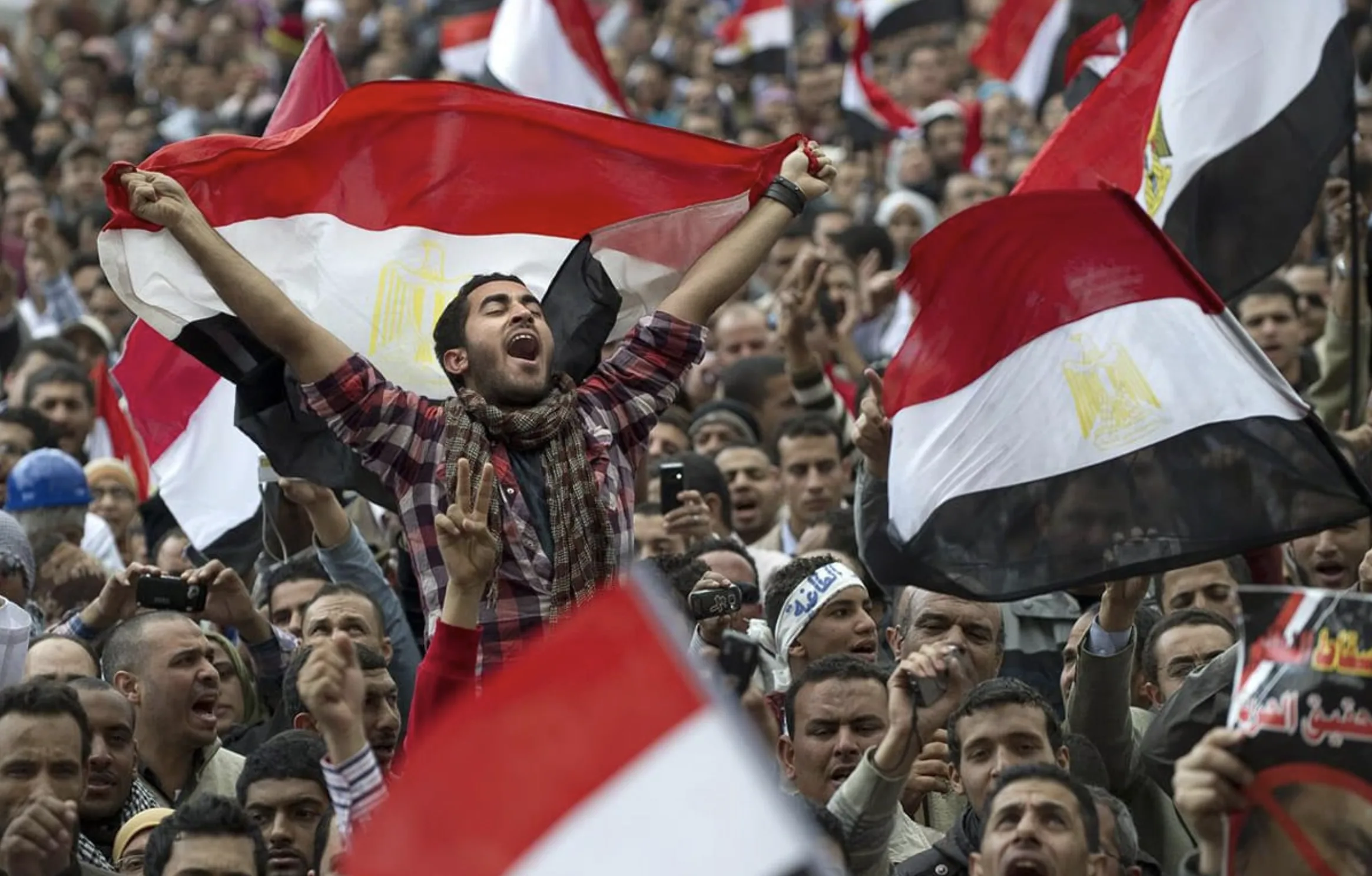
The January 25 Revolution of 2011 unleashed a wave of youthful and civic energy. Activists, intellectuals, and politicians emerged directly from the heart of the protests to shape Egypt’s sociopolitical and cultural life, dramatically expanding the horizons of civic and political participation.
But by 2013, the landscape had shifted. These same actors were swept into a campaign of systematic marginalization and exclusion: imprisonment, new legal restrictions, surveillance, frozen financial resources, media blackouts, and dismissals from public service.
These measures effectively erased their influence, pushing them from the center of national life to the fringes or out of the country altogether.
At the same time, Egypt witnessed a reversal of fortunes for former regime figures. Many key players from Hosni Mubarak’s government were released, and some returned to powerful roles, particularly in the economic sphere, leveraging their existing networks and influence. Meanwhile, the youth and revolutionaries who had championed change remained sidelined and persecuted.
The post-2013 regime embarked on a systematic dismantling of the revolutionary energy and talent that had risen in 2011. Activists and intellectuals lost their ability to organize, articulate reform, or influence society.
This led to a profound vacuum in expertise and momentum, stagnating civic, political, and cultural engagement while the regime consolidated its control over the public sphere.
An Explosion of Expression
The revolution opened Egypt’s public sphere like never before. A vast range of political, social, and cultural expression flourished, drawing in broad sectors of society. A new generation of activists and thinkers took center stage.
This period saw a political boom: new parties, movements, and coalitions emerged. The number of political parties surged from 24 before the revolution to 68 after it—a staggering growth of 44 parties in a short span, signaling an unprecedented political opening.
Newspapers and media outlets proliferated: 25 new newspapers were launched, alongside 25 new TV channels, including independent voices like Al-Wadi, Al-Tahrir, and Al-Badeel, as well as emerging online platforms born out of the revolution. These outlets gave the public broad access to news and political analysis.
Diverse ideological currents flourished Islamist, liberal, leftist, Christian and young revolutionary movements like April 6, Ahrar, and the Revolutionary Socialists played a key role. Student activism peaked, with campuses becoming vibrant arenas for political dialogue and organization.
Coalitions representing various revolutionary and social groups sprang up, including the Coalition of Revolutionary Youth, the Egyptian Islamic Coalition, and the Copts’ Coalition, as well as professional alliances like the Youth Doctors Coalition and the Honorable Teachers’ General Coalition.
The revolution’s influence extended to education and community development. Some activists founded educational institutions aimed at fostering awareness among youth. Notably, Sheikh Emad Effat established the Sheikh Al-Amoud Foundation to promote open, independent religious and civic education. He was killed by military forces in 2011, but his vision endured in the civil spirit the revolution sparked.
Many January-born actors directly influenced public debate, founded new political parties, and gained modest representation in parliament, while others remained in the streets, betting on continued revolutionary momentum.
From Influence to Marginalization
Post-2013, Egypt entered a phase of systematic repression targeting the very figures who had risen during the revolution. The public sphere was no longer open—it was tightly controlled in an attempt to bury the revolutionary moment.
The first move was reengineering the media landscape. Independent media born from the revolution was reined in. Where once the media operated independently, after July 3, 2013, the state imposed total control. Security forces raided and shuttered 14 Islamist TV channels, including Misr 25, a crackdown unseen even during the revolutionary upheaval.
Simultaneously, severe restrictions were imposed on public gatherings, protests, and political forums, stripping youth movements and revolutionary platforms of their tools for public engagement and influence. Political activity became a legal and security risk.
Digital platforms were next. Once the bedrock of revolutionary mobilization, they came under strict surveillance. Prominent activists were targeted, and platforms like Masr Al-Arabia and Yaqeen Network, both born out of the revolution, were shut down.
Civil society organizations, too, faced escalating pressure shutdowns, prosecutions, and accusations of spreading “false news.” Independent rights and cultural organizations found their funding frozen and their operations paralyzed by burdensome laws.
Even non-political initiatives weren’t spared. Despite distancing itself from politics, the Sheikh Al-Amoud Foundation was shut down, and its director, Sheikh Anas Al-Sultan, was arrested and remains detained. The crackdown made no distinction between political and educational initiatives.
On the political party front, parties formed after the revolution particularly those opposing the post-June 30 trajectory faced waves of repression. Islamist leaders were jailed, and leftist and liberal parties lost visibility and influence, unable to fulfill meaningful political roles.
Parties born out of January found themselves scattered: some were co-opted, others disbanded or marginalized, while many were exiled or imprisoned. Some formally exited politics, a clear admission of disillusionment and the closure of political space. Revolutionary action became confined to a narrow, surveilled margin.
How Sisi Eliminated the Revolution’s Actors
Imprisonment and Security Pursuits
After 2013, arrest became a central tool of state policy to neutralize the political actors of the revolution. Detention was no longer exceptional; it was the norm.
Initially, repression targeted the Muslim Brotherhood and its allies. But it quickly expanded to include a broad range of activists: youth organizers, independent journalists, human rights defenders, and even members of the post-revolution parliament. The goal wasn’t ideological it was to erase the memory of January and prevent its resurgence.
Ahmed Maher, founder of April 6, was repeatedly jailed, along with dozens of Tahrir Square activists and Revolutionary Socialists. Many faced prolonged pretrial detention, travel bans, or probation-like conditions.
This crackdown directly paralyzed the political activity of January’s veterans and sent a chilling message to others, deterring youth from political or protest engagement. Some were tried in absentia while in exile, making return nearly impossible. Those released remained under tight surveillance, unable to resume public life.
Meanwhile, those still imprisoned suffered routine abuse, torture, and legal “recycling” recharged with new cases as soon as their detention periods ended. These detainees spanned ideological lines Islamists, leftists, liberals, and independents underscoring the regime’s aim to purge all remnants of January.
With repression escalating, many activists were pushed into silence or exile. Egypt built over 45 new prisons in a decade reflecting the punitive expansion of the state.
Economic Strangulation
The regime’s campaign wasn’t only political it also sought to economically suffocate January’s actors. Arrests served as financial punishment, with exorbitant bail conditions burdening activists and their families.
Key among these tactics was the Asset Seizure Committee, initially targeting Brotherhood-linked entities but soon expanding to freeze assets of January-linked individuals, businesses, and civil society organizations.
Domestic funding for independent civic institutions also dried up. Activist-led small businesses were shut down, and vague charges like “funding anti-state activities” justified bank account freezes and property confiscations. This deprived January’s figures of the ability to sustain initiatives or fund public work.
These combined policies effectively impoverished January’s political base, turning potential change agents into an economically drained, politically isolated group—and signaling that dissent would carry steep costs.
Erasing Presence from Media and Employment
After 2013, January’s young revolutionaries were barred from the media public and private alike. Talk shows and panel discussions excluded their voices, even as entire programs dedicated to youth perspectives were taken off air.
Journalists who had covered the revolution were fired, censored, or forced into exile. Platforms like Oxygen Egypt were shut down, and journalists were pushed to the margins or out of the country entirely. The result: a severed connection between revolutionaries and the public.
Many were also purged from public employment, particularly in academia and education. University professors affiliated with revolutionary or civic movements were dismissed. This drained state institutions of valuable expertise and deepened youth activists’ marginalization.
Meanwhile, regime loyalists retained top positions.
Forced Exile
Numerous activists were forced into exile to escape prosecution and repression, scattering across Turkey, Qatar, and European countries in search of freedom or safety.
Among the most prominent are Hiba Raouf, an academic and political educator who held influential weekly lessons at Sultan Hassan Mosque before continuing her academic work in Turkey, and Rami Essam, the “singer of the revolution,” now living in Sweden and Finland after threats and harassment.
Physicist Ahmed Abdel Baset, sentenced to death in absentia in a military case with no actual casualties, now lives in the United States.
Impact of Marginalization on Egyptian Society
The exclusion of the January Revolution’s actors left a deep mark on Egyptian society. The country lost an innovative generation of youth capable of shaping policy. Political and cultural stagnation set in, and civic engagement withered.
Beyond activists, scientists and engineers were also imprisoned for civic or political activity, stripping the country of top-tier technical talent and weakening its scientific capacity.
With intensifying repression, many activists fled abroad. This brain drain of politically and intellectually engaged youth crippled civic education and leadership development initiatives.
University students turned away from politics after witnessing their peers’ persecution. Public discourse thinned, with intellectuals retreating from debates amid surveillance and fear.
Official politics suffered too: election participation fell, regime media dominated the narrative, and public trust in the state eroded.
In short, marginalizing the January actors wasn’t just about sidelining opposition. It drained the country of talent, suppressed innovation, and dulled the cultural and political vibrancy that had briefly emerged in 2011.
The ultimate irony: while the revolutionaries remain exiled, imprisoned, or silent, many figures of the regime they rose against are once again in power.