
After much anticipation, the US administration has unveiled the composition of the Peace Council and appointed a High Representative for Gaza, coinciding with the start of work by the Palestinian technocratic committee tasked with managing the Strip. The committee held its first meeting in the Egyptian capital, Cairo.
Under the US-brokered agreement, the committee is expected to manage Gaza’s affairs until the reformed Palestinian Authority assumes full control—a process that, according to Washington’s blueprint, is intended to offer a “credible pathway” for Palestinians to achieve self-determination and statehood.
According to President Donald Trump’s statement, this “milestone” aligns with UN Security Council Resolution 2803 (2025), which approved Trump’s comprehensive plan and welcomed the establishment of the Peace Council.
The Council is to play a pivotal role in implementing the 20-point plan by offering strategic oversight, mobilizing international resources, and ensuring accountability during Gaza’s transition from conflict to what is described as peace and development.
These moves follow weeks of Israeli stalling and attempts to obstruct progress to the agreement’s second phase. US envoy Steve Witkoff eventually announced the start of this phase, which includes disarmament, formation of a technocratic government, and the launch of reconstruction efforts without seriously addressing Israel’s failure to meet the obligations of the first phase, which the Palestinian resistance had fulfilled in full.
A Council with a Predefined Agenda
The announced composition of the Peace Council and its executive bodies raises multiple questions and hypotheses, particularly regarding its lack of alignment with earlier descriptions by President Trump. The Council members exhibit clear bias toward Israeli narratives and objectives, and the Council’s mandate and mechanisms remain vague and opaque.
The Peace Council and Its Founding Body
According to the official statement released by President Trump, the Peace Council aims to provide strategic oversight for implementing his comprehensive roadmap to end the war in Gaza. The 20-point plan, as framed by the US, focuses on achieving “lasting peace,” stability, reconstruction, and economic development—while ensuring accountability and marshalling international resources during the transitional period.
To realize this vision, a Founding Executive Council has been established under President Trump’s leadership, comprising individuals with experience in diplomacy, development, infrastructure, and economic strategy. Each member is expected to oversee a portfolio critical to Gaza’s long-term stability, including administrative capacity building, regional diplomacy, reconstruction, investment attraction, and large-scale financing.
-
Donald Trump: Former 45th and current 47th President of the United States, inaugurated in January 2025 after winning the 2024 election. Trump frequently describes himself as “the most pro-Israel president in US history,” a claim strongly endorsed by Israeli Prime Minister Benjamin Netanyahu.
-
Marco Rubio: Current US Secretary of State and former Senator from Florida (2011–2025). A staunch Republican, Rubio is known for his unreserved support for Israel, including public justifications of what critics call genocide in Gaza.
-
Steve Witkoff: A billionaire real estate developer and lawyer, appointed by Trump in 2024 as Special Envoy to the Middle East. He plays a central role in US foreign policy, particularly on Gaza, Iran nuclear negotiations, and the Ukraine war. Witkoff is closely tied to Israeli leaders and enjoys Trump’s full trust.
-
Jared Kushner: Orthodox Jewish businessman, owner of Kushner Properties and the New York Observer, and son-in-law of Donald Trump. As a key architect of the “Deal of the Century” and the Abraham Accords, Kushner remains deeply involved in Gaza’s post-war planning and ceasefire negotiations, despite holding no official position.
-
Tony Blair: Former UK Prime Minister (1997–2007) and former Quartet envoy to the Middle East. Blair is associated with the wars in Iraq and Afghanistan and has played a controversial role in shaping Palestinian political structures in ways that align with Israeli interests.
-
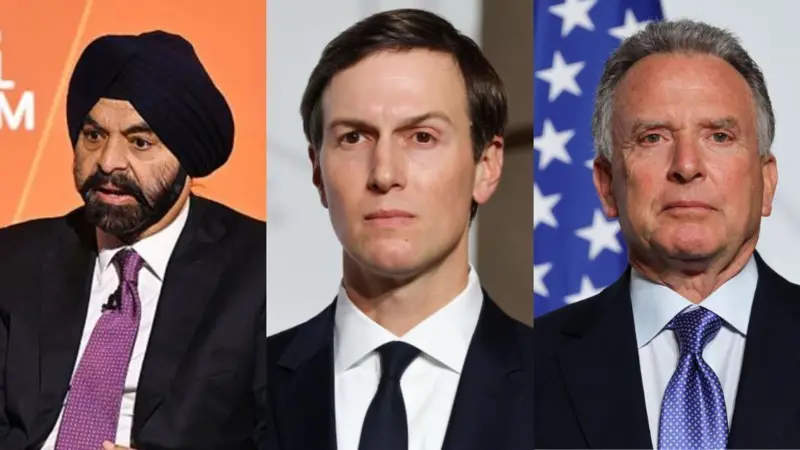
Marc Rowan: CEO and co-founder of Apollo Global Management, with an estimated net worth of $8.2 billion. A low-profile investor, Rowan holds diverse investments across finance and real estate.
-
Ajay Banga: Indian-American businessman and current President of the World Bank (since May 2023). Formerly led Mastercard and served as a trade advisor to President Obama.
-
Robert Gabriel: Political advisor, speechwriter, and former television producer, currently serving as Deputy National Security Advisor and senior policy aide to President Trump.
-
Nickolay Mladenov: Former UN Special Coordinator for the Middle East Peace Process, appointed as High Representative for Gaza. He brings extensive experience in Palestinian affairs, though he is known for prioritizing temporary economic relief over political solutions.
-
General Gasper Jeevers: Head of the international force in Gaza and commander of US SOCCENT since June 2024. He has served in multiple Middle Eastern conflict zones and will lead the multinational force tasked with ensuring security and aid delivery in Gaza.
Peace Council Advisors
The White House named two advisors to manage the Council’s strategic and operational direction:
-
Aryeh Lightstone: Former rabbi, Trump campaign staffer, and advisor to the US Ambassador to Israel. He managed the controversial “Abraham Fund” and helped found the “Gaza Humanitarian Foundation,” accused of facilitating civilian massacres during aid distribution.
-
Josh Greenbaum: Former head of procurement in Trump’s administration and a key figure behind economic proposals for Gaza, including the “Own Gaza” project, which sought to rebrand the Strip as the “Middle East Riviera.” He will oversee the Council’s financial and administrative operations.
Gaza Executive Council
Alongside the Peace Council, a second executive body referred to as the “Gaza Executive Council” will operate with a closer focus on field realities. Its aim is to “promote effective governance and provide high-quality services that foster peace, stability, and prosperity for Gaza residents.”
The council includes several Peace Council members Witkoff, Kushner, Blair, Mladenov, Rowan alongside regional stakeholders:
-
Hakan Fidan: Turkish Foreign Minister and former intelligence chief, known for his strong support of Palestinian rights and vocal criticism of Israeli aggression. He played a central role in the ceasefire negotiations in Sharm El-Sheikh.
-
Ali Al-Duwadi: A prominent Qatari strategist and unofficial mediator in several global conflicts, including Gaza ceasefires. Known for his quiet influence on diplomatic outcomes.
-
Hassan Rashad: Head of Egypt’s General Intelligence Directorate since October 2024, with a key role in ceasefire mediation and Gaza governance planning. The Egyptian intelligence service is a critical channel between Palestinian factions and the global community.
-
Reem Al Hashimy: UAE Minister of State for International Cooperation, known for controversial stances, including her condemnation of Operation Al-Aqsa Flood and early calls for an international mission in Gaza.
-
Yakir Gabay: Billionaire real estate magnate with a 15% stake in Aroundtown SA, Europe’s largest commercial real estate firm. His family has held high-level Israeli government roles. Gabay began his career at Israel’s Securities Authority and Leumi Bank.
-
Sigrid Kaag: Dutch diplomat and current UN Assistant Secretary-General. Fluent in Arabic, Kaag has held senior roles in Lebanon and Gaza and is married to former Palestinian diplomat Anis Al-Qaq.
Gaza National Governance Council
The US administration’s plan assigns day-to-day governance of Gaza to a body termed the “Gaza National Governance Council.” Its mission: restoring basic public services, rebuilding civil institutions, and stabilizing daily life to lay the foundation for sustainable governance.
The Council is headed by Dr. Ali Shaath, described as a “widely respected technocratic leader.” Shaath is tasked with service restoration and civil institution rebuilding, alongside a council of professional Gazans representing diverse sectors:
-
Bashir Al-Rayyes (Finance)
-
A’ed Yaghi (Health)
-
Ali Barhoum (Local Governance)
-
Hanaa Terzi (Solidarity and Relief)
-
Adnan Abu Warda (Justice)
-
Osama Al-Sa’dawi (Housing)
-
Abdel Karim Ashour (Agriculture)
-
Omar Shammali (Telecommunications)
-
A’ed Abu Ramadan (Industry and Economy)
-
Sami Nussman (Interior and Security)
While the US refers to it as the “Gaza National Governance Council,” Palestinian factions and the Palestinian presidency describe it as the “Palestinian National Transitional Committee for Gaza Administration.” This discrepancy underscores a key political divide: Palestinians insist the process remain part of a unified national political structure, whereas the US nomenclature frames Gaza governance as an internationally led initiative potentially undermining its Palestinian legitimacy.
Lingering Questions and Fundamental Concerns
The structure and membership of the Peace Council suggest a fundamental failure by the US to secure broader international buy-in. Instead of the envisioned assembly of world leaders, the final roster largely reflects Trump’s inner circle from the Gaza ceasefire talks.
Moreover, the overwhelming pro-Israel stance of most Council members is deeply troubling. Many have justified or downplayed Israeli atrocities, including acts widely condemned as genocide, while others have advocated for policies involving mass displacement of Gaza’s population and commercialization of its land.
The division between the Peace Council and the Executive Council—despite including regional mediators like Egypt, Qatar, and Turkey—suggests an attempt to sideline these actors from strategic decision-making and limit their role to technical execution. This undermines Palestinian agency and risks imposing a “solution” defined entirely by a biased team.
The term “High Representative,” too, evokes colonial-era “mandates,” where external powers ruled under the guise of trusteeship fueling fears that Gaza’s transitional arrangements are a prelude to stripping Palestinians of political agency. The Palestinian-led governance body may be reduced to a glorified municipal committee, detached from the national political struggle.
Together, these dynamics raise urgent questions about the Peace Council’s real objectives and its alignment with Palestinian rights, particularly as Israel’s war machine continues to reconfigure its tactics while maintaining the overarching goal of suppressing Palestinian self-determination.