
A man who writes literature with deep optimism and an unwavering faith in humanity and love rooted in trust in human exchange and in the simple Arabic maxim: “I am of you and to you.” He believes that most people carry inner beauty that can emerge if given the chance, even if they seem to display evil at certain moments.
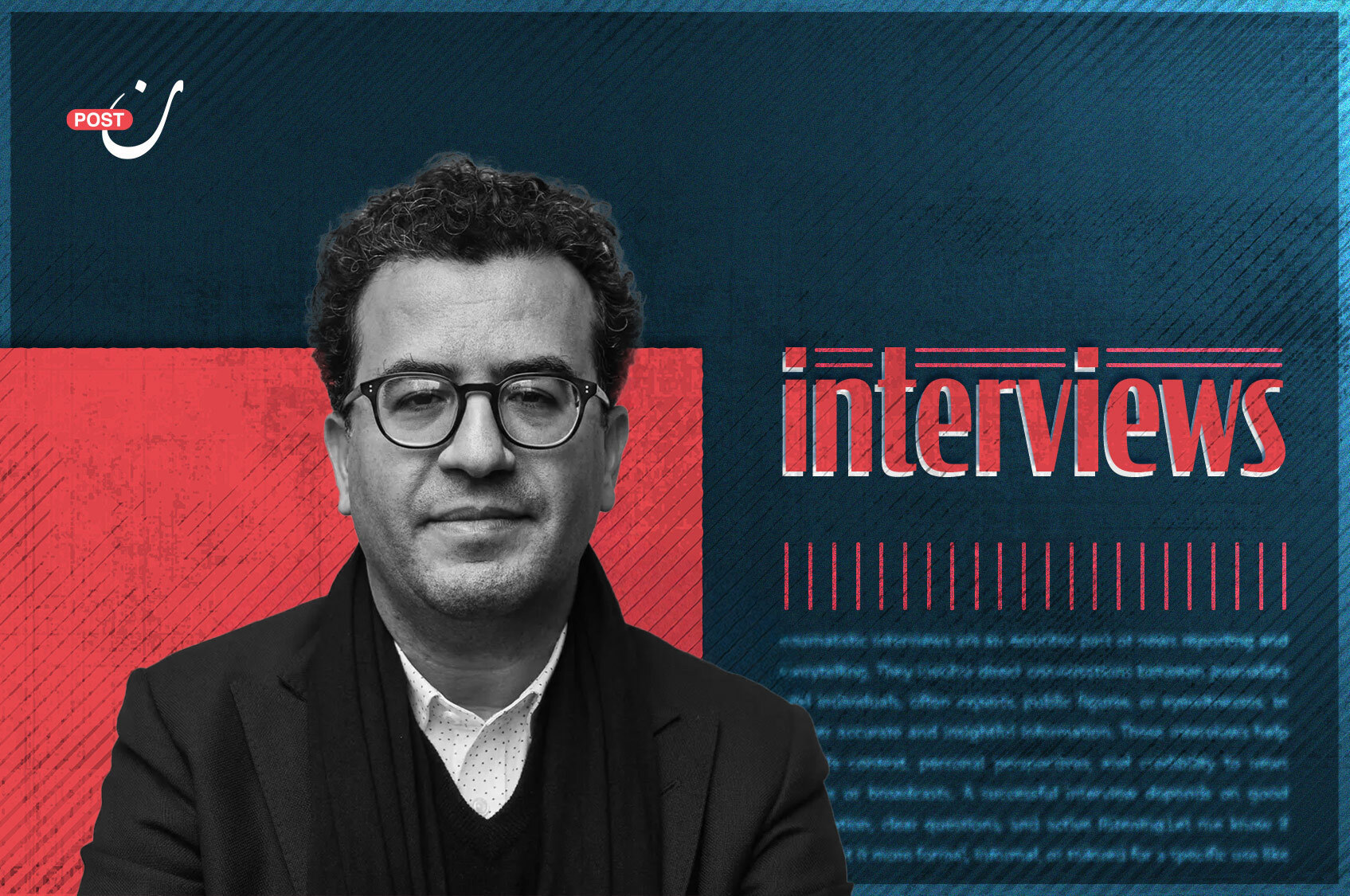
From New York, just days ago, the globally acclaimed Libyan writer Hisham Matar spoke to Noon Post after nearly a year and a half of effort while reviewing the Arabic translation of his newest novel, Friends, which has won and been shortlisted for several awards since its publication in 2024. Its Arabic translation is expected to be published soon by Dar El Shorouk in Egypt.
His latest project involves translating the book Ahlam: A Period of Recuperation by Egyptian Nobel laureate Naguib Mahfouz into English, released last May under the title I Found Myself… The Last Dreams, with a foreword by Matar and photographs by his wife, the photographer Diana. Matar met Mahfouz in Egypt at a pivotal moment in the latter’s life as he was writing these dreams a meeting that left a profound mark on Matar’s literary and human sensibilities.
Matar writes in English and does not have much time to read contemporary literature not out of arrogance, but due to lack of time. He admits feeling that he falls short toward his friends who are writers, both Arab and foreign, but emphasizes that reading for him is “oxygen,” and that he is a slow reader who needs a long time to finish a single book.
Matar studied architecture but changed his path to writing both creative and academic. He leans toward writing as his most honest means of saying what he wants and prefers to leave his book alone with the reader, allowing them to interact without his presence, because the text, in his view, is the most precious thing he can offer.
He finds a constant tension between writing and speaking, which leads him to avoid intensive media appearances, given the pressures they impose on the writer and on literature itself.
Just as Matar takes a long time to read, he also takes a long time to write: his latest novel took three years to write after carrying its idea for nearly a decade; his book The Return took about three years; the novels In the Country of Men and Anatomy of a Disappearance each took about four years; while A Month in Siena, where he blends visual art, travel, and reflection, was written in only six weeks.
Here is the full conversation:
You won the George Orwell Prize for Political Fiction for your novel Friends. Do you think the Arab world needs a similar prize for political fiction perhaps launched by Arab writers abroad as a form of resistance or free expression amid the broader Arab political climate?
Prizes are important, but the attention given to them by readers, writers, and publishers alike is excessive. I care more about development than about prizes.
A writer needs support to write because writing doesn’t come with an income, and it’s difficult for a novelist in particular to make a living from writing even successful writers and those who write serious novels.
A prize encourages social and political critique, but what I prefer, from the perspective of a writer, is to give a modest sum annually over five or ten years to a group of writers to support and sustain them be it five, ten, fifteen, twenty, or even one hundred writers if you have the influence rather than giving a £50,000 prize to one writer for one book each year.
Use the same budget over a period of time because writing and novels take time. That’s if our concern is nurturing literature and its makers.
The prize remains fine, but its problem is that it gives you the idea that literature is a race; in truth it is cooperation, not a race. Writing is a craft of solidarity and collaboration. When you sit alone in a room and write, you are in dialogue with the history of literature, with other books, with many voices, and with every person who has influenced you in life.
Your father paid a high price for opposing Gaddafi. Would you have opposed repression or tyranny in the same way?
In other words, what is your method for confronting despotism whether in a dictatorship or a democracy as we see in the world today?
My father was a politician with his own methods and ideas that he wanted to realize in his country ideas about managing freedoms and social existence that would grant freedom to the press and independence to the law. All of these ideas were completely opposed to the ruling system in Libya at the time Gaddafi’s regime.
I agree with my father on many ideas, but our personalities are different, and the beautiful thing is that he always encouraged my choices. I am more interested in art, philosophy, and thought. Though I share his political perspectives, my approach is different. I don’t see myself as a writer of a particular type of novel or literature I don’t see myself as a political or oppositional writer.
For me, the writing and the project itself drive the thought; I don’t drive it. I’m not against those who do this there are excellent writers who do but it’s not my way. When they gave the Orwell Prize for Political Fiction to my novel Friends, I was delighted by the honor.
I’m not against those who see the novel in these terms, but that’s simply not where I write from. I know the idea is sometimes hard to understand and may seem full of contradictions, but for me it’s simple.
You enter the kitchen to cook something you want today, then friends come in and find the food they crave. You will be happy that what delights you also pleases them but you didn’t cook it for them in the first place.
Writing emerges from an obsession. Even the word obsession is problematic for me it’s like a dream. All the books I’ve written, whether novels or memoirs, started from an image, a sound, or a feeling without knowing what would come next, but something draws me.
That’s how Friends began with a long sentence full of circling yearning and a desire to measure the distance between feeling and existence. One sentence that I didn’t know who would say it, in what context, or why I felt that way.
I wrote it and carried it for about eight or nine years before sitting down to complete the whole novel. There is drama that holds any story, and there are deeper existential or philosophical questions that sustain the work.
That’s how a beginning happens. You don’t jump into the work and decide it will be political or emotional or revolutionary. Writing is an attempt to strip yourself bare. You will write what draws you regardless of its resonance with people or their admiration of it. If they like it, you will not find yourself alone in those feelings.
Do you feel a responsibility to express the voices of the voiceless, or is that a burden the writer must resist?
I don’t feel that consciously. There is a problem in deciding who the voiceless are many are voiceless. I have an ethical and political sympathy with the concept, but I also have artistic doubts about it.
As a reader because I am a reader more than a writer I want to live in a culture that allows all voices to be heard and allows the marginalized to be part of the conversation. That is genuine plurality not giving the responsibility of representing the voiceless to some people.
Exile in your writings is not just political but also intimate. To what extent has exile become a lens through which you see the world, reflected in your writing and in your university teaching of exile literature?
Without a doubt, exile is a very powerful factor in my life and in my formation as a human being. I’ve lived between two cultures, and I am a son of both.
I am fundamentally Arab raised as an Arab, with those roots, my people, and my family but I was raised in the West—especially in Britain—since I was 15.
I’m 55 now, and I have lived all this time with the West and in its language in which I write.
The most important relationship for a writer is with the language he uses. Language is not just a system of concepts it is philosophy, feeling, emotion, history, and psychology. There is a deeply important reason for the Arabic word for injustice being the opposite of light, whereas in English injustice is the opposite of justice.
It may seem simple, but it’s a philosophy that influences everything. It influences how we welcome, for example, or how we approach food. All of this has deep cultural roots. So when you are an Arab writer writing in English, you have great contradictions in your life.
Overall, every culture has two dialogues: one with the self and one with the other, which are completely different. How we speak about ourselves with those who resemble us and how we speak about ourselves to the other.
I am British and Libyan, and that’s a problem because these are countries with historical conflict and still today between Europe and the Middle East and America as well.
I am not Japanese and Libyan, for example. I find myself between two cultures with all the disputes and historical tensions and also the old cultural cooperation between them.
Your book The Return, in which you trace your father’s path, is the only one not yet translated into Arabic despite being a declared project. What happened?
And what is your relationship with Cairo, where you lived for a period and where your father disappeared?
There is always a distinction in my mind between governments and peoples. My relationship with Egypt is not like my relationship with the Egyptian regime that kidnapped my father and handed him over to Libya. Similarly, my relationship with Libya is different from my relationship with the Gaddafi regime or any regime.
I say that the more difficult our countries are and the more problems they have, the more we must maintain social relations with them. I have great faith in the genius of social relationships that surpasses anything else.
Egypt—Cairo, specifically—has its own intelligence and confidence in social exchange. Perhaps at the time of the event itself I carried some distance from it, but I never bore it hatred. This is one of the things I thank God for. The desire for hatred or revenge was never part of my life.
Even when my father was in prison in Libya during the darkest and most painful times I never wished those who imprisoned him to be harmed. In my view, revenge is the greatest defeat accepting that the oppressor’s method is the method that must continue. Literature is deeply interested in this idea. Shakespeare’s Hamlet, for example, is essentially concerned with the problem of revenge.
When we went to Egypt, my accent became entirely Egyptian indistinguishable from Egyptians. After my father was kidnapped, the accent returned to Libyan. This is the only psychological impact on my relationship with Egypt, but the social connection with Egyptian friends after what happened to my father was deep and sincere. You don’t need much time to distinguish political violence or corruption from the people themselves.
What about the translation of the book? Some see political reasons that might be hindering its translation since the Arab publisher is ultimately in Egypt and your book deals with disappearance there…
No, that’s not the case. Translation is a long story and always has its challenges. The Return in particular is difficult to capture in its voice. We have a translation, but it wasn’t accurate, and we haven’t yet succeeded in achieving a better one.
Writing in English creates distance between you and the Arab reader. Has this choice cost you something, or has it given you protection in saying what you want?
For me, writing in English was not so much a choice as it was the result of many things even before I left Egypt. Education in Egypt in the 1970s and especially the 1980s suffered from major problems that pushed those who could afford it to enroll their children in foreign schools and I was one of those caught in that.
My initial relationship with Arabic was extraordinary. In grammar exams, for example, the boys would gather around me and sit next to me because I excelled. I wrote poetry too, and my entire relationship with literature and language was in Arabic until age eleven.
Then I was transferred to an English school a painful transition because I didn’t know a single English word. They put me in an office with headphones, and I listened daily to Jane Austen novels for two hours every morning before other classes.
I had just six months to learn the language so I wouldn’t lose the school year, so I dove entirely into English and after two years I moved to a boarding school in Britain. There was a profound loss when the language slipped away. In my twenties and early thirties, I was deeply concerned with these questions and they weighed heavily on me. I felt I was a child of contradictions that would never align.
For freedom it’s certainly tangible but there are Arab writers who have courage and freedom, and there are writers who write in English without freedom. Living in a culture that can cancel a book or imprison a writer that happens and has serious consequences. But the first space of freedom is internal. That is the first battlefield a writer must win for his zeal for freedom and that doesn’t come merely by changing place.
Your writings represent a different model of the relationship between son and father in the Arab context. How has this relationship evolved over time?
Has the prolonged uncertainty about your father’s fate shaped your sense of narrative as an alternative to the experience of ultimate loss?
My first three books In the Country of Men, Anatomy of a Disappearance, and The Return all focused on the father‑son relationship in different circumstances. I was 19 when my father was kidnapped, and I returned to Libya at 42. During that entire period, my primary concern in life was the presence of my father, which consumed much of my effort and thought.
Strangely, in the midst of all this preoccupation with trying to find my father which took various forms, including working with international human rights organizations, in the judiciary, and in the media I felt distant from him. I didn’t understand how I could feel that distance when I devoted so much effort to finding him. He visited me in dreams, yet I felt a distance between us.
In Libya, I had the chance to search for him in the place where he was taken without knowing how or exactly where he was moved. Every new piece of information opened up new questions. Then I reduced the intensity of the search that had occupied my life for six years. I continued searching but in a lesser way and this is where the surprise happened.
My father returned in my mind not with the language I had been speaking about him related to abduction, torture, and prison, but as my father the smiling, uninjured father before all of that. It was a great mercy and a gift from the Most Merciful that changed my concept of our relationships with loved ones who have died.
That is the personal difference that occurred, but in terms of writing which is also a personal matter the greatest gift my father gave me was respect for my personal freedom and respect for the plurality within me and the plurality within the family.
He had his ideas and style, and I have another style. Plurality itself is richness, not a burden to be borne. I am sure that if he had not done this with me, I would have been a different person given the complexity of the situation I found myself in and the difficulty of finding my own freedom.
My father was kidnapped, my friends were in prison, my cousins were in prison, my uncle was in prison there was danger to me too. It is very difficult to dream in such a context, to read a novel, to contemplate a painting in a museum, to have a relationship with dawn or with Beethoven. These are all questions you ask yourself in such a situation.
Even when he succeeded in writing a letter from prison describing what happened to him and brave youths smuggled it to us later he wrote to each one of us in the family. He started with my mother, then my older brother, and when he addressed me he asked whether I was still writing poetry and whether the guitar was still my friend.
At that moment, my heart felt it had stopped. I wondered: Will he now tell me I should focus on other things with all these developments? And the next sentence he wrote amid all this very difficult situation was: “I hope you are still keeping up with poetry and music.”
Perhaps that helped you move beyond the theme of fatherhood to write Friends? Do you see this as a transition to a new phase in your writings?
I don’t see it that way. I am building a specific fabric in which all the threads connect, each different from the other. Only God knows what will happen in the end. I am like someone listening to music humming in his head, wishing it would never end. When it ends, we can examine the fabric.
Let me tell you something else that influenced me: when I went to Libya, I met many people who had been imprisoned with my father, and they gave me impressions that helped me form a picture of his presence in prison he was loyal to his beliefs and principles, strong, full of the poetry he memorized, and unbroken by torture.
This gave me a sense that my father’s essence did not withdraw from him and that he remained who he was, which gave me courage in life and optimism and pride not as a son, but as a human being.
Not every writer wins awards or finds, for example, an American president like Barack Obama reading and praising their book. How fortunate do you consider yourself, and what setbacks did you face early in your writing journey?
I consider myself lucky with my family and friends that is the fundamental standard. In writing, yes, luck certainly plays a role. It’s a beautiful thing to be a writer with readers. That’s the kind of dialogue you want. The setbacks were at the beginning. I sent a sample of my first book to agents and received many rejection letters.
I show these letters to my students now to encourage them. But generally, it didn’t take long for me to find an agent and a publisher who have continued to publish me from the first book until today.
I always tell beginner writers not to focus on prizes or financial gain from the publisher or other matters, but to put all their concern into the writing itself and not ask it too much.
In a world burning with events tyranny and extremism, Gaza, revolutions and coups over the past decade and a half, civil wars and forms of international bullying what contemporary issues or concerns occupy you today?
I’ll answer as a citizen, not as a writer. Sometimes the concerns overlap, but not always. As a citizen, I am very concerned about what is happening in Palestine.
It’s the issue we grew up with the most important issue in our lives and it’s deeply connected to what is happening in our countries. It’s a complex issue intertwined with other concerns, especially the pressures Arab governments face because of it or the pressures these governments place on us as a society.
I am also preoccupied with the prevailing concept of progress, knowledge, or success presenting Dubai as a model of all that. Also, our impact on nature in what is known as the environmental crisis, which I see as a human problem, not an environmental one, because the environment will endure humans are the ones in grave danger.
Likewise, America going into Venezuela and talking about Greenland what I call political bullying. Israel striking in seven countries at the same time. This bullying has undermined international law and the institutions we built after World War II.
All of this carries a heavy weight in the chest as a citizen, and as a writer I write about these topics in journalistic work. And I am certain they appear in my books in one way or another.
For you, the novel is not just a story but a history of ideas, feelings, and connection. What are you currently writing, and is it different from before?
For me, each book is completely different from the other. I begin my day with writing. Right now I’ve been writing a novel for a year that has nothing to do with a son and his father but it’s difficult to talk about because writing and talking use the same thing, which is language.
It took many years to publish Friends since the birth of its idea. Do you think some truths become writable only after a certain period of time?
This is important, especially in the novel. It’s difficult to write a novel about an event happening in real time not impossible, but difficult. It requires some time because the novel comes from imagination, and imagination needs time because it simmers history or thinks about it differently.
However, my new novel is connected to contemporary time and tests the idea of writing about something happening now this is my first experience in this context.