















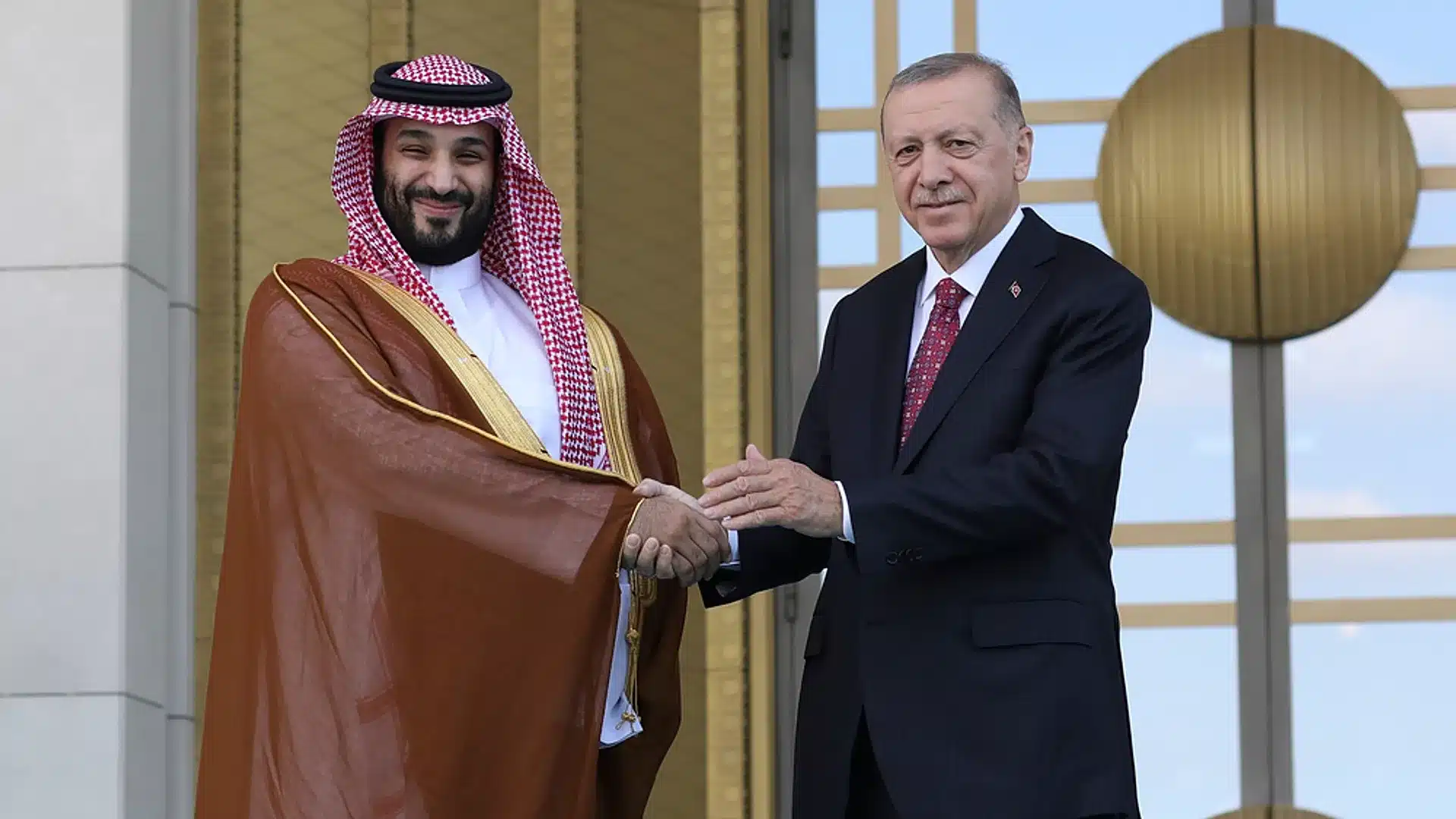
“The Islamic world has awakened from a century-long slumber, and we are now certain that unity is the key to realizing our true potential.”
This statement by Turkish Foreign Minister Hakan Fidan is more than a rhetorical flourish.
It signals a shift in regional power dynamics and a reconfiguration of Turkey’s strategic posture alongside key countries in the region, as they confront the mounting threat posed by Israel under the protective umbrella of the United States.
The significance of Fidan’s statement becomes clearer when viewed in its timing. Just hours earlier, Bloomberg revealed that Ankara is seeking to join the Saudi–Pakistani joint defense alliance, signed in September last year. Sources familiar with the matter confirmed that negotiations are at an advanced stage and an agreement is now highly likely.
This development comes amid escalating tensions between Turkey and Israel on multiple fronts most recently in Somalia, preceded by disputes over Palestine, Syria, the Eastern Mediterranean, and Cyprus.
These tensions have effectively made Turkey “Israel’s second enemy” after Iran, prompting Tel Aviv to diversify its security partnerships instead of relying solely on the United States, whose protection has emboldened Israel’s aggressive policies in the region.
It is against this backdrop that Ankara’s desire to join the Saudi–Pakistani alliance should be understood.
But key questions remain: How might this agreement bolster Turkey’s regional standing? What military and economic benefits could Ankara gain from this alignment? And could this agreement evolve to include other countries, ultimately forming a robust Arab–Islamic alliance with a real stake in global political equations?
What Is the Agreement?
To answer these questions, one must begin with the agreement itself. Turkey’s potential inclusion in the Saudi–Pakistani defense alliance can only be understood by examining the pact as a turning point one that could reshape the region’s geopolitical map and serve as a dual deterrent against both Israel and India.
On September 17, in an unexpected move, Saudi Crown Prince Mohammed bin Salman and Pakistani Prime Minister Shehbaz Sharif signed a strategic defense agreement in Riyadh a deal hailed as “historic.” While such agreements typically require years of preparation, the timing, coming just a week after Israel’s attack on Doha, carried unspoken implications.
Still, Riyadh was keen to distance the deal from immediate events. A Saudi official told Reuters that the agreement capped years of negotiations, insisting it was not a reaction to any specific country or incident, but rather a formalization of long-term, deep-rooted cooperation between the two nations.
At its core, the agreement clearly states: “An attack on one shall be considered an attack on both,” according to the joint statement, which also emphasized the aim of “developing defense cooperation and enhancing joint deterrence.”
According to Agence France-Presse, the agreement effectively grants Saudi Arabia a Pakistani nuclear umbrella. A Saudi official confirmed that “nuclear capabilities are an essential component of the pact,” pointing to Saudi financial support for Pakistan’s nuclear program during periods of sanctions.
The agreement’s strategic significance can be summarized in three key points:
Strategic Integration:
The alliance combines Saudi Arabia’s financial might, political influence, and religious symbolism with Pakistan’s military power as the only Muslim nuclear state and the world’s seventh-largest nuclear force, ranking among the top ten global military powers. This gives the agreement considerable weight, regionally and globally.
Dual Deterrence:
The deal reflects Riyadh’s intent to diversify its security alliances amid doubts over the reliability of American commitments to Gulf security particularly after Israeli strikes in the Gulf region. It sends a strong deterrent message to Israel. Simultaneously, it has raised deep concerns in India, Pakistan’s historical rival. The timing was especially sensitive: the agreement was signed as India was hinting at possible military action, despite its strong political and economic ties with Saudi Arabia.
Sustainable Partnership:
The alliance offers a platform for cooperation in military industries, localization of defense technology, and the development of space and cybersecurity programs. It aligns with Saudi Vision 2030 and relieves some of Pakistan’s defense spending burden amid chronic economic distress making the agreement a durable strategic partnership adaptable to future political or financial pressures.
Turkey’s Accession: Ideological Alignment and Strengthened Deterrence
Turkey’s inclusion would bring significant strategic depth. Beyond being NATO’s second-largest military power, Ankara has emerged over the past decade as a rising regional force, with substantial advancements in military industries and operational capabilities. Its participation would be particularly valuable to Riyadh and Islamabad in the realm of defense technology and expertise sharing.
From Ankara’s perspective, joining this alliance offers tangible strategic returns. Turkish political analyst Mahmoud Alloush told Noon Post that the move would benefit Turkey on multiple fronts. Geopolitically, it would enhance Turkey’s regional role through an alliance with three influential Muslim powers that share similar identities and complementary strengths:
Turkey, as a rising Muslim power with NATO membership and growing economic clout; Saudi Arabia, as the Arab and Islamic world’s central hub; and Pakistan, as the only Islamic nuclear state.
Alloush added that this convergence aligns with Turkey’s broader strategic interests — whether in the Middle East and Africa through ties with Saudi Arabia, or in South Asia through its partnership with Pakistan.
Militarily, the alliance could expand Turkish defense industry cooperation with both countries. Alloush suggested that Ankara may seek Saudi investment in its defense projects and hopes to become the primary weapons supplier for both Riyadh and Islamabad.
But defense is only the starting point. This alliance could open the door to broader economic and technological partnerships, fostering a comprehensive military-industrial integration among the three nations.
What makes this alliance particularly noteworthy is not merely its potential for multi-tiered strategic collaboration. It is fundamentally a response to the rapidly shifting regional and international landscape. Designed for a new geopolitical era marked by intensifying great-power rivalries, the alliance creates space for medium powers like Turkey, Saudi Arabia, and Pakistan to assert themselves and fill the voids left by waning global leadership.
Alloush noted that rising tensions with Israel are a key motivator for Turkey. The alliance sends an indirect deterrent message to Tel Aviv, especially amid growing security vacuums in the Middle East and Africa that have enabled Israel to expand into areas seen as strategic hinterlands for both Turkey and Saudi Arabia.
He also warned of Israeli-backed fragmentation projects across the Arab world, which in varying degrees target both countries. Israel’s strategy in Syria threatens Turkey’s interests, while its actions in Yemen, Somalia, and the Red Sea directly challenge Saudi priorities.
Still, Alloush emphasized that this alliance is not geared toward direct confrontation with Israel. Instead, it aims to protect the interests of its member states and provide a collective voice for the Islamic world amid mounting global and regional threats.
An Islamic Defense Pact or an Arab NATO?
The Saudi–Pakistani agreement was met with enthusiasm across the Arab world enthusiasm that grew stronger with reports of Turkey’s imminent accession. One notable reaction came from former Qatari Foreign Minister Hamad bin Jassim Al Thani, who urged the alliance’s expansion to include Egypt and other Gulf nations.
In a post on X (formerly Twitter), he wrote: “A Saudi–Pakistani–Turkish–Egyptian alliance has long been a pressing need to protect our interests and enhance our strength amid the shifting policies of Western allies, especially the United States.” He urged Gulf states to join without delay.
He stressed that the alliance must be grounded in practical, long-term vision rather than reactive, short-term responses. A well-crafted founding charter, he said, would be essential to ensure member states’ commitment and the alliance’s longevity.
Similarly, military expert Osama Kabeer predicted that additional Arab states especially Egypt would join. He cited Egypt’s close military, economic, and political ties with Pakistan and the warming relations between their leaderships. With regional threats mounting, Egypt’s inclusion seems increasingly plausible.
Kabeer argued that an expansive military alliance including Egypt, Saudi Arabia, Pakistan, and Turkey among the Arab and Islamic world’s top military powers would dramatically reshape the geopolitical landscape of both the Middle East and South Asia. It would also strengthen the Islamic world’s ability to counter regional threats.
Though the Saudi–Pakistani agreement potentially with Turkey’s inclusion may form the nucleus of a future Arab or Islamic collective defense structure, it still falls short of the long-elusive “Arab NATO.” Realizing such a vision would require transforming the alliance into a multi-party entity with clear joint-response scenarios, a defined nuclear deterrence posture, and the ability to overcome complex regional politics.
Despite containing elements similar to NATO’s founding charter, there are key differences. First, the Saudi–Pakistani pact leaves collective response protocols vague and undefined. Unlike NATO’s Article 5, which mandates action in the event of an “armed attack” and is clarified by Article 6, this agreement lacks a comparable level of specificity.
Second, the deal makes no explicit mention of nuclear deterrence. Nuclear weapons have been central to NATO’s security guarantees since its 1954 MC/48 strategic directive. Yet this dimension is entirely absent from the current agreement despite Pakistan’s nuclear capability being implicitly part of the security equation.


