NoonPost NoonPost

NoonPost

  • Home
  • Politics
  • Economy
  • Society
  • Culture
  • Files
  • Long Reads
  • Podcast
AR
Notification Show More
نون بوست
“There Are Nights I Can’t Close My Eyes”: How Gazans Are Living in Homes on the Brink of Collapse
نون بوست
From al-Jolani to Ahmad al-Shara: The Evolution of Syria’s New Leader
نون بوست
When Political Islam Receded in Egypt: Who Filled the Void?
نون بوست
An Extension of Genocide: Gaza’s Detainees Speak Out
نون بوست
A Tightrope Between Survival and Sovereignty: The Syrian Government Faces Normalization Pressures
نون بوست
American Aircraft Carriers: Has the Era of “100,000 Tons of Diplomacy” Ended?
نون بوست
U.S. Regime‑Change Policies: Why They Are Destined to Fail
نون بوست
Transformations of Israeli Judaism: Between the Victim Complex and the Colonizer’s Doctrine
نون بوست
The Gulf’s Balancing Act: Iran, Israel, and Hidden Links
نون بوست
Iraq–Turkey Oil Export Treaty: Why Did Ankara Cancel It After 52 Years?
نون بوست
Syria’s Northeast on Edge: QSD Between Ankara and Damascus
نون بوست
Has Europe Changed Its Stance on Israel… or Just Its Language?
NoonPost NoonPost
AR
Notification Show More
نون بوست
“There Are Nights I Can’t Close My Eyes”: How Gazans Are Living in Homes on the Brink of Collapse
نون بوست
From al-Jolani to Ahmad al-Shara: The Evolution of Syria’s New Leader
نون بوست
When Political Islam Receded in Egypt: Who Filled the Void?
نون بوست
An Extension of Genocide: Gaza’s Detainees Speak Out
نون بوست
A Tightrope Between Survival and Sovereignty: The Syrian Government Faces Normalization Pressures
نون بوست
American Aircraft Carriers: Has the Era of “100,000 Tons of Diplomacy” Ended?
نون بوست
U.S. Regime‑Change Policies: Why They Are Destined to Fail
نون بوست
Transformations of Israeli Judaism: Between the Victim Complex and the Colonizer’s Doctrine
نون بوست
The Gulf’s Balancing Act: Iran, Israel, and Hidden Links
نون بوست
Iraq–Turkey Oil Export Treaty: Why Did Ankara Cancel It After 52 Years?
نون بوست
Syria’s Northeast on Edge: QSD Between Ankara and Damascus
نون بوست
Has Europe Changed Its Stance on Israel… or Just Its Language?
Follow US

The Battle Has Begun: Why Syria Has Chosen to Confront the SDF in Aleppo

فريق التحرير
Noon Post Published 26 March ,2026
Share
نون بوست
نون بوست

Tensions have flared once again in the northern Syrian city of Aleppo at the start of 2026, following fierce clashes between the Syrian army and the US-backed Syrian Democratic Forces (SDF) in the predominantly Kurdish neighborhoods of Sheikh Maqsoud and Ashrafieh.

The renewed fighting on January 6 led to casualties, including among civilians, marking one of the most intense bouts of violence in Aleppo since the fall of the Assad regime.

Why Did the Clashes Resume?

The escalation came after a period of uneasy calm that followed a temporary truce brokered in late December. That fragile quiet unraveled when the SDF began launching indiscriminate rocket and mortar attacks on neighborhoods of Aleppo under government control.

Observers point to the collapse of the latest US-mediated negotiations which aimed to integrate the SDF into the Syrian army as the spark that reignited the conflict amid a stalled political process.

On January 8, for the third day in a row, the SDF intensified its military activity in the province, targeting the Lirmoun industrial zone and the Shihan roundabout with heavy machine gun fire.

Syrian authorities accused the SDF of a “major escalation,” attacking army positions and residential areas in Aleppo, and committing a series of massacres against civilians in recent weeks.

According to the Ministry of Information, SDF attacks on government-held areas in recent months have left more than 20 civilians dead and at least 150 wounded. The ministry also reported the deaths of at least 25 Syrian soldiers.

This is not the first time the SDF has triggered unrest in Aleppo. Similar escalations took place in October and December of 2025. On both occasions, the Syrian government responded in kind, followed by lulls in fighting that stretched back to April of that year.

This time, however, Damascus responded more decisively from the outset. It declared that a ceasefire would only be possible if all SDF fighters withdrew entirely from Aleppo.

The Syrian army has already announced that all SDF military sites in Sheikh Maqsoud and Ashrafieh are now considered “legitimate military targets,” urging residents to evacuate through humanitarian corridors ahead of the operation.

Why Aleppo?

The neighborhoods of Sheikh Maqsoud and Ashrafieh have become focal points of the conflict due to their unique demographic and geographic characteristics. Though predominantly Kurdish, they lie within the city limits of Aleppo but have remained outside the control of the Syrian state.

Kurdish armed units never withdrew from the area, despite an agreement reached in March 2025 between Damascus and the Autonomous Administration requiring SDF fighters to leave Aleppo by April. The SDF maintained its grip on this enclave in open defiance of state authority.

For the Syrian government, continued SDF control of an isolated pocket in the heart of Aleppo is a direct challenge to national sovereignty and state authority.

The issue is further complicated by the SDF’s insistence on its autonomous governance project and its refusal to fully integrate into Syria’s post-conflict national institutions—a stance Damascus rejects, seeing it as incompatible with the unified state that is supposed to emerge after the regime’s fall.

Why Now?

Analysts say the government’s decision to pursue a full-scale military solution against the SDF in Aleppo stems from a confluence of factors, including:

1. The Expiration of the Political Solution

The move came after all attempts to integrate the SDF into the Syrian army—per the March 10, 2025 agreement—had been exhausted. The deadline for implementing the deal passed at the end of 2025 without any progress.

Moreover, the latest round of US-brokered talks between Damascus and the SDF in early 2026 ended in failure, dashing hopes for a peaceful resolution and prompting the government to conclude that military action was inevitable.

2. Escalating Attacks on Civilians

The decision was also driven by the SDF’s continued targeting of civilians and infrastructure in Aleppo.

By intensifying its shelling of populated areas, the SDF sought to pressure the Syrian government in the country’s second-largest city—economically and demographically—turning the conflict from a political issue into a humanitarian and security crisis.

3. Testing Israeli Involvement

Another factor is Damascus’ desire to gauge the extent of potential Israeli interference. Israel has long been accused of supporting anti-government groups, including the SDF, during the war.

The Aleppo operation comes just weeks after a new negotiation track opened between Syria and “Israel” mediated by the US aimed at de-escalating tensions in southern Syria. Damascus reportedly made non-intervention by Tel Aviv a precondition for any understanding.

Humanitarian Impact

The military escalation has imposed a severe humanitarian toll on civilians trapped in the combat zones.

From the first day of SDF shelling, civilians were killed and dozens injured, sparking widespread panic.

By the evening of January 7, Aleppo’s Department of Social Affairs reported the displacement of over 45,000 people from the conflict-affected neighborhoods.

Most of the displaced fled on foot toward northwestern rural Aleppo, heading toward Afrin near the Turkish border.

However, not everyone was able to escape. Heavy bombardments prevented many families from leaving, forcing them to shelter in basements and makeshift bunkers.

Some were evacuated to temporary shelters in safer parts of Aleppo using buses deployed by Syrian Civil Defense teams.

Internal security forces and civil defense units were deployed to secure evacuation routes from Sheikh Maqsoud and Ashrafieh via Zohour Street.

Aleppo’s governorate suspended all educational and government operations on January 7 and 8 to safeguard residents.

The Civil Aviation Authority halted all flights to and from Aleppo International Airport for 24 hours starting January 7 due to the security situation.

The Aleppo–Turkey international highway was closed, operations at factories in Lirmoun’s industrial zone were halted, and main roads leading to the city center were effectively paralyzed.

Military Capabilities of Both Sides

On the ground, the Syrian government enjoys a clear advantage in firepower and weaponry in this direct confrontation.

The Syrian army has deployed armored units and heavy reinforcements to Aleppo and is actively using tanks, artillery, and multiple rocket launchers to target SDF positions in Sheikh Maqsoud and Ashrafieh. It also has access to combat drones.
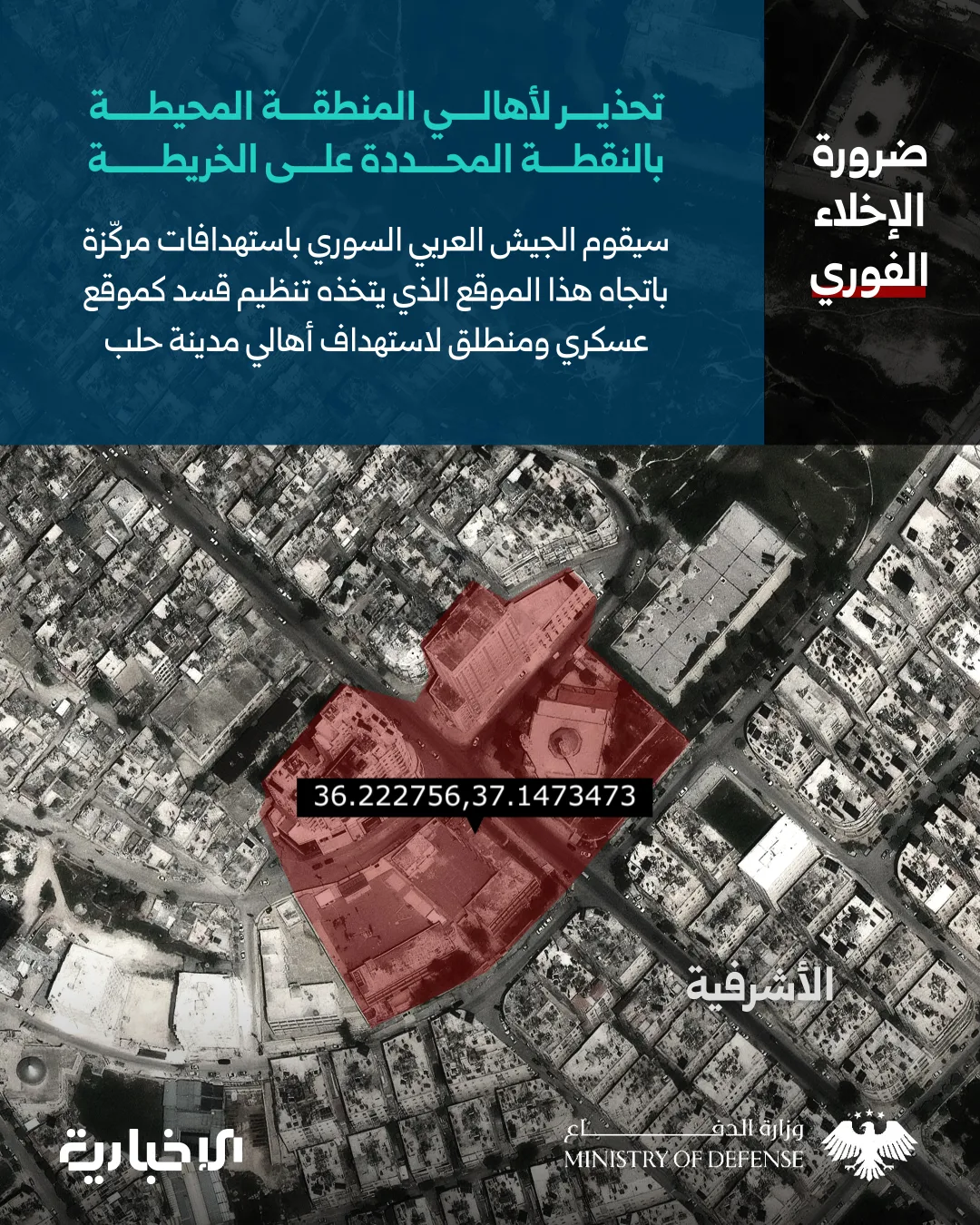
نون بوست
A notice issued by the Ministry of Defense calling on citizens to evacuate specific areas before they are targeted.

In contrast, the SDF suffers from limited capabilities in Aleppo. Their arsenal is largely confined to rifles and light machine guns, with no access to armored vehicles or heavy artillery.

Kurdish officials acknowledged that the SDF’s presence in Aleppo primarily consists of internal security forces (Asayish) and a few hundred fighters equipped only with personal weapons. Despite this, they’ve leveraged the urban terrain and pre-built fortifications to repel attacks.

Still, military analysts and security sources agree that the balance of power clearly favors the Syrian army, thanks to its superior firepower and numbers. Government forces have mobilized enough troops to fully encircle and isolate the Kurdish enclave.

Observers believe the army is awaiting the evacuation of most remaining civilians before launching a decisive assault to “cleanse” and retake the neighborhoods.

Reuters quoted Syrian security officials as saying they expect a major offensive to be launched soon to end what they described as an “abnormal situation” in Aleppo.

Military analysts similarly believe that Damascus now has a prime opportunity to conclude the battle swiftly and with minimal losses, especially after weakening SDF defenses through sustained bombardment and severing their supply lines.

Still, analysts caution that the core of the crisis will persist unless the delayed integration agreement with the SDF is fully implemented. Damascus remains determined to reassert full sovereignty over all Syrian territory and to bring all factions under the command of the national army while the SDF continues to resist abandoning its autonomous governance project.

Download this article as PDF
Share this Article
Facebook Twitter Whatsapp Whatsapp Telegram Email Copy Link
فريق التحرير
By فريق التحرير تقارير يعدها فريق تحرير نون بوست.
Follow:
Previous Article نون بوست Israeli “Turkophobia”: How Turkey Became the Next Enemy After Iran
Next Article نون بوست Between Islamophobia and the Zionist Guillotine: Mamdani’s Toughest Test Yet

Read More

  • U.S. Regime‑Change Policies: Why They Are Destined to Fail U.S. Regime‑Change Policies: Why They Are Destined to Fail
  • The Gulf’s Balancing Act: Iran, Israel, and Hidden Links
  • Iraq–Turkey Oil Export Treaty: Why Did Ankara Cancel It After 52 Years?
  • Syria’s Northeast on Edge: QSD Between Ankara and Damascus
  • Has Europe Changed Its Stance on Israel… or Just Its Language?
part of the design
NoonPost Weekly Newsletter

You May Also Like

U.S. Regime‑Change Policies: Why They Are Destined to Fail

U.S. Regime‑Change Policies: Why They Are Destined to Fail

إسراء سيد Esraa sayed 8 April ,2026
The Gulf’s Balancing Act: Iran, Israel, and Hidden Links

The Gulf’s Balancing Act: Iran, Israel, and Hidden Links

فريق التحرير Noon Post 8 April ,2026
Iraq–Turkey Oil Export Treaty: Why Did Ankara Cancel It After 52 Years?

Iraq–Turkey Oil Export Treaty: Why Did Ankara Cancel It After 52 Years?

فريق التحرير Noon Post 8 April ,2026

أزمة في العائلة: أمير سعودي يتهم ابن عمه بتخديره وخطفه

فريق التحرير
Noon Post Published 18 July ,2015
Share
3b4b3503-657b-4af7-81f9-93f6c29e6219-2060x1977

كشفت صحيفة الغارديان البريطانية عن أزمة كبيرة داخل العائلة المالكة السعودية على وشك أن تنتقل للعلن، بعد أن اتهم أمير كبير أميرا آخر بتنسيق عملية اختطافه، وتخديره وترحيله القسري من سويسرا.

ففي خطوة غير مسبوقة تقدم الأمير سلطان بن تركي بشكوى جنائية في سويسرا ضد ابن عمه الأمير عبدالعزيز بن فهد، وكذلك الوزير الحالي للشؤون الإسلامية صالح الشيخ، حيث يدعي بن تركي أنه أُصيب بجروح خطيرة نتيجة عملية الاختطاف التي جرت في يونيو من عام 2003.

ووفقا لمحامي الأمير سلطان، فقد أمر المدعي العام السويسري بإجراء تحقيق جنائي في هذه القضية، حيث تم تقديم شكوى نيابة عن الأمير في جنيف.

حاولت صحيفة الغارديان من جانبها الاتصال بالأمير عبدالعزيز والوزير الشيخ بشكل متكرر، كما أرسلت طلبات للتعليق على الخبر لسفارات المملكة في لندن وجنيف وإلى جناح الأمير عبدالعزيز في فندق جورج الخامس في باريس.

وكان الرد الوحيد الذي حصلت عليه الصحيفة البريطانية من المستشار الإعلامي لسفارة المملكة في لندن حيث قال إن طلبه تم توجيهه إلى الأشخاص المعنيين، مؤكدا أن “هذه ليست قضية سفارة المملكة ولا وزارة الخارجية، لكنها قضية شخصية بين الأمراء”.

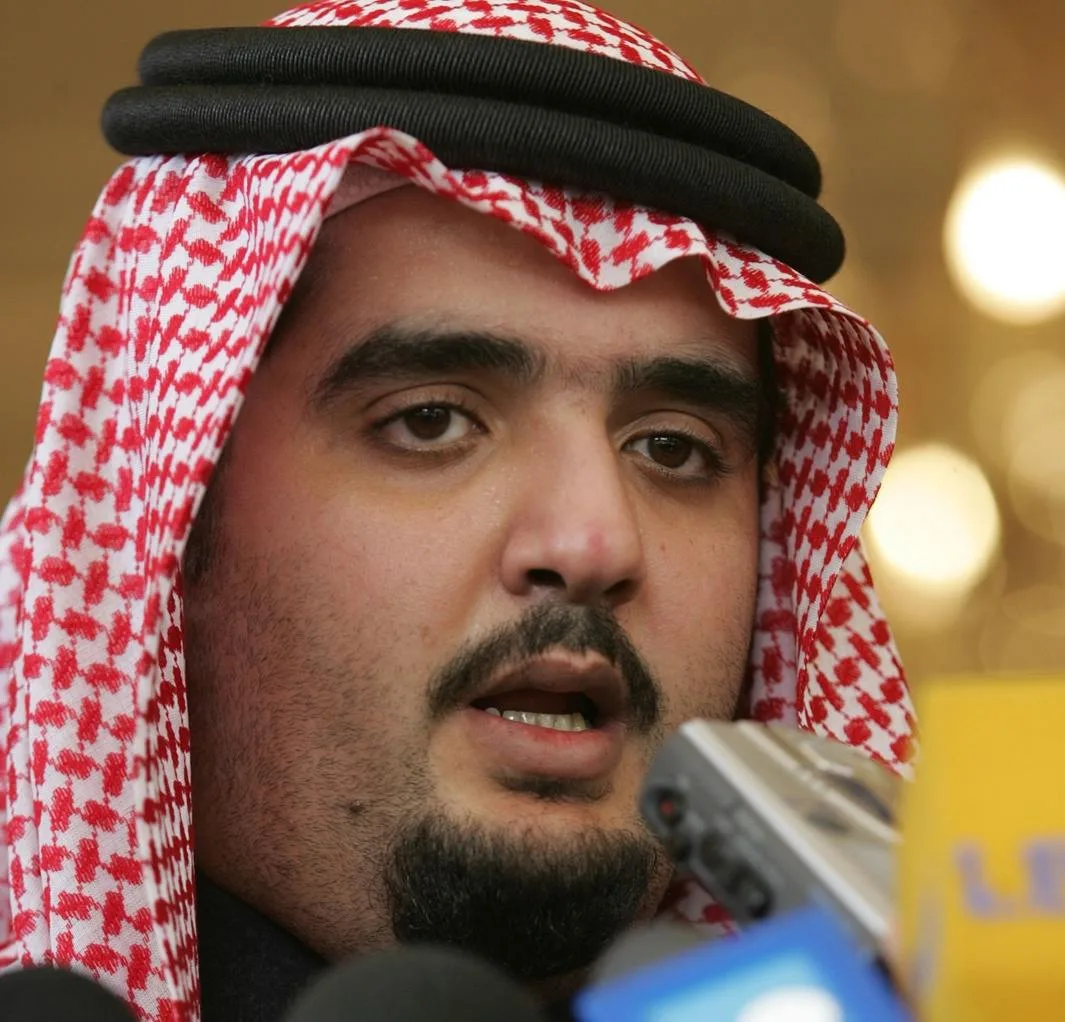
الأميران المتخاصمان، أحدهما هو ابن الأمير سلطان، حفيد الملك المؤسس، وقد عُرف عنه أنه صوت نادر داخل العائلة من المطالبين بالإصلاح، أما الثاني فهو ابن الملك الراحل فهد بن عبدالعزيز والذي حكم البلاد بين 1995 و 2005

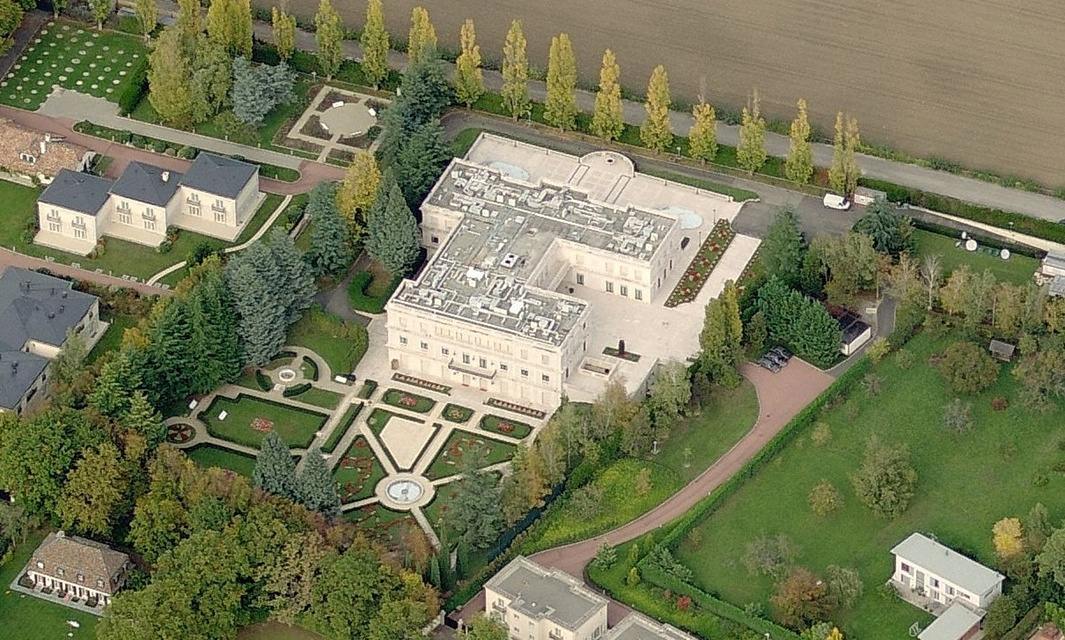
وتعود الأزمة إلى وقت مبكر من 2002 عندما بدأ الأمير سلطان باتهام وزارتي الدفاع والداخلية بالفساد، وفي مايو 2003 أعلن أنه سوف يعقد ندوة عامة في جنيف للكشف عن مدى الفساد في وزارة الدفاع. وبعد شهر، قام بحضور فعالية داخل قصر مملوك لأفراد من العائلة السعودية في مقاطعة كولون-بيليريف السويسرية بالقرب من جنيف، مع المتهمين الاثنين، عبدالعزيز بن فهد وصالح الشيخ.

وبعد حوار خاص مع المتهمين الاثنين، يقول الأمير سلطان إن خمسة رجال ملثمين ظهروا من وراء الستائر وبدأوا بمهاجمته وضربه حتى أُغمي عليه.

نون بوست

صورة القصر الذي اختُطف فيه الأمير سلطان بن تركي والمملوك لأمراء من العائلة السعودية بالقرب من جنيف


يروي الأمير أنه تعرض للتخدير، ونُقل إلى طائرة تنتظر في مطار جنيف حيث نُقل جوا إلى الرياض. كما أنه عانى من مضاعفات طبية وظل في حالة حرجة لمدة خمسة أيام في العاصمة السعودية. وبعد ذلك وُضع سلطان في حراسة أمنية مشددة داخل سجن الحائر حيث بقي هناك لعدة أشهر، قبل أن يُسمح له لاحقا بالعودة إلى منزله في الرياض، ويوضع تحت الإقامة الجبرية.

ولم يتحدث الأمير سلطان إلى الإعلام بشكل علني سوى مرة في 2004 حيث أعطى تصريحا لقناة الجزيرة، إلى أن جاء عام 2010 حيث نُقل إلى الولايات المتحدة لتلقي العلاج. وطبقا للأمير، فقد استطاع تجاوز الحراسة المفروضة عليه وقام بالهرب في نهاية 2010، ومنذ ذلك الحين بدأ في التخطيط لاتخاذ الإجراءات القانونية ضد أولئك الذين اختطفوه.

ومنذ أن علم والده الأمير تركي بن عبدالعزيز بما جرى لابنه، بدأت جولة من تبادل الاتهامات داخل العائلة السعودية، إلا أن الدعوى العلنية كانت متوقفة لأسباب كثيرة.

لكن مع التغييرات الأخيرة في موازين القوى داخل البيت السعودي، ومجيء الملك سلمان على رأس السلطة، وهو أحد السديريين السبعة، والذين من ضمنهم أيضا الأمير تركي، والد سلطان، تبدو الدعوى القانونية على وشك المُضي قدما في سويسرا، حيث أن الأمير عبدالعزيز (والذي ينتمي للفرع السديري أيضا في العائلة) لا يتمتع بنفس القدر من الدعم داخل العائلة.

وقد قدم الأمير سلطان سجلات طبية تدعم شكواه، كما يُتوقع أن يتم سماع إفادات الشهود، على الرغم من أنه من التوقع أن يكون من الصعوبة بمكان إجبار المتهمين الاثنين على التحدث مع السلطات القضائية السويسرية.

وإلى جانب الاتهامات الجنائية، قال الأمير سلطان إنه سيطلق دعوى مدنية للمطالبة بتعويض عن الأضرار التي لحقت به.

ورغم تعدد الأزمات داخل العائلة المالكة السعودية، لا سيما مع العدد الكبير من منتسبيها والذي يُقدر بالآلاف، إلا أن هذه هي المرة الأولى التي يتم فيها اتهام عضو بارز من العائلة بجريمة على هذا القدر من الخطورة أمام محكمة أوروبية.

القضية يمكنها إشعال فتيل خلاف دبلوماسي بين سويسرا والسعودية، حيث يقول الأمير سلطان إن العديد من الأجهزة السعودية تآمرت على خطفه بما في ذلك المخابرات العامة ووزارة الداخلية وسفارة المملكة في جنيف والخطوط الجوية العربية والسعودية وكذلك بعض الأمراء الأكثر نفوذا وتأثيرا في العائلة.

ووفقا لمحامي الدفاع، فقد بدأ المدعي العام السويسري بالفعل في استجواب الشهود الذين كانوا مع الأمير في زيارته إلى كولون بيليريف في 12 يونيو 2003.

والأمير سلطان، يبلغ من العمر 47 عاما، وهو حفيد الملك المؤسس للسعودية، وظهر إلى المجال العام لفترة وجيزة في عام 2002 حيث ندد بالفساد وأصدر نداء مطالبا بالإصلاح. كان والده الأمير تركي على خلاف مع العائلة المالكة وعاش في المنفى في القاهرة والولايات المتحدة لسنوات عديدة.

أما الأمير عبدالعزيز فيبلغ من العمر 42 عاما، وهو أيضا حفيد لابن سعود، والابن المدلل للملك الراحل فهد، الذي حكم السعودية لعشر سنوات. اهتماماته تجارية بالأساس، حيث تشمل شركات مثل سعودي أوجيه، وشبكة إم بي سي، ويقال إن لديه محفظة عقارية بأكثر من مليار دولار في الولايات المتحدة. لديه أسطور من الطائرات الخاصة، ويوصف دوما بأنه المسرف وتشتهر عنه صورة الفتى اللعوب.

TAGGED: أمراء السعودية ، الأسرة الحاكمة في السعودية ، الأمن السعودي
TAGGED: الإصلاح في السعودية
Download this article as PDF
Share this Article
Facebook Twitter Whatsapp Whatsapp Telegram Email Copy Link
فريق التحرير
By فريق التحرير تقارير يعدها فريق تحرير نون بوست.
Follow:
Next Article نون بوست The Stigma of “ISIS”: A Heavy Legacy Haunting Women and Children of Former Members

Read More

  • U.S. Regime‑Change Policies: Why They Are Destined to Fail U.S. Regime‑Change Policies: Why They Are Destined to Fail
  • The Gulf’s Balancing Act: Iran, Israel, and Hidden Links
  • Iraq–Turkey Oil Export Treaty: Why Did Ankara Cancel It After 52 Years?
  • Syria’s Northeast on Edge: QSD Between Ankara and Damascus
  • Has Europe Changed Its Stance on Israel… or Just Its Language?
part of the design
NoonPost Weekly Newsletter
dark

An independent media platform founded in 2013, rooted in slow journalism, producing in-depth reports, analysis, and multimedia content to offer deeper perspectives on the news, led by a diverse young team from several Arab countries.

  • Politics
  • Society
  • Rights & Liberties
  • Opinions
  • History
  • Sports
  • Education
  • Technology
  • Economy
  • Media
  • Arts & Literature
  • Entrepreneurship
  • Travel
  • Cinema & Drama
  • Food
  • Health
  • Culture
  • Latest Reports
  • Files
  • Long Reads
  • Interviews
  • Podcast
  • Interactive
  • Encyclopedia
  • In Pictures
  • About Us
  • Our Writers
  • Write for Us
  • Editorial Policy
  • Advanced Search
Some rights reserved under a Creative Commons license

Removed from favorites

Undo
Go to mobile version