


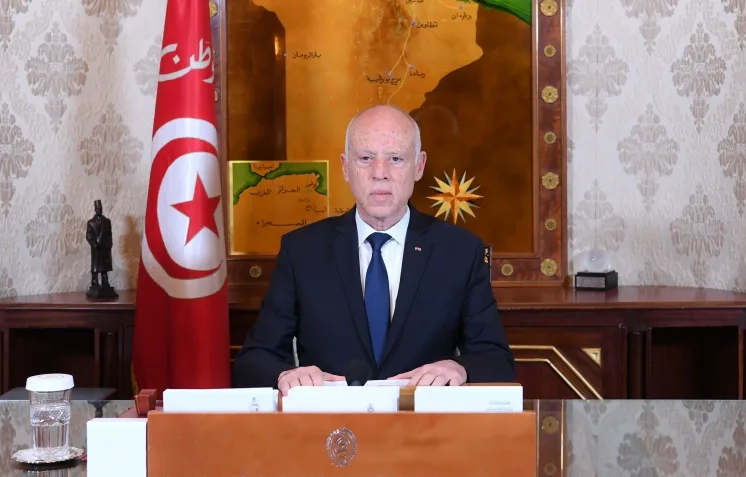
Once again, thirty more days are added to what has become Tunisia’s new normal: the state of exception. Through a new presidential decree, the country’s state of emergency has been extended for yet another month, now running through January 30, 2026just the latest installment in a seemingly endless cycle of renewals that has continued for years.
But the central question is no longer why the emergency is extended; it is how it has evolved into a mode of governance. Tunisia’s President Kais Saied has used the emergency framework to consolidate power, control the streets, and reshape the public sphere to suit the authority of the state.
The Story Behind the State of Emergency
Tunisia’s exceptional measures began in the wake of its 2011 revolution. Following the ouster of longtime ruler Zine El Abidine Ben Ali in January 2011, a state of emergency was imposed to curb widespread unrest and security breakdowns. It remained in effect until March 2014, when it was temporarily lifted.
But it returned with force a year later, following a series of deadly terrorist attacks in 2015 that shook the nation. These included horrifying assaults on the Bardo Museum and the Sousse beach, both of which targeted foreign tourists, as well as a suicide bombing that struck a presidential guard bus and killed 12 officers.
In response, then-President Beji Caid Essebsi reinstated the state of emergency. Since then, it has been renewed almost continuously every few months.
In effect, Tunisia has lived under what amounts to a permanent state of emergency since late 2015. With only brief pauses, the emergency has never been fully lifted in over a decade. Media reports have described this as the longest uninterrupted emergency rule in Tunisia’s modern history.
The Official Justifications
Tunisian authorities officially justify the ongoing emergency on the grounds of an “imminent danger” and persistent security threats. The legal basis Presidential Decree No. 50 of 1978—allows for emergency declarations in response to threats to public order or major disasters that cannot be managed through ordinary means.
Each time President Saied issues a new extension, he invokes the need to safeguard national security and prevent chaos. However, the government has never provided a clear explanation to the public about the exact nature of these persistent threats warranting a chronic state of exception.
More concerningly, Saied has also overstepped the procedural limits of the emergency law itself. Under the 1978 decree, emergency status may only be extended in 30-day increments, with a maximum total extension of six months.
Yet in January 2024, Saied issued an unprecedented decree extending the emergency for 11 consecutive months, covering the remainder of the year. He then renewed it again for the entirety of 2025, citing ongoing counterterrorism efforts.
These moves sparked legal and political controversy in Tunisia. Constitutional experts argued that such long-term extensions violate the spirit of the law and require compelling public justification.
It’s also worth noting that in the years leading up to Saied’s 2021 constitutional power grab, successive parliaments had failed to pass a modernized emergency law that would meet democratic standards despite mounting criticism from civil society that the 1978 decree was outdated and repressive.
Emergency as a Mode of Governance
Since his July 25, 2021 constitutional coup and subsequent consolidation of sweeping powers, Kais Saied has used the emergency as a tool to rule by decree and executive order bypassing institutional oversight.
He first froze the elected parliament, then dissolved it entirely, suspended key parts of the 2014 constitution, replaced it with a new one, and installed a legislature with severely limited powers.
Along this trajectory, Saied also dissolved the High Judicial Council and other regulatory bodies, invoking a doctrine of “extraordinary necessity” made possible by the permanent emergency and a deepening political crisis.
Initially, Saied justified his actions under Article 80 of the 2014 Constitution, which permits the president to act in the face of “imminent danger.” But the ongoing emergency climate allowed him to enact unprecedented measures and centralize authority without real opposition.
The absence of a constitutional court, coupled with the president’s unilateral power to declare and extend the state of emergency without any institutional checks, has effectively granted the executive unchecked control over critical national decisions.
Observers increasingly question the government’s official reasoning for prolonging the emergency. Many point to a lack of transparency in disclosing the nature of the “imminent danger,” and suggest that political motivations often outweigh genuine security concerns.
Human rights activists go further, arguing that the uninterrupted emergency no longer rests on actual threats but rather serves as a political mechanism for avoiding oversight and tightening the state’s grip on power.
Impact on Civil Liberties
The state of emergency grants broad, extraordinary powers to the executive branch and security forces typically at the expense of fundamental rights and freedoms.
Under emergency conditions, the Ministry of Interior (and local governors, with presidential approval) can issue orders restricting various civil activities without prior judicial approval.
These powers include:
-
Banning public gatherings, protests, and strikes deemed threatening to public order.
-
Imposing nighttime curfews in designated areas.
-
Conducting raids and searches of homes and businesses without court warrants.
-
Enforcing strict surveillance over media, digital platforms, and cultural events.
-
Placing individuals under house arrest and restricting their movement if deemed a potential threat.
While these extraordinary measures are ostensibly designed to counter terrorism and urgent security risks, they seriously undermine civil liberties such as freedom of expression, assembly, and movement particularly as they are implemented through administrative decisions that bypass judicial review.
Tunisia’s state of sustained emergency has led to a measurable decline in public freedoms in recent years. Since Saied assumed near-total control in 2021, arbitrary arrests and travel bans without court orders have become commonplace, particularly against political opponents and civil society activists under the guise of national security.
Human rights organizations have documented the use of house arrest and travel bans against opposition figures and journalists without formal charges, facilitated by the lack of judicial oversight.
A recent report by Human Rights Watch described Saied’s use of arbitrary detention as a “cornerstone of his repressive policy,” noting that since 2023, dozens of opposition leaders, journalists, and lawyers have been arrested marking a stark reversal of the democratic gains achieved after the 2011 uprising.
This crackdown has been accompanied by increasingly hostile rhetoric: Saied frequently brands his critics as “traitors” or “terrorists” to justify his actions.
In this context, the ongoing state of emergency has provided a flexible legal umbrella for a wide range of violations targeting political opponents, judges, media professionals, and even business figures.
Economic and Tourism Fallout
The emergency regime has also shaken investor confidence and hurt Tunisia’s already struggling economy and vital tourism sector. In recent years, many international actors have refrained from investing in Tunisia, citing deepening political instability and the absence of a credible roadmap to restore democratic governance.
Key financial support programs such as the International Monetary Fund loan have been delayed due to donor concerns over the country’s political trajectory and the erosion of the rule of law. These delays have worsened Tunisia’s economic crisis, characterized by ballooning debt, budget deficits, and record inflation.
The tourism sector once the backbone of Tunisia’s economy has been particularly hard hit by recurring security incidents and the ongoing state of emergency.
Prior to 2011, tourism accounted for about 7% of GDP. But after the devastating 2015 attacks, the number of visitors plummeted and revenues were slashed by nearly half.
Although the government has since enhanced security at key sites and security checkpoints have become a routine sight in tourist areas these measures have reinforced the image of a country perpetually under threat.
This perception, combined with ongoing political instability and the never-ending emergency status, has discouraged many potential visitors and prompted travel insurers to increase risk premiums for trips to Tunisia.
As a result, the chronic state of emergency has delayed the full recovery of the tourism sector, depriving the economy of a critical source of jobs and foreign currency at a time when Tunisia needs them most.
Today, Tunisia finds itself caught in a vicious cycle of emergency rule: the exceptional becomes routine, renewed in the name of national protection, yet increasingly used to entrench authoritarian rule and roll back democratic gains.
While President Saied insists he is saving the state from collapse and chaos, his critics argue that he has steered the country down an authoritarian path dismantling a decade of democratic progress and extinguishing the very freedoms that emerged from the 2011 revolution.