














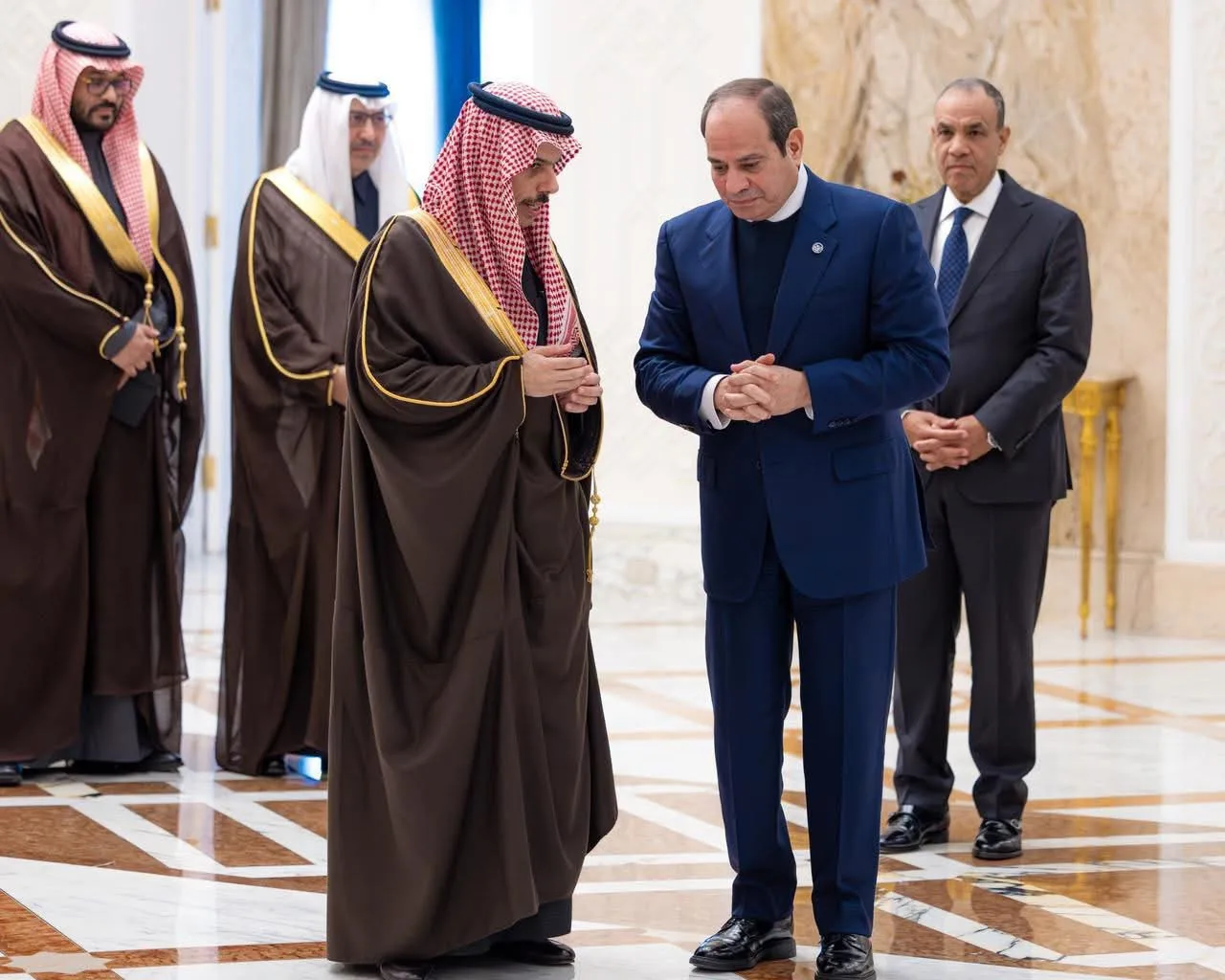
Cairo has officially declared its alignment with Riyadh on the need to push for peaceful resolutions to regional crises, with an emphasis on preserving the unity, sovereignty, and territorial integrity of states particularly in Sudan, Yemen, Somalia, and the Gaza Strip. The announcement came following a meeting between Egyptian President Abdel Fattah el-Sisi and Saudi Foreign Minister Prince Faisal bin Farhan in Cairo on Monday, January 5, according to a statement released by the Egyptian presidency.
President Sisi, as per the statement, stressed the importance of deepening and expanding Egyptian-Saudi coordination on issues of mutual concern, especially in light of escalating regional crises. He also praised the Kingdom’s efforts to host a comprehensive conference bringing together the southern Yemeni factions to initiate an inclusive dialogue on the southern issue.
The Saudi foreign minister had arrived in Cairo on Sunday evening for an official visit aimed at discussing the trajectory of bilateral relations and exploring ways to enhance and expand cooperation across various domains, according to Saudi Press Agency (SPA).
This unannounced visit and the consensus it yielded, particularly regarding the unity of Yemen and Somalia comes at a particularly sensitive moment. It coincides with rising tensions between Riyadh and Abu Dhabi over recent developments in Yemen, raising questions about Egypt’s approach to this increasingly complex regional equation and the extent of its role in balancing the competing interests involved.
A Critical Context for the Visit
This visit cannot be interpreted through the lens of routine diplomatic protocol. It comes at a time of heightened regional volatility and growing risks of confrontation, which lend it deep political and strategic significance far beyond mere formalities.
The timing intersects with a series of pivotal developments, including:
-
Yemen’s Shifting Landscape: The Southern Transitional Council (STC), backed by the UAE, has tightened its grip over southern provinces while openly embracing secessionist rhetoric. In response, Saudi Arabia has intervened directly, demanding the withdrawal of Emirati forces from certain areas a move that has already taken place.
This marks an unprecedented escalation in Riyadh–Abu Dhabi relations since the onset of the Arab Coalition’s operations in Yemen, revealing a profound divergence over the future of a unified Yemeni state.
-
Israeli Recognition of Somaliland: In a move that could dramatically reshape the geopolitics of the Horn of Africa, Israel has unilaterally recognized Somaliland as an independent, sovereign state. In turn, Somaliland authorities have expressed interest in joining the Abraham Accords, potentially redrawing a key geostrategic map in a sensitive logistical corridor.
-
Mounting Tensions in the Horn of Africa: The region, which overlooks one of the world’s most vital maritime routes, is experiencing rising tensions among Ethiopia, Eritrea, and Djibouti, with indirect spillovers into Somalia and South Sudan. These developments threaten the overall security of the Red Sea and, by extension, the Arab world’s broader national security interests in Africa.
-
Parallel Regional Maneuvers: The visit also coincided with a phone call between Turkish President Recep Tayyip Erdoğan and Saudi Crown Prince Mohammed bin Salman, during which the two leaders discussed bilateral ties and reiterated shared views on key regional issues chiefly Yemen and Somalia signaling a broader realignment among influential regional powers.
What Does Saudi Arabia Want?
In plain terms, Riyadh is seeking to forge a regional coalition that backs its strategy in the escalating confrontation with the UAE. Egypt tops the list of potential partners due to its geopolitical heft, regional influence, military capabilities, and central role in regional security dynamics.
Cairo’s long-standing policy of relative neutrality in the Yemen conflict has not sat well with Saudi Arabia, serving as a point of divergence between the two countries. However, the current situation appears to have reached a level of complexity that renders neutrality an untenable strategic position, especially as the cascading threats begin to directly impact the national security of all involved.
Saudi Arabia is also acutely aware of the deep-rooted ties between Cairo and Abu Dhabi relations underpinned by a dense web of political, economic, and security interests. This has prompted Riyadh to recalibrate the regional balance and explore various means to break through what has been a solid alliance, in hopes of securing either Egypt’s active engagement or its pressure on the Emirati side to reassess its strategic calculations.
Why Now?
The convergence between Cairo and Riyadh on Yemen, Somalia, and Sudan cannot be characterized as part of rigid regional alliances. Rather, it reflects a calculated alignment of interests, governed by pure pragmatism and rooted in national security imperatives and the dynamics of regional influence even if it occasionally overlaps with or runs counter to the goals of other regional players.
In Yemen, both Egypt and Saudi Arabia share a firm commitment to preserving the integrity of the nation-state and rejecting fragmentation models based on armed factions or state-like entities. This vision stands in stark contrast to the Emirati approach, which has prioritized support for local armed actors and the expansion of geopolitical coastal influence.
A similar logic applies to Somalia, where Cairo and Riyadh exhibit acute sensitivity toward the security of the Red Sea and Bab al-Mandab Strait. Egypt views any push toward partition or increased roles for non-state actors in the Horn of Africa as a direct threat to its own national security and strategic interests.
This shared concern translates into joint support for Somalia’s federal government and a mutual effort to curtail trajectories that could undermine central authority or deepen political fragility.
The case of Sudan is no different. As a direct strategic hinterland for Egyptian national security, Sudan’s future is of critical concern to Cairo and, increasingly, to Riyadh. Both countries now favor a comprehensive political settlement that can rebuild state institutions and avert Libya- or Somalia-style disintegration scenarios.
These efforts are unfolding amid mounting accusations against the UAE of backing the Rapid Support Forces (RSF) and encouraging secessionist dynamics developments that have complicated Sudan’s conflict and derailed diplomatic efforts to contain it.
What About Cairo?
Over recent years, Cairo has gone to great lengths to avoid direct confrontation with the UAE, even as several of Abu Dhabi’s regional maneuvers were viewed by Egyptian circles as infringing upon Cairo’s national security interests.
This has been particularly evident in:
-
Gaza, where UAE coordination with Israel has stirred significant controversy;
-
Sudan, where Emirati actions are seen as fostering factionalism;
-
Yemen, where Emirati involvement is perceived as undermining Red Sea maritime security and potentially threatening the Suez Canal.
The same holds true for the Horn of Africa, particularly Somalia, and Egypt’s water security concerns regarding Ethiopia—where accusations of Emirati support for the Grand Ethiopian Renaissance Dam (GERD) project have also surfaced.
In response, Cairo has generally pursued a policy of restraint and selective disengagement, motivated by the desire to maintain the strategic partnership with Abu Dhabi. From the Egyptian leadership’s perspective, the UAE remains a key ally particularly due to its backing of the Egyptian government in the post-2013 transition making a direct clash both politically and strategically costly.
However, the mounting scale and complexity of regional challenges, combined with shifting dynamics—especially Saudi Arabia’s recent assertiveness in Yemen have compelled Egypt to revisit its strategic posture. This doesn’t mean open confrontation with Abu Dhabi, but rather the adoption of a more decisive stance in defending its core national security interests.
Within this context, the growing alignment with Riyadh emerges as a pragmatic response to a new regional reality one in which Egypt is reordering its priorities and reassessing its alliances.
Where Do Egypt-UAE Relations Stand?
Some analysts have suggested that Cairo’s rapprochement with Riyadh and their apparent alignment on issues where the UAE plays a central role could directly impact Egypt–UAE relations. Yet this assumption runs up against the nuanced strategy Cairo employs in managing its complex regional ties.
Egypt does not subscribe to rigid alliance blocs or absolute alignments. Instead, it adopts a flexible approach that preserves its strategic partnership with Abu Dhabi while managing differences without allowing them to erode the foundation of the relationship. This reflects a deeply rooted conviction that regional politics are neither zero-sum nor permanently adversarial.
Cairo sees its ties with the UAE as a cornerstone of its foreign policy an intricate relationship built on massive economic investments and clear security coordination on several regional fronts. While temporary disagreements or divergent positions may arise, they are not seen as grounds for rupture.
From this standpoint, Egypt is likely to pursue a careful balancing act between its two Gulf allies. It is unlikely to abandon its relationship with Abu Dhabi, but instead will recalibrate its alliances in line with its longstanding doctrine: prioritizing national interest, maintaining balanced relationships, and embracing political pragmatism.
As such, Egypt is not expected to engage directly in the Yemen or Sudan conflicts on Saudi Arabia’s behalf. Rather, it will likely offer calibrated support through non-confrontational means ensuring that its growing ties with Riyadh do not come at the expense of its strategic relationship with Abu Dhabi.
Cairo remains keenly aware that aligning too closely with either side in this Gulf rift carries significant political and strategic risks particularly given its belief that the current discord between Riyadh and Abu Dhabi is unlikely to last.