








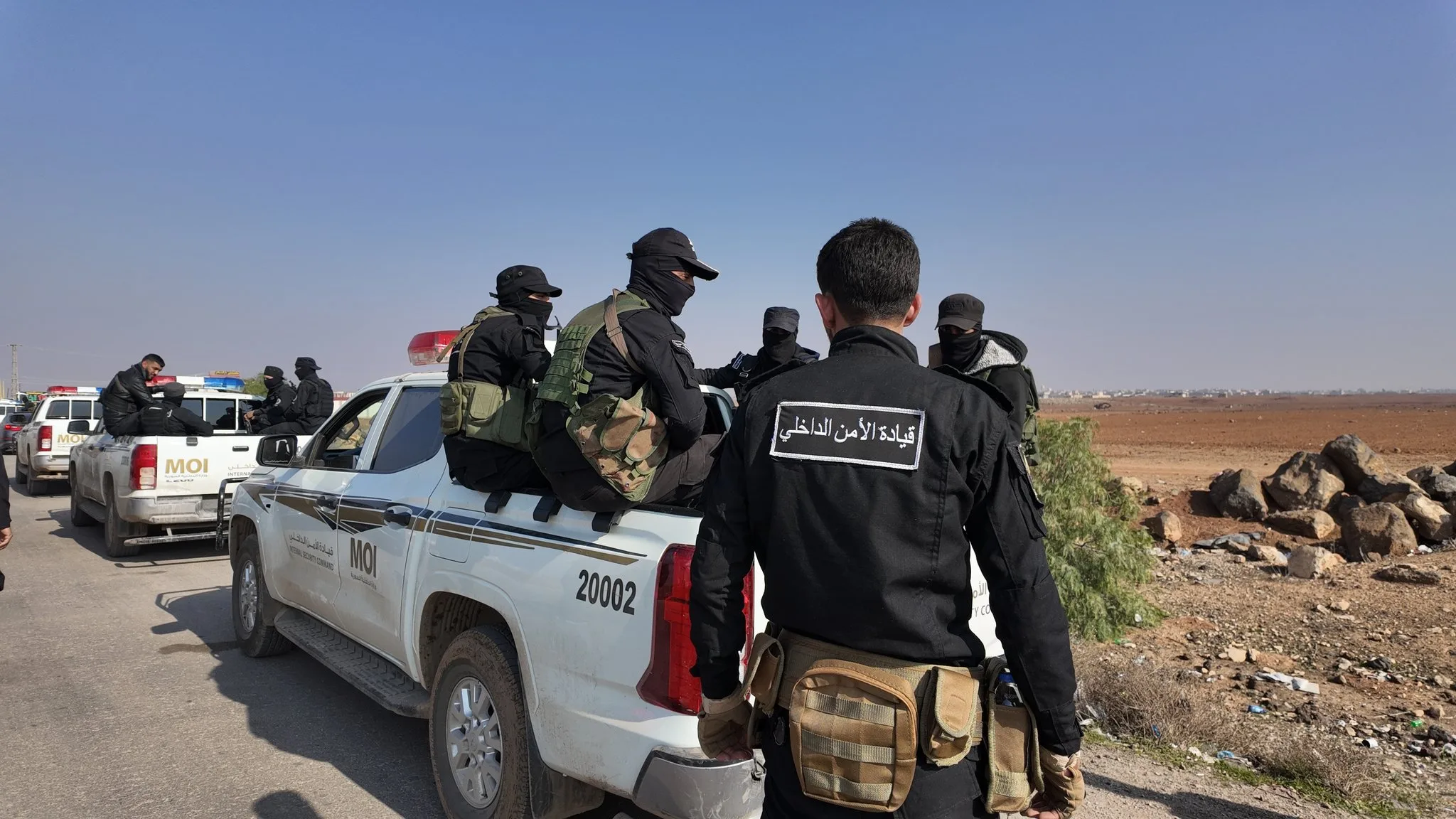
For nearly six decades under the rule of the Assad family, Syrians endured a fraught and fearful relationship with their country’s security apparatus. This fear became so deeply ingrained that it followed those who fled or were exiled, surfacing even in foreign lands.
A Syrian abroad might feel uneasy around any policeman even a traffic officer or hesitate before entering a government building, even in a Scandinavian country.
This fear did not emerge in a vacuum. The Assad regime subjected Syrians to decades of oppression, torture, and abuse, abuses that intensified dramatically during the years of the revolution.
Investigative reports and journalistic exposés continue to shed light on the regime’s brutality, and the new Interior Ministry appears acutely aware of this legacy. Since its formation, the ministry has taken steps to consolidate security and police services into a single entity: the Internal Security Force.
Reforming Practices and Modernizing Services
In contrast to the old regime, which since the days of Hafez al-Assad weakened the Interior Ministry while empowering intelligence agencies, the new ministry has moved swiftly to upgrade its operational capacity. Seeking to redefine its relationship with the public, it has taken practical steps on the ground, including the launch of a mobile application named “Your Voice Has Reached Us” on December 21, 2025. The app is designed to provide fast, accessible services to citizens, regardless of location.
The app allows users to check travel bans, verify their legal status before travel, and track the status of detainees transparently and efficiently. It also offers a direct channel to file and follow up on complaints. Interior Minister Anas Khattab emphasized that the ministry is committed to streamlining procedures, enhancing transparency and accountability, and alleviating citizens’ burdens.
He described the app as a vital link between citizens and the ministry, stressing that it should only be downloaded from official ministry platforms.
On October 29, 2025, the ministry unveiled its new fleet of vehicles in Damascus, showcasing a fresh visual identity. In a statement, it said the fleet symbolized institutional discipline and professionalism and reflected a strong commitment to developing its capabilities and reinforcing a national identity. The new fleet is equipped with advanced operational and technical systems tailored for various departments, enhancing response efficiency and the quality of public services.
These upgrades reflect a shift toward a modern, service-oriented security institution that aligns with the aspirations of a new Syria. The minister also announced plans for modern uniforms as part of a broader initiative to create a comprehensive visual identity that draws from Syria’s evolving national character.
In line with these reforms, the ministry issued a six-page Code of Conduct on November 21, 2025. The document serves as a binding ethical charter for ministry personnel, both on and off duty. Its goals include upholding the rule of law, fostering justice, strengthening public trust, promoting integrity, and shielding staff from corruption while enhancing service delivery standards.
The code delineates duties and responsibilities, emphasizing the protection of human rights, lawful execution of orders, punctuality, safeguarding lives and property, protecting public resources, and efficient, ethical performance. It also outlines a set of 25 prohibitions within its 45 articles.
These include mistreatment of detainees, insubordination, misuse of authority, leaking classified information, and unlawful communication or publication of internal operations. Excessive force, soliciting gifts or donations, and the display of unauthorized flags or emblems are also banned.
Detention Facilities, Human Rights, and Ongoing Concerns
The ministry has also turned its attention to detention centers and prisons. On December 24, 2025, Daraa Governor Anwar al-Zoubi inaugurated a new police station in the town of Saida, designed with architectural elements reminiscent of Western prison standards.
Emphasizing the importance of a visible security presence, local police chief Brigadier General Badr al-Nuaimi said the new stations serve as reassuring spaces that contrast starkly with facilities from the era of the deposed regime.
On May 24, 2025, ministry spokesperson Nour al-Din al-Baba announced the creation of a special Prisons and Corrections Directorate. The aim, he said, was to enshrine human rights principles and transform prisons into institutions of rehabilitation rather than punishment, preserving inmate dignity while ensuring justice.
Speaking on April 16, following his appointment the previous month, Minister Khattab acknowledged that for many Syrians, prisons remain symbols of trauma. He revealed a plan to temporarily renovate existing facilities until new detention centers designed to uphold human dignity and legal rights can be built. In August 2025, he visited prisons in Idlib, listened to inmates’ concerns, and reiterated that incarceration should restrict freedom not dignity.
Despite these efforts, several incidents have undermined public confidence. One such case involved a young man named Youssef al-Labbad, who was detained at the Umayyad Mosque in late June 2025 and died the next day.
The ministry attributed his death to head trauma from blunt force, but provided no further clarification. Minister Khattab promised his mother a full investigation once the autopsy was complete.
Unopened Cells and Controversial Sentencing in Idlib
In another controversial case, Abdulrazzaq al-Masri, a member of Hizb ut-Tahrir who had played a role in organizing protests in Idlib in 2024, was sentenced in late 2025 to ten years in prison. The sentence provoked public outcry, especially as it coincided with the release of dozens of individuals linked to the former regime, raising serious questions about transitional justice and accountability standards.
Hizb ut-Tahrir, an Islamist political party advocating for a global caliphate and rejecting national borders, had clashed with Hay’at Tahrir al-Sham (HTS), the former ruling force in Idlib, leading to the arrest of many of its members.
Although Idlib witnessed mass protests in 2024 demanding the release of detainees both from the Assad regime and HTS prisons little tangible progress has been made. In February 2025, cleric Abdulrazzaq al-Mahdi declared that “emptying Idlib’s prisons is the duty of the moment,” criticizing leniency toward figures associated with the fallen regime.
Around two weeks after the regime’s fall, Syrian revolutionary activists issued a public appeal to military commander Ahmad al-Shara’, urging him to release all detainees uninvolved in bloodshed.
The Challenge of Trust and the Weight of History
Colonel Fayez al-Asmar, a defector from the former regime, told Noon Post that while the ministry appears sincere in its attempts to transform its image, much depends on whether its directives are grounded in Syria’s current realities and whether they are implemented with discipline and monitored for impact. Syrians, he said, are no longer paralyzed by fear, but are also wary of hollow promises.
He also criticized the marginalization of highly qualified defected officers, many of whom have been sidelined in favor of less competent individuals promoted through personal connections. Asmar pointed out the absence of a clear judicial mechanism to regulate arbitrary detention timelines, which is a consequence of overcrowded courts and a high number of detainees from the previous regime.
Asmar urged the judiciary to conduct a thorough and swift review of detainee cases in Idlib, issuing legal opinions and timely decisions in accordance with national laws and judicial norms.
Attorney Ghazwan Qurnful told Noon Post that while the ministry’s recent actions are promising, the real test lies in ensuring that no one is detained without a legal warrant. Detainees and their families must be informed of the charges and allowed access to legal counsel. Although Qurnful acknowledged a generally positive shift, he noted that many arrests still occur without judicial orders, calling for accountability for officers who violate legal protocols.
He added that the file of detainees in Idlib must be resolved, criticizing the release of suspected war criminals while prisoners of conscience some of whom were sentenced for opposing HTS remain incarcerated.
From State Security to Public Service
Dr. Talal al-Mustafa, a specialist in psychological and social studies, told Noon Post that a security institution’s image is not reshaped by statements or structural changes alone. From a sociological standpoint, what matters is the cumulative public experience. Syrians will believe change has occurred only when they feel the security doctrine and behavior of officers has genuinely shifted.
While the ministry’s reforms such as its digital app, new visual identity, and code of conduct signal a shift in official rhetoric, these have yet to spark widespread public transformation. Educated civil society actors may distinguish today’s Interior Ministry from the former regime’s security agencies, but much of the general population still views the ministry as a continuation of a repressive culture.
Mustafa explained that trust in security institutions is among the hardest forms of social trust to rebuild in post-trauma societies. The Assad regime left behind a collective memory of fear, negative social conditioning, and a learned avoidance of authority. Therefore, changing uniforms and logos is not enough. Real change requires enforceable accountability, behavioral consistency, and long periods without major setbacks.
He warned against a culture where accountability only follows public scandal. If violations are addressed only after widespread outrage, people receive the message that justice is selective and reactive.
According to Mustafa, the transition must shift from security for power to security as a public service. Security officers should be seen not as enforcers, but as public servants. Achieving this requires behavioral training, independent and visible complaint mechanisms, and publicly reported outcomes. Institutions should not merely provide hotlines, but credible avenues for grievances.
Institutional, not isolated, accountability must be the norm. Disciplining a single officer while ignoring structural issues only perpetuates the problem. Public reassurance comes not from declaring an incident “isolated,” but from establishing that it was a violation of clear rules, and implementing reforms to prevent recurrence.
Community involvement not surveillance is vital, through regular dialogues, partnerships with unions and organizations, and the creation of genuine community policing.
Though the Interior Ministry has begun a genuine transformation in form and rhetoric, public trust remains incomplete. Success will not be measured by statements or policies, but by consistent implementation and a reality in which citizens no longer fear knocking on the ministry’s door.
That will be the true indicator of success a goal that, according to Mustafa, is within reach, though not yet achieved.