
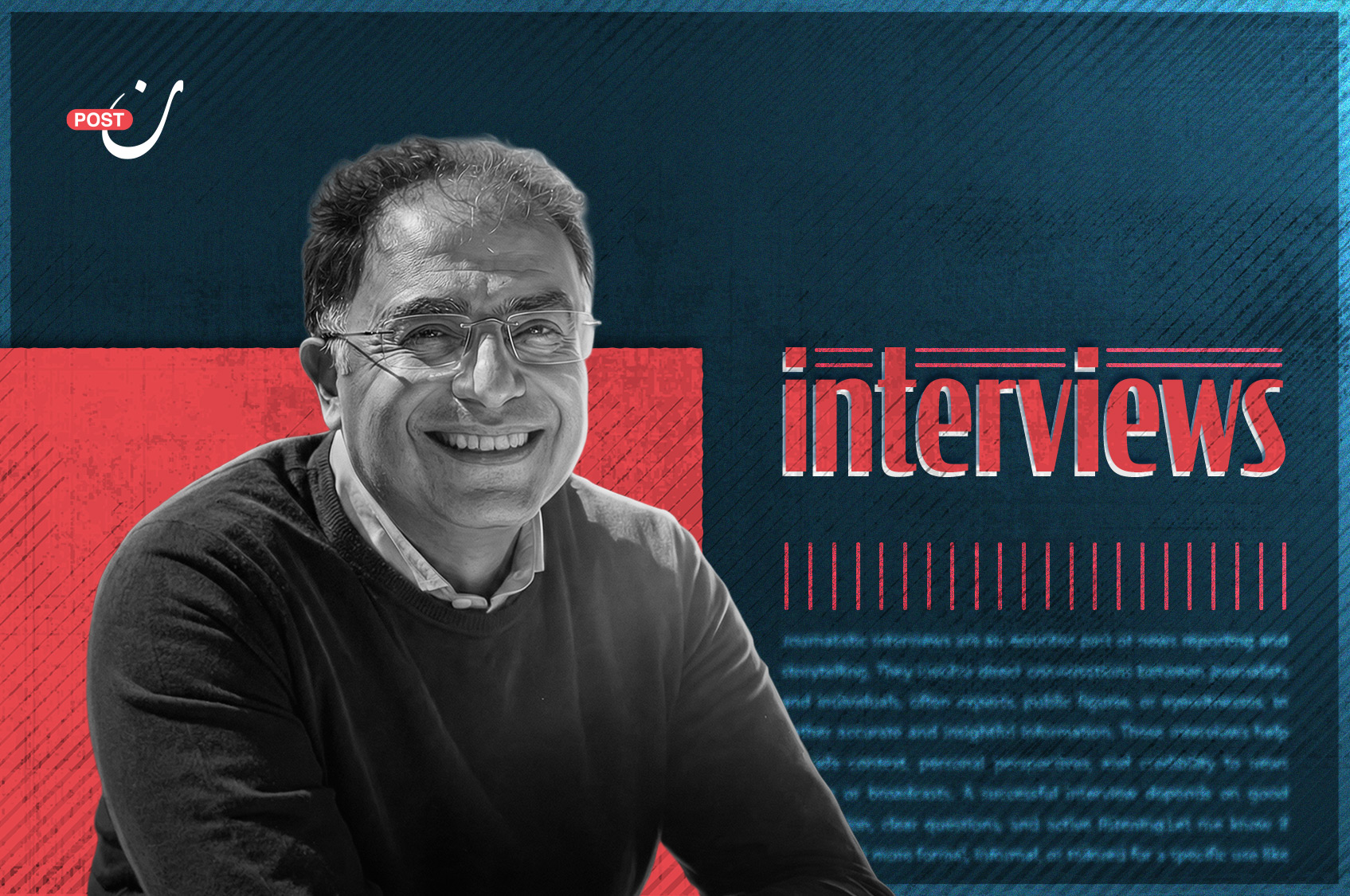
A certain beauty lies in bringing together two worlds that appear contradictory; rigidity and art, forms and emotions, firmness and humanity, decisiveness and relativity law and literature as embodied by the Egyptian writer and counselor Ashraf El-Ashmawy. El-Ashmawi has been shortlisted for several literary awards, and won others most notably the Katara Prize in 2023 for his novel “The Secret Society of Citizens”.
His trio-novellas book “Born in the Zoo” was also longlisted for the Sheikh Zayed Book Award last month.
Between symphony and authority, fear and art, this in-depth conversation with the Egyptian novelist and judge Ashraf El-Ashmawy opens a window onto his writing universe and his existential and aesthetic questions, starting with his boldest novel to date, The Last Symphony, published last October.
The dialogue goes beyond unpacking the novel’s psychological and narrative backstage to probe the relationship between literature and power, reality and fantasy, writing and profession, fear and audacity reaching the boundaries of freedom and the responsibility of publishing. It also revisits El-Ashmawy’s record of dismissing all publication cases he investigated during his tenure at the Public Prosecution forty-four cases in total except for one that the Prosecutor General at the time decided should go to court.
In this interview, Noon Post meets a writer who insists that his work be judged as that of a novelist rather than a judge, and that the novel remain a free space for questions without ready answers. Throughout the conversation, El-Ashmawy reveals his wager on the psychological novel as a gateway to understanding the cruelty latent in human beings when talent intersects with authority; his choice of music particularly the violin as a parallel language to narration, capable of carrying melancholy, tension, and disappearance.
And his engagement with the question of time in his works. He addresses accusations of distancing himself from the contemporary in favor of history, explaining how the idea leads him to choose the time frame not the other way around—and why he believes literature is not measured by its darkness or optimism, but by its artistic truthfulness.
The conversation also ventures into sensitive terrain: self-censorship, the three taboos, freedom of publication, literary awards, publishing inside and outside Egypt, and the impact of professional position on a writer’s freedom without evasion or defensive rhetoric. In the background, larger questions resonate: literature as an alternative to journalism in articulating the unsayable; disappearance as a symbolic fate for victims of power; and writing as a quiet act of resistance, a source of personal joy, and a persistent attempt to grasp truth before time lets it slip away.
– Perhaps the novel “The Last Symphony” is the boldest thing you have written so far or more precisely, the boldest you have published. What were the backstage circumstances of its idea and writing?
The idea of the novel began about a year and a half ago, or perhaps two years. It is a psychological novel concerned with a severe inner crisis experienced by an extremely sensitive person—an artist—who, at the same time, possesses tremendous power, and a crushing authority. This led me to a central question: does authority attract individuals with violent tendencies, or does cruelty grow and take root because of one’s position and power? This was the core issue that preoccupied me and that I worked on.
At first, I stumbled with the novel for nearly six months until I managed to put hands on the psychological thread of the character. I faced some difficulty because of the instrument he plays. Initially, I did not use the violin. The protagonist, Sami Irfan, existed with all his traits, but without a specific instrument. I felt something missing the musical dimension that would allow me to play on the reader’s emotions.
Once I found that element, the novel began to resemble a symphony. Its chapters would rise and fall, grow loud and then quiet, filled with echoes and reverberations. This was the game I started to play after deciding that he would be a violinist. The violin, in particular, is one of the most sorrowful instruments, much like the ney, the harp, or the cello.
These instruments carry sadness and melancholy; they are not joyful like the piano, nor rhythmically exuberant like the drum.
The instrument itself is different. I was keen to choose it because it can be played solo, or in a concerto alongside another complementary instrument, or within a full symphony with many instruments. At the same time, I worked on the psychological composition of the character, and his job at the presidential palace ceremonies department became the thread from which I began.
— Among your fourteen literary works, most of them novels, and if we exclude the novella “A Cabin That Cannot See the Sea” from the trio-novellas book “Born in the Zoo”, “The Last Symphony” is the only novel set entirely in contemporary time.
It seems like you generally avoid writing about the present moment we live in?
I would not say I am frequently accused of that nor do I see it as an accusation. No writer returns to history gratuitously. Returning to history always serves a purpose: either to draw parallels, or to suggest that history does not repeat itself, or to bring a vision closer to the reader. I do have novels set in contemporary times. For example, “The Barman” takes place in 2005.
“The House of the Coptic Woman” is set in 1995, which is a recent period. “The Guide”, my third novel, ends in 2012. “The Secret Society of Citizens” concludes in 2008.
Intentionality is always against art. It is the idea that leads me to choose the time frame not the opposite. In “The Last Symphony”, I was able to continue the narrative until 2015 because the plot and dramatic arc required the protagonist to reach the age of sixty—he was born in 1955. I could have ended it in 2011 or 2012, but there was no reason not to continue into the following years.
Writing a contemporary novel is not difficult. In fact, writing about the past is harder because it requires extensive research and meticulous attention to detail. The effort precedes the writing itself. Contemporary time, however, is something I live. If I were to write a fully contemporary novel, I must have the ability to truly astonish the reader because the reader lives this same reality just as I do.
— Sami Irfan, the protagonist of “The Last Symphony,” is a passive character, haunted by fear, incapable of saying “no.” Are there many people like him in real life?
In my opinion, I have never encountered someone exactly like Sami Irfan. He is entirely fictional. But subconsciously, I may have picked up certain traits from people I know personally. I believe that a character so deeply ruled by fear is often the result of an extremely closed upbringing. This leads us to the question: are we born this way, or do we acquire these traits through upbringing, environment, culture, or through contact with certain figures like the grandmother in his case?
I do not know. Is the absence of the father and mother the reason? All these questions circulated in my mind, and I found no definitive answers. At times, I believe some people are born with a seed of fear. If parents notice it early, they can mitigate its impact—or even uproot it—by instilling self-confidence. We are not born into neutral conditions and then freely choose our lives.
Ninety percent of this novel is fiction. The parts related to the presidential palace ceremonies, or the dialogues attributed to former President Hosni Mubarak, are real. He actually said them in conferences, meetings, or press interviews, and I employed them dramatically as a political backdrop or stage upon which Sami Irfan moves. Yet, at its core, this is a psychological novel not a political novel, nor even a social one.
— Many readers described “Born in the Zoo” as dark, yet you said you are a realist novelist and that any other endings would have been unrealistic. In “The Last Symphony,” the final scenes especially the reckoning with the security officer appear dreamlike, as though the revolution itself is delivering justice.
Have you revised your stance in favor of a fictional ending, perhaps as an escape from the harshness of reality?
I cannot say that I have completely revised my stance, nor that I am escaping reality. I still write realistic novels. I still write open endings. Endings may be sad, but literature is not divided into sad and happy, dystopia or utopia.
This classification no longer holds. What matters is whether the elements used by the writer align with the core idea. If I build everything toward a happy ending and then suddenly impose a tragic one, that would be a technical flaw a distortion of truth and narrative logic.
You see the ending of “The Last Symphony” as dreamlike, or revolutionary in its justice. I believe the January Revolution inevitably changed me, you, and many others even officials. It was a colossal event, and such an event must leave an impact.
It continues to do so to this day because it is still recent. However, as the author, I see the ending as open. The female protagonist, Dina Yaacoub, chooses silence, seeing it as the safest place to preserve the truth. That means everything is postponed—and this carries sorrow, sadness, and cruelty…
— But what about the previous scene in the theater, where recorded confessions are played during the musical performance?
The idea of revenge through exposure through public revelation of guilt, or enforced purification by cleansing a man who wronged a citizen for sixteen years during the Mubarak era, felt entirely consistent with the novel’s vision. Whether it could happen in reality or not, I allow myself to stand at the edge of fantasy.
I approach it cautiously, as I did in “The Secret Society of Citizens”. There is no such society in reality. Nor do its members resemble their fictional counterparts, nor do its pamphlets exist.
In “Pig Farm”, there is no real-life equivalent to the complete character of Fayez Hanna. In “Born in the Zoo”, I fully crossed into fantasy with Ismail and Aida living inside a cage as animals. In “The Last Symphony”, I would not call it fantasy, but I am standing at its threshold.
This aligns with the ending I envisioned for the protagonist that he deserves to disappear. Not a traditional ending with a trial, punishment, or verdict. What I always had in mind was that this man must vanish through his art, his virtues, and his sins alike. This regime in Mubarak’s era must disappear entirely, in all its forms, because time has surpassed it.
— The novel seems to echo the real-life disappearance of journalist Reda Helal during the Mubarak era. To what extent do you agree with the idea that “literature is a substitute for journalism in saying what cannot be said”?
I completely agree. Literature is a substitute for what journalism and official history cannot say. Literature and the arts are mirrors of society. Theater, cinema, short stories, and novels are the closest forms capable of revealing what is suppressed in official narratives whether journalistic or historical.
Reda Helal’s case was not a direct parallel so much as a strange incident. He was an ordinary journalist, not an opposition figure, and posed no threat to the regime yet he vanished suddenly, and we still know nothing about his fate. His story was compelling because the protagonist of the novel also disappears suddenly during the Mubarak era without justification or warning.
This sudden disappearance summoned Reda Helal from memory, alongside other figures deeply etched in our cinematic consciousness: Adel Adham in “The Sad Night Bird”, Kamal El-Shennawy in “The Karnak, and Ahmed Zaki in “The Wife of an Important Man”. All these roles depict the man of authority who is deceived by illusions of power and tyranny, exercises extreme cruelty, and ultimately discovers that he is its victim.
This was Sami Irfan’s crisis. He wanted to claim that he was not such a man that he merely executed orders, that he was neither influential nor powerful. He is affiliated with the police but not a police officer. He lacks the intelligence or importance of real officers and is never entrusted with serious tasks, despite serving in a sensitive security apparatus.
He is surrounded by presidential favor merely because Hosni Mubarak once liked him when he was vice president he became the hand that supported him. Sami is obsessed with the fate of such men and senses that it awaits him. He denies his guilt, insists on seeing himself as a victim just as Ahmed Zaki justified his actions by claiming they want to sabotage the country, or Adel Adham warning that democracy has fangs, or Kamal El-Shennawy claiming he was safeguarding the regime.
My invocation of these figures was meant to reflect Irfan’s denial, though he differs from them. He exercised his authority narrowly, furtively, exploiting a decaying system, the state of emergency law, and the absence of judicial oversight detaining a man for years without anyone knowing his fate.
— Do you practice self-censorship in your writing out of fear that it might affect your judicial career?
Self-censorship, in my view, is antithetical to art. If I began writing while thinking, “I am a judge, I am married, I have children, I work here or there, I am conservative,” then my imagination would be paralyzed. I may fear at the time of publication, but during writing, I do not censor myself. I do not think of the reader either, so that I do not write what readers expect.
I write what I want to write what I enjoy writing and the world I live in, the questions I carry, the public and personal concerns that preoccupy me. All of this emerges in the form of a novel the form I know best. Writing novels makes my life genuinely happier. I write first for my own happiness, then try to reach the reader through a respectable work that astonishes, entertains, builds a world, and offers better language each time.
I completely separate my judicial work from my hobby. I do not exploit my profession, nor do I enjoy being presented as a “counselor who writes novels.” I prefer readers to judge the work as the work of a novelist nothing more.
— You mentioned fear. Do you consider yourself adventurous, cautiously bold, or someone who believes that “he who fears, survives”?
“He who fears, survives”—certainly. I am human, and I fear like anyone else. I have limits. But when writing, I do not calculate consequences. As long as publication is possible, I do not think beyond that. I avoid anything that might constrain imagination—thinking about my profession or its traditions. I do not violate these traditions; I do not write vulgar literature, sensational titles, or seek publicity. I respect my profession and its customs. But when I sit alone to write, I think only of Ashraf the creator otherwise, there is no point in writing.
— What are your personal criteria for writing about sensitive subjects political, religious, or sexual?
I tend toward freedom, and I do not believe in saying that this is permissible and that is not in writing. There was once a famous book titled Why I Am an Atheist, and another book was published in response titled Why I Am a Believer. I believe the true brilliance lies in responding using the same tool, even the same title.
Instead of imprisoning the author of the first book and saying we are an Islamic country and you are not allowed to write this, one can simply respond with another book. Some readers will go here, others there, and there is no problem.
I write what I like to read; I am my own standard. I do not like crude sexual content, nor loud, direct political writing. That belongs more to an article or a political speech. Some novels contain that, but I do not like it. I also dislike portraying society as completely stripped of hope. Pure darkness that turns into total bleakness, which I do not gravitate toward. Art is about extracting beauty from within ugliness.
This is what Amr El-Adly did brilliantly in “The Journey of the Unholy Family” a wonderful novel that captures pearls of beauty and goodness amid filth, oppression, and an environment worse than slums. This is beautiful writing. I approach the three taboos artistically and hide behind the character. The more successfully I hide behind the character, the more I am able to do anything.
— Have any of your novels ever been rejected? And if that were to happen, would you publish outside Egypt?
So far, none of my novels has been rejected. I have been publishing regularly with “Al Masriah Al Lubnaniah (The Egyptian Lebanese Publishing House) for fifteen years, since December 2010. But if I were forced to and could not publish in my country, I would publish abroad although I would not like it.
I would do so reluctantly, because I want my work to be published, but I would not feel comfortable and there are many reasons for that. Economically even, the book would be sold in Egypt at double the price because of the dollar exchange rate, which would prevent it from reaching readers. Print runs abroad are small perhaps only a hundred copies would reach Egypt due to shipping costs.
All of this is at the expense of the reader. As a writer, you know the situation; publishers in Egypt do not make large profits, nor do writers of course and yet books are pirated from the day of release. This would also happen if I published abroad. A novel priced at 800–1,000 Egyptian pounds (17–21 USD) would be sold on the street for 100 pounds (2 USD). People are not to blame for buying the cheaper copy.
— You are a criminal court judge and have handled several publication cases. What were the most prominent ones, and where do you believe freedom of publication ends?
Freedom of publication ends at insult. When I say “this person is such-and-such, son of so-and-so,” this is not freedom, criticism, or a right it is a crime, and the person should be punished because he is engaging in verbal abuse.
There are limits to everything. I handled publication cases mostly during my time in the prosecution rather than on the bench. I worked on forty-four cases and dismissed forty-three of them for lack of criminal offense.
— What about the case that was not dismissed?
In my view, it should have been dismissed as well, so that we would not turn the accused into a hero. But because the prosecution is hierarchically subordinate, the late Prosecutor General Counselor Ragaa El-Araby decided in 1995 to refer the case to trial, with the condition that I would not prosecute aggressively and would leave the matter to the court. I disagreed with him.
I went to court, refrained from prosecuting, and delegated the decision to the judge so as not to manufacture a hero. The court issued a suspended sentence.
The defendant was a paint merchant married to a Dutch woman but unable to obtain citizenship. He wanted to live in the Netherlands, but when he found no legal means, he decided to become a “writer”.
He published four poorly written books imitating Naguib Mahfouz the mentally disturbed protagonist wandering through an alley, dispensing wisdom. He submitted them to the Writers’ Union to obtain membership.
But, the novels were terrible. Instead of Mahfouz’s trilogy, he produced a quartet. Seeking political asylum, he chose religion as the easiest path to claim religious persecution.
In his novels, he claimed prophethood and attacked Islam, the Prophet Muhammad (peace be upon him), and Imam Ali. I knew his sole aim was imprisonment to summon the Dutch embassy. From the first day, he sent them telegrams. Eventually, the Dutch consul came once because the man’s wife was Dutch but after understanding the case, he never returned.
This was why I believed the man did not deserve the attention. Nevertheless, the case went to court and received media coverage as the first “writer” prosecuted under Mubarak as though he were Naguib Mahfouz himself. I was deeply upset. We had given value to someone who did not deserve it. This is the real problem. We manufacture paper heroes and then complain about them. After the suspended sentence, the issue ended completely. Even the press lost interest because he had nothing to say.
— What was his name?
Salah Mohsen.
— Have you faced problems because of your writing on any level? Or do you enjoy greater freedom because of your professional status, where things allowed for you might not be allowed for others?
Writing has caused me problems. I was attacked from both sides because of “The House of the Coptic Woman”, but the strongest attacks came from Salafist circles due to reading the text through a religious lens rather than a literary one. I was asked questions like: “Are you Christian?” which I do not answer because they drag me into a different subject altogether one unrelated to literature. Moreover, the novel is about justice, not religion.
As for the idea that my profession grants me special freedom this is absolutely untrue. Others write more boldly than I do, and many of them are journalists.
— But their work might be confiscated or restricted…
Yes, but there are works published and available that are far bolder than mine. Perhaps I fear and worry more. Contrary to what people may think, I believe my job has harmed me rather than helped me. I am attacked because of it. If someone passed through my hands thirty years ago when I was a prosecutor and was imprisoned for a case, he will still say today, “This writer imprisoned me,” without mentioning the reason.
People forget the facts and reduce everything to that narrative. Meanwhile, there are five or six others in the literary scene who are judges or prosecutors, but when judiciary and writing are mentioned, only Ashraf El-Ashmawy is named. That makes me a target and it causes me distress..
— Is that because you are the most successful?
Even if that were the case, success has its price. I am a target for attack. I do not respond, but it troubles me. What am I supposed to do in such cases? Publish investigation records to defend myself? My professional ethics and judicial traditions forbid that. I cannot remain in a permanent defensive position. Some people know I cannot respond, and they enjoy placing me there and escalate their attacks.
— Some writers refuse to apply for Arab literary prizes due to the organizing body. Are there prizes you refuse to apply for, or do you see this as posturing, believing that applying for all prizes is legitimate?
I fear encroaching on the rights of other writers. Some believe it is their right to apply for all prizes regardless of the organizing country or individual. Last year, we saw a prize established around a single person in one Arab country.
Some writers apply because the financial reward is tempting; their circumstances, mindset, and culture lead them to do so. I do not judge them. I personally apply to prizes whose juries I respect where I recognize names I trust.
I am not among those who disparage prizes if they do not win. I applied to the Arabic Booker Prize three times reaching the longlist once and not qualifying twice. Others had the same experience but insulted the prize and its winners when they failed. Winning or getting to the shortlist makes me happy. It represents moral and financial recognition.
— What if the objection comes as a political stance?
I respect those who take that stance and I have done so myself, but I do not wish to publicly name the prize or the country. A writer must have a position, and we should respect it without attacking others or moral grandstanding. I act according to my convictions and accept responsibility for them.
— What idea do you want to write but cannot publish under current conditions?
Everything I have thought of, I have written. I have unpublished works in my desk drawer: a novel, a novella, half a novel, and two short stories. Perhaps next year I will publish one of them.
If a new idea comes, I may abandon them all and write it instead. The drawer is a childish idea in a way as if I am asking God for more time on earth. I fear I will not be able to express all my ideas in one lifetime. I never throw anything away. A novel is like cooking—they are very similar crafts.
— But do current conditions prevent publishing some of these works?
Perhaps I have concerns about some of them. Sometimes there is the temptation of prizes that accept unpublished manuscripts winning would make publication and translation easier. But, time moves on. With age, ideas diminish, imagination weakens, and styles change. Writing must keep pace with its time. In 2009, I wrote a novel about events that lead entirely toward a revolution.
Publishing it today makes no sense. Had it been published then, it might have made a difference. But I am content with my path. I extract parts from that novel now for other works and completely avoid the parts predicting revolutions or major upheavals. That writing belonged to its time and its time has passed. I do not dwell on the past, nor do I believe in regret.