



The Al‑Qassam Brigades, the armed wing of the Islamic Resistance Movement (Hamas), announced in a statement on the afternoon of Monday, December 29, 2025, the martyrdom of their spokesperson Hudhayfah al‑Khalut, known as Abu Ubaida, alongside a number of its senior leaders, including Muhammad al‑Sinwar, Chief of Staff of the Al‑Qassam Brigades; Muhammad Shabana, “Abu Anas,” commander of the Rafah Brigade; the senior commander Hikmat al‑Isa, “Abu Omar,” who held several positions, most notably head of training and the Military Academies Authority; and Sheikh Rida Saad, “Abu Muadh,” head of munitions production and former operations chief.
In a filmed statement, the new spokesperson of Al‑Qassam who adopted Abu Ubaida’s name, keffiyeh, and mannerisms said: “Today we proudly and honorably deliver to you a magnificent constellation of the sons of our people and of the heroic fighters who met their fate after the occupation breached the ceasefire and resumed its criminal war last March, joining the long procession of righteous martyrs.
We especially remember a number of our stalwart Qassam leaders who fell on the battlefield and in command centers while at their posts, performing their jihadist duties without weariness.”
About the martyr Abu Ubaida, the new spokesperson of Al‑Qassam said: “As we stand before you in this moment, we cannot but pause in reverence and respect for this figure who has long appeared before you with his commanding voice, sincere words, and awaited proclamations.
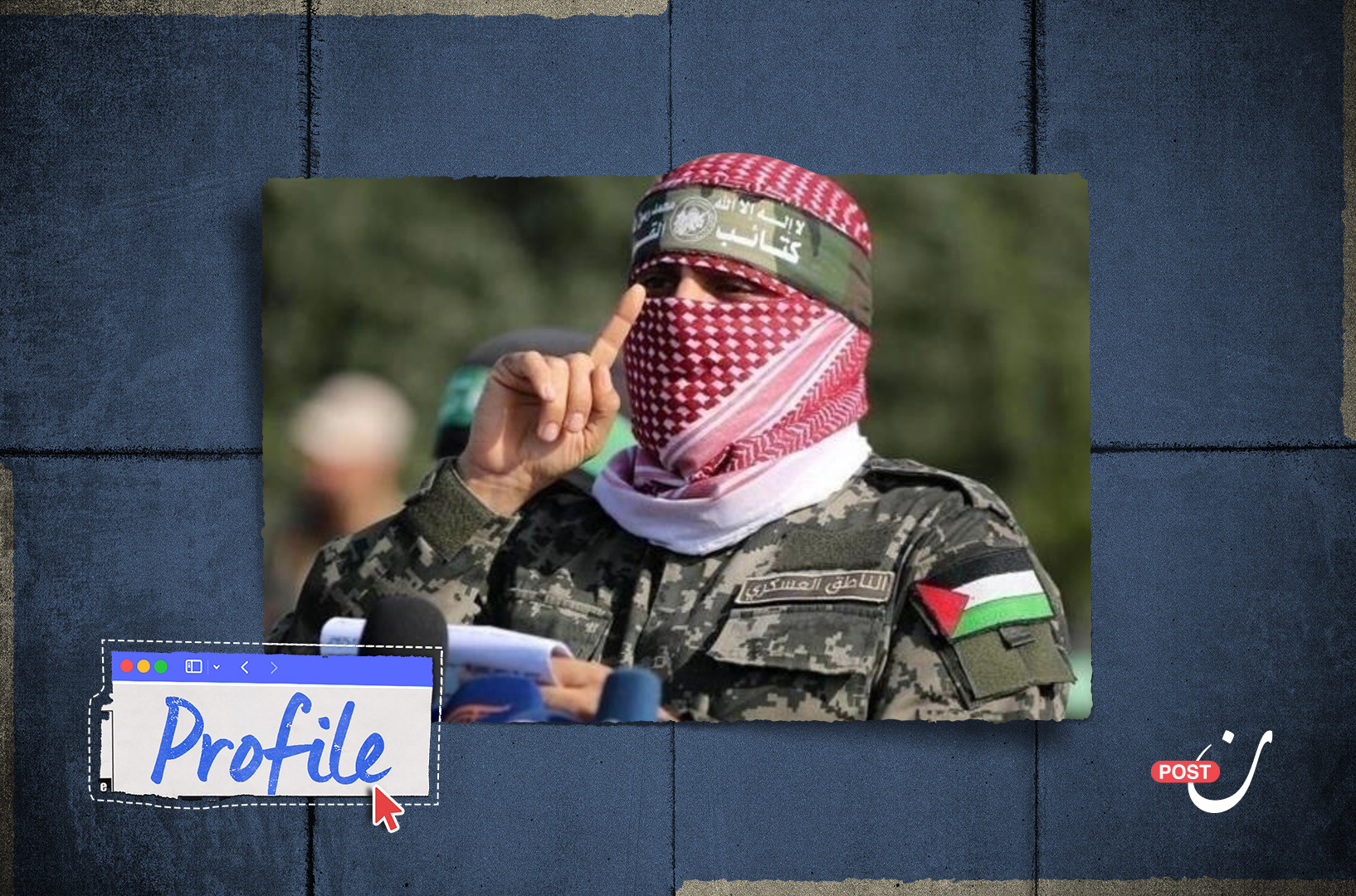
The masked man whom millions loved and awaited with passion, whom they saw as a source of inspiration, and whose red‑patterned keffiyeh became an icon for all the free people of the world the great commander and spokesperson of the Al‑Qassam Brigades, Abu Ubaida.”
He added: “Today we send him to our nation and our people by his given name and real kunya the great commander Hudhayfah Samir Abdullah al‑Khalut, Abu Ibrahim, who dismounted after two decades of vexing the enemies and uplifting the spirits of the faithful, meeting his Lord in the best of states.
And what greater sign of sincerity with God is there than that God elevates his mention among the worlds and grants him acceptance on earth?
He dismounted after leading Al‑Qassam’s media apparatus with great capability and with his brothers etched an honorable record seen by both friend and foe alike.”
Palestinians, Arabs, and broad audiences around the world knew Abu Ubaida by his distinctive appearance: a masked face beneath a red keffiyeh and a resonant voice delivering strong, coherent messages filled with conviction and purpose. He was not merely a military spokesman but an icon of resistance and a symbol whose rhetoric offered a renewed beacon of hope.
He occupied a special place in the hearts of millions, and his name and image were present in every arena and gathering indeed in every free conscience as expressions of resistance and symbolism.
Hudhayfah al‑Khalut, Abu Ibrahim, was therefore the man behind the mask: a son of the Jabalia Refugee Camp, a scion of revolution and resistance; a fighter in the field and a member of the Northern Brigade of the Al‑Qassam Brigades before becoming its military spokesperson.
Today he takes his place alongside a constellation of resistance leaders who ascended on the altar of freedom in confronting the Al‑Aqsa Flood and resisting the war of annihilation, mourned as a martyr ascending to the heights of glory, with his words remaining a beacon and guide.
The announcement of the martyrdom of Abu Ubaida, Commander Hudhayfah al‑Khalut, comes in one of the darkest and most brutal phases of the Palestinian cause as the Israeli occupation continues to pursue its destructive and eliminationist plans. The resistance finds itself facing precise calculations to preserve its sustained presence and its core idea, with priority given to protecting the cause.
This has coincided with abandonment at its extreme limits by publics, parties, and regimes whom the military spokesperson had long addressed urging them to mobilize, rise, and support the Palestinian people until his final address contained what was considered a break that transcended mere reproach when he said: “You are our adversaries before God.”
From “Days of Rage” to “Sword of Jerusalem”
Over two decades, Abu Ubaida, the Al‑Qassam Brigades’ spokesperson, grew in stature as the resistance in the Gaza Strip expanded, and his symbolism increased alongside the expansion of its field actions and political rhetoric.
On September 29, 2004, the occupation launched a major military operation in the northern Gaza Strip, deploying more than one hundred military vehicles, led by Merkava tanks, under the name “Days of Regret.” The stated objective was to dismantle the growing resistance structure and eliminate locally manufactured rocket capabilities, whose range did not then exceed ten kilometers, targeting primarily the settlement of Sderot.
The operation continued until October 16 but encountered epic resistance that halted the incursion and thwarted its attempt to reach the heart of the Jabalia Camp. It bore significant strategic implications for future resistance actions and resilience.
In response to the Israeli designation of the operation, the resistance crafted its own narrative, dubbing the confrontation “Days of Rage.” From the heart of Jabalia, a young masked man rose to read the first statement on behalf of the Al‑Qassam Brigades, announcing a new voice that would later become an iconic voice of resistance: Abu Ubaida. His first appearance was on December 14, 2004, when he delivered the first Al‑Qassam statement during the Days of Rage battle.
Subsequent major milestones followed. In the 2006 “Dispersed Illusion” operation, Abu Ubaida announced the resistance’s responsibility for the capture of Israeli soldier Gilad Shalit, affirming that releasing him would only come through a prisoner exchange restoring freedom to Palestinian prisoners.
From that moment, the military spokesperson’s rhetoric crystallized as one of the pillars of the Palestinian narrative infused with resolve and confidence, wrapped in a sound military persona crowned by the historic red keffiyeh once worn by the martyr Imad Aqel before his death.
During the 2014 aggression, his presence reached its peak. To this day, Palestinians recall his words when he announced behind‑enemy‑lines landing operations, the resistance’s responsibility for capturing soldier Shaul Aaron, and the loss of contact with the group that captured Hadar Goldin. His famous declaration during the ground invasion “You threaten us with what we await, O son of Judaism” remains a defining moment.
Over the years, his role solidified and advanced as he led the resistance’s military media, developing rhetoric that united word and action and translated battlefield heroism into a compelling narrative.
He was most notable during “Sword of Jerusalem,” when he announced the deadline given by general commander Mohammed Deif to the occupation forces to withdraw from the Al‑Aqsa Mosque and halt attacks, warning of resistance retaliation. When the deadline passed, resistance rockets surged, stopping Tel Aviv “on a single leg.”
The Al‑Aqsa Flood: Rhetoric and Psychological Warfare
With the launch of “Al‑Aqsa Flood,” Abu Ubaida emerged as the foremost voice expressing the resistance’s position recounting heroic field exploits, calling for mobilization, and rebuking the hesitant. His robust and cohesive rhetoric formed a bulwark against the Israeli propaganda machine, which sought to craft an alternative narrative to justify genocide and tarnish the image of resistance.
As Israel marketed the “Daeshization” of the resistance and painted it as terrorist before international public opinion, the resistance held firmly to its moral rhetoric and its natural right to resist occupation.
The occupation deployed its media arsenal in broad collaboration with Western and international outlets in a massive campaign of deception, but the battlefront of narrative was no less important than the battlefield. Here, Abu Ubaida played the primary role in presenting the Palestinian story, confidently articulating the resistance’s perspective on prisoners, clearly defining the ethical stance toward civilians, and backing this with serious humanitarian proposals to release foreign nationals in exchange for keeping soldiers as leverage for a comprehensive exchange deal.
He also presented the resistance’s narrative regarding the motivations behind the Al‑Aqsa Flood and its historical and political context, countering the Israeli and Western narratives that sought to depict October 7 as the starting point of the conflict, ignoring decades of occupation and bloodshed against Palestinians.
But leading the resistance’s media in such an expansive war of annihilation was not easy. The occupation leveraged all its lethal, intelligence, and technical tools from military artificial intelligence to cutting communications and the internet to isolate Gaza and conceal its reality from the world.
Between managing field media, documenting events on the ground, maintaining integrated rhetoric aligned with policy and the battlefield, and waging psychological warfare against the occupation and its domestic front, Abu Ubaida and his team navigated a complex and difficult task one they managed with remarkable fortitude.
Military media became one of the most prominent features of the resistance’s success in this war. The footage emerging from the field documenting fighters’ courage and their ability to raise the cost of occupation on every front did more than dismantle the enemy’s narrative; it proved that the command, control, and communications network between field units and operations rooms remained resilient and cohesive.
It was no surprise that the occupation included the assassination of the military media commander on its list of “achievements,” holding him responsible for psychological warfare tools that shook its internal front. The video clips related to prisoners and Abu Ubaida’s statements whose accuracy was confirmed on the ground enjoyed credibility even among the Israeli public more than the speeches of their political leaders.
These messages helped spark protests by families of detainees, pressuring a government that avoided a prisoner exchange for narrow political calculations.
Thus, Abu Ubaida became the truest expression of the coherence and integration of the Palestinian narrative in the largest and longest battle the Palestinian people have fought confronting an annihilationist Zionist war seeking to end their existence on the land.
An Icon Complementing the Historical Narrative
Israeli targeting of Palestinian icons was not born of the moment but has long been part of its attempts to solidify deterrence and melt Palestinian consciousness by striking at symbols and guerrilla leaders, aiming to shatter the great values that nourish the resistance approach.
From this perspective, the occupation assassinated Palestinian writer Ghassan Kanafani, who served as the official spokesman of the Popular Front for the Liberation of Palestine and editor‑in‑chief of Al‑Hadaf. Kanafani was a central gateway for shaping a resistant Palestinian narrative against attempts to bypass historical rights and propagate defeatist ideas.
His symbolism grew when he spearheaded press conferences during the “Revolution Airport” operation (September 1970), in which the Popular Front hijacked four planes and held Israelis to demand a prisoner exchange and bring the Palestinian narrative to the world.
His symbolism multiplied further after the Lod Airport operation (May 30, 1972) carried out by members of the Japanese Red Army. On July 8, 1972, the occupation sensed the danger of this symbolism and assassinated Kanafani and his niece Lamis Najm in Beirut by bombing their car.
In the same vein, the occupation pursued the Palestinian narrative in Europe through “Wrath of God” a campaign of assassinations initiated by Golda Meir targeting writers and thinkers who carried the resistant discourse, such as Dr. Basel Kbeissi, Muhammad Boudia, Mahmoud al‑Hamshari, and Wael Zaiter, recognizing the danger of their role in recruiting global solidarity with Palestine.
Extending this criminal mindset, the occupation’s intelligence and public opinion measuring tools were well aware of the extent of symbolism that Abu Ubaida had woven into collective consciousness not only Palestinian but Arab, Islamic, and global as well.
His image, with masked features, keffiyeh, and steadfast rhetoric, became a concentrated icon of the Palestinian resistance no less threatening in the occupation’s calculations than the resistance’s actual acts.
This symbolism, which the occupation has sought to assassinate since the 1970s, found new expressions in new bodies and icons that have become revolutionary global symbols similar to historical international struggle icons.
From this perspective, the occupation sensed the danger of this image, which draws legitimacy from Palestinian armed struggle and became a point of international convergence expressing solidarity with Palestinians’ right to resist and exist.
From this viewpoint, the occupation assassinated the spokesperson of Saraya al‑Quds, Abu Hamza, and assassinated the Al‑Qassam Brigades’ spokesperson Abu Ubaida — within a broad exterminationist campaign targeting not only human beings and land but voice, image, and word in the widest process of “consciousness forging” not only for the Palestinian people but for all free people in the world.
History’s Lessons Speak Louder Than Missiles
For Abu Ubaida, death was never absent from calculations; it was present in his person and rhetoric, masked or unmasked, as part of the inevitable outcomes of an open battle with an occupation that does not hesitate to kill any Palestinian when given the chance.
This war has claimed the best leaders of the resistance and has driven Gaza and its people to lose tens of thousands of martyrs on the road to freedom. In every alley and clash, leaders left their imprint and laid the foundations for a generation that will not be easily uprooted a generation whose bullets have not ceased in confronting occupation assaults on every sector of the Strip.
The Palestinian people bleed with every martyr, and their hearts tear with every leader the occupation succeeds in assassinating. Nevertheless, symbolism remains broader than individuals, and heroism deeper than charisma. In the case of Abu Ubaida, who remained behind the mask for two decades, his presence was a collective expression of the unknown Palestinian fighter confronting the most formidable and brutal army in the region and his martyrdom will cement that symbolism rather than extinguish it.
Abu Ubaida’s speeches were not mere military communiqués but the voice of a people facing annihilation daily. His calls were echoes of what every besieged Palestinian feels in the face of abandonment watching audiences applaud the symbolism of resistance and glorify it, then denying their individual role in mobilizing the streets and stopping the massacre.
His final address, laden with the harshest words of reproach, remains a testament and indictment to all who fell short or wavered.
Leaders rise, fighters ascend as martyrs, and Gaza advances with its children confronting a U.S.‑backed Israeli killing machine. But the march does not break, the oppressed people never raise a white flag, and there is always someone to carry the banner.
From Ghassan Kanafani, Majid Abu Sharar, and Mu’in Bseiso, to Abu Ubaida and Abu Hamza, it is a struggle that does not stop at borders constantly reinventing its rhetoric to the world and translating it into new acts by its heroes on the ground until this people seize its inevitable freedom.
The Israeli occupation army had announced in a joint statement with the General Security Service (Shabak) on Sunday, August 31, 2025, that it had assassinated “the head of the propaganda apparatus of the armed wing of the Hamas movement and its official spokesman,” known as Abu Ubaida.