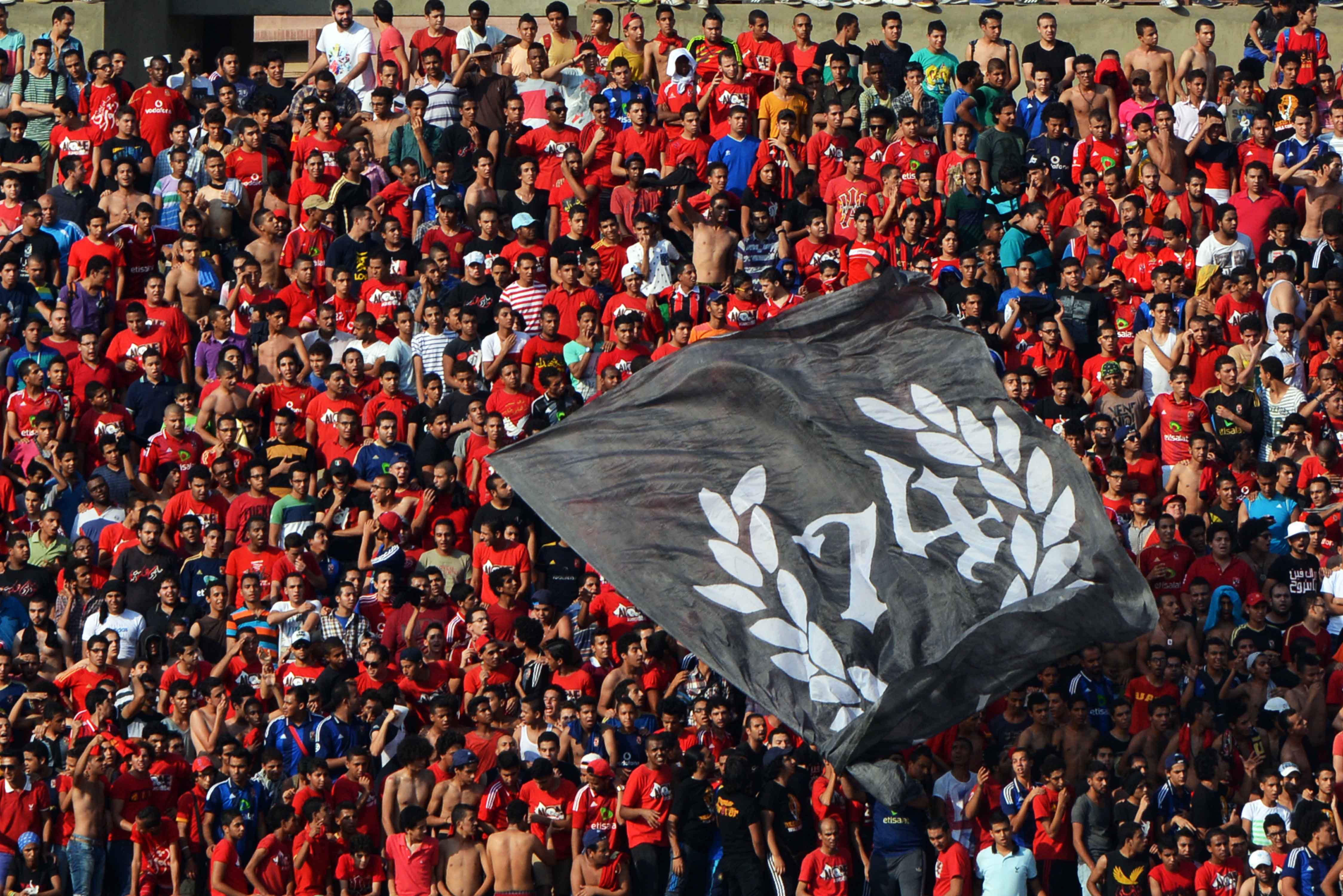

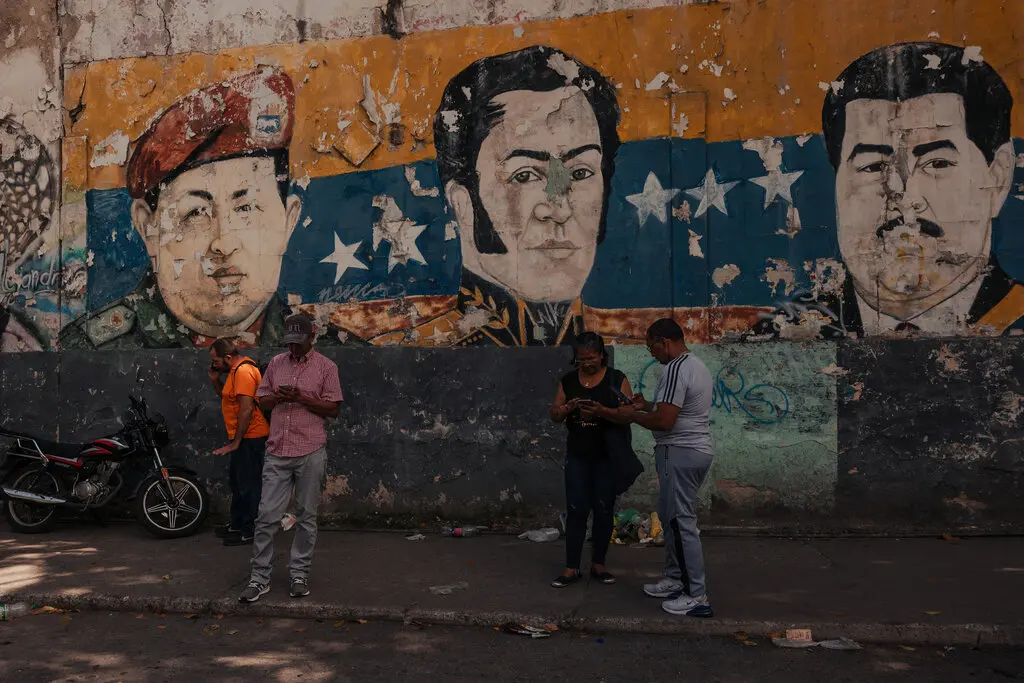
Whenever the Caribbean or Latin America experiences political tensions or regional realignments, the United States tends to resurrect the familiar narrative of an “external threat.” Just as the “communist threat” dominated the Cold War and “terrorism” shaped post-9/11 policy, today the notion of an “Iranian threat” in Venezuela is being repurposed as the latest rationale for sanctions, blockades, political pressure, and a re-militarization of U.S. discourse toward the region.
This narrative was on full display in recent statements by U.S. Senator Marco Rubio, who led the charge in portraying Venezuela as a hub for Iranian, IRGC, and Hezbollah activities in South America, allegedly with full cooperation from the Venezuelan government.
Rubio escalated his rhetoric by placing Venezuela at the forefront of what he called “the gravest threats emerging from the Western Hemisphere,” reducing a complex crisis into a single security storyline that conflates terrorism, crime, and ties with Tehran.
This framing cannot be separated from the ongoing tensions between Washington and Caracas, nor from a broader American worldview that regards any influence outside the Western order in Latin America as an illegitimate intrusion into its traditional sphere.
What stands out is not merely the exaggeration of Iran’s role, but the strategic relocation of the U.S.-Iran rivalry from the Middle East to the Western Hemisphere specifically Venezuela, a country that has symbolized political defiance of U.S. hegemony in Latin America for over two decades.
The real question, then, is not whether ties between Iran and Venezuela exist—they do, and they are well known but rather the nature, origins, and scope of that relationship. Does it truly rise to the level of an “existential threat” as framed in the American security narrative?
Cooperation Under Sanctions: The Roots of Iran-Venezuela Ties
Moving from Rubio’s rhetoric to an actual analysis of the relationship between two countries separated by thousands of miles and two continents requires stepping back from alarmist language and examining the historical and political context in which this alliance was forged.
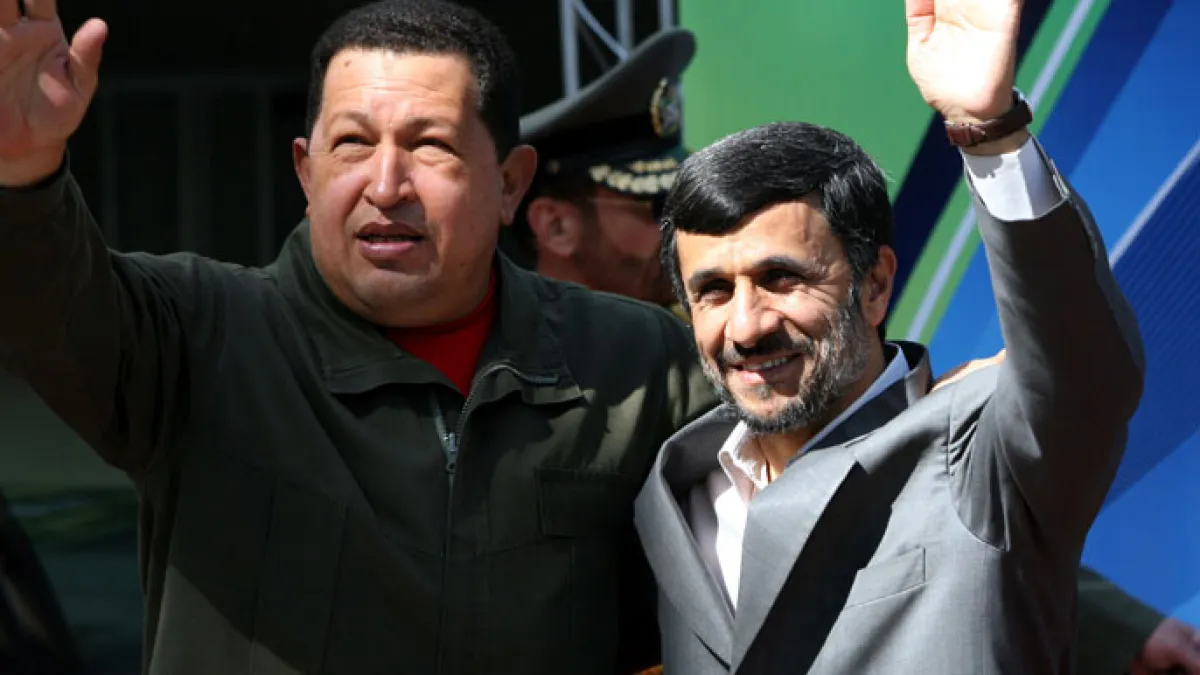
The Iran-Venezuela relationship did not arise from a crisis or tactical maneuver. It developed within a broader international context marked by growing resistance to U.S. global dominance. It deepened significantly in the early 2000s when President Hugo Chávez began seeking strategic partners outside the traditional Western sphere.
Gregory Wilpert, a scholar at the Institute for Policy Studies, writes in his book Changing Venezuela by Taking Power that Chávez was less interested in military alliances than in building a symbolic political network of nations rejecting American unipolarity.
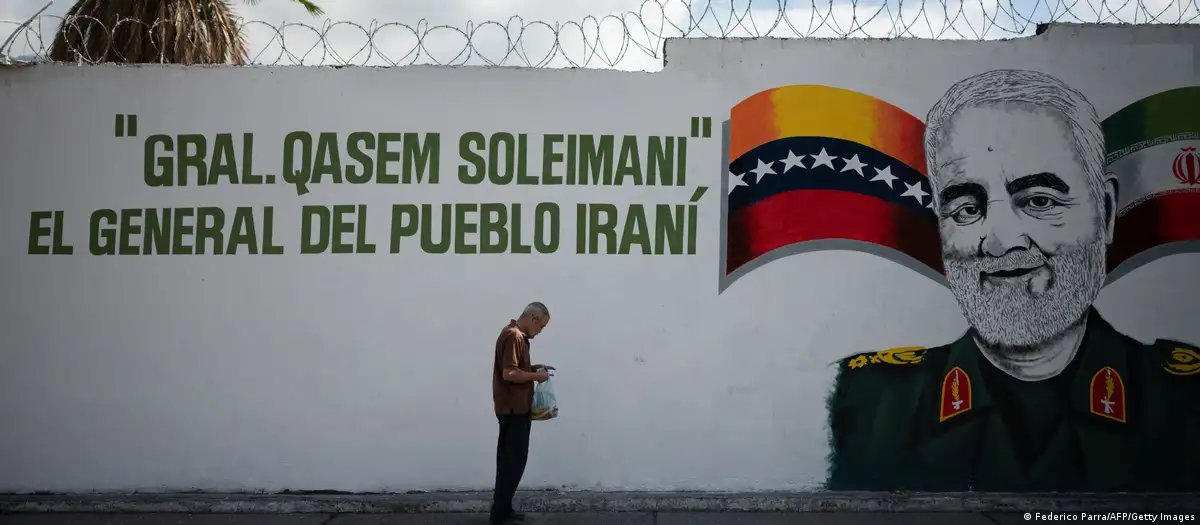
In this context, Venezuela found a natural partner in Iran especially after Mahmoud Ahmadinejad’s 2005 election. The partnership was not based on geography but on shared positions within the international system, as two nations targeted by U.S. pressure. Over time, the two moved from rhetorical solidarity to structured political cooperation shaped by mutual isolation.
This relationship fits what analysts call “marginal alliances” pacts between states not seeking dominance but aiming to reduce vulnerability to coercion. This explains its durability despite shifting circumstances and the economic and political costs borne by Venezuela for aligning with Iran.
A key pillar of the alliance is ideological: not simply anti-American slogans but a shared critique of the global order. Both reject economic sanctions as a form of undeclared warfare and advocate for “economic sovereignty” against Western-dominated institutions like the IMF and World Bank.
Economically, Iran-Venezuela cooperation must be understood in light of U.S.-imposed sanctions, especially during Trump’s “maximum pressure” campaign. At that point, cooperation was not ideological but a matter of economic survival.
Initially, the partnership centered on the energy sector. After 2018, Iran provided technical assistance to Venezuela in oil and gas to help circumvent sanctions. Joint projects aimed to revive local fuel production and improve refining capacity, which had collapsed due to sanctions targeting infrastructure.
The cooperation extended to banking, petrochemicals, technology transfer, spare parts, and limited fuel shipments from Iran during Venezuela’s 2020 energy crisis. There were also initiatives in military manufacturing and logistics.
This was not a case of large-scale strategic investments or Iranian control of resources. On the contrary, Iranian fuel shipments and technical support were limited in scale and politically costly. They emerged in exceptional circumstances.
Venezuela’s goal was to diversify partnerships and reduce dependence on the U.S., not to invite permanent Iranian influence. Nonetheless, the economic side of the relationship is often misrepresented in U.S. discourse, which frames joint projects as tools of Iranian expansionism, when in fact they reflect mutual attempts at economic survival.
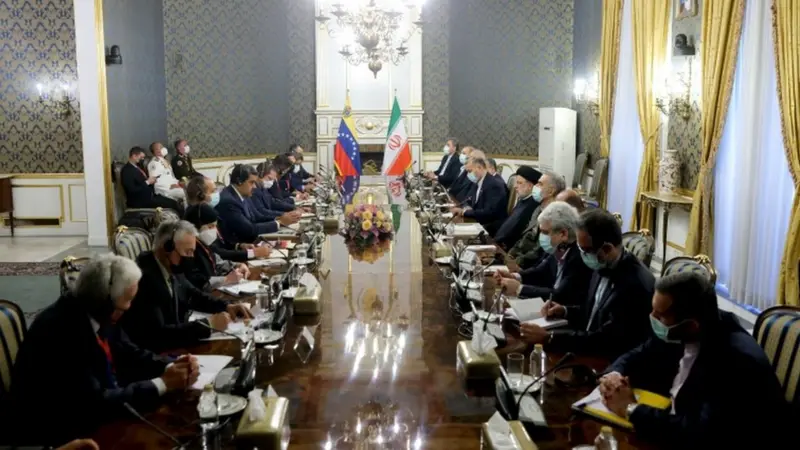
As Steve Ellner argues in Rethinking Venezuelan Politics, Caracas did not replace U.S. hegemony with Iranian power. Rather, it sought alternative partnerships to ease sanctions and isolation.
Iran lacks the financial means to dominate Venezuela’s economy or significant internal political influence unlike China, which enjoys deeper economic ties but is not portrayed as a direct threat in U.S. discourse.
Politically, the alliance is more symbolic than strategic. For Iran, Venezuela offers a low-cost diplomatic outpost in the Western Hemisphere and a way to challenge isolation. For Venezuela, Iran is a model of resilience under sanctions and a partner unconcerned with domestic political conditions. It is not a military ally capable of altering regional power balances.
At its core, the relationship is based on “solidarity among the sanctioned.” It evolved not as a strategic military alliance but as a way for two countries to operate outside the Western-dominated system.
Academic studies show that cooperation remains within the bounds of economically driven defense partnerships under sanctions. Diplomatic visits and political statements reflect opposition to U.S. hegemony more than measurable Iranian influence over Venezuelan decision-making a nuance that is deliberately omitted in U.S. security narratives.
The Limits of Iranian Influence: Between Perception and Reality
When Washington speaks of “Iranian influence” in the Caribbean and Latin America, it often does so not with analytical precision but with a loose security vocabulary summoned for political utility. The term is inflated to suggest a strategic breach of the Western Hemisphere.
In academic literature, international influence is measured through trade volume, investments, military presence, institutional participation, and soft power. Yet in U.S. discourse on Iran, influence is defined by perceptions, worst-case scenarios, and any diplomatic or economic presence outside Western frameworks.
Cynthia Arnson, former director of the Wilson Center’s Latin America program, calls this “hyper-securitization of international relations” turning normal state interactions into security threats. Under this logic, Iran becomes a threat even when lacking actual leverage.
A breakdown of U.S. claims reveals Iran’s limited reach. Its presence is mostly diplomatic and technical. These are tools many global powers employ without being labeled existential threats.
Iran has embassies in several Latin American countries, but its footprint is modest even less than that of mid-tier powers. Congressional Research Service reports confirm that Iran’s activities are “primarily diplomatic and economic.”
Crucially, Iran is not a central economic actor in the region. Even at the peak of its engagement with Venezuela, trade volume remained minimal compared to China or the EU—amounting to only a few billion dollars annually, concentrated in sanction-evasion sectors rather than long-term economic influence.
From a geopolitical standpoint, Iran lacks the capabilities to turn Venezuela into a strategic threat to the U.S. Geographic distance, logistical constraints, and limited military assets make any scenario of Iranian military presence in the Caribbean more fantasy than credible threat.
Iran does not control regional institutions, lacks logistical capacity and military bases, and has no extensive security networks in Latin America. No credible UN or intelligence reports suggest otherwise. Even the U.S. Southern Command speaks cautiously of Iranian “influence,” implicitly acknowledging its limited military footprint.
Ironically, the U.S. itself maintains an expansive military presence in Latin America, dominates financial institutions, conducts regular military exercises, and runs security programs within regional armies via Southern Command.
Yet Washington portrays Venezuela as Iran’s “gateway” to the Caribbean, inflating Tehran’s minimal presence into an existential danger a contradiction that exposes double standards in how influence and threat are defined.
The real issue is not the extent of Iranian influence but the disruption of America’s symbolic and political monopoly in a region it has long treated as its backyard. The U.S. exaggerates Iranian involvement to justify existing policies and frame any deviation as a security threat.
The Exaggerated “Iranian Threat”: A Politicized Security Narrative
The narrative of an “Iranian threat” targets more than just Tehran or Caracas. It also affects regional allies and broader global dynamics. In Latin America, the narrative pressures governments to align with Washington or avoid rapprochement with Caracas, legitimizing escalatory measures and keeping economically dependent Caribbean nations within a U.S.-approved geopolitical framework.
In Europe, the same narrative undermines attempts at independent diplomacy. When European countries advocate for humanitarian or diplomatic solutions in Venezuela, the “Iranian dimension” is invoked to reframe the issue as one of security rather than politics. The European Council on Foreign Relations notes that this securitization has shaped transatlantic policy discourse on Venezuela.
Israel also plays a role in amplifying this narrative. Viewing Iran as its top strategic threat, Israel promotes the idea of Iranian activity as globally destabilizing, linking it to its own conflict with Tehran regardless of geography or context. This reflects a securitized worldview aimed at globalizing its regional struggle.
Framing Venezuela as a threat to Israeli security defies geopolitical logic and reveals a desire to internationalize a bilateral conflict. Yet this framing resonates in Washington, where it aligns with broader narratives of an “axis of evil” and “transregional threats.”
In American media, this narrative dominates. Iran is almost automatically linked with terrorism, while Venezuela’s social and economic crises are ignored. The Iran-Venezuela relationship is caricatured through images of shadowy oil tankers, secret networks, IRGC operatives, drones, and missiles.
This oversimplification critiqued by thinkers like Noam Chomsky as a form of “manufacturing consent through fear” fosters a public perception of Latin America as a playground for foreign conspiracies, obstructing rational debate about the real causes of regional instability.
The narrative ignores internal Venezuelan issues economic mismanagement, corruption, and infrastructure collapse and reduces them to an imagined foreign menace. It overlooks Iran’s limited capacity for sustained engagement and sidesteps the rise of other global powers like China and Russia that challenge U.S. dominance.
It also shields U.S. policies from scrutiny. Questioning sanctions or advocating for change is framed as weakness in the face of threats. This avoids accountability for how U.S. actions pushed Venezuela to seek alternatives in the first place, only to then criminalize those choices.
Ultimately, this politicized security narrative, reinforced by Israeli lobbying, is effective in shaping public opinion and sustaining long-standing policies. But it hinders adaptation to an increasingly multipolar world where states seek diverse partnerships and where Latin American societies reject being reduced to geopolitical battlegrounds.