














As Israeli policies aimed at emptying Bedouin communities of their inhabitants intensify, the Bedouin file has emerged as one of the most urgent humanitarian and political issues today one whose implications extend far beyond daily assaults to encompass projects of forced displacement and sweeping demographic engineering.
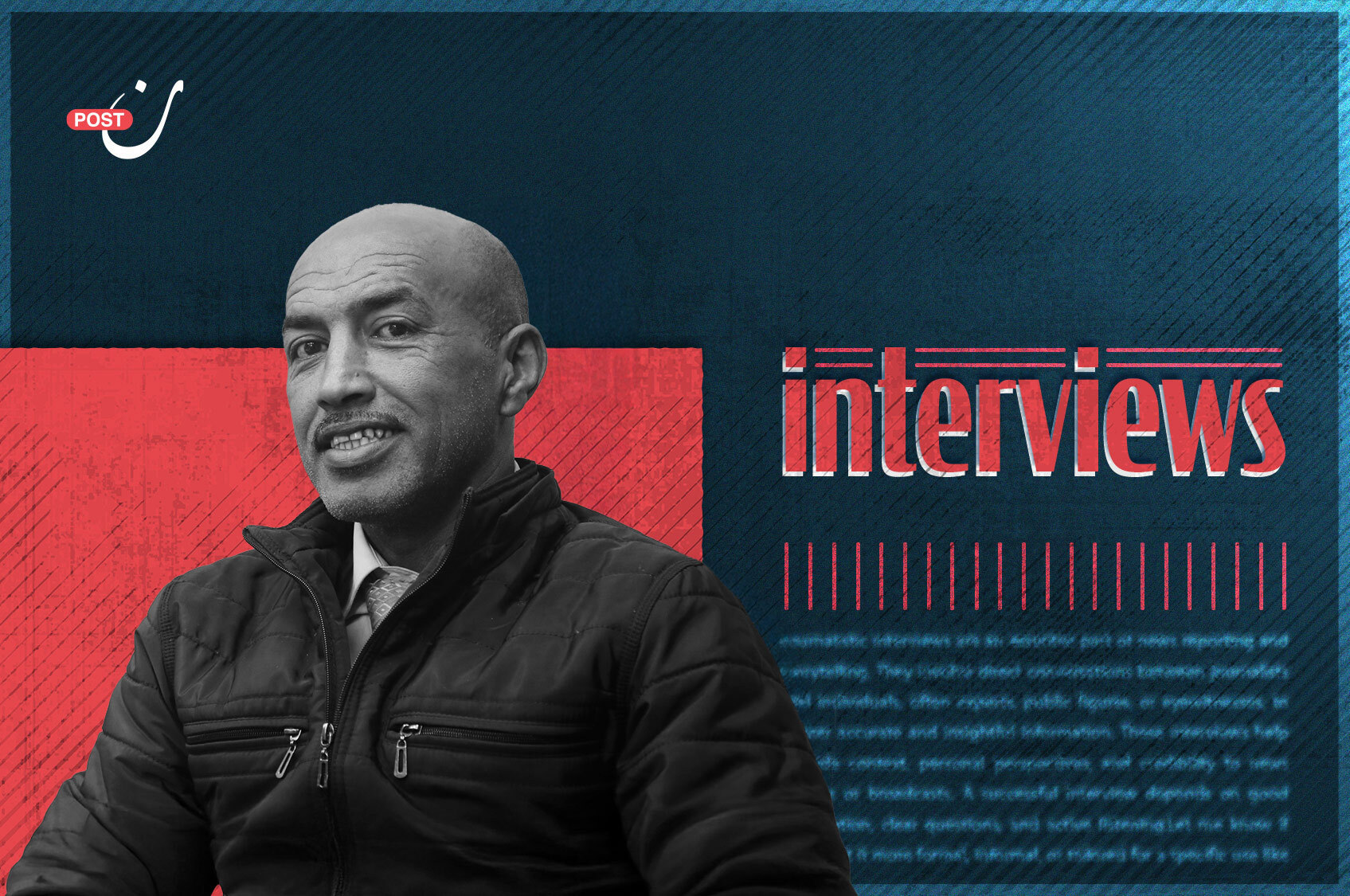
In an effort to understand the realities unfolding on the ground, Noon Post conducted this in-depth interview with Hassan Mleihat, General Supervisor of Al-Baidar Organization for the Defense of Bedouin Rights, an organization dedicated to documenting violations and providing legal and humanitarian support to Bedouin communities now facing some of the most extreme forms of settler colonialism.
The struggle waged by the Bedouins today is not the battle of a marginal social group; it is a struggle over the very existence of Palestine itself one that Israel seeks to resolve through policies of ethnic cleansing and the forcible redrawing of demographic maps.
Despite limited international response and the escalation of daily attacks, Mleihat places his faith in the resilience of Bedouin communities and in Palestinian awareness that this cause must be understood as an integral part of the broader struggle to defend land and identity.
He also calls on the world to shoulder its legal and moral responsibilities before these communities are erased by force. As conveyed by Mleihat, the Bedouins’ voice remains an open cry to the world—searching for absent justice and clinging to the land despite siege and displacement.
Through this interview, Hassan Mleihat offers a deeply grounded field-based assessment of the Bedouins’ reality under occupation, the strategies targeting their existence, and his vision for safeguarding the future of this indigenous Palestinian component.
How does Al-Baidar Organization assess the current situation of Bedouin communities amid escalating settlement expansion and forced displacement?
We at Al-Baidar view with profound concern the forced displacement and systematic ethnic cleansing targeting Bedouin communities across the West Bank, particularly in areas classified as Area C under the Oslo Accords. Since October 7 until today, approximately 70 Bedouin communities have been entirely displaced.
This comes in addition to more than 15,000 attacks carried out by settler gangs against Bedouins targeting their bodies, livestock, and their sole means of livelihood. Schools attended by Bedouin children have also been targeted, either through takeover or demolition.
The reality facing Bedouins today is catastrophic by every measure. Attacks are escalating at an unprecedented pace whether through imposing sieges on communities, preventing residents from herding or moving between surrounding hills, or cutting off essential services such as water and electricity, which Bedouins rely on through solar energy systems.
Based on your field monitoring, can what is happening to Bedouins be described as a systematic policy of ethnic cleansing and demographic change?
What Bedouins are facing is indeed a systematic policy aimed at uprooting Palestinians from vital land targeted by settlement projects. By nature of their livelihood as pastoralists, Bedouin communities reside primarily in Area C the largest and most heavily targeted portion of the West Bank.
Most of these areas lie in the eastern West Bank, where Bedouins constitute a real barrier to settlement expansion. This is precisely why they are directly targeted. As one of the most impoverished and vulnerable populations, they are particularly exposed to forced displacement, assaults, home burnings, and livestock theft.
What Bedouins are experiencing is not random violence but a settlement project with clear geopolitical objectives, through which Israel seeks to gradually annex the West Bank by displacing Palestinian Bedouins and replacing them with settlers.
How do you link settlement expansion with organized attacks on Bedouin communities?
In the past, Israel relied on traditional methods of expelling Palestinians issuing demolition orders through the Civil Administration, followed by enforcement. Since 2019, however, it has shifted to a new phase known as pastoral settlement, one of the most dangerous contemporary forms of expansion.
These outposts typically consist of five to ten armed settlers who set up tents or mobile homes near a Bedouin community, bringing with them flocks of sheep or cattle. They then launch repeated, systematic attacks aimed at forcing Bedouins to leave, with direct backing from the Israeli government. This method alone has led to the displacement of nearly seventy Bedouin communities.
Its danger lies in its bottom-up nature, allowing Israel to evade political and legal accountability by portraying events as “local conflicts” between settlers and Palestinian civilians when in fact they are part of a coordinated, state-backed settlement project.
What are the main tools and policies Bedouins face daily that push them toward displacement?
What Bedouins endure today is a policy of systematic ethnic cleansing that, in its brutality, surpasses some practices of apartheid-era South Africa. Daily violations include:
-
Repeated and systematic demolition of Bedouin homes
-
Arson attacks on dwellings and assaults on property
-
Seizure of livestock their only source of income including the theft of between 9,800 and 10,300 sheep and goats, valued at $4.9–$5.15 million, and the killing of 630–710 animals by gunfire, poisoning, or vehicle attacks. This brings total livestock losses since the start of the year to 10,430–11,010 animals, threatening the economic and social stability of these communities
-
Demolition of Bedouin schools and denial of education to children
-
Organized terror attacks by settler gangs on civilian homes
These practices evoke the actions of the Haganah, Irgun, and Stern gangs during the 1948 Nakba. Today’s “Hilltop Youth” attacks are even more violent and brutal. I find no description more accurate than a holocaust aimed at ethnically cleansing Palestinians by erasing their presence from vital West Bank areas.
How does Al-Baidar view the future of Bedouin presence amid escalating attacks?
Bedouin existence faces immense challenges as attacks intensify. Settlers and occupation forces now practice sustained violence—assaulting families and confiscating livestock impoverishing many households.
Palestinians in these areas receive no services or protection, while settlers enjoy full governmental support, including funding, weapons, and backing from international Zionist agencies. These assaults are carried out in a highly organized manner by armed groups, leaving Palestinians alone in an extremely unequal battle in Area C.
These realities raise grave concerns about the future of Bedouin communities, especially as the ultimate goal of these policies is clear: uprooting Palestinians and emptying the land of its indigenous population.
Are specific Bedouin regions targeted for strategic reasons?
Yes. Israel is currently focusing on two strategically critical regions:
First: The Jordan Valley, which comprises roughly 27% of the West Bank. It holds immense geopolitical significance along the Jordanian border and is rich in fertile land and water resources exploited by settlers, while Palestinians suffer severe water scarcity.
Second: The Jerusalem Desert, which has seen intensified targeting since the summer of 2025 due to its location within the E1 corridor, a key zone for annexation and for severing the northern and southern West Bank. Over the past year, several settlement outposts were established adjacent to Bedouin communities east and northeast of Jerusalem, resulting in the displacement of two communities under siege and attack.
Both regions are subjected to sustained, coordinated pressure aimed at clearing them of their indigenous inhabitants.
What is the psychological and social impact on women and children?
Women and children being the most vulnerable—have suffered deep psychological trauma. Home invasions, arson, and school attacks have created a state of constant fear, leading to forced school dropouts as families fear sending children to school.
Many children now suffer from severe anxiety and recurring nightmares, prompting families to seek psychological support. Some women have been directly assaulted while trying to protect their children, compounding the social and psychological toll on Bedouin families.
What legal role does Al-Baidar play in confronting demolition and eviction orders?
Demolition and eviction orders are legalized through Israeli Knesset legislation and Civil Administration decrees designed explicitly to displace Palestinians, rendering the Israeli judiciary entirely untrustworthy. Courts enforce these laws to serve settlement interests, far removed from justice.
Al-Baidar focuses on meticulous documentation of violations to situate the Bedouin issue within its legal, political, and humanitarian context. We were among the first to frame this issue as a political and moral cause—not merely a humanitarian one—recognizing Bedouins as a core component of the Palestinian social fabric and a frontline protector of land in Area C.
Under international humanitarian law, particularly the Fourth Geneva Convention (1949), these practices constitute war crimes—especially Article 53 concerning forcible transfer and the implantation of settlers in occupied territory since June 1967.
Alongside legal efforts, Al-Baidar provides humanitarian aid, including food, water, education support, and community protection, striving to mitigate the devastating impact of these policies.
How has settlement expansion altered traditional Bedouin presence maps?
Repeated attacks and forced displacement have reshaped the demographic map of Area C. These policies aim to reengineer population distribution by removing Bedouins from vast swathes of their historic lands.
Displaced families often integrate into related Bedouin communities, reflecting social resilience and efforts to preserve cohesion despite immense pressure.
Is there meaningful international response when reports are submitted?
International engagement remains limited and insufficient relative to the severity of violations. Al-Baidar therefore works tirelessly to internationalize the Bedouin cause by documenting abuses and presenting them in global forums.
Many countries are either unaware of Bedouins’ existence in the West Bank or unaware of the scale of settler violence. Internationalizing the issue is essential to building global awareness and reinforcing the Bedouins’ vital role in safeguarding land and Palestinian presence in Area C.
How do you assess the UN and international organizations’ response?
The response of the United Nations and international human rights bodies has fallen far short of the gravity of violations. Their performance has been extremely weak, failing to curb forced displacement, ethnic cleansing, or the denial of basic services and freedom of movement while settlers receive full material and military support.
These conditions compel Al-Baidar to pursue a long-term strategy of perseverance and accumulation, despite the arduous path ahead.
Your message to Palestinians and the world?
I call on all Palestinians to engage in the Bedouins’ struggle as a sacred national battle to protect the land. Despite its imbalance, it is a moral and national duty.
To the international community, my message is clear: this is a struggle for justice and humanity. Support Bedouins as they defend their homes, women, and children against some of the most brutal forms of ethnic cleansing—carried out in full view of the world. Moral responsibility precedes political responsibility. Ignoring these crimes does not erase them; it multiplies the world’s accountability to act urgently and decisively.


