
At “Al-Usṭūra” Café in the heart of Al-Haram, Giza, 27-year-old Abdullah, a young Sudanese man, sat gazing into his coffee cup as if peering into a distant homeland. Reflections of Khartoum flickered in his eyes, while the silence around him echoed with chants from the streets once more.
Seven years have passed, but December has never left him. It returned, alive and pulsing, just as it first erupted from chests and throats demanding change.
Abdullah retraced the steps of those early protests starting from the day he decided to break through fear, all the way to the fall of Omar al-Bashir. Around him sat dozens of people from different regions and age groups, bound less by geography than by shared memory.
They listened closely as he spoke, his words brimming with both nostalgia and fire, as if unlocking a hidden portal back to those fateful days.
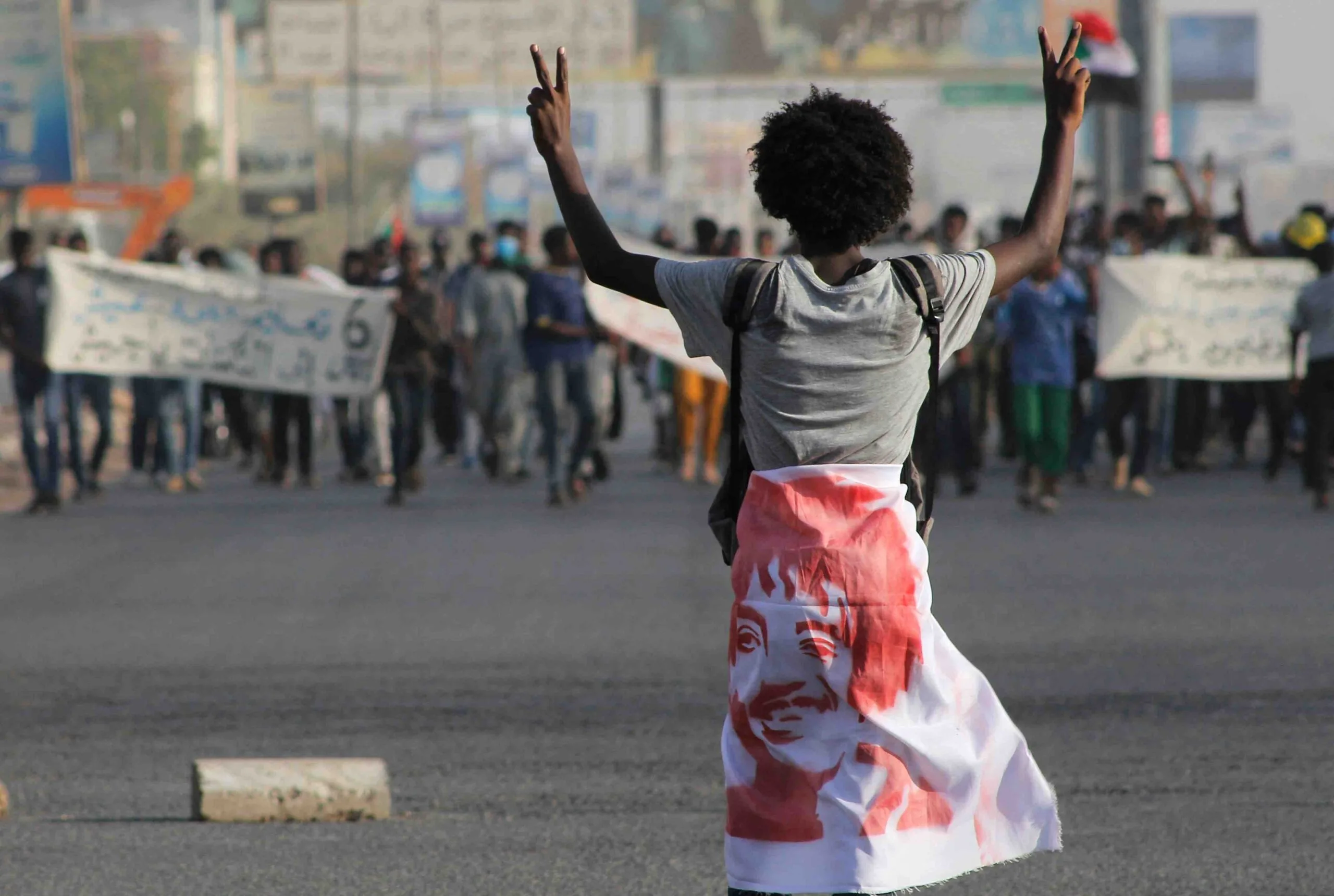
Suddenly, Abdullah stood up. His voice rang out in the café, as if carried from Sixty Street or the heart of the sit-in. He declared that the revolution was not over, that its spirit remained alive within them no matter how much time had passed.
He said the December Revolution was not merely a fleeting political event, but a sacred covenant between the people and the sacrifices of their martyrs, their wounded, and their missing.
With a voice heavy with longing, he added that honoring this covenant required more than words it demanded defense of the revolution’s values: freedom, peace, and justice; resistance to war in all its forms; solidarity with women and marginalized communities; and a steadfast commitment to the dream of a democratic, civilian state.
The emotional charge in the room could no longer be contained. The café erupted with chants drawn from the depths of collective memory: “Freedom… Peace… Justice… The revolution is the people’s choice,” and “Fall or not… We’re staying strong.” For a few moments, the café transformed into a miniature revolutionary square, as if December had crossed the border to visit Giza.
Seven years ago, millions of Sudanese rallied around a single dream, a single flag, a single goal: to bring down a regime that had suffocated them for decades, and to uproot authoritarianism from its very foundation.
Back then, the dream was both simple and grand: a new Sudan one that respects human dignity, safeguards citizenship, enshrines liberty, and restores the meaning of honor. While that dream may remain unfinished, it is certainly not dead.
Today, as Sudanese live in exile with bodies far from home but hearts still tethered to its chapters the question returns with every December anniversary: What remains of that revolutionary spirit in the hearts of those millions forced to flee by the generals’ war for power?
The homeland may no longer be near, but December still lives within them as an idea, a yearning, and a deferred promise of return.
A Present, Not a Memory-A Future, Not the Past
“Who said December is just a memory?” asked Ahmed Kanan, a 55-year-old academic from the University of Khartoum, now residing in Cairo, surprising us when we inquired about the revolution’s seventh anniversary.
It wasn’t a rhetorical question, but a philosophical jolt that challenged the very premise of our inquiry. With the certainty of someone who has lived the experience and understands its gravity, Kanan insisted: December is a living present, not a relic of the past, and a future that cannot be buried in history.
Speaking to Noon Post, Kanan described December as a living entity breathing with the Sudanese wherever they are. He affirmed that the revolution endures as long as the people do, and that it remains the brightest moment in Sudan’s contemporary history the rare spark that united Sudanese across ideological and political divides.
It is the path they will continue to walk, no matter how many obstacles arise or how long the journey takes.
This view was far from isolated. It was echoed by Nahed, an educator in her fifties living in Al-Haram, Giza. She spoke with quiet conviction born of lived experience, emphasizing that December holds a particularly deep place in the hearts of Sudanese women.
For them, the revolution wasn’t merely a political struggle it was a direct confrontation with a regime that trampled their dignity, stripped away their rights, and institutionalized discrimination against them.
In a poignant moment, Nahed revealed to Noon Post that she insists on teaching the revolution with all its details to the children in the kindergarten she runs in Egypt. She doesn’t teach it as a history lesson, but as a seed of hope a legacy she tries to plant in young hearts where adults failed to protect it.
She believes that what faltered in one generation may blossom in the next, and that the path to a free and democratic Sudan might begin with a story told to a child and a dream that grows with time.
Thus, December is not simply a memory summoned in the minds and souls of its children—it is a spirit that resists erasure, that insists on survival in words, in memory, and in the eyes of children who never lived it but may one day carry it forward.
A Revolution Stolen by Generals
“Everything was unfolding as we had dreamed as imagined by the revolutionaries in their minds and their blood until the military came and overturned the table, dragging Sudan years backwards.” With these heavy words, Sudanese lawyer and human rights advocate Asaad Al-Mirghani began his conversation with us. His words seemed to carry the rubble of a dream never allowed to be completed.
Al-Mirghani traced Sudan’s current tragedy to its core: the generals’ unrelenting hunger for power. Speaking to Noon Post, his tone carried the weight of a witness to a broken era. He said the military could not tolerate the idea of a civilian-led government that would return them to the barracks, as the revolution demanded.
Such a shift would have stripped them of the privileges amassed over decades of dominance. For this reason, the coup against the revolution wasn’t a reaction it was a deliberate choice, a banner under which both the army and the Rapid Support Forces united.
But once the civilian government led by Abdalla Hamdok was ousted, cracks began to show within the military’s own ranks. Power struggles erupted, with each faction seeking absolute control. No partners. No accountability. According to Al-Mirghani, this is how Sudan was plunged into an open-ended spiral of violence, with no end in sight.
He went further, insisting that none of this was spontaneous. Everything had been premeditated. The military’s initial alignment with the revolution was merely a mask a tactic to contain the street and avoid direct confrontation. But when the critical moment of transition to civilian rule arrived, the masks dropped all at once, revealing the military’s true face—unapologetic and unmasked.
And yet, amid the darkness, Al-Mirghani’s words held a glimmer of hope. He firmly believes that Sudan’s current suffering does not extinguish December it summons it. Within the spirit of that revolution lies the path to liberation from the heavy burdens of the past and the lingering agents of dictatorship. Despite the wounds, it remains the final cry that refuses to fall silent.
December: The Road to Salvation
The voices of Kanan, Abdullah, Nahed, and Al-Mirghani are but reflections of a broader Sudanese consciousness echoed in civil society statements, exile conversations, and the silences of destroyed homes. Despite differences in place or language, they are united by one conviction: the road to salvation begins with December.
Seven years on, the revolution has not faded into a pale memory. It remains alive in the collective conscience the only national compass out of the deep crisis engulfing Sudan.
This sentiment is shared by the Sudanese diaspora, those forced from home but still anchored to it in heart. Their demands are painfully simple: commit to the revolution’s goals freedom, peace, justice, and democratic civilian governance; end the war immediately; and initiate a comprehensive political process that preserves Sudan’s unity and sovereignty, and restores its people’s right to safety and dignity.
In this context, the National Umma Party issued a statement heavy with the weight of tragedy, noting that this year’s anniversary comes amid a devastating war unprecedented in modern Sudanese history a conflict that has left behind death, displacement, and vast violations against civilians, while dismantling state institutions and threatening the nation’s social fabric.
The party warned that the war is a dangerous attempt to abort the December Revolution and undermine its achievements a descent into proxy conflicts and regional entanglements.
Nevertheless, it reaffirmed its commitment to the revolution’s path, calling on Sudanese at home and abroad to rally behind the December project, reject all narratives justifying war or division, and demand that both warring parties shoulder their moral and historical responsibilities and cease hostilities.
Similarly, the Sudanese Congress Party and other civil forces reiterated that December was a transformational revolution that ended three decades of repression and opened a door to democratic civilian rule before the coup slammed it shut and war flung open the gates of hell.
They stressed that the war has returned Sudan to isolation, drained its resources, and torn apart its social fabric with hate speech and racism. Still, they insisted that December remains a moral imperative and a unifying national vision.
Their closing message was clear: war may dominate the present, but December still inhabits the future firmly rooted in the hearts of Sudanese people and their central path to a state built on freedom, peace, and justice.
In distant exiles, where cafés resemble one another and faces change, December’s spirit lives on in Sudanese imaginations as a final refuge from despair. In Cairo, Nairobi, Addis Ababa, and beyond, the revolution is no longer a past event to be recalled—but a living memory experienced daily, carried in accents, in songs, and in long conversations about a betrayed yet unbroken homeland.
Four years have passed since the military stole the dream, but they failed to steal its essence. December remains a defiant idea, a wound that refuses to close over injustice, a promise postponed but not forgotten.
And so, for Sudanese abroad, the only road to redemption is through December—not as a sentimental yearning, but as a national project to reclaim what was lost: a state that respects human dignity, a civilian government that serves its people, and a peace that brings people back to their homes and their memories.
They believe the dream snatched by force can be reclaimed with persistence, and that the revolution, though faltering, was never defeated it’s merely waiting for its next moment. For them, December isn’t the end of the story it’s the beginning. The only path through which Sudanese can reclaim their homeland and write their dream anew.