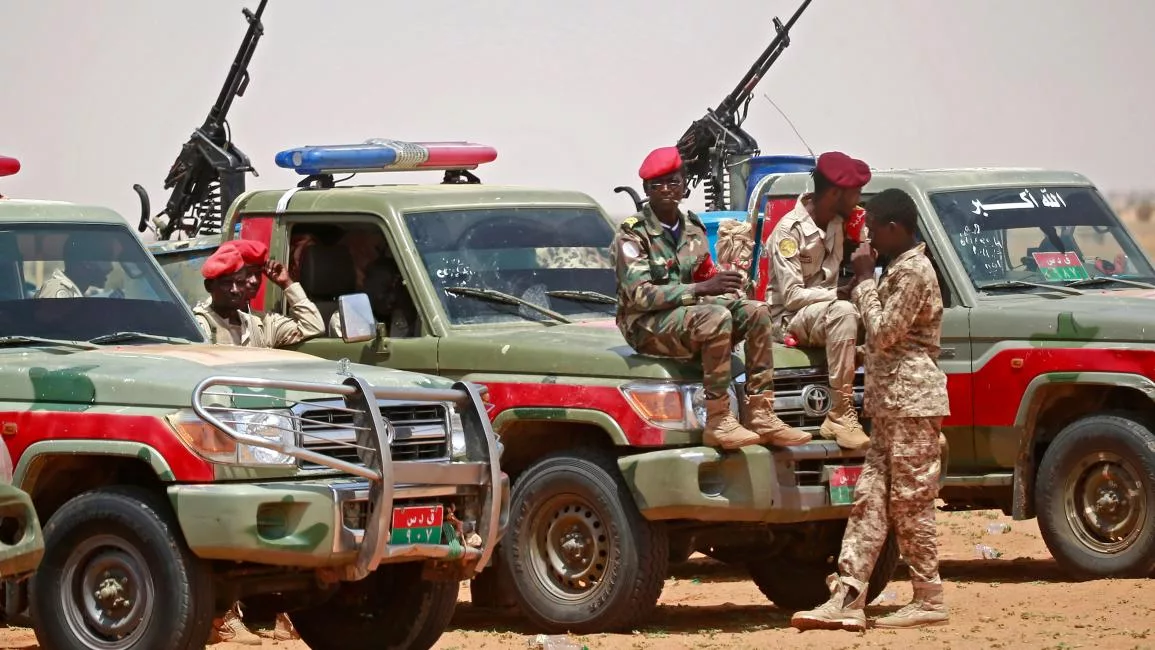
In early December, Sudan’s Rapid Support Forces (RSF) and allied militias seized control of the city of Babanusa in West Kordofan following nearly a year-long siege and weeks of intensified assaults. The offensive triggered a massive wave of displacement. According to Babanusa’s Emergency Room, more than 177,000 people had fled the city by November 9, leaving it largely deserted.
On December 4, the Sudanese army announced that its forces had withdrawn from Babanusa and regrouped at Brigade 90 in Heglig. Military sources later revealed that the RSF had employed foreign mercenaries and advanced jamming equipment during the final assault. These systems reportedly disrupted communications within the army’s command center, cutting off contact between commanders and their units and accelerating the city’s collapse.
Although RSF leader Mohamed Hamdan Dagalo commonly known as Hemedti had declared a humanitarian ceasefire, his forces continued their offensives in southern Kordofan, including Babanusa, Kadugli, and a December 4 drone strike on a kindergarten in Kalogi that killed several children and civilians.
Local sources claim the drones pursued civilians, targeted medical responders, and then attacked a nearby hospital, in blatant violation of international humanitarian law.
UN High Commissioner for Human Rights Volker Türk expressed deep concern over the escalating violence across Greater Kordofan, warning of a repeat of the devastation seen in El Fasher. “We must not allow Kordofan to become another El Fasher,” he stated, urging influential countries to pressure both warring sides to cease hostilities and halt arms supplies.
A Strategic Turning Point
Babanusa lies some 697 kilometers southwest of Khartoum, in a region of immense strategic importance. Its geographic location and economic assets have made it a coveted target in the ongoing war between the army and the RSF.
The city is a key transportation hub, home to one of Sudan’s most important railway intersections. Rail lines from Babanusa connect westward to Darfur, southward to Wau in South Sudan, and link western Sudan with the north and east. The presence of institutions like the University of West Kordofan gave the city an urban character, drawing students from across the region.
Its location at the crossroads between Sudan’s north, south, east, and west gives any military force controlling Babanusa dominance over crucial supply and transport routes. More than just a logistical prize, it also serves as a launchpad for exerting influence over West Kordofan and beyond into Darfur. Unsurprisingly, both sides have fought bitterly for control of the city.
A Timeline of Battle
The siege of Babanusa began on January 22, 2024, when RSF fighters and allied militias attacked the Sudanese Army’s 22nd Infantry Division headquarters. Initial RSF gains included police stations and parts of the military base, triggering panic among civilians. However, a counteroffensive by the army temporarily broke the siege.
In November 2025, the RSF renewed its attack with heavy artillery barrages targeting army positions. By December 1, the RSF declared full control of the city and the 22nd Division’s base, calling it a strategic milestone in its efforts to dominate West Kordofan and link it with Darfur.
Footage shared by RSF fighters from the gates of the 22nd Division base confirmed their presence. According to some reports, the army’s defeat in Babanusa marked the end of its operational presence in West Kordofan a significant development that could reshape the military map of the conflict.
Heavy shelling and ground battles forced tens of thousands to flee. International organizations report that many displaced families now endure dire conditions without shelter, food, or medical care, and that humanitarian access remains severely restricted.
The city’s fall has disrupted key supply lines between Kordofan and Darfur, and the loss of the 22nd Division a symbolic pillar of army strength dealt a major psychological and tactical blow to the military.
A Tactical Withdrawal or Strategic Setback?
According to strategic and security expert Major General Moatasem Abdelqader, the army’s withdrawal from both El Fasher and Babanusa may appear as territorial losses, but could also be seen as a strategic regrouping. He argued that the army might be preserving its manpower, weapons, and resources to fight on more favorable fronts with better logistical support.
“In some cases, withdrawal is as crucial as defense or offense,” he said. “Holding ground at all costs can lead to total destruction of a unit. Redeployment might ensure the army lives to fight another day.”
Abdelqader remains optimistic about the army’s long-term prospects, pointing to advances in both North and South Kordofan as well as the recapture of territories long held by the Sudan People’s Liberation Movement (SPLM).
“The armed forces have taken back areas the SPLM controlled for over 40 years. If momentum continues, they could soon retake all of South Kordofan and launch operations in East Darfur especially Al Daein and then into North Darfur,” he predicted.
Meanwhile, in the south, the army is locked in fierce battles. A statement by Emergency Lawyers confirmed an army airstrike on a school in Kamo, a town in Heiban locality controlled by the SPLM-North led by Abdelaziz al-Hilu. The attack reportedly killed and injured dozens. The army has not commented on the incident.
Implications of RSF Control
Dr. Mohamed Torshin, an expert on African affairs, argues that RSF’s capture of Babanusa signals a shift in operational momentum in its favor. With major wins like El Fasher and now Babanusa, the RSF could push to seize Kadugli, Dilling, and even El-Obeid, he warned.
While some speculate about the possible breakup of Sudan, Torshin cautions against jumping to conclusions. “RSF might try to impose de facto partition, but under international law, unilateral secession isn’t legally valid,” he said.
Torshin also questioned the effectiveness of international pressure. He sees Western messaging and sanctions threats as tools to pursue geopolitical interests particularly pushing Sudan away from Russian and Chinese influence rather than genuine efforts to stop atrocities or bring justice.
The US Senate recently proposed designating the RSF as a terrorist organization. Senator Marco Rubio accused the group of committing atrocities and didn’t rule out formal classification as a terror group.
Meanwhile, the African Great Lakes countries, during their November 16 summit, adopted a resolution labeling the RSF a terrorist organization and urged the UN Security Council to condemn its crimes.
The US government has also targeted the army. In January 2024, Washington imposed sanctions on Sudanese army chief Abdel Fattah al-Burhan, citing alleged use of chemical weapons though no evidence was presented. A recent France 24 investigation provided the first public evidence that the army used chlorine gas in September 2024.
A Dangerous Precedent
After the RSF seized Babanusa, its fighters posted videos in front of the 22nd Division’s base vowing to capture El-Obeid, capital of North Kordofan, as their next goal.
Political analyst Mohamed Abbas believes Babanusa’s fall was only a matter of time, blaming the army’s failure to break the siege from inside or reinforce from outside a scenario reminiscent of El Fasher’s fall, where the RSF enjoyed unbroken supply lines and freedom of movement.
Given the RSF’s widespread control in Darfur and increasing presence in Kordofan, Abbas likens Sudan’s current situation to Libya’s: a recognized government in Port Sudan with international legitimacy, and an unofficial but effective authority operating from Nyala under RSF control.
“This dual-governance model is dangerous and threatens the very fabric of the Sudanese state,” he said.
Abbas warned that discussions around changing Sudan’s flag or even the country’s name hint at an agenda to fragment the nation. “There are clear signs of international interests pushing for Sudan’s division,” he said. “Even if the international community claims to support unity, the reality on the ground suggests otherwise.”
He added that recent calls to change national symbols by RSF leaders and government figures could be laying the groundwork for secession. “The RSF’s so-called ‘foundational government’ is actively working to detach western Sudan under the guise of unity.”
Abbas dismissed US pressure as largely symbolic, aimed more at geopolitical leverage than accountability or transitional justice.
On December 1, General Abdel Fattah al-Burhan proposed reviving Sudan’s pre-1970 flag blue, yellow, and green. The move was echoed by Islamist-aligned analyst Naji Mustafa, who even called for changing the country’s name, arguing that such a philosophical shift could improve Sudan’s global standing, much like Burkina Faso did.
These statements sparked outrage among Sudanese observers, who fear such rhetoric is a prelude to national disintegration.