
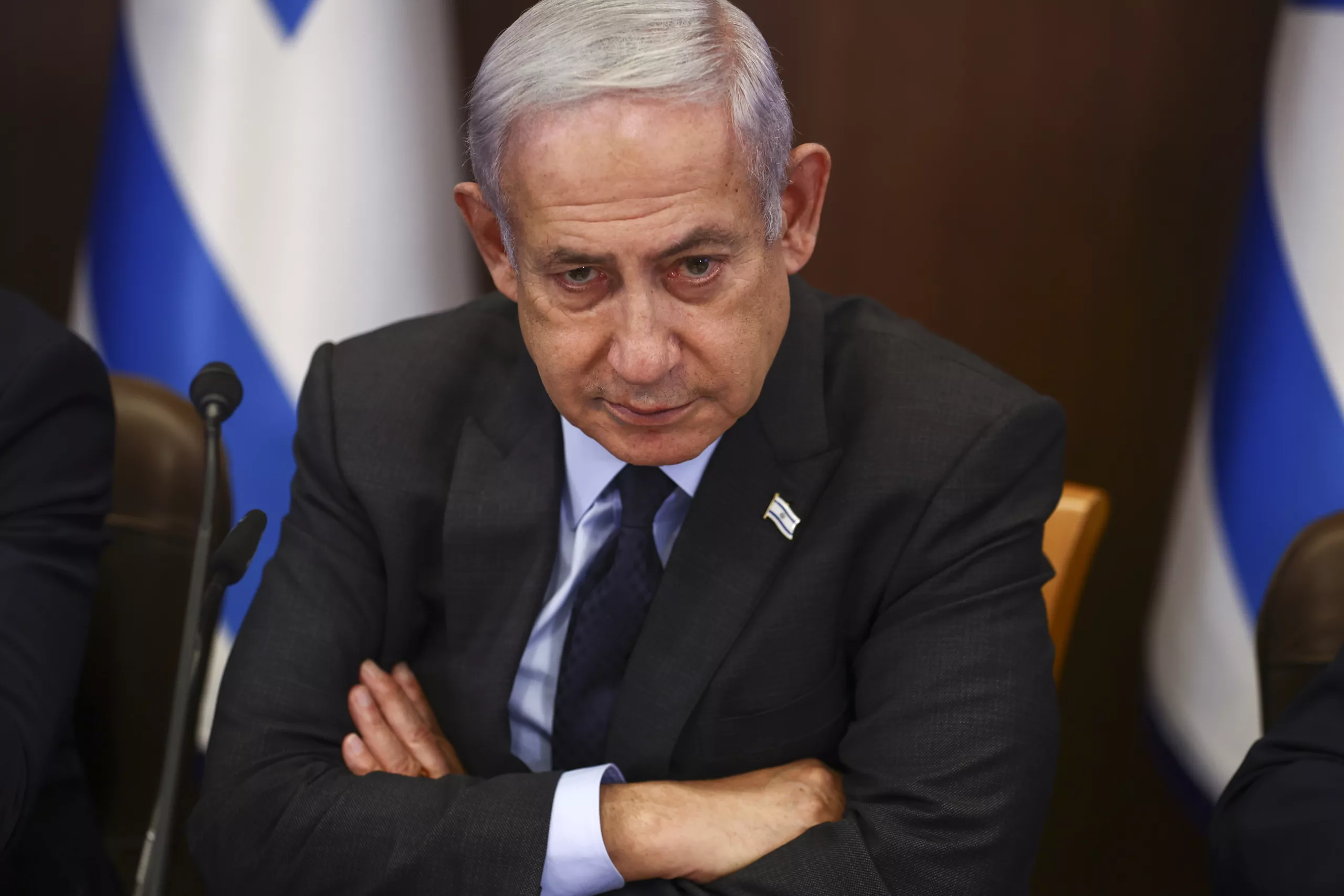
In a highly charged political moment and at the height of his trial over corruption charges some of the most serious ever faced by an Israeli prime minister Benjamin Netanyahu has submitted a formal request for a presidential pardon to Isaac Herzog. Herzog described the move as “extraordinary” and said it demands careful consideration “with responsibility and a serious heart.”
Netanyahu submitted the request not merely as a defendant seeking legal relief, but from his position as head of government, presenting himself as a unifying figure “a bridge to mend the rift within the people” and ease internal tensions, as his letter stated.
But behind this conciliatory language lies a profound political crisis, intertwining Netanyahu’s survival strategy with the seismic aftershocks of the October 7 attack, ongoing military and economic hemorrhaging, mounting pressure from the White House, and deep societal fractures within Israel.
Because Netanyahu made the request before any verdict has been reached, and without acknowledging guilt or pledging to retire from politics, the pardon request places Israel at one of the most sensitive junctures in its relationship between judicial authority and executive power.
This move reveals more than just Netanyahu’s personal legal dilemma it raises broader questions: Is the prime minister trying to defuse a legal time bomb before it detonates in the middle of a fateful election season? Has he sensed the court’s direction and abandoned hope for acquittal? Are we witnessing a constitutional precedent that could redraw the boundaries of power in Israel?
Electoral Stakes and Political Earthquake
It is difficult to separate the pardon request from the electoral context pressing in on Netanyahu. He is gearing up for one of the most consequential campaigns of his career and knows that waging it while knee-deep in interrogations and corruption files would weaken him and strip his campaign of the “historic leader” image he so often projects.
Thus, he frames the pardon as a move to “strengthen the resilience of the national state,” while opponents see it as a blatant attempt to neutralize the judicial bomb before the moment of reckoning.
The timing is also critical. Israel is entering an election year marked by the fallout from October 7, unprecedented social divisions, and deep mistrust in political and military leadership. Even within the right-wing bloc, Netanyahu no longer enjoys the dominance he once held.
The rise of figures further to the right, the exhaustion from a protracted war, and a deteriorating economy have weakened his standing within his own camp. Any internal fractures in the coming months could derail his ability to form a cohesive right-wing coalition.
Though Netanyahu portrays the pardon as serving the public interest, the political scene views it differently as a shrewd maneuver to rewrite the rules of the game. His trial is no longer a purely legal matter but a political battlefield shaping Israel’s internal future. His move appears like a leap from a sinking ship taking on water fast.
The request has triggered a political earthquake. The opposition decried it as a “moral collapse,” interpreting it as a tacit admission by the prime minister that he no longer believes in his own acquittal.
Meanwhile, within the ruling coalition, the tone is optimistic, with right-wing figures welcoming the move as a way to safeguard the continuity of right-wing rule and preserve the gains the nationalist camp has made within Israel’s deep state.
In this sense, the pardon is not a mere legal procedure it is a pivotal political moment. It could either rescue Netanyahu from political extinction or end one of the longest leadership eras in Israeli history with a legal blow at the heart of a contentious election.
Ongoing Corruption Cases
To understand Netanyahu’s move, one must consider the complex legal proceedings that have haunted him for years, forming the backdrop of all his political battles. He faces three major cases Cases 1000, 2000, and 4000 centered on bribery, fraud, and breach of trust. These charges strike at the heart of public confidence and governance integrity, setting a precedent in Israeli political history.
In Case 4000, the most serious, Netanyahu is suspected of granting regulatory favors worth approximately $370 million to telecom giant Bezeq in exchange for favorable coverage on the Walla news site, owned by Shaul Elovitch.
According to former Attorney General Avichai Mandelblit, the case is backed by hundreds of pieces of evidence and key testimonies, forming the core of the bribery indictment.
Case 2000 revolves around Netanyahu’s dealings with Yedioth Ahronoth publisher Arnon Mozes. He allegedly sought a deal to curb the circulation of rival daily Israel Hayom in return for favorable coverage. Prosecutors argue this shows Netanyahu leveraging legislative power to influence the media.
In Case 1000, Netanyahu is accused of accepting lavish gifts worth hundreds of thousands of dollars including from businessman Arnon Milchan in return for personal and political favors. While this case is less severe than Case 4000, it reinforces the image of a prime minister entangled in a web of financial and political interests.
These are not relics of the past but live elements of Israel’s political reality. For years, Netanyahu has endured courtroom sessions, cross-examinations, leaked testimonies, and unrelenting media and political scrutiny.
Even after the eruption of war and political chaos, court proceedings continued unabated—contrary to Netanyahu’s expectations that national security crises might absorb or delay the legal process.
As elections loom, Netanyahu realizes the ongoing trial undermines his ability to campaign and erodes his public image. Voters may not be willing to trust a leader who walks into court each morning and runs the government by evening. The pardon request thus appears as an escape hatch from a courtroom increasingly exposing the fragility of the “politically persecuted leader” narrative.
Trump’s Pressure
Netanyahu’s pardon request was not an isolated domestic move. It coincided with increasing pressure from former US President Donald Trump, who openly backs Netanyahu and has repeatedly dismissed the charges as a “baseless political witch hunt.”
Over recent months, Trump has publicly and persistently urged President Herzog to close the case via a pardon, culminating in an unprecedented official letter urging him to terminate the legal process.
In that letter, Trump declared: “It’s time to let Bibi unify Israel,” linking the end of Netanyahu’s trial with his ability to advance major regional initiatives chiefly expanding the Abraham Accords and courting more Arab nations. This wasn’t just political endorsement it was a strategic vision portraying Netanyahu’s trial as an obstacle to a regional realignment spearheaded by Washington.
This direct intervention has placed Israeli institutions in a bind. Traditionally, pardons are considered strictly sovereign affairs. But Trump’s involvement has turned the matter into an international political file, placing Herzog in a difficult spot: granting the pardon might be seen as caving to foreign pressure, while denying it could be interpreted as a slap to Netanyahu and a snub to an unpredictable, impulsive former US president.
For Netanyahu, Trump’s support provides external political cover and reinforces his claim of political persecution. It also helps frame the pardon as a national necessity, echoing Trump’s own legal woes following his White House exit.
But beyond the public theatrics lies a deeper question: Is this convergence Trump’s repeated appeals, the timing of the pardon request, Netanyahu’s stance on Trump’s ceasefire plan for Gaza mere coincidence, or part of undisclosed understandings between the two?
Many analysts believe Trump and Netanyahu are acting in concert based on mutual interests. American pressure may be linked to post-war arrangements, regional normalization, handling Iran, and Netanyahu’s future role in Israel.
There’s also a growing view that Trump is trying to “save Israel from itself,” aiming to avert internal collapse that could paralyze governance, while also helping Israel escape the international isolation it faces amid the war in Gaza.
In this light, the pardon request becomes more than a legal plea it’s part of a broader effort to reshape Israeli politics along lines aligned with shared Israeli-American objectives.
A Judicial Precedent?
What makes Netanyahu’s pardon request exceptional is not just its content, but its timing. This is the first time in Israeli history that a sitting prime minister or any senior official of this stature has sought a presidential pardon before a verdict has been issued or the trial concluded.
Legally, Netanyahu remains “innocent” until convicted under Israeli law. Requesting a pardon is not, in itself, an admission of guilt. Normally, pardons are granted post-conviction, but Israeli law grants the president broad discretion to issue a pardon at any stage of the legal process if it serves the state’s higher interests.
Yet politically and morally, the move carries heavy implications. Netanyahu’s request is written in a language of “reconciliation,” “bridging divides,” and “national unity” a stark departure from the combative “innocent fighter” rhetoric he’s espoused for years. The shift suggests he no longer trusts the judicial process or his chances of acquittal.
Israeli media has described the move as a “historic precedent,” though there have been similar exceptions, especially in Jewish terrorism cases. A prime example is the “Bus 300” affair, where a pardon was granted before trial proceedings concluded.
But the crucial difference here is that the subject is a sitting prime minister, and his trial touches the very structure of governance. A pardon in this context doesn’t just end a legal process it alters the balance between the judiciary and executive power, potentially undermining the judiciary’s authority at a time of internal division and waning public trust.
This episode also revives the Israeli concept of a “shame deal” plea bargains that typically involve an admission of guilt and withdrawal from public life. Such a deal was once offered to Netanyahu by former Attorney General Mandelblit, requiring him to admit to breach of trust and step back from politics for seven years. Netanyahu rejected it, unwilling to bear the “stain” of guilt or relinquish his role.
Now, the irony is that his current pardon request bypasses even the shame deal Netanyahu seeks total absolution without admission, penalty, or withdrawal, under the banner of “national resilience.” What he once refused through formal legal channels, he now seeks through a political and presidential route free of consequences. Legal experts warn this precedent could turn pardons into tools for voiding entire trials no guilt, no responsibility, no cost.
Ultimately, this dramatic development reinforces Netanyahu’s enduring image: the leader who never runs out of cards, the political tactician who finds new paths when all roads seem blocked.
For Netanyahu, moral arguments and public discourse are instruments to be leveraged in service of one goal: clinging to the pinnacle of political power. This is not a new trait—it reflects his deeply held belief that he is no mere prime minister but the “King of Kings of Israel,” more influential than Ben-Gurion, as his supporters often claim.
Regardless of Herzog’s decision, the mere act of submitting the request marks a key step in Netanyahu’s political reinvention, bolstering his narrative as the untouchable leader capable of weathering Israel’s gravest crises without losing his grip on power.
Should the request be granted, it will be far more than a legal maneuver it may well serve as the jolt that propels Netanyahu back into electoral safety at a time when Israel’s political map is wide open and primed for his return as the uncontested leader.