












The sons of Zayed have adopted a different approach to consolidating Emirati influence one that achieves through economics and soft investment what military power often cannot. Thanks to its vast financial resources, Abu Dhabi has been expanding its global footprint, placing Africa at the center of its ambitions, viewing the continent as both a strategic depth and a gateway for enhanced political and economic influence.
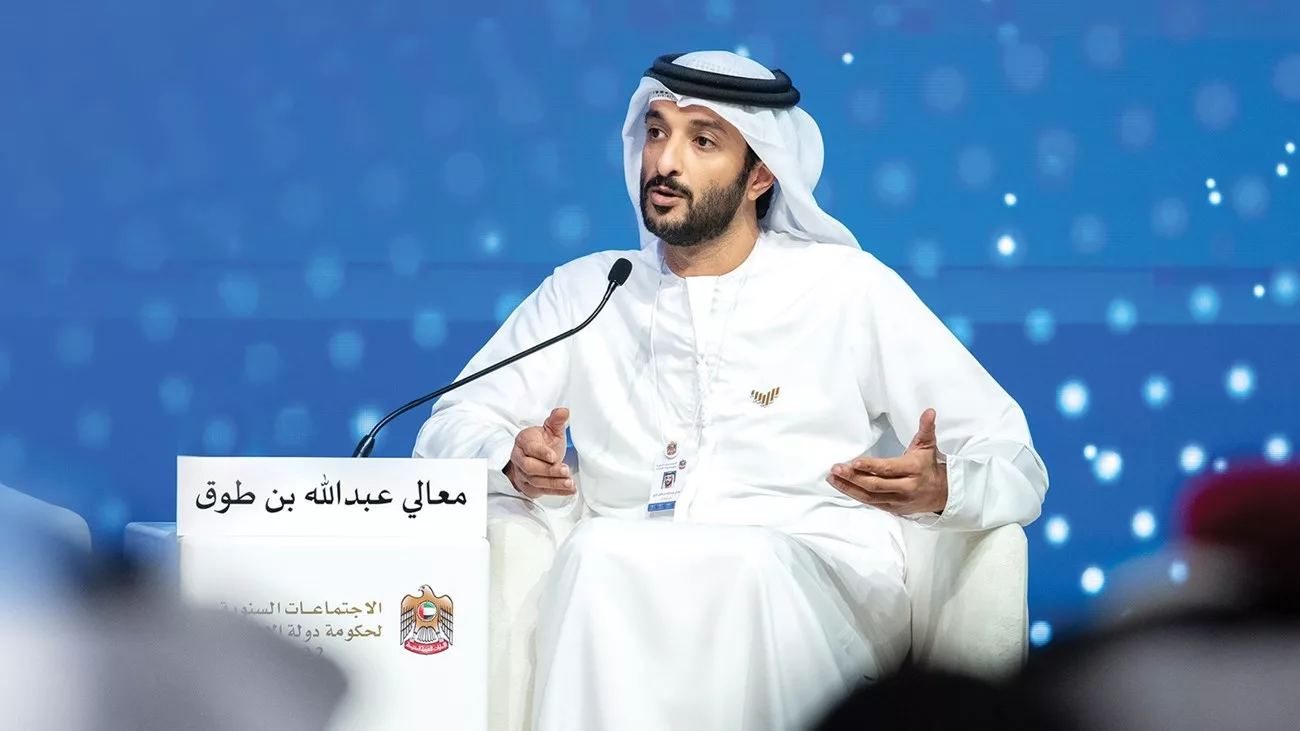
At the heart of this vision stands Abdullah bin Touq Al Marri, Minister of Economy and Tourism, one of President Mohammed bin Zayed’s key lieutenants in executing this strategy. Since assuming office in 2020, Al Marri has been instrumental in deepening the UAE’s presence across Africa through financial tools, investments, and economic partnerships.
Al Marri maintains a close relationship with Mohammed bin Zayed, whom he regards as an exceptional leader who has ushered the UAE into a new era of global engagement, including normalizing ties with Israel. So, who is Abdullah bin Touq Al Marri—the man who has, in just a few short years, become a cornerstone of Emirati foreign policy and a key architect of the UAE’s growing influence in Africa?
Bin Zayed’s Man in Africa
In less than five decades, the UAE has transformed from a fledgling state emerging from British protection in the 1970s into a quasi-imperial regional power. Using a combination of political, economic, and military tools, it has been redrawing the geopolitical map of the Middle East and Africa.
Central to this transformation is a calculated geopolitical strategy focused on controlling maritime trade arteries and logistics hubs. Abu Dhabi has prioritized a firm grip over ports surrounding the African continent from the Red Sea in the east to the Atlantic Ocean in the west in a bid to dominate global trade routes and leverage them as potent instruments of geopolitical influence.
Two primary actors lead this expansion: the Abu Dhabi Ports Group, owned by the Abu Dhabi Developmental Holding Company (ADQ), which concentrates on the Red Sea; and DP World, the Dubai-government-controlled operator of ports and free zones (FZE), which focuses on the Horn of Africa and key Indian Ocean entry points.
However, the last five years have marked a significant shift. The UAE is no longer content with merely controlling port infrastructure. It has moved deeper into the African mainland, penetrating sectors such as trade, tourism, technology, and economic development. This signals a recalibration of soft power tools aimed at consolidating Emirati influence.
Within this context, Al Marri has succeeded in positioning Abu Dhabi as one of Africa’s most important strategic partners. Under his tenure, UAE investments on the continent soared from approximately $60 billion in 2019 to over $110 billion in just four years, making the UAE the fourth-largest global investor in Africa after the United States, China, and the European Union.
Economy as a Soft Power Weapon
Abdullah bin Touq Al Marri has faithfully implemented Mohammed bin Zayed’s vision for Africa, unlocking the UAE’s financial arsenal to deepen partnerships and build bridges with African governments, many of which struggle with fragile economies.
The “UAE-Africa Tourism Investment Summit 2025,” held in October 2025, is the latest manifestation of this ambitious strategy. More than 100 projects worth $6 billion were unveiled in collaboration with 20 African countries, aiming to create around 70,000 jobs. The focus centered on clean energy and tourism two of the five pillars of sustainable development.
But Al Marri’s efforts haven’t been confined to economics. He has forged diplomatic alliances through economic initiatives with nations like South Africa and Burundi, fostering collaboration in renewable energy and tourism. This has positioned the UAE as a developmental partner capable of expanding influence without direct military engagement.
Tourism, renewable energy, infrastructure, logistics, and real estate have become key pillars of this strategy. Notable projects include the $200 million Bilene Hotel Resort in Mozambique, the Muyuni Beach Resort in Kenya, and the Kempinski Hotel in the Comoros.
In South Africa, flagship ventures like the Pearl Valley Golf Estate and the Shamwari Game Reserve developed by Leisurecorp exemplify the UAE’s deepening presence on the continent through a visible and growing development footprint.
Over the past five years, under Al Marri’s leadership, the UAE has expanded its political and economic reach across more than 20 African nations from Angola and Nigeria to South Africa and Zimbabwe projecting itself as a borderless Emirate that champions investment, development, and opportunity on the African continent.
Tel Aviv’s Ally
Al Marri has also emerged as a leading proponent of deepening UAE-Israel relations, becoming the second most prominent figure behind the normalization push—not only in his role as Minister of Economy, but also as a principal backer of the Abraham Accords and Mohammed bin Zayed’s broader strategy of regional integration through cooperation with Israel.
In October 2020, Al Marri was part of the first official Emirati delegation to visit Israel following the signing of the Abraham Accords the previous month. He described the agreement as “remarkable,” emphasizing the economic and trade opportunities it offers.
Since then, he has overseen dozens of agreements, most notably the Comprehensive Economic Partnership Agreement (CEPA) signed in May 2022, which aims to boost bilateral trade to $10 billion annually within five years. The deal removes tariffs on 96% of goods and increases investments in advanced technologies aligning with the UAE’s vision for a diversified, sustainable future economy.
Al Marri’s role extended beyond signing deals. He launched joint summits and investment initiatives, framing the Abraham Accords as a platform for collaboration across health, agriculture, space exploration, and more. Direct flights were expected within weeks, with Al Marri asserting that this alliance would “help preserve regional security,” and hinting at North African countries joining the fold.
In a candid interview with Israel’s Globes newspaper after the official White House signing ceremony, Al Marri made clear that the Palestinian issue was not a direct priority for Abu Dhabi. He argued that economic and trade advancement should precede political concerns, signaling a paradigm shift in regional diplomacy.
He even revealed his involvement in economic mediation efforts to persuade the Palestinian Authority to normalize ties with Israel, stressing that peaceful commercial relations had always been a catalyst for peace. He encouraged Palestinian business leaders to take the lead, expressing hope that Ramallah’s government would eventually follow suit.
A Graduate of the UAE Government Leadership Program
Born in 1982, Abdullah bin Touq Al Marri holds a bachelor’s degree in civil engineering from the University of Sheffield (2005). A graduate of the UAE Government Leaders Program and the Mohammed bin Rashid Centre for Leadership Development, he launched his career in the Prime Minister’s Office in 2007, where he rose to Executive Director and interim CEO.
He also served on the board of the Dubai Future Foundation, an initiative aiming to transform the emirate into a future-oriented city.
In October 2017, Al Marri was appointed Secretary-General of the UAE Cabinet, where he played a key role in shaping national strategies such as Vision 2021 and the UAE Artificial Intelligence Strategy. He also established the Legislative Lab, a platform for creating a trustworthy legislative environment a topic he spoke about at EmTech MENA in 2019.
In July 2020, Al Marri became Minister of Economy under the newly formed cabinet. He also chairs the General Civil Aviation Authority, the Securities and Commodities Authority, the UAE Investors Council, and the Board of Trustees of the National CSR Fund.
That same year, his name was included in the “Agile 50” list by the Apolitical platform, honoring him as one of the most influential figures in government transformation particularly for his work on legislative innovation and bridging the gap between local and federal authorities.
Today, he is widely regarded as one of the key architects shaping the UAE’s economic and developmental future.
Al Marri has thus transcended the traditional role of economy minister, emerging as a principal enabler of Mohammed bin Zayed’s African strategy marrying economic might with diplomatic finesse to drive Abu Dhabi’s soft power expansion through sustainable investment and long-term partnerships.
At the same time, he stands as a prominent symbol of normalization with Israel, embodying Bin Zayed’s vision of expanding regional influence by building bridges with Tel Aviv.
Abdullah bin Touq Al Marri now ranks among the most prominent figures driving the UAE’s presence in both Africa and the wider region a living example of how economic interests can become powerful tools of geopolitical influence, even at the expense of pan-Arab, Islamic, or nationalist foundations.