At dawn on November 27, 2024, western rural Aleppo resembled a heart bracing for a major convulsion: a thin mist hovering over the hills, intermittent booms of artillery that people had grown used to until they became part of the ambient noise of life and a city that learned to wake not to a weather forecast but to news of bombardment.
No one, that morning, imagined that the next eleven days would bring down a regime that had governed Syria for more than half a century.
Just eleven days later, Syrians held their breath at the sight that froze them: the state television screen uttered a phrase that for a decade had seemed closer to fantasy than fact: “The great Syrian revolution has triumphed and the Assad regime has been toppled.”
Leading Arab and international newspapers and networks circulated images of fighters entering the Umayyad Square in Damascus, while reports converged on the escape of Bashar al‑Assad to Moscow, and the fall of the capital without a battle worthy of a security machine that built its myth on fear.
What to many looked like a fleeting headline in a news scroll “Operation Deterring the Aggression” was, in reality, the culmination of an immense system of unseen details and entire worlds woven in silence, to produce a single outcome that everyone heard in three words while the rest of the sentence was written on the faces of the fighters, in war plans, and in operation rooms too remote for cameras.
From Defeat to Initiative
To understand how Syria reached that moment, we must go back to 2020. Back then, following the regime’s final campaign (with its allies) on Idlib, the Syrian revolution seemed to have reached its nadir: new territories lost, another wave of displacement, and a heavy sense that the balance of power had decisively tipped in favor of the regime backed by Russian air power and Iranian militias.
In those bleak days, many spoke of “the end of the revolution.” But inside narrow rooms in Idlib and the Aleppo countryside, a different conversation was unfolding among Ahmad al‑Shar’ (Abu Muhammad al‑Jolani), Marhaf Abu Qusra (Abu al‑Hasan 600), and a small circle of military and political leaders: should they continue as a fragmented chain of competing factions, or reinvent themselves as a unified system in the face of this existential moment?
Marhaf Abu Qusra now defense minister recounts in one of his later interviews that the post‑2020 moment constituted an outright confrontation with chaos: overlapping factions, multiple flags, and a fragmented military decision‑making process.
He recalls that the consensus from those discussions was stark: either build a single army under a clear central command, or allow these entities to dissolve gradually under the pressure of time and adversaries.
Thus began the restructuring plan: establishing a unified command center that would bring together Hayyat Tahrir al‑Sham, Ahrar al‑Sham, factions from the National Front for Liberation, and some units of the National Army under one operational room empowered to make the strategic decisions of war and peace.
They also founded military and policing academies with professional training, assigning police forces to internal security, and dedicating military forces to preparation and combat so that factions could focus on the enemy rather than policing cities. In doing so, they laid the foundation for a more disciplined, less factional army.
The primary objective was clear: transform the liberated zones and their factions from a “rebellious geography” into a fighting system with a brain, executing limbs, and a backbone capable of carrying the battle if the moment came.
These four years of preparation were not slogans or speeches. In practice, they were a silent war to build what leaders now call “solid combat capability” an effectiveness not shown in photographs of flags or patriotic chants, but in underground cables, communications equipment, ammunition depots, and evacuation routes for the wounded from front lines.
The first of those battles was the battle for organization: a unified command center in Idlib operating around the clock, linking fronts from the countryside of Latakia to the outskirts of Aleppo and Hama. Secure communication channels resistant to jamming and eavesdropping were established, using encryption systems partly improvised locally and partly adapted from Turkish and Western experience while cadres were broadly trained to use them.
Field commanders of brigades and sectors were granted wide autonomy, under the guiding principle later articulated by Ahmad al‑Shar’: “One strategic decision but at the moment of engagement, he who sees the enemy with his own eyes, not the one who sees him on the map, decides.”
“Al‑Shaheen”: Eye of the Battle and Its Wing
In all previous wars, control of the sky was the decisive factor. Since 2015, the equation was simple and ruthless: whoever had air superiority dictated the tempo of the battle on the ground. Russian strikes over Aleppo, Ghouta, Daraa, and eastern and southern rural Idlib taught everyone that lesson in the loudest possible manner.
But from around 2021, something different began taking shape above the fronts: the sky was no longer closed, though it wasn’t equal either. Gradually, small locally-made aircraft called “Al‑Shaheen” appeared on the scene.
They began as reconnaissance drones, then evolved into precision-strike platforms eventually turning into a modest aerial arm of war, poor in resources, but effective enough to reshape the balance on the ground when needed.
Against this backdrop, when “Operation Deterring the Aggression” was launched, it didn’t emerge in a vacuum: the fighters were supported by an integrated network of electronic and human reconnaissance that had been primed for years.
Specialized units amassed intelligence on the regime’s structure in the north and center: these included a target bank of operations rooms, ammunition stores, air-defense sites, supply routes, and airports.
These maps were continuously updated by blending ground reconnaissance (agents near contact lines) and aerial reconnaissance via “Al‑Shaheen,” while small electronic units intercepted wireless communications, tracked movement of convoys and assessed where defense lines were thinning or collapsing.
In repeated briefings, Colonel Hussein Abdul Ghani the military spokesman and one of the most prominent voices of the campaign emphasized that “Deterring the Aggression” was not a blind battle; it was an operation built on preexisting and precise intelligence about the regime’s vital nerves where it feeds and where it could be strangled at minimal cost, both human and strategic.
In this way, “Al‑Shaheen” merged with reconnaissance and intelligence units, making the sky for the first time in years part of the battle on behalf of the revolutionary forces, under a new doctrine that viewed technology as a way to compensate for the vast disparity in conventional air power.
The course of the battle across eleven days
The first day of “Deterring the Aggression” did not begin with the first shell landing on western rural Aleppo; it began days earlier, far from the front lines. In those cold days preceding November 27, five young men entered Aleppo wearing the same military uniform as regime forces. They moved like patrol units, passing through the same checkpoints — but they weren’t part of the regime’s army. They were part of the plan to dismantle its backbone.
Multiple accounts and later testimonies describe these men today named across revolutionary platforms as “the Five Martyrs Commandoes” each assigned to a specific operations room, provided with precise coordinates, information about the number of officers and soldiers inside, and the location of each within the regime’s command network.
In the early hours of dawn, four command centers of the regime and its allies were simultaneously struck: security and military operations rooms around Aleppo, the most dangerous target being the Iranian-run operations center that coordinated Tehran’s direct presence in the north.
There, the commander of the Iranian Revolutionary Guard Corps in Aleppo known as “Hajj Hashem,” real name Keyumarshtpour Hashemi was killed. He was one of the principal Iranian military advisors in Syria and the head of the militia network linked to Tehran around Aleppo, as confirmed by Iranian news agencies and international channels.
This strike didn’t just target a building it disabled the “eye and mind” the regime and its allies used to survey the northern front, plan, and respond to military developments. In the hours that followed, as news of Hajj Hashem’s death spread through Iranian media as “martyrdom during an advisory mission,” units of “Deterring the Aggression” opened main attack axes around Aleppo: the western countryside, then the southern countryside combining concentrated artillery fire with “Al‑Shaheen” strikes on the most fortified defensive nodes.
According to field commanders interviewed after the battle, the original plan was for “Deterring the Aggression” to be an Aleppo‑first campaign: a year or more of gradual work to liberate the countryside, encircle the city, and then take it in stages. What happened on the ground, however, outpaced the plan.
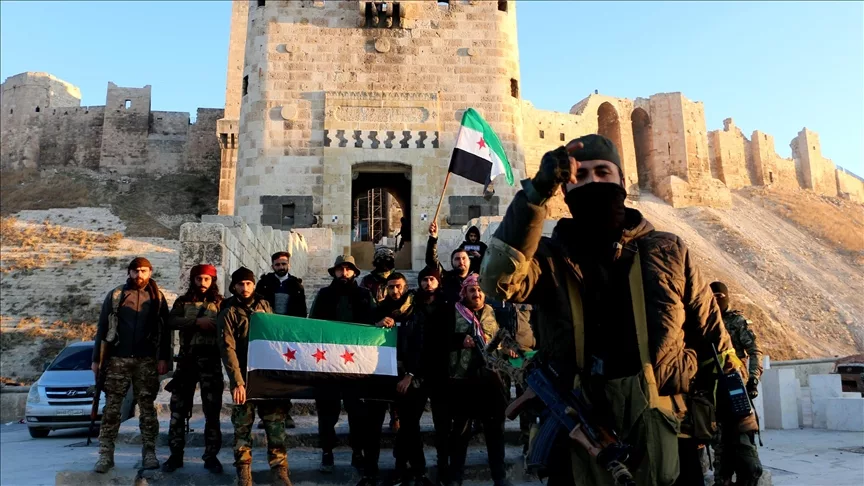
In less than 48 hours, units under the military operations room reached the outskirts of the Citadel of Aleppo one of Syria’s largest and most historic cities and images of fighters at its walls began spreading across social media and news agencies.
By November 29, Aleppo appeared to be rewriting a chapter of its history; the city that had once been besieged and bombarded for years was now being confronted from the opposite direction: “Deterring the Aggression” forces entered its western districts with no heavy urban warfare, and the regime lost control of its northern stronghold faster than allies or enemies could fathom.
Subsequent field reports noted that regime units “fled their positions” in rural Aleppo and Idlib and withdrew southward without significant fighting marking one of the fastest collapses the front lines had witnessed since 2011.
The moment when the forces of “Deterring the Aggression” entered western Aleppo districts, the leadership faced two choices: allow the city to bask in the euphoria of victory, as in previous experiences complete with the chaos that often followed or transform Aleppo into a “model” for what liberated cities might become.
They chose the second path. Within hours, local police patrols appeared in uniform, some civil institutions re‑opened under the supervision of professional committees, schools resumed under temporary schedules, and judges and lawyers were dispatched to restart courts.
Ahmed al‑Dalati recounted in one interview that the Aleppo moment was the definitive test of the “model liberation” concept: when the city did not descend into chaos, but quickly stabilized under disciplined administration, they realized that what had been discussed behind closed doors could live on the ground not as rhetorical luxury, but as practical reality.
As the regime’s army continued to collapse on most fronts, a question arose in the operations room: would the battle stop at Aleppo, as planned on paper, or would they exploit the state of collapse to push further?
Events answered unequivocally. With each passing day, the regime’s map shrank without significant defensive battles until it attempted a “last stand” around Hama. There, on Mount Zayn al‑Abidin overlooking the city, it tried to gather its remaining elite units and local militias to draw a new defensive line stopping the advance of “Deterring the Aggression” northward and toward the center.
Over days, the mountain became a heavily fortified fortress: artillery positions, concrete bunkers, trenches, and repeated counterattacks aimed at halting the momentum of the campaign through attrition.
Fierce fights broke out on the slopes, where the regime used nearly all its remaining heavy ammunition while the “Deterring the Aggression” units relied on a combination of “Al‑Shaheen” strikes, supply route interdiction, and small assault teams digging their way upward.
Night after night, counterattacks weakened until one dawn when revolutionary flags rose atop Zayn al‑Abidin the mountain long emblematic of the regime’s might now becoming a living testament to its collapsing will.
From that moment, the path to Hama no longer seemed a distant dream, but a road paved with tears and memories; a city whose name was whispered more often than spoken, as if Syrians feared calling forth the specter of 1982 every time they spoke it.
And when the front opened toward it this time, many felt they were pursuing not a strategic goal on a map, but an old wound finally breathing again after decades.
That is why the liberation of Hama was not merely a military step, but also a symbolic event: the city which, for decades, stood as a monument to silent massacres became this time the stage for images of fighters by the ancient water-wheels (nawa‘ir), chanting for a city that for once broke free of the 1982 shadow pressing on its chest.
After Hama, the road opened toward Homs. There too the pattern repeated: regime units retreated more than they fought, as “Deterring the Aggression” advanced into the city and its countryside. On December 7, the operations room announced full control over Homs and its main prison, alongside the liberation of key towns in northern and western rural Damascus.
Simultaneously, in the south another front awakened. Factions belonging to the “Southern Operations Room” formed by groups that had recently shed their “settlement” identity in Daraa and Quneitra, alongside military units from As-Suwayda seized control within days of dozens of checkpoints and towns, stretching from Daraa al-Balad to the Nasib border crossing. This came in clear coordination with the “Deterring the Aggression” room in the north.
Suddenly, regime forces found themselves caught in a vast vice: from the north, “Deterring the Aggression” advancing through Aleppo, Hama, Homs; from the south, southern factions regaining the initiative after years of forced subjugation under reconciliation or ceasefire deals.
Although Damascus was theoretically the last red line, events leading up to December 8 indicated that in reality this line had long since been ineffective: identical field and human rights reports spoke of mass withdrawals without notable combat in Hama, Homs, and rural Damascus, and of collapse in will rather than a decisive defeat after the final defensive line at Mount Zayn al‑Abidin fell.
On the dawn of December 8, vanguards of “Deterring the Aggression” entered Damascus from multiple axes, amid limited clashes considering the size and complexity of the capital.
Many units of the regime’s army and security apparatuss chose withdrawal or localized deals rather than engage in a losing urban war.
By morning, images flooded in: toppled statues, empty checkpoints, and revolutionaries roaming squares long held as symbols of state control.
That evening, the scene that would embed itself into the memory of Syrians unfolded: the Great Umayyad Mosque thronged not with passing worshippers, but fighters, activists, and civilians who came to see with their own eyes what they had long been told was impossible.
There, Ahmad al‑Shar’ known to Syrians for years as Abu Muhammad al‑Jolani stood not as a besieged commander of a “pocket” but as the victor who had turned the capital on its head.
He spoke firmly, reminding Syrians that they were the true owners of the country; that this victory had not been gifted but paid for with years of pain and displacement he spoke of those who drowned at sea, those who slept in tents then delivered a line captured by headline writers: “A new history is being written.” But forging the new Syria, he warned, would be “arduous work,” demanding long effort, not a fleeting euphoria.
Media coverage of his speech summarized the main messages in two clear points: no revenge, and Syria belongs to all Syrians. The speech closed a chapter of vengeance stretched over decades he stressed that the country would no longer be run under a dominant identity that excludes others, but as a state attempting despite stumbles to become a shared home. He publicly criticized Iran’s role that had turned Syria into a sphere of influence, confirming that the era of decisions seized by foreign capitals must end.
In this sense, the eleven days of lightning advance were not merely a series of successive military victories — they were the practical conclusion of four years of restructuring and preparation, tested for the first time in Aleppo, then extended to Hama, Homs, the south, and finally reaching the heart of Damascus. The final result summarizes the whole journey in a single equation: a regime collapsing from within, an army unraveling under the pace of native fighters, and a revolution trying to win its war at the lowest possible cost in blood — aware that the hardest test begins when the guns fall silent.
The Front of Meaning: When Words Joined Arms
All that solid capability built with so much effort would not have reached Damascus’s walls had it not been supported by, in the background, a long-standing work on another front quieter but far deeper: the front of meaning.
For four years, a different narrative for the revolution was being built, and a discourse crafted to explain to people why this fight was being waged, for whom its end was being written, and what shape the victorious force should take.
Since around 2020, Ahmad al‑Shar’s rhetoric gradually shed its heavy ideological load, shifting toward a language more akin to that of a state leader than a faction commander.
In public meetings with civilians and fighters, he adopted a broadly national tone closer to the speech of a political leader than the commander of a besieged group speaking of a united Syria, of people’s right to return to their homes and cities, and promising that the struggle with the Assad regime was not over, no matter how bleak the external scene appeared.
Observers watching from afar called those speeches nothing more than propaganda no match for a reality weighed down by years of battlefield and political defeats, through which Assad was rehabilitated and capitals one by one opened their doors to him.
But in the liberated north, that language quietly accumulated as an alternative narrative, telling people that the revolution had not ended, and what had been lost on the ground could be recovered once the balance of power shifted.
When talk began in fall 2024 of a “last opportunity” to break the equation, the political leadership did not need to invent a new discourse from scratch; “Deterring the Aggression” was already a military name for a moral‑political trajectory that had started years before.
Therefore, when the operation was announced, it was presented from the outset as a defense of the people, not a mere offensive against the regime: a response to the intense bombing of Idlib and rural Aleppo, an attempt to stop the bleeding of displacement rather than a militaristic crusade in search of empty glory.
The tone remained the same as in years of losses: calm, confident, sparsely rhetorical more focused on crafting measured sentences that people could cling to for hope thus opening a wider margin of sympathy for the operation inside Syria and across the diaspora.
On the ground, that discourse did not remain ink on paper. In every area where frontiers changed, units from a “Civil Relations Department” marched alongside military convoys sometimes preceding them into towns and villages.
They would meet with community elders and notable families, reassure residents that there would be no lists of vengeance or collective retribution, and that houses were not spoils of war.
In neighborhoods where fear had long outlasted the revolution, these units labored to dismantle decades of humiliation: explaining that the aim was to return the state to the people, not replace one tyranny with another.
As one of the campaign leaders, Ahmed al‑Dalati, summarized in a recorded interview: the goal was not “liberating Syria by gunfire” in the classical sense of destroying cities over their inhabitants but “liberating it through example”: through the conduct of fighters, through the ethics of victorious power before its slogans.
Behind this civil-front, another front worked no less brutally: the political front. Throughout the days of “Deterring the Aggression,” a parallel operations room managed political affairs, issuing statements almost as quickly as military convoys moved sometimes even before them.
In the first two days alone, a series of declarations explained to the world and to Syrians alike why the operation was triggered: not as a new war of expansion, but as an attempt to stop bombing in the northwest, open a path for the displaced to return, and a direct appeal to foreign journalists and media to come see with their own eyes what was happening. That was followed by a clear message to the international and Arab community and influential states.
Inside Syria, the discourse was not addressed to a single “street,” as regime propaganda had long reduced the opposition to. Messages were carefully distributed along the social fabric: statements targeted at Kurdish residents in liberated Aleppo districts, reiterating reassurance; measured words sent to the families of Al-Salamiyah and Alawite residents in rural Hama, urging them to stay in their homes and not be lured into being fuel for another slaughter, emphasizing that the revolution did not view them as an existential enemy but part of a unified national tapestry.
Civil‑relations teams appeared in districts such as al-Sulaymaniyah and al-Aziziyeh in Aleppo after liberation, roaming streets and cafés, visiting homes, listening more than speaking, then rephrasing the political message in the language of people, not in dry bureaucratic statements.
Externally, the threads of the discourse extended beyond borders. Statements in Arabic and English were sent to hesitant capitals and traditional adversaries alike: messages assuring Ankara the fighting would not spiral into border chaos and expressing readiness of the new leadership to cooperate on security and refugee issues. Other messages nodded to Washington, suggesting a new partner to engage with on missing persons, detainees, and border control.
Even toward Moscow whose name had for years been synonymous with the barrel bombs raining on Syrian cities a statement was released condemning its bombardment, yet simultaneously offering a different opening: the revolution was not against any people or country including Russia and its interests in Syria should not forever depend on the person of Bashar al‑Assad, but on the Syrian people, their history, and future; if Russia chose to side with them, it could become a partner in building a free Syria, not a protector of a fallen tyrant.
In this way, the Political Affairs Directorate became almost like a “ministry of foreign affairs under fire”: releasing contact numbers for foreign missions and foreign media teams in Aleppo to ensure their safety, affirming protection of consulates and diplomatic premises, and gradually announcing which countries were resuming embassy work in Damascus after Assad’s fall in a scene that had until recently been entirely under regime control.
Behind the scenes, Asaad al‑Shaybani the man who established that department years earlier was reaping the fruits of long-term diplomacy with foreign diplomats and United Nations representatives, transitioning from architect of the “political front” to foreign minister in the new state.
On the other side of the scene, the “media front” worked as the operational shadow of these efforts. A centralized media room coordinated between warfront correspondents and official accounts; a single military spokesman conveyed the narrative instead of hundreds of conflicting voices that had weighed down the revolution in its early years; news teams raced to release footage before rumors could consolidate into “facts” in people’s minds.
Every time a unit took control of a town or position, a short video preceded the official communique reaching Syrian viewers at home and abroad even before the regime’s media apparatus could spin its counter-narrative.
With all this accumulation, for the first time since the uprising began, there appeared a real harmony between gun, political discourse, and imagery: what was declared in military operations room statements found its echo in political declarations for domestic and international audiences, and materialized in real life through civil and war media in multiple, consistent voices.
Neither the military commander promised empty things, nor did politicians engage in denial, nor did media exaggerate on top of both. Instead, a unified language emerged in many voices, trying to tell Syria and the world at once: that what happened was a moment in which the revolution sought not only to change who ruled Syria, but the way Syria’s story is told to its people and to the world.
Between “Deterring the Aggression” and “Deterring Collapse”: What Lesson Remains for Syria?
The battle of “Deterring the Aggression” was not a miracle that fell out of the sky, nor simply an automatic collapse of an oppressive regime eaten by its internal contradictions. It was above all the convergence of a rare alignment: methodical, far‑sighted preparation that restored revolutionary forces’ organizational mind after years of chaos; real battlefield courage built on genuine combat capability.
Not fleeting enthusiasm; a historical moment when the regime’s allies withdrew and its army decayed to the point it was vulnerable to a focused strike; and a national narrative that sought as much as possible to frame the victory in the context of state-building, not revenge.
Yet perhaps the hardest lesson is not about the collapse of the regime itself, but what comes after. For Syria which managed to overthrow decades-old security apparatus in eleven days the challenge ahead is far longer: dismantling its legacy from minds, institutions, and the relationships between its components.
“Deterring the Aggression,” in that sense, was an end to one battle and the beginning of a test: can the forces that engineered the overthrow also succeed in engineering state-building?
Can the “model liberation” mentality that began in the streets of Aleppo extend to all of Syria so that domination by force no longer prevails, but a national contract guaranteeing everyone’s place?
That remains the open question that will determine whether the history written in the Great Umayyad Mosque in December 2024 marks the true beginning of a new era or just another chapter in a long Syrian story whose final line is yet unwritten.