

Over the past year, Turkey and Qatar have played a prominent political and diplomatic role in accompanying the “Deterrence of Aggression” operation, launched in a region governed by complex international understandings particularly between Ankara and Moscow. This has made the political dimension inseparable from the military course and field developments of the campaign.
Neither country’s involvement in Syrian affairs is new, nor was it limited to this battle. As Syria’s closest neighbor, Turkey has long been one of the revolution’s main backers and a host to millions of refugees despite its recent steps toward rapprochement with the regime prior to the operation. Meanwhile, Qatar has consistently upheld its 2011 position: backing the revolution and refusing to restore ties with Bashar al-Assad.
This report examines the roles of Turkey and Qatar during the “Deterrence of Aggression” operation, from November 27 to December 8, 2024, and assesses their impact on a campaign that culminated in the collapse of the Assad regime.
Syrian military officials from the “Military Operations Directorate” emphasized that the decision to launch the operation was entirely Syrian, with preparations starting from scratch and no regional or international support involved.
Ankara: Monitoring and Minimizing Losses
Turkey wields significant influence in northern Syria, reinforced by three major military operations carried out in coordination with the Syrian National Army (SNA) against the Syrian Democratic Forces (SDF): Operation Euphrates Shield in 2016, Olive Branch in 2018, and Peace Spring in 2019.
These were accompanied by ongoing targeted strikes against PKK leadership, military facilities, vital infrastructure, and sources of income and energy.
As of July 2024, Turkey had established 126 military positions in Syria: 58 in Aleppo countryside, 51 in Idlib, 10 in Raqqa, four in Hasakah, two in Latakia, and one in Hama, according to the Jusoor Center for Studies.
Under the umbrella of the “Military Operations Directorate”—which included factions such as Hay’at Tahrir al-Sham, Jaysh al-Izza, and other SNA groups—the “Deterrence of Aggression” campaign began with the aim of striking regime and militia positions and facilitating the return of displaced Syrians. The operation quickly escalated and expanded, eventually toppling the regime.
From the outset, Ankara appeared to give the operation a “green light,” signaling tacit approval. However, initial Turkish statements reflected surprise and caution. On the day after the operation began, Turkish authorities said they were closely monitoring developments in Syria and taking necessary precautions to protect their forces.
Two days later, Middle East Eye quoted a senior Turkish security official stating that the opposition offensive aimed to stop regime attacks on civilians and restore the boundaries of the 2019 Idlib de-escalation zone. Yet the campaign soon exceeded those limits as opposition forces advanced and captured new towns and cities.
On the third day of the campaign, Turkish-backed SNA factions launched “Dawn of Freedom” against regime forces and the SDF, seizing key areas including Tell Rifaat and Manbij. The operation was later halted amid mutual accusations between Turkey and the SDF of undermining a ceasefire agreement.
As opposition forces gained control over more towns and cities, Turkish statements intensified alongside increased diplomatic activity, particularly with Moscow, Tehran, and other parties involved in the Syrian file. Key Turkish statements during the campaign include:
-
Dec. 2: Foreign Minister Hakan Fidan warned against interpreting the Syrian developments as foreign intervention, stressing Turkey’s opposition to further escalation.
-
Dec. 3: President Erdoğan, in a call with Russian President Vladimir Putin, emphasized the need to create space for diplomacy and urged the Syrian regime to engage in a political process, reaffirming Turkey’s commitment to Syria’s territorial integrity and a “just and lasting solution.”
-
Dec. 5: Erdoğan told UN Secretary-General António Guterres that Syria had entered a new phase and expressed hope for stability, avoiding further civilian losses.
-
Dec. 6: Erdoğan stated, “Idlib, Hama, Homs and of course, the ultimate goal is Damascus. The opposition’s march continues. We hope it proceeds without incident.”
-
Dec. 8: Fidan reiterated Turkey’s commitment to Syria’s unity, sovereignty, and territorial integrity, revealing ongoing contact with U.S. counterparts and urging all actors to exercise restraint to avoid regional destabilization.
-
Dec. 15: Fidan confirmed that Turkey had not participated in planning the operation and had worked to support Hay’at Tahrir al-Sham’s initiative without bloodshed.
A Three-Phase Turkish Approach
Turkey’s evolving response from official statements to diplomatic outreach followed a clear trajectory. While Ankara repeatedly denied involvement or planning, Syrian commanders emphasized the operation was a fully domestic initiative, built on local capabilities developed since 2020.
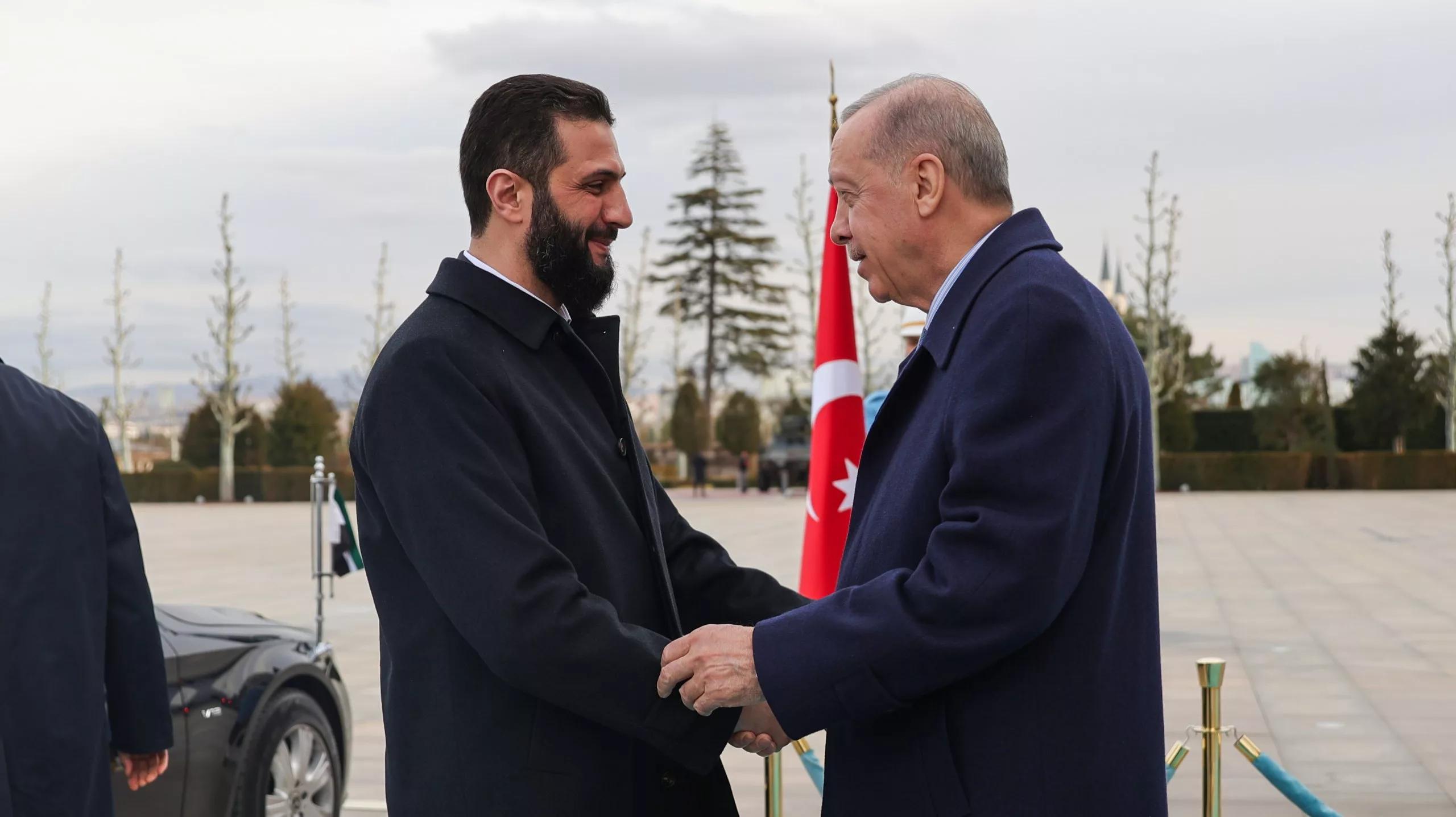
Turkey was the first country to re-establish diplomatic contact with Damascus after Assad’s fall, with senior officials led by Intelligence Chief İbrahim Kalın visiting the capital on December 12, 2024 the first official Turkish visit since Foreign Minister Ahmet Davutoğlu’s trip in 2011.
According to Osama Sheikh Ali, analyst at the Omran Center for Strategic Studies, the surprise element of the campaign underscored its Syrian origins, catching regional and global powers off guard especially after opposition forces entered Aleppo. He outlined Turkey’s position in three distinct stages:
-
Initial Phase: Marked by caution and close observation, Ankara stressed stability and preventing escalation, wary of disrupting the Astana process or ties with Washington. It was also concerned about potential new waves of refugees.
-
Expansion Phase: Following opposition advances into southern Idlib and Hama, Turkey intensified its diplomatic outreach to Arab and regional capitals to assess the operation’s limits and prevent broader clashes. Ankara facilitated indirect communication between the operations room, Russia, and other key actors to reduce escalation risks.
-
Final Phase: As regime collapse became imminent, Turkey engaged more deeply in the political track, dispatching high-level officials to Damascus and strengthening ties with HTS. This helped solidify military leadership and avert a political vacuum.
Sheikh Ali concludes that Turkey’s role was crucial in ensuring the success of the campaign by limiting its duration, avoiding internationalization, and neutralizing foreign powers especially Russia.
It also provided early regional acceptance and helped legitimize the new local administration by enabling dialogue between exiled opposition leaders in Turkey and field commanders, thus minimizing the risk of internal fragmentation after Assad’s fall.
Qatar’s Constructive Role
During the “Deterrence of Aggression” operation, Qatar played an active role through a series of high-level meetings and calls with key actors in the Syrian file. Notably, Foreign Minister Sheikh Mohammed bin Abdulrahman Al Thani held talks with counterparts from Turkey, Jordan, and Iran to discuss Syria’s fast-evolving landscape.
Qatar consistently reiterated its call for a political solution based on international legitimacy that fulfills Syrians’ aspirations and preserves the country’s sovereignty.
As opposition fighters approached Damascus, attention turned to Doha, which hosted an extraordinary meeting of the Astana guarantors Turkey, Russia, and Iran on December 7, 2024.
Though the final statement echoed standard positions maintaining Syria’s unity and de-escalating militarily its timing was significant. Observers noted the meeting provided a political platform that helped prevent disruption to the campaign, thanks in part to Qatar’s proven ability to manage complex negotiations, including its role in facilitating talks between the U.S. and the Taliban.
A turning point came with Qatari Emir Tamim bin Hamad Al Thani’s visit to Damascus on January 30 his first since Assad’s fall, and the first by any Arab leader. The visit underscored Qatar’s longstanding support for the Syrian people over the past 14 years.
Wail Alwan, political analyst at the Jusoor Center, told Noon Post that while the decision to launch the campaign was fully Syrian, there was genuine fear among some diplomats that Idlib could face a fate similar to Gaza or that Russia might retaliate forcefully.
However, opposition leaders saw a historic opportunity and concluded that remaining in a constant state of attrition was no longer viable especially after observing that the regime had lost key pillars of power it had relied on since 2015.
According to Alwan, the regime collapsed far faster than expected, prompting the liberation of Aleppo and further advances. This rapid downfall convinced many that the opposition was serious about broader liberation goals, not mere rhetoric.
The turning tide prompted regional and international actors to reassess their assumptions: the prior bet on Assad’s stability had failed, and normalization efforts had not restored Syria’s place in the Arab world or global order.
Alwan believes the Turkish and Qatari interventions particularly after the battle began were instrumental in supporting the revolutionaries and reducing losses through diplomatic mediation with former regime allies, especially Russia.
This constructive involvement facilitated Assad’s exit as opposition forces entered Homs, enabling Damascus and its suburbs to fall without major bloodshed or confrontation.