

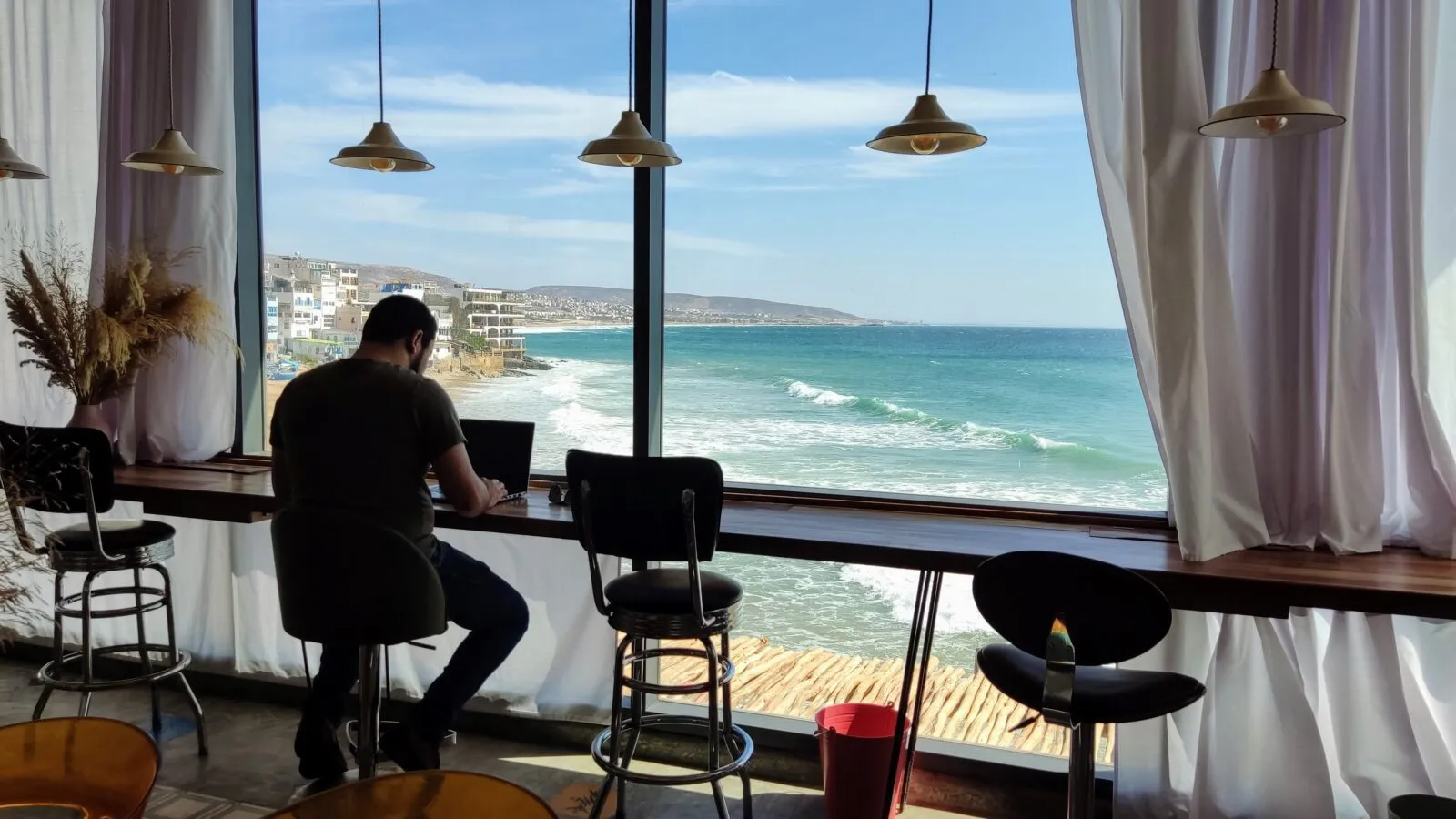
For years now, North African societies have been undergoing profound social and economic transformations, reflecting a shift in how a new generation of youth envisions work and success. Ambitions among young people across the region are moving away from the traditional view of public sector jobs as the ultimate safe and stable career path.
This generation, raised in a digital world, no longer sees government employment as the end goal. Instead, they increasingly aspire to digital freelancing as a viable alternative that offers respectable income especially in the face of structural labor market crises, high unemployment rates, the dominance of informal employment models, and a minimum wage that lags far behind rising living costs.
This shift is the result of regional adaptation to global changes in the labor market, the rise of online self-education, and the growing importance of digital skills as tools for economic empowerment. The post-COVID-19 boom in remote work culture has only accelerated these changes.
The Labor Market Reality in the Maghreb
The Maghreb region has some of the highest youth unemployment rates in the world, according to data from the World Bank and the International Labour Organization. In 2023, the average unemployment rate for those aged 15–24 reached 33%, more than double the global average of 14%.
These high figures reflect deep structural imbalances, including weak production diversification and the dominance of the informal sector, which in countries like Tunisia and Algeria can absorb more than half of the labor force.
A report by the UN Economic Commission for Africa highlighted that Tunisia’s youth unemployment rose to 40.5% in 2023, up from 39% in 2019. Morocco has seen modest improvements in 2025, yet still faces alarming levels of labor market fragility: youth unemployment dropped to 35.8% in Q2 of 2025, down from 37.7% in Q1. In 2024, the annual youth unemployment rate stood at 36.7%, with unemployment among university graduates hitting 19.6%.
In Algeria, available data shows youth unemployment at 29.3% in 2024, with female unemployment reaching 25.4% a high figure despite the country recording 3.9% economic growth in the first half of the year. This reveals a persistent gap between economic performance and the labor market’s capacity to generate real opportunities for young people.
These statistics confirm that youth unemployment remains one of the region’s most pressing challenges. Despite their varied economic structures, Maghreb countries share a common feature: labor markets that are ill-equipped to absorb young talent.
This fragility stems not only from a lack of jobs but also from the slow pace of institutional reforms to embrace new paradigms like flexible work, the digital economy, and tech entrepreneurship.
While global economies are adapting education and employment policies to the digital transition, much of the Maghreb’s bureaucratic and educational infrastructure still clings to outdated training and employment models.
The mismatch between youth skills and labor market needs, compounded by the dominance of insecure informal work, continues to widen the gap between young people’s capabilities and the opportunities available to them year after year.
Freelancing as a Lifeline
The shift toward acquiring digital skills mirrors deeper social changes in how Maghreb youth perceive their futures. Confronted with a lack of prospects, this new generation now sees its path forward in self-initiative and adaptability within an evolving labor market.
The digital revolution has given them unprecedented tools to transform their ideas into projects from digital marketing to cross-border e-commerce and global freelancing.
Freelancing has become a flexible and practical alternative to the crisis in traditional employment. For many, it offers higher incomes than local wages particularly when working with international clients. Moreover, the ability to choose projects and clients allows young people not only to sharpen their technical skills but to forge their own unique career paths.
Despite challenges like intense competition and weak legal protections, a growing number of Maghreb youth view freelancing as a more promising and sustainable option than relying on limited and unreliable local opportunities.
In this context, digital employment platforms have emerged as one of the most effective solutions. They act as intermediaries that efficiently bridge gaps between job seekers and employers worldwide. Their ability to do so has made them a vital escape hatch for youth struggling to integrate into the regional labor market.
These platforms draw their appeal from several advantages: they reduce the cost of job searching, provide access to a broader range of opportunities, and enhance labor market transparency through real-time information about supply and demand.
Advanced algorithmic tools help better match skills with available jobs, accelerating market integration particularly in countries where job creation lags.
Studies show that in Algeria, 65% of platform-based workers are aged 20–29, with 80% being male, primarily working in IT and creative design.
In Tunisia, around 120,000 young people rely on freelancing as a primary source of income, benefiting from “the digital revolution and the emergence of artificial intelligence, which has fundamentally changed patterns of production and labor worldwide.”
However, this momentum is not backed by suitable local legislation. Many freelancers complain about strict banking restrictions on foreign currency transfers.
In Morocco, growing economic pressures and the gap between graduate skills and employer demands have made freelancing and digital platforms increasingly seen as viable solutions. A report by Forbes noted that several Moroccan institutions have begun investing in youth training programs focused on digital skills particularly coding and web development as a direct gateway to global freelancing markets.
This indicates that freelancing is no longer just a personal choice but a national strategy pursued by countries facing similar crises, such as Jordan, Turkey, and Iraq.
The report emphasizes that what it calls “the freelancing revolution” is a global phenomenon, not a regional exception. Arab and local platforms have begun emerging alongside global ones, expanding opportunities for freelancers and encouraging businesses to tap into digital talent.
Challenges and Risks
While freelancing offers youth greater autonomy, diversified income, geographic flexibility, and in-demand digital skills, it is not without drawbacks. Studies suggest that around 79% of freelancers report greater job satisfaction compared to traditional employment.
Still, the model carries real risks. A World Bank report titled “Working Without Borders: The Promise and Peril of Online Gig Work” presents a critical assessment of this form of employment. It notes that most freelancers lack a stable income and work under precarious conditions that make saving nearly impossible.
They are also excluded from social and health protection systems issues that are especially severe in low-income countries, where over 90% of workers operate outside any legal or insurance framework.
Given these realities, the World Bank has urged governments to expand social safety nets to include this growing workforce. Several countries have begun implementing initiatives in partnership with digital platforms to integrate freelancers into social security systems.
One notable example is Malaysia, where the government partnered with a freelancing platform to contribute 5% toward the national pension scheme and social protection programs encouraging freelancers to enroll in systems that offer them a minimum level of stability and security.
A Strategic Opportunity for the Region
This shift is not merely a personal coping mechanism for Maghreb youth. It also represents a strategic opportunity for the region itself. Investment in digital infrastructure, modern vocational training, and the regulation of non-traditional work models could help reduce unemployment, curb migration, and cultivate a dynamic workforce that contributes to national growth all while generating significant foreign currency inflows.
However, this trend must be accompanied by comprehensive policies that ensure social protection and balance the interests of both the public and digital sectors.
With the expansion of digital training infrastructure and growing support from both public and private sectors, the future of freelancing in the Maghreb appears poised for further growth offering a promising solution within a broader strategy to correct labor market imbalances and empower a generation seeking new tools for economic inclusion.