Trade routes whether by land, air or sea have constituted the cornerstone of human life since antiquity. For centuries, the majority of global commerce traversed the Silk Road, the Incense Route, the Amber Road, the Horse and Tea Route, and the Amber Route whoever held control over them possessed the keys to geopolitical influence and power, which explains the magnitude of the wars and conflicts revolving around them.
Major powers seek, by controlling trade corridors and routes, to reap political, economic and military gains across the domains of technology, commerce, regional and global influence. In recent years, various projects have emerged in this context, such as the “Belt and Road Initiative”, the “Economic Corridor” and the “Path of Development”.
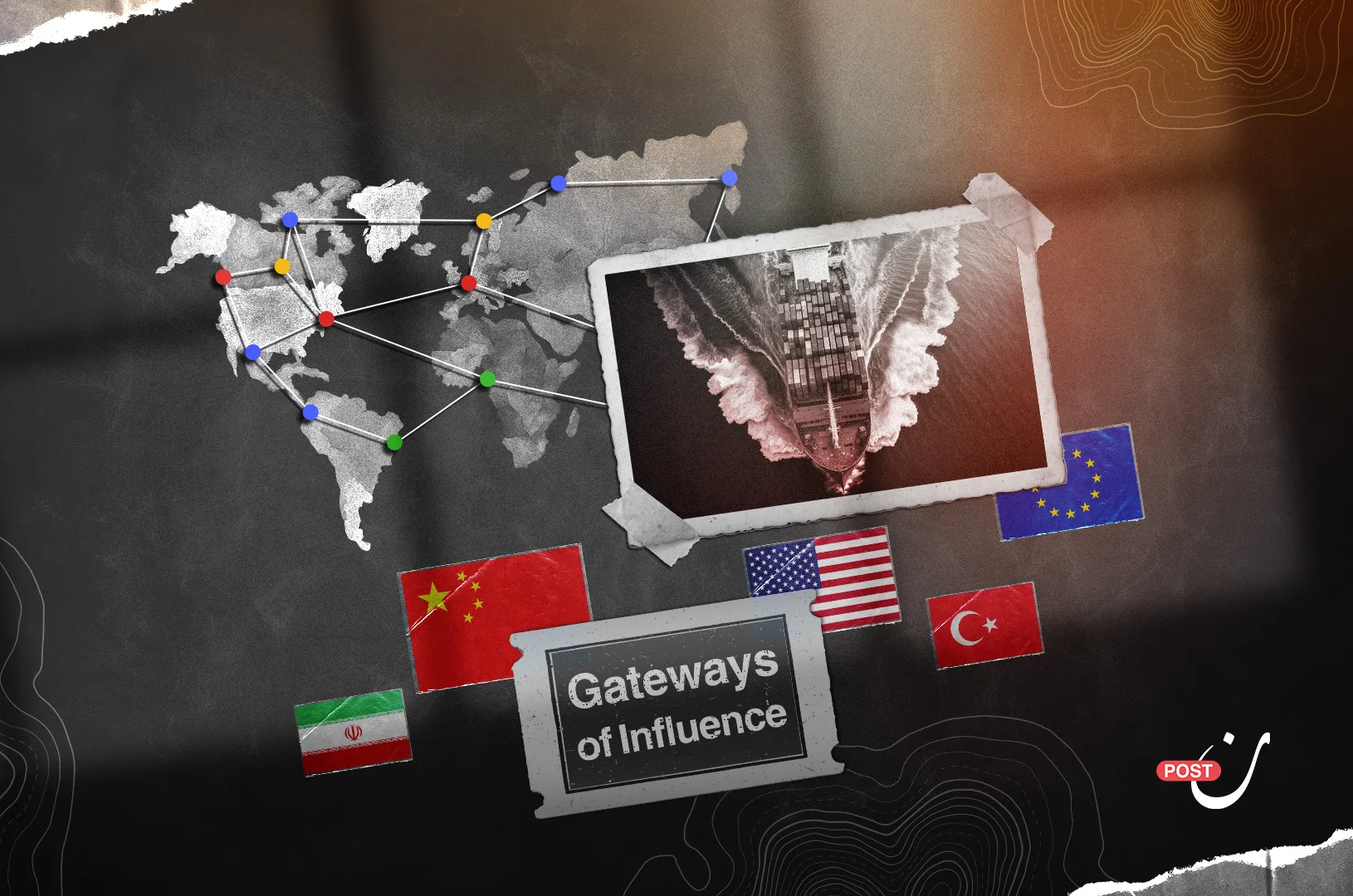
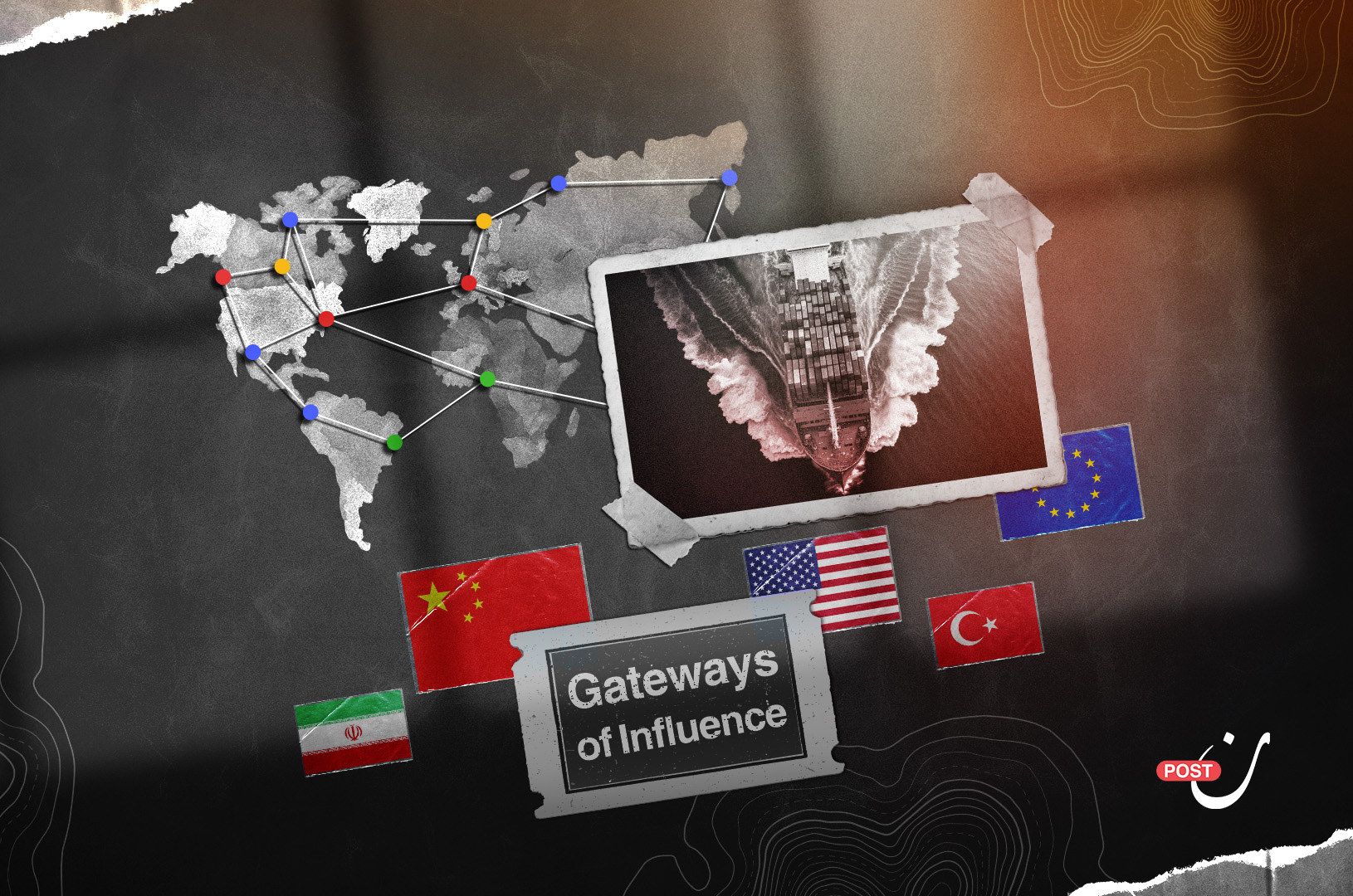
Given the significance of these trade paths and their role in reshaping political alliances and economic interests, we dedicate this dossier, entitled “Gateways of Influence”, to tracking the most prominent of these corridors, their importance to key actors, their impact on competitors, and their outcomes in the trade balance and on the political stage.
Global Trade
Over the last five years, global supply chains have faced many difficulties first triggered by the COVID‑19 pandemic, which forced countries to close their borders and adopt protectionist measures; and secondly, by the Russian‑Ukrainian war which threatened global energy security.
As a consequence, the global economy declined and trade slowed: in 2023 world trade grew by only 0.2%, the slowest rate in fifty years. This had negative consequences for people’s living standards around the world.
Yet the outlook from major international institutions, including the World Trade Organization (WTO), appeared brighter for 2024, with some estimates forecasting global trade growth of 2.7 % to 3.5%. However, these institutions later revised their expectations downward again due to the impact of the war in Israel and Gaza.
The brutal war has disrupted supply chains across the Red Sea particularly the Bab el‑Mandeb Strait and further pressure is expected on global and regional economies if the Israeli war in Gaza continues, according to the WTO Director‑General Ngozi Okonjo‑Iweala.
In response to the Israeli atrocities against Palestinians, the Houthis in Yemen began targeting commercial vessels in the Red Sea and the Arabian Sea linked to the Israeli entity, which resulted in disruptions of global trade via the Bab el‑Mandeb strait and the Suez Canal.
According to reports from the International Monetary Fund (IMF), shipping costs through the Bab el‑Mandeb rose by as much as 170 % as a result of Houthi attacks; this tension caused commercial ships bound for Europe to reroute via the Cape of Good Hope in southern Africa, increasing delivery times by an average of 10 or more days.
The disruptions were not confined to the Red Sea and Arabian Sea: the Black Sea was also affected by the ongoing Russia‑Ukraine conflict, and the Panama Canal suffered from drought and low water levels in Lake Gatun, which it relies upon that canal handles about 5 % of global trade.
Similarly, the South China Sea is drawn in, due to periodic Chinese‑Philippine skirmishes over the Second Thomas Shoal in the larger dispute between Manila and Beijing.
These facts underscore the importance of trade corridors and routes in the global economy: when they are stable, the economy by extension enjoys a measure of stability. Consequently, major powers and regional actors have adopted strategies to safeguard these vital arteries of trade, ensure smooth and secure flow of global commerce and supply‑chains, and prevent any strike or disruption that might upset the functioning of these routes thereby bolstering economic and political stability internationally.
Even if military force is required. Recently, the United States dispatched additional military reinforcements to the Red Sea, while simultaneously launching a multinational operation to protect commerce there, following a series of missile attacks by the Houthis on vessels linked to Israel.
The Importance of Trade Corridors
Maritime straits and trade routes in general are the lifeblood of global commerce and economy any threat to their security directly affects the national security of all countries, because of their major influence on the flow of global trade and supply chains.
The security of trade corridors intersects with many dimensions of national and global security, most importantly: energy security, food security—which explains the interest of major powers. It is only logical that every major power focuses its attention on those corridors in order to secure them in a way that protects its interests and the interests of its allies.
According to data from the International Maritime Organization (IMO), 90 % of goods traded globally are shipped by sea, and maritime routes account for 61 % of global petroleum and other liquid‑fuel production — equivalent to some 58.9 million barrels per day.
In the context of competition and conflict, some powers have felt compelled to build new trade routes that would render them less reliant on their rivals’ corridors. These efforts have been driven by countries such as the United States, China, the European Union, Turkey, India, Russia and certain Arab states like Iraq.
The Key Actors
United States
The United States remains the foremost active player in the sphere of trade corridors, even though the corridors do not necessarily run through its territory. It invests heavily in them to guarantee its international influence and control over global commerce.
The U.S. deploys troops and military hardware around the world to secure control of these routes. For instance, it safeguards the Suez Canal via the U.S. Sixth Fleet in the Mediterranean and through its dense military, naval and air bases across the eastern Mediterranean in Greece, Turkey, Cyprus and Eastern Europe. It is also involved in NATO operations to continually monitor maritime corridors in the Mediterranean.
Washington also leads the Combined Maritime Forces (CMF) from Bahrain home to the U.S. Fifth Fleet seeking to secure freedom of navigation in the Red Sea and the Arabian Sea, which include the Bab el‑Mandeb strait, one of the world’s most important sea routes for global goods shipments particularly crude oil and fuel.
The U.S.’s control isn’t limited to just maritime corridors; it extends to corridors that run across allied territories, as it perceives freedom of movement through these passages as vital national‑security interests. Safeguarding these corridors is fundamental to its global role one typically performed by a dominant power.
Recently, Washington felt that its dominance over the world’s main trade corridors was threatened by regional and international powers establishing alternate routes so it initiated its own new corridors to demonstrate its strength and control.
China
China is the United States’ foremost competitor in nearly every field, including trade corridors. In 2013 Beijing launched the “Belt and Road Initiative” (BRI) also called the New Silk Road referencing the old Silk Road linking central, eastern, southern and south‑east Asia with the Middle East, east Africa and southern Europe.
Chinese authorities say they have signed cooperation documents under the BRI with more than 150 countries and over 30 international organizations; the initiative includes building ports, airports, roads, railways and industrial zones, making it the largest infrastructure project in human history.
This project represents China’s most prominent means of projecting economic and geopolitical influence: Beijing desires to become a global power surpassing the U.S., and views controlling a new trade corridor of global commerce as a prime means to that end.
Thanks to the Belt & Road, China has already increased its political and commercial ties with Middle Eastern, African and European nations, and its influence worldwide has grown markedly. It is expected to further strengthen over time.
Iran
For its part, Iran places special importance on international trade corridors due to its strategic location and the advantages this grants. It borders 15 countries, facilitating access to Central Asian, Caucasus and Persian‑Gulf markets. Geographically, it lies at the intersection of three continents (Asia, Europe and Africa) and is a nexus connecting north, south, east and west.
Iran’s advantage is not only geographic: it also possesses vast energy reserves and access to northern and southern energy sources, as well as territorial waters covering long distances and possessing numerous large ports and land/rail transport networks extending into neighbouring states.
Amid Western economic sanctions, Tehran sees transit operations as a viable alternative to oil revenues, so it is working to activate all transit routes crossing its territory—more than five international corridors currently pass through it.
Today, Iran is a major player in several emerging international corridors, including the Silk Road initiated by China in 2013, the North–South Corridor linking India and Russia, the TRACECA corridor (which connects Central Asia and Europe), among others still partly undeveloped.
Iran’s control of the Hormuz Strait located between Oman and Iran, linking the Persian Gulf with the Gulf of Oman and the Arabian Sea provides it with major leverage. In 2022, average oil flow through that strait was 21 million barrels per day, representing some 21 % of global liquid‑fuel consumption, according to the U.S. Energy Information Administration (EIA). The strait is also a key route for transporting basic commodities such as grains, iron ore and cement.
Iran exploits these features to break out of international isolation and revive its economy, thereby creating significant political, economic and trade weight at a time when Western sanctions are intensifying.
European Union
Historically, European states controlled the majority of the world’s trade corridors, but their role has receded since World War II in favor of the United States and other international and regional powers like China.
Today, the European Union oversees joint patrols in the Mediterranean to secure transit of commercial ships and leads Operation “Active Endeavour” (launched 2003), which comprises specific measures that allow naval forces to board various vessels, including civilian ones.
Although most goods and merchandise still flow toward Europe, European states are at best participants in most corridors they do not dominate or control them because of their inability to form a unified stance and their diverging interests, making them vulnerable to threats in their own geographic heartlands.
Egypt
Egypt derives its significance from the importance of the Suez Canal opened in 1869 which holds a strategic place in maritime shipping. The canal is one of the world’s most important waterways and the shortest shipping route between Europe and Asia, stretching 193 kilometers from Port Said to Suez the longest artificial waterway in the world.
The canal facilitates between 10 % and 15 % of international maritime trade and constitutes a vital source of foreign currency revenue for Egypt. In fiscal year 2022‑2023, its revenues reached $9.4 billion the highest annual figure recorded, marking around a 35 % increase from the previous year.
Fearing the ongoing regional tensions and disruptions in the area, major powers such as the United States and the European Union have sought alternate, more secure trade corridors. Egypt, however, remains skeptical of those efforts and maintains that no commercial route can truly rival the Suez Canal.
Turkey
Turkey is a formidable player on the global trade‑corridor map: the so‑called “Middle Corridor” between China and Europe traverses it, and is one of the six major corridors of China’s Belt & Road. This corridor gained prominence following Russia’s war against Ukraine, as the northern route via Russia lost much of its importance for shipping goods from China to Europe.
The Middle Corridor through Turkey offers the shortest distance, lowest time and cost compared to the northern and southern routes. Yet the Caspian Sea remains a natural barrier to this path, meaning Turkey and its allies still need to make substantial new investments to enhance its viability.
Turkey is also working to revive the Zangezur Corridor linking it to Azerbaijan via Armenia if opened, this corridor could make Turkey a major logistical hub in Eurasia and a central actor in global trade traversing the Eurasian landmass.
Ankara is keen to join most of the region’s trade corridors, recognizing their importance in bolstering its regional influence; it leverages its unique geography, its developed maritime/land/air transport network and its significant production capabilities.
India
A relatively new actor competing in global trade corridors is India, whom the United States is eager to draw into its camp in its ongoing contest with China.
India leads the International North–South Transport Corridor (INSTC) created under the agreement signed by Russia, Iran and India on September 12, 2000 subsequently joined by ten other countries, including Azerbaijan and Turkey.
About a year ago, Washington and New Delhi announced a new corridor project starting from Mumbai in India and linking the Middle East with Europe. The aim is to increase trade, secure energy supplies and improve digital connectivity; alongside India and the United States, France, Germany, Italy, Saudi Arabia and the UAE signed the agreement.
If implemented, this route would shorten trade between India and Europe by 40 %, giving it major significance in the global trade‑corridor map, advancing India’s influence and providing it with additional leverage.
Iraq
Iraq aspires to become an important player in the global trade‑corridor map; historically it was a hub for international land trade from the heart of Europe to Gulf markets and Asia via the sea, and vice versa.
Iraq hopes to reclaim its past glory as an ideal trade‑attraction point, which explains its drive to implement giant cross‑border trade projects, open up to open markets, integrate into the global economy, and expand the services sector.
Iraq is currently promoting a trade‑corridor project called the “Path of Development,” which will include the Grand Faw Port, highways, railroads and energy‑transmission lines stretching from southernmost Iraq to the Turkish border at F Ishkhabur, at a cost of $17 billion. The project is planned in three phases: the first ends in 2028, the second in 2033, and the third in 2050.
Russia
Among the most prominent actors in the trade‑corridor file is Russia, through which the North–South Corridor passes, allowing Moscow permanent access to warm waters via a network of land routes, railroads and maritime shipping lines.
This corridor has strengthened relations between Russia, Iran, India and the nations of Central Asia and the Caucasus: the link passes through Iranian territory between Russia’s northern city and port of Saint Petersburg and India’s financial and commercial capital Mumbai.
Faced with Western sanctions, Russia has launched two new trade‑routes linking Asia and Europe, in an effort to undermine these sanctions. It is therefore deepening alliances with China, Iran, Turkey and, to a lesser degree, India which appears to have aligned with the West.
As a result of states’ interest in building giant projects by leveraging borders and corridors for their economic, political and security interests, many inter‑regional and global conflicts have emerged. This helps explain why many of these projects have been disrupted, albeit simultaneously they offered opportunities to open up new horizons and gateways for economic prosperity and geopolitical balance worldwide.