














For centuries, mysticism in Syria Sufism has constituted one of the pillars of spiritual and social life, with roots extending deep into ancient cities and village zawiyas. Yet this profound heritage was not immune to the storms that have swept the country, especially since 2011.
Today, as signs of a post‑liberation era emerge, the Sufis face a new test: Can they regain their role, or will they remain captive to the political shifts that have bound them for decades?
Sufism in Syria’s history
Sufism entered the Levant in the early Islamic centuries, but it flourished in earnest under the Zengids and Ayyubids and then the Mamluks. During Ottoman rule, it reached a peak of dissemination and organization: in Damascus, the Rifaʽiyya, Naqshbandiyya and Qadiriyya orders took prominence; Aleppo became known for the Shadhiliyya.
The shaykhs of the orders enjoyed high standing with both authority and the public, assuming religious and advisory positions and performing moral oversight in public life.
With the collapse of the Ottoman state, the nature of religion‑state relations changed, and the influence of the Sufi orders waned in the face of the rise of nationalist ideas and modern Islamic reform movements.
Syrian governments after independence paid little heed to Sufism: it no longer carried the ideological weight it had under Ottoman rule, and so the status of the orders declined in favor of modern political and civil frameworks.
Nevertheless, despite its institutional decline and the increasing control of the state over the religious sphere, Sufism remained present as a deeply rooted spiritual and social force in Syrian society. The Sufi zawiyas continued their activities within city quarters, making Sufism an enduring part of Syrian identity albeit no longer in the central position it once occupied.
The beginning of the conflict with the regime
When Hafez al‑Assad came to power, the Sufis found themselves in a new reality that required cautious repositioning. The stances of the Sufi orders ranged between muted rejection and acceptance tinged with wariness; some sought neutrality and adaptation, while others preserved their independence and steered clear of direct confrontation.
The Naqshbandiyya order emerged as a model of neutrality remaining silent during the regime’s clash with the Muslim Brotherhood in the 1980s while some Sufi shaykhs in Hama engaged in field work against the regime and responded to by violence from the authorities: prominent Sufi figures were assassinated, imprisoned or exiled.
In Aleppo, the Rifaʽiyya shaykh was assassinated, and a number of zawiyas destroyed. The Shadhiliyya, led by Abdul Qader Issa (who died in exile in Jordan), faced tightening pressure. In Hama the Sufi shaykh Adib al‑Kilani was assassinated, and the circulation of works by critics of the regime such as the shaykh Saeed Hawa was banned.
It is worth noting that the 1990s and early 2000s witnessed a “soft” conflict between some Sufi shaykhs in Syria and Iran more intellectual and missionary than overtly political. The traditional Sufi orders in Damascus and Aleppo viewed Iran’s cultural and charitable outreach as a threat to Sunni religious structures and the local Sufi heritage.
Some Sufi scholars warned of an “infiltration of the Sunni religious sphere” under the guise of inter‑sectarian rapprochement, arguing that these initiatives essentially aimed to spread Shiʿism.
Among the voices who clearly articulated this stance was Muhammad Suhaib al‑Shami, who spoke on several occasions of the need to “protect Syrian identity,” noting that some associations and centres funded by Iran attempted to recruit youth in Aleppo and its countryside.
One can say that this soft conflict marked a station wherein Syrian Sufism affirmed its defensive function in safeguarding local religious identity before it re‑emerged in new forms after 2011 amid the rising Iranian presence in the Syrian scene.
The Sufi orders’ alliance with the regime
After the 1982 massacre in Hama, the regime reshaped its religious policy, shifting from a secular‑confrontational approach to one of containment and control exploiting some Sufi currents as a soft power tool to confer legitimacy in its confrontation with political Islamic currents.
From then on, the regime began integrating Sufi orders into state institutions via the ministries of awqâf (endowments) and education.
In this context, the figure of Ahmed Keftaru stands out as the clearest example of this alliance. He assumed the leadership of the Naqshbandiyya Khalidiya in Damascus in succession to his father, Muhammad Amin Keftaru, and established the Abu al‑Nour complex, which became a major institution housing a mosque, religious colleges and charitable associations.
Keftaru provided the regime with official religious cover in exchange for wide influence within the religious community, making his group one of the leading arms of “official Sufism” in Syria; as his influence expanded throughout the country, the Keftariyah became one of the main pillars of the regime‑aligned religious discourse.
Upon Bashar al‑Assad’s assumption of power, this policy continued in more institutionalized form: some Sufi orders received support and facilitation in return for adopting a discourse advocating stability and rejecting sedition.
This inclusion extended to Sufi‑affiliated women’s groups such as the Kubaysi‑affiliated women, numbering in the tens of thousands, who maintained social influence within the official framework.
Religious families with Sufi backgrounds such as the al‑Furfour family in Damascus and Naqshbandi shaykhs in Aleppo assumed sensitive roles in fatwa councils and administration of awqâf.
But this alliance came at a cost: the credibility of certain Sufi shaykhs eroded in the eyes of broad popular sectors, as many figures of Sufism came to be seen as part of the authoritarian system. Nevertheless, some Sufi personalities retained their popular legitimacy especially among non‑politicised masses.
On the other hand, not all orders were equally loyal to the regime: some maintained a cautious distance from authority, while others entered the state’s religious apparatus directly. Clear differences emerged between Sufism in major cities like Damascus and Aleppo where institutional penetration was strong and rural orders that retained some independence.
Motives for Sufi shaykhs’ cooperation with the regime varied: some sought to preserve their zawiyas and circles from repression; others saw support for the regime as a path to ensure stability; while yet others wished to benefit from financial backing and official positions.
Thus, various patterns of alliance formed, ranging from tactical cooperation to explicit support.
One can describe the relationship between the regime and most Sufi orders as a clear bartering: the regime granted many orders operational freedom, expansion and religious posts, in return for their silence about its policies and avoidance of critical discourse.
While general approval from the authorities became the dominant characteristic, isolated tensions or purges nonetheless occurred such as the case of Mashuq al‑Khaznawi, who was killed in 2005 after his public criticisms of the regime, and whose assassination marked the boundary of what was permissible within Syria’s Sufi space.
The changes after 2011
With the outbreak of the Syrian uprising in 2011, the Sufi scene entered a turbulent phase. Sufi shaykhs and their disciples found themselves facing a decisive test between preserving ties with the regime which had granted institutional protection to many of them and responding to the demands of a popular uprising and landscape shaped by conflict on the ground.
At first, most of the major orders adopted either neutrality or support for the regime, justifying this by a desire to maintain “the stability of country and people,” while others remained silent without declaring any clear position.
In contrast, a number of Sufi shaykhs sided with the uprising: demonstrations took place in Sufi‑aligned mosques (such as the Rifaʽi Mosque in Damascus whose imam was a member of the Naqshbandi path), and in the Al‑Asi square in Hama where disciples of the Shadhiliyya participated.
Sufi figures opposing the regime emerged early in the uprising such as Osama al‑Rifai, his brother Sariyah al‑Rifai and Karim Rajeh, who aligned with the popular demands and later established the “Syrian Islamic Council” in exile in Turkey as a religious umbrella for the opposition. They were not alone: other lesser‑known shaykhs from several provinces joined them.
Some shaykhs of the Shadhiliyya, Rifaʽiyya and Naqshbandiyya issued statements supporting the protest movement, and some disciples also participated in peaceful demonstrations.
Activism surfaced in Baniyas, Homs and Aleppo: in Baniyas the shaykh Anas ʿIrout, in Homs the shaykhs Asad Kahil and al‑Saqa al‑Shadhli, and in Aleppo the shaykh Muhammad al‑Yaqoubi was among the boldest voices, delivering a sermon near the Presidential Palace in which he openly criticized the regime despite severe risks.
As the popular movement expanded, confrontation between the regime and several Sufi symbols intensified: the regime began to pursue personalities that had shown sympathy to the uprising or participated in it some were detained (for example, Asad Kahil was imprisoned in the Mezze prison), while many others were forced into exile.
With the escalation of war and the rise of Iranian and sectarian militia influence, the traditional Sufi zawiyas’ presence declined Tehran exploited the religious vacuum to expand its sectarian outreach in several areas, becoming the dominant force in some of them.
Iran also established competitive religious centres in regions cleared of independent scholars and shaykhs. In this new reality, some Sufi leaderships attempted to adapt to the shifting balance of power in order to survive.
In opposition‑held areas northern Syria, Sufi orders continued their religious and social activities with indirect support from entities and figures connected to Sufi shaykhs and disciples in regime territories and Turkey.
Some of the Syrian Sufi activity moved into exile: the Saʿdiya order reorganized itself in Germany and its disciples established zawiyas and dhikr sessions. Meanwhile, the shaykh Mukhlif al‑Ali al‑Qadri operated in Egypt, integrating into Egyptian Sufi circles, authoring works and engaging on YouTube.
By the second decade of the uprising, the Syrian Sufi scene had divided into three main currents:
-
The pro‑regime: the major orders and official leaderships that remained in the state religious institutions.
-
The independent or exiled: those who withdrew from the public arena or continued their work in exile.
-
The adaptors to Iranian influence: Sufi elements compelled to recalibrate their discourse under the pressure of Iran‑backed Shiʿite centres that sought to fill the religious void in many areas.
Thus, Syrian Sufism ended up in a state of fragmentation and weakening after having once been one of the most important outlets of popular religiosity in the country. Its historical zawiyas declined, its scholars scattered in exile, and some of its symbols transformed into instruments in power struggles.
The fate of the Sufi orders
With the beginning of Syria’s “new” transitional phase, the Sufi current has sought to adapt to the emerging political and religious scene.
In a symbolic move, Ahmad al‑Sharʿ (fictional name in your text) appointed the shaykh Osama al‑Rifai as Grand Mufti of the Republic a step aimed at unifying religious authority and rebuilding the official institution on centrist foundations.
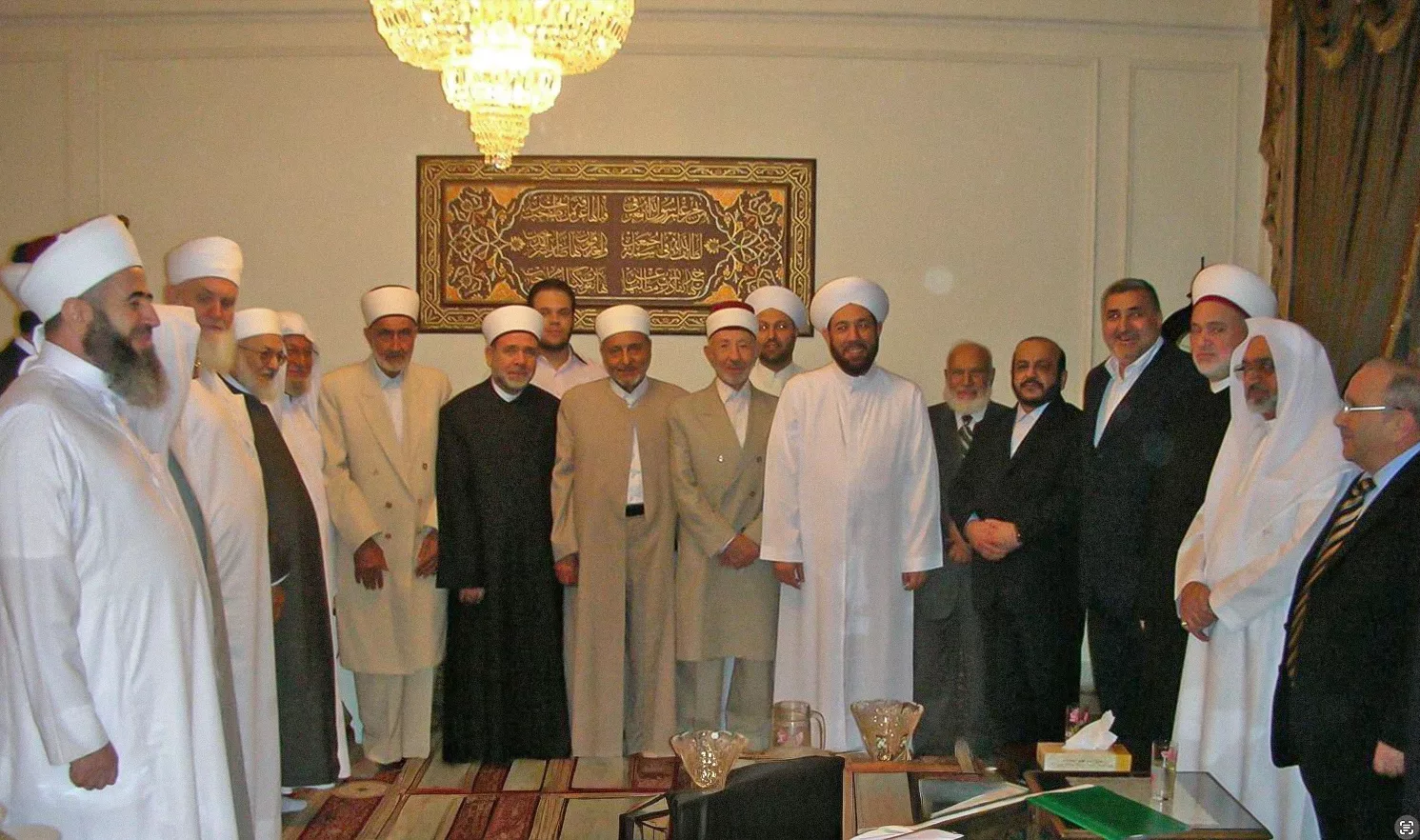
Coinciding with this, a conference of scholars from different schools assembled and announced the formation of a Higher Fatwa Council headed by al‑Rifai to unify legitimate religious authority and regulate religious discourse in the post‑war phase. Sufi personalities assumed positions in the Ministry of Endowments and fatwa bodies.
Despite decisions by the Ministry of Endowments to dismiss a number of Sufi shaykhs (including those affiliated with the Shadhiliyya and other orders), the vast majority of Sufi shaykhs continue their religious and social activity, and some hold influential positions in the new state institutions indicating that their presence in the official religious scene remains despite administrative reshuffling.
It can be observed that the major Sufi orders have succeeded in preserving their institutional presence in the new Syria thanks to their deeply rooted educational and organizational networks meaning that what has declined is more the “institutional Sufism tied to the previous regime” than Sufism itself.
However, the Sufi educational institutions that dominated the religious scene for decades lost part of their popularity after the war, due to the erosion of public trust in figures associated with the regime and the opening of space for other currents.
As indicated in the table (referenced in the article), most Sufi shaykhs who supported the regime or remained neutral have continued their activity, while the marginalization has limited itself to a limited number of personalities whose popularity declined or who were removed from their posts.
In this context, the shaykh Abdul Aziz al‑Khatib a leading Shadhili figure in Damascus sent a letter to the Minister of Endowments complaining of harassment of his disciples and the prevention of their religious activities, demanding an end to arbitrary arrests and the discourse portraying Sufism negatively despite his own historic explicit support for the Assad regime, he continues his activities to this day.
Also notable was the wide reaction to the news of the expulsion of the shaykh Sharif al‑Saffaf from one of Damascus’s mosques, which was seen as a sign of shifting power structures within the current religious scene and of the decline of some Sufi symbols associated with the regime.
Al‑Saffaf, known for his affiliation with the traditional Damascene Sufi current and close ties to the endowments institutions, represents a model of “official Sufism” that the previous authority sought to employ to reinforce a directed religious discourse.
In conclusion, Syrian Sufism does not appear headed toward extinction, but toward repositioning. Many Syrian Sufi orders still maintain strong ties with their counterparts in Turkey and Egypt via spiritual lineages or direct relationships between shaykhs and disciples, and through a cross‑border network that is renewed through reciprocal visits and participation in major religious occasions such as mawlids (saint‑festivals) and commemorations.
Despite what it has lost in terms of symbols and sites, Sufism remains one of the cultural and spiritual pillars of Syrian society, capable of adapting to political and social transformations as it has done repeatedly throughout its long history and perhaps this phase will herald a new chapter in the saga of Sufism in Syria.


